
PRIN-140 · Lesson 6 of 12 · 24 min
Directing a project I: the project board's role and decisions
Directing a project is the process through which the project board is accountable for the project's success. It starts when starting up sends the request to initiate and ends when the board authorizes project closure. Unlike the managing processes, it is not a sequence of activities carried out day to day. It is a set of decision points, plus continuous availability for advice and direction. This lesson looks at the board's role, the principle of management by exception that shapes it, and the five activities of directing. Lesson 7 looks at the authorization decisions in more depth.
The purpose of directing a project
In plain terms, directing a project lets the project board make the key decisions that only it can make, while delegating day-to-day management to the project manager. The board is accountable to the business layer for the project, and it exercises that accountability through a small number of formal decisions at defined points, through tolerances that set how much freedom the project manager has, and through the reports and escalations it receives. It does not attend daily stand-ups, approve every purchase or rewrite plans.
The objectives of directing can be summarized as follows. There is authority to initiate the project. There is authority to deliver the project's products. Management direction and control are provided throughout the project's life, and the project remains viable. Corporate, program or customer management has an interface to the project. There is authority to close the project. Plans for realizing the post-project benefits are managed and reviewed. Each of these objectives maps onto one or more of the activities described below.
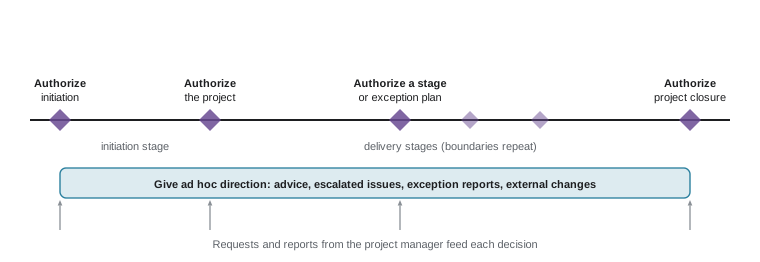
The five activities
| Activity | Triggered by | Decision or result | Main inputs |
|---|---|---|---|
| Authorize initiation | Request to initiate from starting up | Approve, or not, the initiation stage | Project brief; initiation stage plan |
| Authorize the project | Request to deliver at the end of initiation | Approve, or not, the project as defined in the PID | PID; benefits management approach |
| Authorize a stage or exception plan | End of a stage, or an exception plan | Approve the next stage plan, or an exception plan, or close prematurely | End stage report; next stage plan or exception plan |
| Give ad hoc direction | Reports, escalations, requests for advice, external events | Advice, decisions on escalated issues, instructions | Highlight reports; issue and exception reports; business layer advice |
| Authorize project closure | Closure recommendation from closing a project | Confirm closure and notify the business layer | End project report; lessons report; updated benefits management approach |
Authorize the project and authorize a stage often happen at the same meeting at the end of initiation. The board approves the PID, which authorizes the project as a whole, and in the same meeting approves the stage plan for the first delivery stage. Some organizations record these as two decisions to keep the distinction clear: authorizing the project is a commitment to the whole investment in principle, but money is released stage by stage.
Management by exception
Management by exception is one of PRINCE2's principles and the key to how directing works. The board sets tolerances for each stage on the performance targets: time, cost, scope, quality, benefits, risk and, in PRINCE2 7, sustainability. As long as the project manager forecasts that the stage will finish within those tolerances, the board does not need to be involved in day-to-day decisions. When a forecast shows a tolerance will be exceeded, the project manager escalates through an exception report, and the board decides what to do. PRIN-131 studied tolerances and exceptions from the progress practice's side.
Management by exception makes the board's time valuable instead of wasted. A board that meets weekly to review every task trains its project manager to wait for instructions. A board that sets clear tolerances, reads concise highlight reports and responds promptly to exceptions trains its project manager to manage. The test of a well-directed project is not how often the board meets but how quickly it responds when it is needed.
| Board behaviour | Effect on the project | Directing in PRINCE2 terms |
|---|---|---|
| Weekly meetings to approve tasks | Project manager waits for permission; decisions slow | Micromanagement; not management by exception |
| No meetings and no responses to reports | Exceptions sit unanswered; project drifts | Abdication; directing not happening |
| Clear tolerances, short reports, decisions at stage boundaries, prompt responses to exceptions | Project manager manages; board decides what only it can decide | Management by exception working as intended |
Board meetings and event-driven decisions
PRINCE2 does not require the board to hold regular progress meetings. The formal decisions happen at defined events: the request to initiate, the end of initiation, each stage boundary, an exception plan and closure. Between these, the board receives time-driven highlight reports and can respond to them without meeting. Many organizations still hold monthly board meetings, which is fine if they are used for direction rather than status reporting; if a meeting is spent reading out the highlight report, it adds nothing the report did not already provide.
Ridgeline Water's lessons log contained a lesson from a pipe renewal project whose board met only quarterly, so decisions waited up to 11 weeks. Its project management team design therefore includes monthly board meetings during delivery, decisions at stage boundaries scheduled in the plan, and an agreement that exception reports will be considered within five working days, by email if needed. The executive can make urgent decisions on the board's behalf, with the others informed.
The board's responsibilities in directing
| Role | Responsibilities in directing (our summary) |
|---|---|
| Executive | Chairs the board; owns the business case; makes the final decision when board members disagree; is accountable to the business layer |
| Senior user | Ensures products will meet user needs; commits user resources; confirms user acceptance; is accountable for benefits being realized |
| Senior supplier | Ensures products can be delivered; commits supplier resources; advises on technical feasibility and risk |
| Project assurance (board's delegate) | Checks independently that the project is on track and that reports reflect reality |
| Business layer (outside the board) | Sets project tolerances; receives escalations beyond them; receives closure notification |
The board is not a democracy. Senior users and senior suppliers advise and commit resources, but the executive makes the decision, because the executive is accountable for the business case. In practice, a good executive seeks consensus, and a decision the senior user cannot support is a warning sign about benefits. But if the board cannot agree, the executive decides, and if the executive cannot decide within project tolerances, the matter goes to the business layer.
Reviewing the board's decision log
An assurance check sometimes looks at how a board has been directing: how long decisions took, whether exceptions were handled promptly and whether the board strayed into managing. The code below reviews an invented decision log from a previous project at the utility, the kind of evidence the lessons log drew on.
from datetime import date
log = [
    ("Request to initiate", date(2022, 3, 1), date(2022, 3, 9), "authorize initiation"),
    ("PID and stage 2 plan", date(2022, 6, 1), date(2022, 8, 17), "authorize project and stage"),
    ("Exception report: contractor delay", date(2022, 10, 3), date(2022, 12, 19), "exception plan approved"),
    ("Highlight report: approve a 2,000 purchase", date(2022, 11, 2), date(2022, 11, 30), "approved"),
    ("End stage report and stage 3 plan", date(2023, 2, 1), date(2023, 3, 1), "authorize stage"),
    ("Closure recommendation", date(2023, 9, 4), date(2023, 9, 12), "authorize closure"),
]
waits = [(item, (decided - raised).days) for item, raised, decided, _ in log]
for item, days in waits:
    flag = "  <-- slow" if days > 21 else ""
    print(f"{item:44} {days:3d} days{flag}")
avg = sum(d for _, d in waits) / len(waits)
print(f"Average wait: {avg:.0f} days")
micro = [i for i, *_ in log if "purchase" in i]
print("Decisions the project manager should have made:", micro)Request to initiate 8 days PID and stage 2 plan 77 days <-- slow Exception report: contractor delay 77 days <-- slow Highlight report: approve a 2,000 purchase 28 days <-- slow End stage report and stage 3 plan 28 days <-- slow Closure recommendation 8 days Average wait: 38 days Decisions the project manager should have made: ['Highlight report: approve a 2,000 purchase']
Four of the six decisions waited more than three weeks, and the average wait was 38 days. The PID waited 77 days, so the project sat idle after initiation, and the exception report also waited 77 days, during which the project carried on as if nothing had happened. One decision, approving a small purchase, should never have reached the board at all; it was within the project manager's delegated authority. The lessons from this log shaped Ridgeline Water's board arrangements: decision dates planned in advance, a five-day response target for exceptions, and clear delegated limits so that small decisions stay with the project manager.
Directing and the business layer
The board is itself directed by the business layer. It must keep the business layer informed, typically through the executive, and it must refer anything beyond project tolerances upward. It also provides the business layer's interface to the project: if corporate strategy changes, or a program reprioritizes its projects, the business layer tells the board, which gives the project manager ad hoc direction. Ridgeline Water's executive reports to the general manager monthly and to council at each stage boundary, using the end stage report as the basis.
In a Canadian municipality, the business layer's oversight often includes council or a council committee receiving staff reports at key decisions. Aligning PRINCE2 stage boundaries with council meeting dates avoids a common delay: a stage ending two weeks after a council meeting may wait a month for the next one.
Worked problem
Is this a board decision?
During Ridgeline Water's pilot stage the project manager receives four requests: (a) the installation team wants to swap two streets in the schedule, with no effect on stage tolerances; (b) the supplier says meter prices will rise 12 %, which would breach the stage cost tolerance; (c) the senior user asks whether the portal should also show water-saving tips, a change costing 4 thousand; (d) council asks for a briefing on customer complaints. Which need the board?
Show solution
- (a) Swapping streets is within tolerance and within the project manager's authority: no board involvement.
- (b) A forecast breach of stage cost tolerance needs an exception report to the board.
- (c) A 4 thousand change is within the project manager's change authority limit of 10 thousand per change, if the change budget allows: the project manager can decide, and report it in the next highlight report.
- (d) A request from council comes from the business layer: the executive handles it, giving ad hoc direction to the project manager to prepare information.
Answer: Only (b) requires a board decision on an exception; (d) involves the executive as the link to the business layer; (a) and (c) stay with the project manager.
Common mistakes
MistakeHolding weekly board meetings to approve routine work.
InsteadUse tolerances and management by exception; decide at defined points and on exceptions.
MistakeTreating the board as a voting committee.
InsteadThe executive decides, advised by the senior user and senior supplier.
MistakeLetting exception reports wait for the next scheduled meeting.
InsteadRespond promptly, by email or a special meeting if needed.
MistakeThinking directing starts when the project is authorized.
InsteadDirecting starts with the request to initiate, at the end of starting up.
MistakeMaking decisions beyond project tolerances.
InsteadRefer them to the business layer.
Summary and key terms
- Directing a project lets the board be accountable through key decisions while delegating management.
- It runs from the request to initiate until the board authorizes closure.
- Its five activities are four authorizations and continuous ad hoc direction.
- Management by exception, through tolerances, keeps the board out of day-to-day management.
- Formal decisions are event-driven; regular meetings are optional and should add direction, not status reading.
- The executive makes the final decision; the business layer handles anything beyond project tolerances.
- Directing a project
- The process through which the project board is accountable for the project.
- Management by exception
- Managing through tolerances so that higher levels are involved only when tolerances are forecast to be exceeded.
- Authorize initiation
- The board's decision to approve the initiation stage.
- Authorize the project
- The board's decision to approve the project as defined in the PID.
- Ad hoc direction
- Advice, decisions and instructions the board gives between formal authorizations.
- Exception report
- A report from the project manager to the board when a stage tolerance is forecast to be exceeded.
- Event-driven control
- A control that takes place when a specific event occurs, such as the end of a stage.
Practice problems
Work each problem on paper first, then reveal the answer to check.
When does directing a project start and end?
Show answer
It starts with the request to initiate and ends when the board authorizes project closure.
Name the five activities of directing a project.
Show answer
Authorize initiation; authorize the project; authorize a stage or exception plan; give ad hoc direction; authorize project closure.
Which principle explains why the board is not involved day to day?
Show answer
Manage by exception.
Who makes the final decision if board members disagree?
Show answer
The executive.
What does the board do with an issue beyond project tolerances?
Show answer
Refers it to the business layer.
Does PRINCE2 require regular board meetings?
Show answer
No; decisions are event-driven, though meetings may be held.
Which two decisions often happen at the end of initiation?
Show answer
Authorize the project and authorize the first delivery stage.
What target did Ridgeline Water set for responding to exception reports?
Show answer
Within five working days.
In the decision log, how long did the exception report wait?
Show answer
77 days.
Who is the board's link to the business layer?
Show answer
Usually the executive.
Lesson quiz · 5 questions
Score 60% or more to complete this lesson.
Create a free account to save your progress, take quizzes and earn a certificate.