
ROB-360 · Lesson 11 of 12 · 29 min
Open-source licensing, community and export controls
Almost every robot today runs on open-source software: Linux, ROS 2, DDS implementations, OpenCV, PCL, Eigen, MoveIt, Nav2, Gazebo and countless Python libraries. Open source is a gift, but it comes with conditions. Each package has a licence that grants rights and imposes obligations, and ignoring them can force a company to publish proprietary code, withdraw a product or face legal claims. Robot software can also be subject to export controls, because some navigation, perception and autonomy technologies have military uses. This lesson explains the main licence families, how to comply when shipping robots, how to work with open-source communities, and the basics of export controls in Canada and the United States.
What a licence does
Copyright law gives the author of software exclusive rights to copy, modify and distribute it. A licence is the author's permission for others to do those things, on stated conditions. Without a licence, code found on the internet cannot legally be reused, however public it is. Open-source licences, approved by the Open Source Initiative against its Open Source Definition, all permit use, modification and redistribution, but they differ in what they require in return. The two broad families are permissive licences, which ask mainly for attribution, and copyleft licences, which require that derivative works be distributed under the same licence.
| Licence | Family | Main obligations when distributing | Common in robotics |
|---|---|---|---|
| Apache 2.0 | Permissive | Keep notices and licence text, state changes, includes an explicit patent licence | ROS 2 core, many ROS 2 packages, TensorFlow |
| BSD 3-Clause | Permissive | Keep copyright notice and licence text, no endorsement claims | Many ROS 1 and ROS 2 packages, PCL, OpenCV (older versions) |
| MIT | Permissive | Keep copyright notice and licence text | Many Python and JavaScript libraries |
| LGPL 2.1 or 3 | Weak copyleft | Share changes to the library; allow users to replace it (dynamic linking usually used) | Some system libraries, Qt (one option) |
| GPL 2 or 3 | Strong copyleft | Distribute source of the whole derived work under the GPL | Linux kernel (GPL 2), some tools |
| AGPL 3 | Network copyleft | As GPL, plus offer source to users interacting over a network | Some databases and web tools |
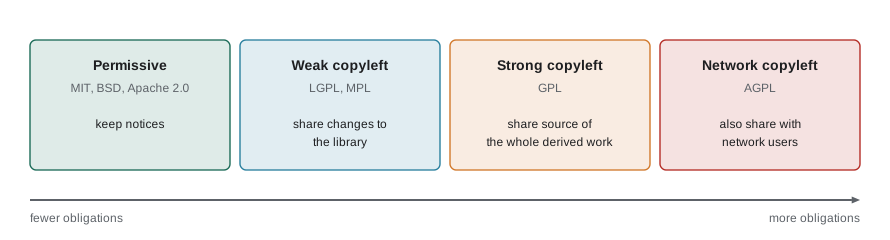
Distribution is the key trigger for most obligations. Software used only inside a company is generally not distributed; software installed on robots sold or leased to customers is. That is why licence compliance matters so much for robot companies: every robot shipped is a distribution of every open-source component in its image.
Permissive licences
Permissive licences let you combine the code with proprietary software and ship it without publishing your own source, provided you keep the copyright notices and licence text, usually in documentation or an 'open-source notices' screen. Apache 2.0, the default licence for new ROS 2 core packages, adds two important features: an explicit patent licence from contributors to users, which terminates if the user sues over patents in the software, and a requirement to state significant changes. BSD and MIT are shorter and simpler. Their low friction is a large part of why the ROS ecosystem has spread so widely in industry.
Copyleft licences
Copyleft licences use copyright to keep software open. The GNU General Public License (GPL) requires that if you distribute a work based on GPL code, you distribute the complete corresponding source of that work under the GPL too. The details of what counts as a derived work are debated, but statically linking a proprietary program to a GPL library is widely treated as creating one, while separate programs that communicate through pipes, sockets or messages generally are not. GPL 3 adds 'anti-tivoization' provisions for consumer products: users must be given the installation information needed to run modified versions on the device. The Lesser GPL (LGPL) relaxes the rules for libraries so that proprietary programs can use them, typically through dynamic linking, provided users can replace the library. The Affero GPL (AGPL) extends copyleft to software offered over a network, which matters for fleet servers and web dashboards.
The Linux kernel is under GPL 2, so a robot company shipping Linux must offer the kernel source, including its own driver modifications. Proprietary applications running on Linux in user space are not affected, because the kernel's licence notes that normal system calls do not create derived works. Robot companies typically keep proprietary code out of the kernel, publish their kernel patches and drivers, and keep a record of exactly which sources went into each image.
Worked problem
Can this be shipped closed?
A team's proprietary planner (1) links statically to an Apache 2.0 geometry library, (2) calls a GPL-licensed command-line tool as a separate process, and (3) links statically to a GPL 3 optimization library. Which uses allow the planner to stay closed-source?
Show solution
- (1) Apache 2.0: permissive; keep the notices and licence text. Closed source is fine.
- (2) Separate program communicating by process call: generally not a derived work; ship the tool's source or an offer for it, but the planner can stay closed.
- (3) Static linking to GPL 3 code: widely treated as creating a derived work; distributing the planner would require releasing it under the GPL.
Answer: Uses 1 and 2 are compatible with a closed planner; use 3 is not. The team should replace the optimization library, obtain a commercial licence if one is offered, or open its planner, and record the decision in an ADR.
Licence compliance in practice
Compliance is a process, not a one-off check. Companies maintain a policy listing which licences are pre-approved (often Apache, BSD, MIT), which need review (LGPL, MPL) and which are not allowed in shipped products without legal approval (GPL in certain contexts, AGPL). Automated tools scan source and container images, identify components and licences, and produce the SBOM (lesson 10) in SPDX format, which also carries licence information. The release process then generates the required notices and source offers. ROS packages declare their licence in package.xml, and the REUSE specification and SPDX licence identifiers in file headers (such as SPDX-License-Identifier: Apache-2.0) make licences machine-readable.
# A toy open-source policy checker over a release's components (illustrative policy)
policy = {"Apache-2.0": "ok", "BSD-3-Clause": "ok", "MIT": "ok",
          "LGPL-2.1-only": "review", "MPL-2.0": "review",
          "GPL-2.0-only": "review", "GPL-3.0-only": "block", "AGPL-3.0-only": "block"}
components = [("rclcpp", "Apache-2.0", "dynamic"), ("pcl", "BSD-3-Clause", "static"),
              ("libqt", "LGPL-2.1-only", "dynamic"), ("solver_x", "GPL-3.0-only", "static"),
              ("linux", "GPL-2.0-only", "kernel"), ("fleet_db", "AGPL-3.0-only", "server")]
counts = {}
for name, lic, use in components:
    verdict = policy.get(lic, "unknown")
    if lic == "GPL-2.0-only" and use == "kernel": verdict = "ok: publish kernel source"
    counts[verdict.split(":")[0]] = counts.get(verdict.split(":")[0], 0) + 1
    print(f"{name:10} {lic:15} {use:8} -> {verdict}")
print("summary:", counts)rclcpp Apache-2.0 dynamic -> ok
pcl BSD-3-Clause static -> ok
libqt LGPL-2.1-only dynamic -> review
solver_x GPL-3.0-only static -> block
linux GPL-2.0-only kernel -> ok: publish kernel source
fleet_db AGPL-3.0-only server -> block
summary: {'ok': 3, 'review': 1, 'block': 2}Worked problem
The cost of late compliance
A licence scan finds a GPL 3 library statically linked into a product two weeks before launch. Replacing it takes an estimated 3 engineer-weeks. Had the scan run in CI from the start, the dependency would have been flagged the day it was added, when switching libraries would have taken 2 days. Compare the costs at 40 hours per week.
Show solution
- Late: \( 3 \times 40 = 120 \) hours, plus a launch delay.
- Early: \( 2 \times 8 = 16 \) hours.
- Ratio: \( 120 / 16 = 7.5 \).
Answer: Late discovery costs about 7.5 times more engineering time, plus schedule risk. Licence scanning belongs in CI alongside tests and static analysis.
Contributing and community
Using open source well also means participating. Fixing a bug locally and keeping the fix in a private fork creates a maintenance burden forever, since every upstream release must be merged with the private change. Contributing the fix upstream shares the maintenance with the community. Good contributions follow the project's contribution guide, include tests and documentation, are small and focused, and respect the code of conduct. Many projects ask contributors to sign a contributor licence agreement or to certify the Developer Certificate of Origin by adding a Signed-off-by line to each commit, confirming they have the right to submit the code. ROS 2 core repositories use the DCO.
Companies that depend on open source also contribute through funding, maintainers' time, documentation and testing. The ROS ecosystem is stewarded by the Open Source Robotics Foundation, with industry support through the Open Source Robotics Alliance, working groups and special interest groups on topics such as navigation, security and real-time. Before relying heavily on a package, teams assess its health: recent releases, responsiveness to issues and pull requests, number of maintainers, test coverage and licence clarity. A critical dependency with one tired maintainer is a business risk.
Worked problem
Fork or contribute?
A team patches a navigation package. Keeping a private fork costs about 6 hours to rebase and retest at each upstream release, and upstream releases every 6 weeks. Upstreaming the patch would take an estimated 30 hours once, including review rounds. Over two years, which is cheaper?
Show solution
- Upstream releases in two years: about \( 104 / 6 \approx 17 \).
- Private fork: \( 17 \times 6 = 102 \) hours.
- Upstreaming: about 30 hours once, then no rebasing for this patch.
Answer: Upstreaming saves about 70 hours over two years, and the patch gets tested by everyone else too. Forks make sense only for changes upstream will not accept.
Export controls
Export controls restrict the transfer of certain goods, software and technology to other countries, and sometimes to foreign nationals within a country, for national security and foreign policy reasons. Robots and their software can fall under them: high-performance navigation and inertial systems, certain cameras and lidar, encryption functions, unmanned vehicle technology and some AI capabilities appear on control lists, which are largely harmonized internationally through the Wassenaar Arrangement. Publicly available open-source software is often treated differently from proprietary technology, but the rules are detailed and the exceptions have conditions. Sanctions add country- and person-based restrictions on top.
In Canada, exports of controlled items are governed by the Export and Import Permits Act and the Export Control List, administered by Global Affairs Canada, which issues export permits. The list implements the Wassenaar categories, including dual-use items such as certain navigation equipment, sensors, encryption and unmanned systems, plus Canada-specific controls. Sanctions under the Special Economic Measures Act and related laws restrict dealings with listed countries and persons. Companies classify their products against the list, apply for permits where needed and keep records; technology transfers, including sharing controlled technical data with foreign colleagues, can also require permits.
For robot software teams, the practical steps are to know whether the company has an export compliance program, to classify products and significant software components with its help, to be careful when sharing technical data, source code or model weights across borders, and to screen customers and partners against restricted party lists. Rules on advanced computing and AI have changed frequently in recent years, so current guidance must always be checked.
Common mistakes
MistakeReusing code from a public repository that has no licence
InsteadNo licence means no permission; ask the author or find licensed code.
MistakeStatically linking GPL code into a proprietary product without review
InsteadCheck licence obligations before adding dependencies; scan in CI.
MistakeShipping robots without open-source notices or source offers
InsteadGenerate notices and source offers in the release process.
MistakeKeeping a growing pile of private patches to upstream packages
InsteadContribute fixes upstream to share maintenance.
MistakeSharing controlled technical data with foreign partners without checking
InsteadInvolve the export compliance program and classify before sharing.
Summary and key terms
- Licences grant permission to use, modify and distribute copyrighted code on conditions; unlicensed code cannot be reused.
- Permissive licences such as Apache 2.0, BSD and MIT mainly require notices; Apache 2.0 adds a patent licence.
- Copyleft licences (GPL, LGPL, AGPL) require derived works to be shared under the same terms when distributed or, for AGPL, offered over a network.
- Shipping a robot distributes every component in its image, so compliance must be part of the release process.
- Licence policies, scanners, SPDX identifiers and SBOMs make compliance systematic.
- Contributing upstream, following project processes such as the DCO, is usually cheaper than private forks.
- Export controls in Canada and the US can apply to robot technology and software, and need a compliance program.
- Licence
- Permission from a copyright holder to use, copy, modify or distribute a work on conditions.
- Permissive licence
- An open-source licence that mainly requires attribution, such as Apache 2.0, BSD or MIT.
- Copyleft
- Licence terms requiring derivative works to be distributed under the same licence.
- Derived work
- A work based on another, such as a program linked with a library, in the sense of a licence.
- Source offer
- A written offer to provide the source code required by a copyleft licence.
- SPDX identifier
- A standard short name for a licence, used in file headers and SBOMs.
- Developer Certificate of Origin
- A statement, made by signing off commits, that the contributor has the right to submit the code.
- Upstream
- The original project from which a package or fork is derived.
- Export Control List
- Canada's list of goods and technology that require permits to export.
- Export Administration Regulations
- US regulations controlling the export of dual-use items and technology.
Practice problems
Work each problem on paper first, then reveal the answer to check.
Can code from a public repository without a licence be reused?
Show answer
No; there is no permission.
Which licence is the default for new ROS 2 core packages?
Show answer
Apache 2.0.
What does Apache 2.0 add compared with MIT?
Show answer
An explicit patent licence and a requirement to state changes.
What usually triggers copyleft obligations?
Show answer
Distribution of the software (or, for AGPL, offering it over a network).
Does a proprietary user-space program on Linux have to be GPL?
Show answer
Generally no; normal system calls do not create a derived work.
Which licence family suits a library used by proprietary programs through dynamic linking?
Show answer
The LGPL.
Where do ROS packages declare their licence?
Show answer
In package.xml.
What does a Signed-off-by line certify?
Show answer
The Developer Certificate of Origin.
Why are private forks costly?
Show answer
Every upstream release must be merged and retested with the private changes.
Which agreement harmonizes many dual-use export controls internationally?
Show answer
The Wassenaar Arrangement.
Lesson quiz · 5 questions
Score 60% or more to complete this lesson.
Create a free account to save your progress, take quizzes and earn a certificate.