
ROB-430 · Lesson 5 of 12 · 32 min
Social and assistive robots
Not every robot that works with people is there to assemble parts. Some are designed to engage people socially: to tutor a child, keep an older adult company, coach someone through rehabilitation exercises, greet hotel guests or guide visitors in a museum. Others assist people physically with daily living: robotic arms mounted on wheelchairs, feeding devices, exoskeletons and smart walkers. This lesson looks at both families, at the psychology that makes people respond to robots as social beings, at the norms of personal space that robots must respect, at the famous and much-debated uncanny valley hypothesis, and at the ethical questions raised when machines are built to be liked.
Kinds of social and assistive robots
David Feil-Seifer and Maja Matarić defined socially assistive robotics in 2005 as the intersection of assistive robotics, which helps people with disabilities or illness, and socially interactive robotics, which communicates through social channels. A socially assistive robot helps through social interaction rather than physical contact: it motivates, reminds, coaches and encourages. Physically assistive robots, by contrast, manipulate objects or support the body. Some systems combine both, such as a rehabilitation robot that moves a patient's arm and also encourages them with speech and facial expressions.
| Category | Examples | Main interaction | Evidence and caveats |
|---|---|---|---|
| Companion and therapy | Paro robotic seal, robotic pets | Touch, sound, simple responsiveness | Some studies report reduced agitation in dementia care; many are small or short |
| Education and tutoring | Tutoring robots for language or mathematics | Speech, gesture, feedback | Physical presence can increase engagement compared with screens in some studies |
| Autism support | Small humanoids used in social skills sessions | Simplified, predictable social cues | Promising but mixed results; reviews call for larger, longer trials |
| Eldercare and reminders | Tabletop robots giving reminders and prompting activity | Speech, screens, scheduling | Acceptance depends on usefulness and on not replacing human contact |
| Physically assistive | Wheelchair-mounted arms, feeding robots, exoskeletons | Physical manipulation and support | Can increase independence; cost and usability limit adoption |
| Public service | Museum guides, hospital and hotel delivery robots | Navigation among the public, brief dialogue | Novelty fades; reliability and social navigation matter most |
Paro, a robotic baby harp seal developed in Japan by Takanori Shibata, is one of the best-known examples. It responds to touch, sound and light with movements and sounds, and was cleared by the United States Food and Drug Administration as a class II medical device in 2009, a regulatory classification rather than proof of effectiveness. Studies in long-term care have reported calming effects for some people with dementia, but systematic reviews generally rate the evidence as limited by small samples, short durations and difficulty blinding. This pattern recurs throughout social robotics: encouraging early results, weaker evidence once larger and longer studies are run, and strong dependence on context.
Why people treat robots as social
People readily respond to machines as if they were social actors. In the 1990s, Byron Reeves and Clifford Nass described the media equation: in experiments, people applied social rules such as politeness and reciprocity to computers, even when they knew they were dealing with a machine. This became known as the computers are social actors, or CASA, paradigm. Robots, with bodies that move in shared space, trigger these responses even more strongly. People name their vacuum robots, apologize when they bump into a delivery robot and feel uncomfortable when a robot is kicked in a video.
Nicholas Epley and colleagues proposed in 2007 that people anthropomorphize, attributing humanlike minds to non-human agents, more when three factors are present: when humanlike knowledge is readily accessible to apply (elicited agent knowledge), when they are motivated to understand and predict the agent's behaviour (effectance motivation), and when they want social connection (sociality motivation). This helps explain why lonely people may anthropomorphize more strongly, and why robots that behave unpredictably invite people to attribute intentions to them. Designers can encourage or dampen anthropomorphism through appearance, voice, movement and naming, and should do so deliberately, since raising social expectations that the robot cannot meet leads to disappointment.
Personal space and social navigation
Edward Hall's work on proxemics in the 1960s described how people use distance in social interaction. For the North American middle-class adults he studied, he proposed four zones: intimate distance up to about 0.45 m, personal distance from about 0.45 to 1.2 m, social distance from about 1.2 to 3.6 m and public distance beyond about 3.6 m. The exact values vary with culture, relationship, age, gender and setting, but the idea that people expect others to respect zones of space applies to robots as well. Studies have found that people allow robots closer when the robot approaches from the front rather than from behind, when it moves more slowly, and when they have more experience with robots, and that people keep a greater distance from a robot that looks directly at them.
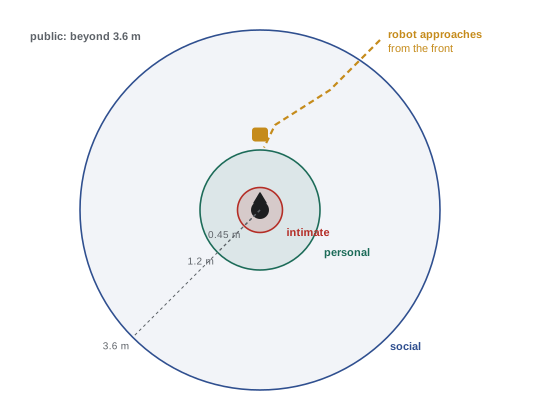
Social navigation applies these ideas to mobile robots moving among people. Rather than treating people as moving obstacles to avoid at a minimum safe distance, a socially aware planner adds costs for passing too close, crossing in front of someone, cutting between people who are talking, or approaching from behind. It follows local conventions, such as keeping to one side of a corridor, and signals its intentions early, as described in lesson 3. Learned methods trained on pedestrian data are increasingly used, but they can inherit the conventions of the place where the data was collected.
Worked problem
Choosing an approach distance
A reception robot approaches visitors to offer help. Studies in the target population suggest people are comfortable when a robot stops at the outer part of personal distance, around 1.0 to 1.2 m, and the robot's localization and control error is about 0.15 m. What stopping target should be used, and why?
Show solution
- Aim inside the comfortable band but away from the inner edge, so that errors do not bring the robot too close.
- With 0.15 m error, a target of \( 1.2 \) m keeps the robot between about 1.05 and 1.35 m.
- Approach from the front, at walking speed or slower, and pause before speaking.
Answer: Target about 1.2 m from the person, approaching from the front; the error band then stays at or beyond the comfortable distance most of the time.
# Classifying approach distances into Hall's zones (synthetic trial data)
import numpy as np
rng = np.random.default_rng(430)
front = rng.normal(1.05, 0.25, 40)      # stopping distance chosen when the robot approaches from the front, m
behind = rng.normal(1.45, 0.30, 40)     # approaching from behind, m
edges = [0.0, 0.45, 1.2, 3.6, np.inf]
names = ["intimate", "personal", "social", "public"]
for label_, d in (("front", front), ("behind", behind)):
    counts = np.histogram(d, bins=edges)[0]
    shares = ", ".join(f"{n} {c / d.size:.0%}" for n, c in zip(names, counts))
    print(f"{label_:6s} mean {d.mean():.2f} m | {shares}")
print(f"difference in means: {behind.mean() - front.mean():.2f} m")front mean 1.06 m | intimate 2%, personal 72%, social 25%, public 0% behind mean 1.52 m | intimate 2%, personal 15%, social 82%, public 0% difference in means: 0.46 m
The uncanny valley
In 1970 the Japanese roboticist Masahiro Mori published a short essay proposing that as a robot becomes more humanlike, people's affinity for it rises, until it becomes almost but not quite human, at which point affinity drops sharply into what he called bukimi no tani, translated as the uncanny valley. Affinity then rises again for a fully healthy human. Mori suggested that movement deepens the effect, and that designers should aim for the first peak, a clearly non-human but appealing design, rather than risk the valley. An authorized English translation by Karl MacDorman and Norri Kageki appeared in 2012. The essay offered no data; it was a thought piece.
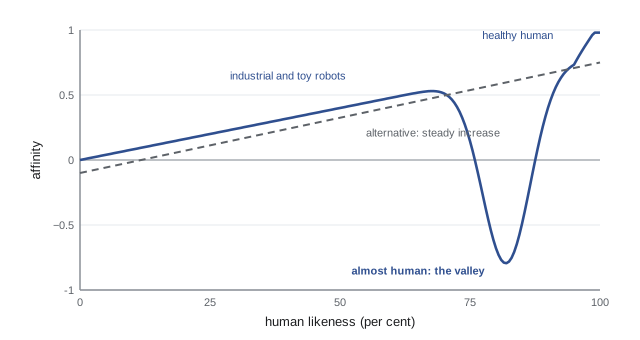
The uncanny valley became hugely influential in robotics, animation and game design, but the evidence for it is contested. Some studies find valley-like dips; for example, Maya Mathur and David Reichling in 2016 rated 80 real robot faces and found a dip in likeability for faces that were highly but not perfectly humanlike. Other studies find no valley, find that the effect depends heavily on how human likeness and affinity are measured, or explain the discomfort by other factors. Critics raise several points.
| Critique | What it says |
|---|---|
| Human likeness is not one dimension | Faces, voices, motion and behaviour can each be more or less humanlike, and mismatches between them may matter more than overall likeness |
| Affinity is poorly defined | Mori's Japanese term has been translated as familiarity, likeability, affinity or comfort; different measures give different curves |
| Stimuli are confounded | Almost-human stimuli are often lower-quality images or morphs, so artifacts rather than likeness may cause the dip |
| Category ambiguity | Discomfort may come from difficulty deciding whether something is a human or a machine, not from likeness itself |
| Familiarity changes responses | Exposure and culture shift reactions, so the curve is not fixed |
| Weak predictive value | Designers cannot use the curve to say how humanlike a particular design can safely be |
For designers, the practical lesson is narrower than the popular version. Mismatched cues, such as a realistic face with jerky motion or a humanlike voice from a machine-like body, often produce discomfort, and raising social expectations through humanlike appearance sets up disappointment when the robot cannot meet them. Many successful social robots therefore use stylized, clearly robotic or animal-like designs with expressive but simple features. That is a sensible heuristic supported by experience, not proof that a universal valley exists.
# Is there a valley? Comparing a straight line with a cubic fit on synthetic ratings
import numpy as np
rng = np.random.default_rng(430)
x = rng.uniform(0, 1, 120)                         # human-likeness score
y = 2 + 3 * x + rng.normal(0, 1.2, x.size)         # true relationship has no valley
def aic(deg):
    c = np.polyfit(x, y, deg); r = y - np.polyval(c, x)
    n, k = x.size, deg + 2
    return n * np.log(np.mean(r**2)) + 2 * k, c
for deg in (1, 3):
    a, c = aic(deg)
    print(f"degree {deg}: AIC {a:7.1f}, coefficients {np.round(c, 2)}")
grid = np.linspace(0, 1, 101); cub = np.polyval(aic(3)[1], grid)
print(f"cubic fit has a local dip: {bool(np.any(np.diff(np.sign(np.diff(cub))) > 0))}")degree 1: AIC 43.5, coefficients [3.4 1.91] degree 3: AIC 46.9, coefficients [ 4.06 -6.48 6.23 1.64] cubic fit has a local dip: False
Worked problem
Interpreting a claimed valley
A student study shows 12 images ranging from a toy robot to a photograph of a person and finds that the second-most humanlike image has the lowest likeability rating. The student claims to have confirmed the uncanny valley. List three questions you would ask before accepting the claim.
Show solution
- How was human likeness measured, and does the low-rated image differ in other ways, such as image quality, expression or lighting?
- Is the dip statistically reliable with this sample, and does a model with a dip fit better than a simple monotonic model?
- Would the result replicate with different stimuli and a different participant population?
Answer: Ask about confounds in the stimuli, statistical comparison of models, and replication; one low-rated image is not enough to confirm a general curve.
Long-term interaction and the novelty effect
Many social robot studies last a single session. In longer deployments, interaction often falls after the first days or weeks as the novelty wears off; a robot that children crowded around in the first week may be ignored by the fourth. Robots that sustain engagement tend to offer real usefulness, variety, memory of past interactions and adaptation to the person. Researchers model engagement over time and design studies that run long enough to see past the novelty peak. A common simple model treats daily engagement as a stable baseline plus a novelty component that decays exponentially.
Worked problem
Planning a study around novelty
In a pilot, children interact with a tutoring robot for 20 minutes on day 0, with engagement settling toward 8 minutes per day and a time constant of 5 days. How many minutes would you expect on day 10, and how long should a study run before the novelty component falls below 10 per cent of its starting size?
Show solution
- Day 10: \( E = 8 + (20 - 8) e^{-10/5} = 8 + 12 \times 0.135 \approx 9.6 \) minutes.
- Novelty below 10 per cent when \( e^{-t/5} < 0.1 \), so \( t > 5 \ln 10 \approx 11.5 \) days.
Answer: About 9.6 minutes on day 10, and the study should run at least about 12 days, preferably longer, before effects are judged.
Physically assistive robots
Physically assistive robots aim to increase independence for people with disabilities and older adults. Wheelchair-mounted robotic arms let users with limited upper-limb function eat, drink, open doors and pick up dropped objects. Feeding robots present spoonfuls of food. Exoskeletons support walking or reduce strain for workers lifting loads. Smart walkers and robotic beds assist mobility and transfers. The HRI challenges are considerable: control interfaces must work for users with limited motor function, often via joysticks, sip-and-puff switches, head arrays or shared autonomy (lesson 6); the robot operates close to the face and body, so safety is critical; and users want control over their own activities rather than having a robot decide for them. Cost, funding through public or private insurance, and training also determine whether a device is used. Lesson 10 returns to inclusive design and disability perspectives.
Ethics of social robots
Social robots raise particular ethical concerns. Amanda and Noel Sharkey and others have asked whether it is deceptive to give a robot behaviours that suggest feelings it does not have, especially for people with dementia or for young children who may not understand. Others argue that people enjoy fictions knowingly, as with pets and stories, and that the key question is whether the person benefits and keeps their dignity. Concerns about replacing human care are also prominent: a companion robot in a care home might reduce staffing pressure, but if it replaces visits or conversation with staff, residents could become lonelier. Robots with cameras and microphones in homes collect sensitive data (lesson 11), and children's interactions with robots raise questions about persuasion and attachment. Responsible design involves the people affected, family and care staff in decisions, and is honest about what the robot is and does.
Common mistakes
MistakeTreating a medical-device clearance as proof that a social robot works.
InsteadClearance is a regulatory classification; look for controlled, adequately powered studies.
MistakeAssuming Hall's distances apply everywhere.
InsteadZones vary with culture, age, relationship and setting; test with the people who will use the robot.
MistakeCiting the uncanny valley as established fact.
InsteadThe evidence is mixed; mismatched cues and raised expectations are better-supported design concerns.
MistakeJudging a social robot from a single session.
InsteadRun long enough to see past the novelty effect.
MistakeDesigning a companion robot without considering deception, dignity or replacement of human contact.
InsteadInvolve users, families and carers and be transparent about what the robot is.
Summary and key terms
- Socially assistive robots help through social interaction; physically assistive robots help through manipulation or support.
- People apply social rules to machines (the media equation) and anthropomorphize more under Epley's three factors.
- Hall's proxemic zones guide how close robots should approach, but values vary across people and settings.
- Social navigation adds costs for passing close, cutting through groups and approaching from behind.
- Mori's uncanny valley is influential but contested; mismatched cues and expectations are the robust design lesson.
- Engagement often decays after the novelty peak, so long studies are needed.
- Ethical issues include deception, dignity, replacement of human care, privacy and effects on children.
- Socially assistive robotics
- Robots that assist people through social rather than physical interaction.
- Media equation
- The finding that people treat computers and media as social actors.
- Anthropomorphism
- Attributing humanlike characteristics or minds to non-human agents.
- Proxemics
- The study of how people use space and distance in social interaction.
- Personal distance
- In Hall's scheme, roughly 0.45 to 1.2 m, used with friends and in conversation.
- Social navigation
- Robot motion among people that respects social norms as well as safety.
- Uncanny valley
- Mori's hypothesis that almost-human robots evoke a sharp drop in affinity.
- Novelty effect
- Temporarily high engagement with something new that fades over time.
- Physically assistive robot
- A robot that manipulates objects or supports the body to help a person.
- CASA paradigm
- Computers are social actors: a research approach testing whether social rules apply to machines.
Practice problems
Work each problem on paper first, then reveal the answer to check.
What distinguishes socially assistive from physically assistive robots?
Show answer
The first helps through social interaction, the second through physical manipulation or support.
Name Hall's four zones in order.
Show answer
Intimate, personal, social and public.
Give Epley's three factors for anthropomorphism.
Show answer
Elicited agent knowledge, effectance motivation and sociality motivation.
Who proposed the uncanny valley and when?
Show answer
Masahiro Mori, in 1970.
Give two critiques of the uncanny valley.
Show answer
Likeness is multidimensional, affinity is poorly defined, stimuli are confounded, category ambiguity may explain it.
With \( E_0 = 30 \), \( E_\infty = 10 \), \( \tau = 7 \) days, engagement on day 7?
Show answer
\( 10 + 20 e^{-1} \approx 17.4 \).
Why do people often keep more distance from a robot approaching from behind?
Show answer
They cannot see it coming, which feels less predictable and less safe.
Name two interfaces for users with limited hand function.
Show answer
Sip-and-puff, head arrays, adapted joysticks, voice or shared autonomy.
Why is a single-session study weak evidence for a companion robot?
Show answer
Novelty inflates early engagement and long-term effects are unknown.
State one ethical concern about companion robots in care homes.
Show answer
Deception, loss of dignity, replacing human contact or privacy.
Lesson quiz · 5 questions
Score 60% or more to complete this lesson.
Create a free account to save your progress, take quizzes and earn a certificate.