
ROB-499 · Lesson 1 of 12 · 30 min
The robotics capstone: purpose, teams and assessment
The capstone is where a robotics degree stops being a set of separate courses and becomes one piece of engineering. Over a single term, a small team takes a real problem, turns it into requirements, designs and builds a robot or robotic subsystem, tests it against those requirements, and shows it working in front of people who did not build it. Every earlier course feeds in: kinematics from ROB-210, sensing from ROB-220, control from ROB-300, estimation from ROB-310, real-time software from ROB-320, perception from ROB-330, mapping from ROB-340, planning from ROB-350 and the software pipeline from ROB-360. This course does not re-teach those topics. It shows how to combine them under time, budget and team constraints, and how to make the evidence of your work visible to examiners, partners and future employers.
The lessons follow the life of a capstone project in order. This first lesson sets out what a capstone is for, how teams are formed and run, and how the work is assessed. Lessons 2 to 4 cover the front end of engineering: defining the problem, writing requirements, generating concepts, running trade studies and holding design reviews. Lessons 5 to 8 cover execution: project management, prototyping, integration, and verification and validation. Lessons 9 to 12 cover safety and ethics review, demonstration and documentation, intellectual property and entrepreneurship, and finally reflection and career launch.
A running example: Team Tern
To keep the ideas concrete, the course follows one invented team through the term. Team Tern has five members: Ana leads mechanical design, Ben leads electrical and power, Chloé leads perception, Dev leads navigation and software integration, and Ema leads planning, testing and documentation. Their partner is Port Willow Parks, an invented municipal parks department that spends many staff hours picking up small litter, such as bottle caps, cans and food wrappers, from a sandy beach and its boardwalk. The parks department wants to know whether a small robot could patrol the upper beach at quiet times, detect litter, pick up common items and report what it found. The team's robot, also called Tern, is a four-wheeled mobile base with a low-cost arm, a depth camera, a lidar and an onboard computer running ROS 2.
Tern is deliberately ambitious enough to touch most of the degree: outdoor localization on sand from ROB-460, object detection from ROB-330, grasping from ROB-400, navigation from ROB-340 and ROB-350, interaction with members of the public from ROB-430, and a safety case from ROB-450. It is also deliberately constrained. The team has 13 weeks, a hardware budget, a shared lab and the usual demands of other courses. Many of the decisions you will see Team Tern make, such as cutting scope, choosing a simpler gripper or adding a test week, are the decisions every capstone team faces.
What a capstone is for
A capstone has three purposes that sometimes pull in different directions. The first is integration: proving that you can combine knowledge from many courses into a system that works. Many students discover that each subsystem works on its own bench but the robot does not work as a whole, because timing, power, mechanical tolerances and software interfaces interact. The second purpose is professional practice: working as engineers do, with requirements, reviews, schedules, budgets, risk management, safety analysis and documentation. The third purpose is evidence: producing artefacts, such as a design report, test data, a demonstration video and a code repository, that show what you can do.
Because of these purposes, a capstone is assessed differently from a problem set. Examiners care less about whether the robot achieves every stretch goal and more about whether the team made sound engineering decisions, tested honestly and can explain what happened. A robot that meets a modest set of requirements with strong evidence usually scores better than an impressive-looking robot whose performance is anecdotal. A team that discovers a fundamental problem in week 8, documents it, re-scopes sensibly and shows a working reduced system demonstrates more engineering maturity than a team that hides the problem.
In Canada, accredited engineering programs must include a significant design experience, usually delivered as a capstone, as part of the graduate attributes assessed by the Canadian Engineering Accreditation Board (CEAB). Attributes such as design, teamwork, communication, professionalism, impact of engineering on society, ethics and equity, and project management are typically assessed through capstone work, so the rubrics you see are often mapped directly to those attributes.
Types of capstone projects
Capstone projects come from several sources, and the source shapes the work. Industry-sponsored projects come with a real client, real constraints and often a non-disclosure agreement; they are excellent preparation for professional practice but may limit what you can publish or keep. Community or public-sector projects, like Team Tern's work with a parks department, bring stakeholders who are not engineers and who care about cost, maintenance and public acceptance. Research-linked projects extend a professor's research; they can be technically deep but may have vague success criteria. Competition projects, such as a rover or autonomous vehicle competition, come with a fixed rule book and a hard deadline; lesson 11 covers them. Student-proposed projects give the most freedom but require the team to find its own stakeholders and to justify its requirements carefully.
| Project source | Strengths | Watch for |
|---|---|---|
| Industry sponsor | Real requirements, mentors, budget, hiring links | Confidentiality, IP ownership, sponsor priorities changing mid-term |
| Community or public partner | Clear social value, varied stakeholders | Limited technical guidance, slow decisions, public safety and privacy |
| Research group | Advanced equipment and expertise | Open-ended goals, dependence on a graduate student or lab schedule |
| Competition | Fixed rules, external benchmark, motivation | Rule changes, travel cost, optimizing for points rather than learning |
| Student-proposed | Ownership and motivation | Weak requirements, scope creep, no real user to validate against |
Forming and running a team
Most robotics capstone teams have four to six members. Smaller teams struggle to cover mechanical, electrical, software and testing work; larger teams spend more time coordinating. Good teams balance skills but avoid rigid silos: each member should lead one area and support at least one other, so that the project does not stall when one person is sick or busy. Team Tern pairs Ana with Ben on the drivetrain and power, Chloé with Dev on perception and navigation, and Ema with everyone on testing.
In the first week, teams should write a team charter. PMP-120 lesson 4 covers charters in detail; for a capstone, a charter usually records the team's goals, each member's lead role and backup role, meeting times, how decisions are made, how work is tracked, how conflict is handled, what happens if someone misses commitments, and how the team will use the shared lab and equipment. The charter is not paperwork for its own sake. When a disagreement arises in week 9 about whether to rebuild the arm, the team can return to the decision rule it agreed on in week 1, for example, that technical decisions with schedule impact over one week are made by consensus after a short trade study, with the instructor consulted if consensus fails.
| Role | Typical responsibilities | Team Tern |
|---|---|---|
| Project lead or coordinator | Schedule, meetings, liaison with partner and instructor | Ema |
| Systems engineer | Requirements, interfaces, budgets, design reviews | Dev and Ema share |
| Mechanical lead | Chassis, mechanisms, CAD, fabrication | Ana |
| Electrical lead | Power, wiring, motor drivers, embedded boards | Ben |
| Software and autonomy leads | Architecture, perception, navigation, integration | Chloé (perception), Dev (navigation) |
| Test and quality lead | Test plans, data, regression testing | Ema with rotating support |
| Safety officer | Lab safety, hazard analysis, battery handling | Ben |
Effective teams meet regularly with a purpose. A short weekly planning meeting reviews progress against the schedule, updates risks and assigns tasks; two or three brief stand-ups during the week surface blockers. Meetings with the partner and the faculty advisor are scheduled well in advance with agendas sent beforehand. Every meeting ends with recorded decisions and actions with owners and dates. Lesson 5 covers the tools teams use for this.
How capstones are assessed
Assessment schemes vary between institutions, but most combine team deliverables, individual contributions and a final demonstration. Typical deliverables include a project proposal, a requirements document, design review presentations, a mid-term progress report, a final technical report, a demonstration, a poster or showcase presentation and a reflection. Weights are usually published in a rubric at the start of term; read it closely, because it tells you what evidence the examiners will look for. If the rubric gives 15 per cent for verification and testing, then a test report with data, not just a demonstration, is expected.
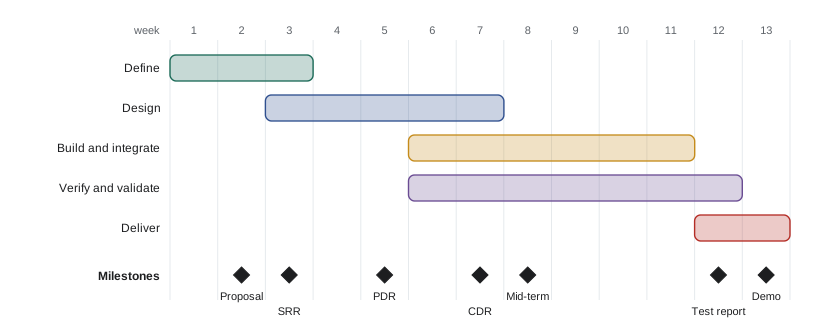
| Deliverable | Week due | Weight | Evidence examiners look for |
|---|---|---|---|
| Proposal and team charter | 2 | 5 % | Clear problem, stakeholders, feasible scope, roles |
| Requirements and concept review (SRR) | 3 | 10 % | Measurable requirements, traceability, trade study |
| Preliminary design review (PDR) | 5 | 10 % | Architecture, budgets, risks, test approach |
| Critical design review (CDR) | 7 | 10 % | Detailed design, prototypes, updated budgets |
| Mid-term progress report | 8 | 5 % | Schedule status, earned value, re-scoping decisions |
| Test report | 12 | 15 % | Verification of each requirement with data and statistics |
| Final demonstration | 13 | 15 % | Robot meets key requirements live, team explains results |
| Final technical report and repository | 13 | 20 % | Complete, honest, reproducible documentation |
| Individual reflection and peer evaluation | 13 | 10 % | Insight into own contribution and learning |
Rubrics usually describe levels of performance, for example unsatisfactory, developing, proficient and exemplary, for each criterion. A proficient requirements document lists measurable requirements with verification methods; an exemplary one also traces each requirement to a stakeholder need and shows how requirements changed through the term with reasons. Reading the exemplary column before you start is one of the most effective things a team can do.
Individual marks and peer evaluation
Team projects raise a fairness problem: should every member get the same mark? Many programs adjust individual marks using peer evaluation. Each member rates every other member, and often themselves, on criteria such as contribution, reliability, quality of work and teamwork. The ratings are converted into a weighting factor that scales the team mark. One common method, often called WebPA after the tool that popularized it, normalizes each rater's scores so that every rater distributes the same total, which removes the effect of generous or harsh raters, and then sums the normalized scores each person receives.
# Peer evaluation: normalize each rater's scores, then compute weighting factors (WebPA-style)
import numpy as np
names = ["Ana", "Ben", "Chloe", "Dev", "Ema"]
# rows = rater, columns = ratee; scores 1-5 on overall contribution (illustrative)
R = np.array([
    [4, 4, 5, 4, 5],   # Ana rates everyone (including self)
    [5, 3, 5, 4, 5],   # Ben
    [5, 4, 5, 5, 5],   # Chloe (a generous rater)
    [3, 2, 4, 3, 4],   # Dev (a harsh rater)
    [4, 3, 4, 4, 4],   # Ema
], dtype=float)
norm = R / R.sum(axis=1, keepdims=True)        # each rater distributes a total of 1
received = norm.sum(axis=0)                    # total normalized score each person receives
factor = received * len(names) / received.sum()  # 1.0 = average contribution
team_mark = 82.0
for n, f in zip(names, factor):
    print(f"{n:6s} factor {f:4.2f}  individual mark {min(100, team_mark * f):5.1f}")
print("raw means:", np.round(R.mean(axis=0), 2))Ana factor 1.02 individual mark 83.3 Ben factor 0.77 individual mark 63.0 Chloe factor 1.12 individual mark 92.1 Dev factor 0.97 individual mark 79.5 Ema factor 1.12 individual mark 92.1 raw means: [4.2 3.2 4.6 4. 4.6]
The normalized factors are close to 1 for most members, which is typical of a functioning team; Ben's factor is noticeably below 1 because most raters, including Ben himself, scored him lowest. Chloé's generous ratings and Dev's harsh ratings no longer distort the result, because each rater's scores are scaled to the same total. Institutions often cap the adjustment, for example to between 0.8 and 1.1 of the team mark, and require instructors to review large deviations, because peer ratings can reflect personality clashes as well as contribution.
Peer evaluation works best as a feedback tool during the term, not only as a grading tool at the end. Many programs run a formative round in week 5 or 6, share anonymized feedback with each member, and give the team time to fix problems before the summative round. The other source of evidence about individual contribution is the project record itself: commit histories, task-tracker assignments, meeting minutes, lab notebooks and design review slides. A member who is quiet in meetings but authored most of the motor-control code will show up clearly in the repository. Keep your own contribution log from week 1; it makes the reflection in lesson 12 far easier and protects you if a dispute arises.
Worked problem
Reading a rubric before planning
Team Tern's rubric awards 15 per cent for the test report, with the exemplary level described as "every requirement verified by an appropriate method, with sample sizes justified statistically and failures analysed". The team had planned one test week at the end. What should change?
Show solution
- The exemplary level needs justified sample sizes, which lesson 8 shows can require dozens of trials per requirement.
- Dozens of trials for 20 requirements cannot fit in a single final week alongside the demonstration.
- The team should schedule verification continuously from week 6, test each subsystem as it is completed, and reserve week 12 for system-level validation.
- It should also write the test plan, with sample sizes, at PDR in week 5 so examiners can see testing was planned rather than improvised.
Answer: Move from a single test week to continuous verification starting in week 6, with a test plan presented at PDR, so the evidence the rubric rewards can actually be collected.
Expectations of professional behaviour
Capstone teams work in shared labs, with expensive equipment and with outside partners, so professional conduct matters. Teams are expected to follow lab safety rules, book equipment fairly, keep partners informed, respect confidentiality, credit the sources of code and designs they reuse, and use generative AI tools within the rules set by their program. Many programs now allow AI coding assistants and writing tools but require disclosure of how they were used and hold students responsible for every line they submit. If you use an AI tool to draft a ROS 2 node, you must understand, test and be able to explain that node at the design review.
Engineering regulators in Canada expect licence holders to practise within their competence, to hold paramount the safety, health and welfare of the public, and to act with fairness and integrity. Although students are not yet licensed, capstone courses commonly assess professionalism against the codes of ethics of the provincial regulators, and lesson 12 explains how the capstone connects to licensure.
Common mistakes
MistakeTreating the capstone as a showcase where only the final demonstration matters.
InsteadTreat it as an engineering project assessed on the whole record: requirements, decisions, tests and documentation carry most of the marks.
MistakeDividing work into strict silos, with one person owning each subsystem alone.
InsteadGive each member a lead area and a backup area so that knowledge is shared and the project survives absences.
MistakeWriting the team charter as a formality and never using it.
InsteadAgree real decision rules, meeting norms and escalation steps, and return to them when disagreements arise.
MistakeLeaving peer evaluation until the end of term.
InsteadUse a formative round mid-term to surface problems while there is still time to fix them.
MistakeIgnoring the rubric until the report is due.
InsteadRead the exemplary column for each criterion in week 1 and plan the evidence the examiners will look for.
MistakeUsing AI-generated code without understanding or disclosing it.
InsteadFollow the program's rules on AI tools, disclose their use and make sure every member can explain and test the code they submit.
Summary and key terms
- A robotics capstone integrates the whole degree into one engineering project under real time, budget and team constraints.
- Its purposes are integration, professional practice and evidence; assessment rewards sound decisions and honest testing over stretch goals.
- Project sources include industry sponsors, community partners, research groups, competitions and student proposals, each with trade-offs.
- Teams of four to six with lead and backup roles, a working charter and regular purposeful meetings perform best.
- Rubrics define the evidence examiners want; read the exemplary level early and plan to produce it.
- Peer evaluation normalizes ratings to adjust individual marks; it is most useful as mid-term feedback.
- Professional behaviour includes safety, confidentiality, crediting sources and transparent use of AI tools.
- Capstone
- A culminating design project that integrates a degree program's knowledge in a substantial engineering task.
- Stakeholder
- A person or organization with an interest in or affected by the project, such as a partner, user or regulator.
- Team charter
- A short agreement recording a team's goals, roles, norms, decision rules and conflict procedures.
- Rubric
- A scoring guide that describes levels of performance for each assessment criterion.
- Peer evaluation
- Ratings of each member's contribution by teammates, used for feedback and to adjust individual marks.
- Weighting factor
- A multiplier derived from peer evaluation that scales the team mark for an individual.
- Lead and backup roles
- An arrangement in which each member leads one area and supports another, reducing single points of failure.
- Design review
- A formal checkpoint at which a design is presented and assessed against requirements before work proceeds.
- Graduate attributes
- Program-level outcomes, such as design and teamwork, that accreditation bodies require programs to assess.
- Contribution log
- A personal record of tasks, hours and outputs used to support reflection and individual assessment.
Practice problems
Work each problem on paper first, then reveal the answer to check.
List the three purposes of a capstone and give one deliverable that serves each.
Show answer
Integration (the working robot or system demonstration), professional practice (design review packages, schedules and risk registers) and evidence (the technical report, test data and repository).
Why might a modest robot with strong test data score higher than an impressive robot without it?
Show answer
Rubrics reward verified performance and sound decisions; anecdotal success cannot be distinguished from luck, while measured results show the requirements are actually met.
Name two risks of an industry-sponsored capstone and one mitigation for each.
Show answer
Confidentiality limits on publishing (agree early what can go in the portfolio); sponsor priorities changing (freeze requirements at SRR and manage changes formally).
A five-person team has one member who is the only person who understands the motor drivers. What is the risk and how should the team address it?
Show answer
A single point of failure; assign a backup who pairs on the drivers, document the wiring and firmware, and review it together.
Give three items a capstone team charter should record.
Show answer
Any three of goals, lead and backup roles, meeting times, decision rules, task tracking, conflict handling, consequences for missed commitments and lab use.
In the peer evaluation code, why are each rater's scores divided by that rater's total?
Show answer
To remove differences in rating generosity so that every rater distributes the same total and contributes equally to the factors.
A member's peer factor is 0.62. What should an instructor do before applying it?
Show answer
Review the evidence, such as commit history, task records and meeting notes, talk to the team, check for personality conflict, and apply any program cap on adjustments.
Why run a formative peer evaluation mid-term?
Show answer
It surfaces contribution or behaviour problems while there is still time to change them, rather than only penalizing at the end.
What evidence of individual contribution exists apart from peer ratings?
Show answer
Commit history, task tracker assignments, meeting minutes, lab notebooks, design review slides and the member's own contribution log.
How should a team use generative AI tools responsibly in a capstone?
Show answer
Follow program rules, disclose use, review and test all generated output, credit sources and ensure each member can explain the work.
Lesson quiz · 5 questions
Score 60% or more to complete this lesson.
Create a free account to save your progress, take quizzes and earn a certificate.