
SLS-250 · Lesson 3 of 12 · 19 min
Finding out what the customer needs
▶ Video coming soon A video version of this lesson is on the way.
On Tuesday, October 27, a couple in their sixties walked straight to the leather recliners. Aiden had been studying the recliner range all morning, and he started explaining the power headrests, the top-grain leather and the lumbar support. After four minutes the husband said, politely, "Thanks, we'll think about it," and they left. An hour later the same couple came back and found Carl. Carl asked one question: "Who is the chair for?" It was for the wife, who was recovering from hip surgery and had been told to avoid low, deep seats. Carl walked them to a lift chair with a firmer seat and a higher arm, which Aiden had not even mentioned. They bought it, with delivery that Friday.
Afterwards Carl told Aiden what Bev tells every new associate: "Find out what changed, and the sofa part is easy." Customers rarely shop for furniture or appliances on a whim. Something has happened: a move, a new baby, a broken fridge, a health change, a child leaving home, a renovation. Knowing what changed tells the associate what matters, what does not, and how soon the customer needs a solution. This lesson turns the questioning skills from SLS-120 into a practical discovery routine for the retail floor.
What discovery is for
Discovery is the step where the associate learns enough about the customer's situation to recommend the right product, or to recognize that the store does not have it. On the retail floor it is usually short, from two to ten minutes, and it happens standing beside the product, not across a desk. It has three purposes. It helps the customer, because the recommendation will fit. It builds trust, because people feel listened to. And it saves time, because the associate does not waste ten minutes demonstrating the wrong product, as Aiden did with the recliner.
Discovery on the retail floor is lighter than the consultative discovery taught for business sales in SLS-211. A household buying a sofa does not need a stakeholder map. But the principles are the same: understand the problem first, then the solution.
The five things to learn
Juniper & Pine trains associates to learn five things in most furniture and appliance conversations. The letters spell ROOMS, which makes them easy to remember on a busy day.
| Letter | What to learn | Example questions |
|---|---|---|
| R: Reason | What changed, and why they are shopping now | "What has you looking for a new sofa?" "What happened to the old fridge?" |
| O: Occupants | Who will use it and how: adults, children, pets, guests, health needs | "Who sits there most evenings?" "Any pets who will claim it?" |
| O: Opening and space | Room size, doorways, stairs, hallways and where it will go | "Do you know the room size?" "Any tight stairs or turns on the way in?" |
| M: Must-haves and money | Features they need, styles they love or hate, and the budget range | "What would make this a perfect fit?" "Do you have a range in mind?" |
| S: Schedule | When they need it and any constraints on delivery | "When are you hoping to have it?" "Is anyone home on weekdays?" |
Not every conversation needs every question. A customer whose fridge died yesterday needs schedule and space first ("What size is the opening, and when do you need it?"). A couple choosing a dining set for a new house may want to talk style for a while. The checklist is a reminder of what to cover before recommending, not a script to read aloud.
Asking about money
New associates often avoid asking about budget because it feels rude. Experienced associates ask early, but gently, and always as a range. "Do you have a price range in mind?" or "So I don't waste your time, what would you be comfortable spending?" Most customers are relieved to be asked. Those who are unsure can be helped with a quick orientation: "Sofas like this run from about 1,200 to 3,500 dollars here, depending mostly on the cushions and the fabric."
The budget answer is information, not a ceiling to aim for or a judgment of the customer. A customer who says "around a thousand" and then falls in love with a 1,600-dollar sectional may decide it is worth it, and that is their choice to make with full information. A customer who says "around a thousand" and is shown only 1,600-dollar sectionals will feel ignored, and with good reason.
Measurements and fit
In furniture and appliances, many bad sales are not about taste at all: the product does not fit through the door, up the stairs or into the space. SLS-130 described how Juniper & Pine added a fit checklist to every appliance sale after delivery complaints. Discovery is where fit problems are prevented.
Associates ask for, or help the customer measure, three things: the space where the item will go, the narrowest point on the way in (usually a door, a stairwell turn or a hallway corner), and anything that limits height, such as a low ceiling over a stair. For refrigerators and ranges, they also check the cut-out size, the door swing and the clearance the manufacturer requires behind and above the appliance. When customers do not have measurements, associates give them a printed measuring card and offer to hold the item for 48 hours.
Worked problem
Will the sofa get in?
A customer's front door is 81 cm wide when fully open. The sofa she likes is 214 cm long, 94 cm deep and 86 cm high, with legs that unscrew. Without legs, it is 78 cm high. A sofa normally goes through a door on its side or on its back, so the dimension that must pass through the door width is the depth or the height, whichever is smaller. Will it fit through the door?
Show solution
- With legs on, the smaller of depth and height is the height.
- \[\min(94,\ 86) = 86\ \text{cm}\]
- Compare with the door width: 86 cm is wider than 81 cm, so it will not pass.
- \[86 - 81 = 5\ \text{cm too wide}\]
- With the legs removed, the height is 78 cm.
- \[81 - 78 = 3\ \text{cm to spare}\]
Answer: With the legs on, the sofa is 5 cm too tall to pass through the door on its back. With the legs removed, it clears by 3 cm. That is tight, so Aiden noted "remove legs; door 81 cm; 3 cm clearance" on the order and asked the delivery crew to bring door-frame pads.
Real deliveries also involve angles, turns and hallway corners, which is why delivery crews and manufacturers publish fit guides and why tight fits are flagged in advance rather than discovered on the doorstep.
Listening for the real need
Customers often describe solutions rather than needs. "I want a sectional" may really mean "I need everyone to fit for movie night" or "my back hurts on our current couch". "I need a bigger fridge" may mean "I need more freezer space for the bulk shopping we do". Associates who hear the need behind the request can suggest options the customer had not considered, including cheaper ones. SLS-120 called this reflecting and summarizing; on the floor it often sounds like: "So the main thing is room for five people on movie nights, and it has to survive the dog. Is that right?"
Summaries matter because customers correct them. When Aiden summarized one couple's need as "a firm mattress because of his back", the wife added: "And I sleep hot, so not the foam one we had." That one sentence removed half the mattresses on the floor from consideration.
Recording what you learned
Everything learned in discovery is useful later: at the counter, at delivery and in follow-up. Juniper & Pine associates add discovery notes to the customer's profile in the clienteling app, as SLS-140 described: the reason, the household, measurements and preferences. A customer who comes back next spring for a dining table should not have to repeat that they have three children and a dog. Notes must stay factual and respectful. "Recovering from hip surgery; needs higher seat" is appropriate if the customer shared it and agreed to a profile; a guess about someone's health or income is not. Lesson 10 covers privacy in the client book.
When the store does not have it
Sometimes discovery shows that nothing in the store fits: the space is too small for any sofa in stock, or the customer needs a feature no product has. Honest associates say so and suggest the next best option, such as a custom order, a smaller piece or a different style. Occasionally the honest answer is that another store would suit them better. Bev's view is that the customer will remember that honesty, and so will the people they tell.
Discovery for gifts and for other people
Some customers are shopping for someone else: a parent buying a first bed for a child leaving home, adult children choosing a recliner for an elderly parent, or a couple buying a guest bed for visiting family. Discovery then has two layers. The associate learns about the buyer's situation (budget, timing, delivery address) and about the person who will use the product (height, mobility, sleeping position, taste). It helps to ask directly whether the user can visit, join a video call or send measurements and photos. When they cannot, associates suggest the safest choices, such as medium-firm mattresses that suit most sleepers, and explain the exchange or return terms clearly so the buyer knows what happens if the gift does not suit.
Discovery when the customer is in a hurry
A customer whose fridge has just died, or who has movers arriving on Friday, does not want a long conversation. Discovery still matters, but it is compressed to the questions that prevent a failed sale: the space and the narrowest point, the deadline, and any must-haves such as an ice maker or a counter-depth model. Associates in this situation lead with what is in stock and deliverable by the deadline, rather than the full range. Carl's first question to a hurried appliance customer is always "What size is the hole, and when do you need it filled?" It sounds blunt, but customers in a hurry find it reassuring.
Whatever the pace, associates should close discovery with a short summary before recommending anything. A summary takes ten seconds and catches the misunderstandings that otherwise surface at delivery.
Turning discovery into a short list
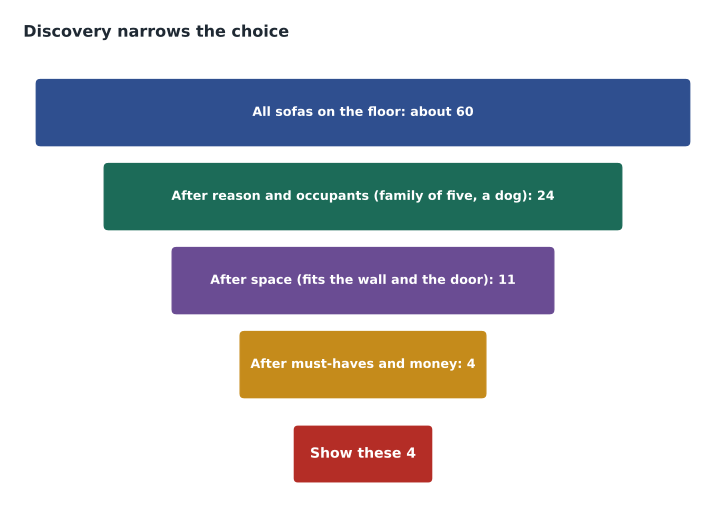
Discovery ends when the associate can name a short list of products worth showing, usually two or three. If the list is longer, there is probably a question still to ask; if it is empty, the associate should say so honestly and explore alternatives, as described above. Carl writes the short list on the back of his business card as he talks, which keeps him focused and gives the customer something to take home if they leave before deciding.
Discovery also protects the store. Many of the complaints SLS-130 described, from sofas that would not fit to fridges without a water line, began with a question nobody asked. A minute of discovery is far cheaper than a failed delivery, a second truck and an unhappy customer, and the notes it produces travel with the order to everyone who handles it after the sale.
Common mistakes
MistakeStart by explaining the product's features.
InsteadStart by learning why the customer is shopping and who will use the product, then recommend.
MistakeNever ask about budget; it is rude.
InsteadAsk early, gently and as a range. Most customers are relieved.
MistakeA budget is a target to sell up to.
InsteadIt is information. Show options within it, and let the customer decide whether to spend more.
MistakeFit problems are the delivery crew's concern.
InsteadFit is checked in discovery. A product that does not fit is a failed sale.
MistakeCustomers know exactly what they need.
InsteadThey often describe a solution. Listen for the need behind it and summarize to check.
Summary and key terms
- Discovery learns enough about the customer's situation to recommend the right product, and it builds trust and saves time.
- Most furniture and appliance purchases follow a change; finding out what changed tells you what matters.
- The ROOMS checklist covers reason, occupants, opening and space, must-haves and money, and schedule.
- Ask about budget early and as a range, and treat the answer as information, not a target.
- Check measurements: the space, the narrowest point on the way in and any height limits.
- Listen for the need behind the request, summarize to confirm, and record useful, respectful notes in the client book.
- Discovery
- The part of the sale where the associate learns about the customer's situation before recommending.
- ROOMS
- Juniper & Pine's discovery checklist: reason, occupants, opening and space, must-haves and money, schedule.
- Narrowest point
- The tightest door, stair turn or hallway on the way to where a product will go.
- Summarizing
- Restating the customer's needs in a few words so they can confirm or correct them.
Practice problems
Work each problem on paper first, then reveal the answer to check.
A customer says, "I need a new washer." Write two discovery questions.
Show answer
For example: "What happened to the old one?" and "How many people are in the household, and how many loads a week do you do?"
What is the risk of showing products before asking any questions?
Show answer
The associate may spend time on the wrong product, as Aiden did with the recliner, and the customer may leave feeling unheard.
A doorway is 76 cm wide. A dresser is 46 cm deep and 102 cm tall. Which dimension must pass through the door, and does it fit?
Show answer
The smaller of depth and height, 46 cm, which fits easily.
Why is "around a thousand" not a ceiling?
Show answer
It is the customer's starting range. They may choose to spend more with full information, but the associate should show options within it.
Lesson quiz · 5 questions
Score 60% or more to complete this lesson.
Create a free account to save your progress, take quizzes and earn a certificate.