
VIS-130 · Lesson 3 of 12 · 29 min
The Renaissance: perspective, the window and sfumato
In fifteenth-century Florence, artists and architects worked out a geometric system for making a flat picture look like a view through a window into deep space. That system, linear perspective, is so fundamental to how we now see images that it is easy to forget it was invented. Every camera lens produces perspective automatically, so photographers and filmmakers inherit the Renaissance worldview whether they know it or not. This lesson explains how linear perspective works, how Leon Battista Alberti described the picture as an open window, how painters such as Leonardo da Vinci added atmospheric perspective and sfumato, and how Renaissance composition, from pyramids to the placement of the vanishing point, still shapes how image makers frame scenes.
Brunelleschi's experiment and the birth of linear perspective
Around 1415 to 1420, the Florentine architect Filippo Brunelleschi carried out a famous demonstration. He painted a small panel showing the Baptistery of Florence as seen from the doorway of the cathedral opposite, drilled a peephole through the vanishing point, and had viewers look through the back of the panel at a mirror held in front. When the mirror was removed, the painted view lined up with the real building. Accounts of the experiment come from a biography written decades later, so details are uncertain, but its significance is clear: a painting could reproduce the view from a single fixed eye point with geometric precision.
Linear perspective rests on a few simple rules.
- The picture represents the view from one fixed eye point.
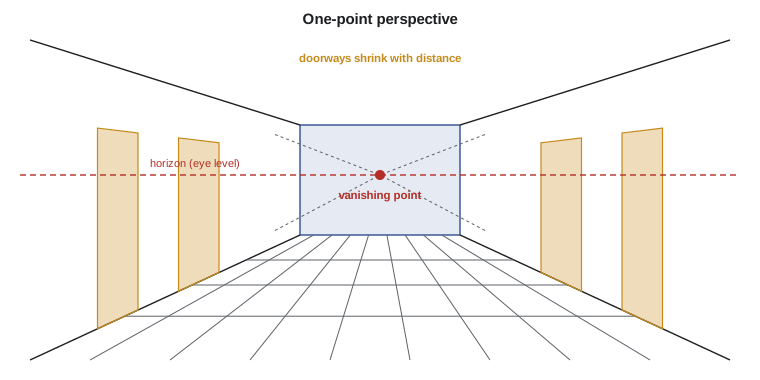
- Lines that are parallel in the real world and recede away from the viewer appear to converge toward a single vanishing point.
- The vanishing point for lines perpendicular to the picture plane lies on the horizon line, at the height of the viewer's eye.
- Objects appear smaller in proportion to their distance from the eye.
- Lines parallel to the picture plane stay parallel in the picture.
Alberti's window
In 1435, Leon Battista Alberti wrote a treatise on painting, known by its Latin title De pictura, which codified perspective for painters. He famously described the rectangle in which he painted as an open window through which the story is seen. He also explained how to construct a floor of square tiles that recedes correctly, using a central vanishing point and a method for spacing the horizontal lines.
Alberti's window is one of the most influential ideas in visual culture. It defines the picture as a view from a particular position, framed by edges that cut off the world. A camera viewfinder, a cinema screen and a phone display all inherit this model. The idea also carries assumptions: there is one correct viewer, standing in one correct place, and the image presents the world as an orderly, measurable space. Later artists, from Cubists to digital collage makers, deliberately broke the window.
Horizon, eye level and camera height
For image makers, the most practical lesson of perspective is that the horizon line always sits at the eye level, or camera height, of the viewer. If you photograph a corridor from standing height, the vanishing point sits at about 1.6 metres in the scene; crouch down and the vanishing point drops, making the ceiling loom and the floor compress. The height of the horizon in the frame changes how a scene feels: a low horizon emphasizes sky and can make figures look monumental, while a high horizon emphasizes ground and can make figures feel small or trapped.
Worked problem
Locating a vanishing point and camera height
In a described photograph of a straight hallway, the floor-tile lines and the top edges of the doorframes converge toward a point 40 per cent of the way up the frame. A person standing upright in the middle distance has their eyes exactly on that line. What do you know about the camera's height?
Show solution
- Receding parallel lines converge at the vanishing point, which lies on the horizon line at camera height.
- Any standing person on the same floor whose eyes sit on the horizon line has eyes at the same height as the camera.
- Adult standing eye height is typically about 1.5 to 1.7 metres.
- The horizon sits below the frame centre, so the camera is held level but framed to include more ceiling than floor, or the image has been cropped.
Answer: The camera was at roughly the person's eye height, about 1.5 to 1.7 m, and was level, because the eye line of the standing person coincides with the vanishing point.
Two-point and three-point perspective
When a building or box is turned at an angle to the picture plane, its two sets of horizontal edges recede toward two vanishing points, both on the horizon. This two-point perspective is common in architectural drawing and in photographs of street corners. When the camera tilts up or down, vertical lines also converge toward a third vanishing point above or below the frame, producing three-point perspective. Photographers call this keystoning, and architectural photographers often correct it with tilt-shift lenses or software, as PHOT-311 explains.
Masaccio and the first great perspective paintings
One of the first paintings to use systematic perspective convincingly was Masaccio's Holy Trinity fresco in the church of Santa Maria Novella in Florence, painted around 1427. It shows a barrel-vaulted chapel that seems to open into the church wall. The vanishing point is placed low, at the eye level of a person standing in the church, so viewers look up into the painted architecture as they would into a real chapel. The painting fuses illusion and devotion: the holy figures seem to share the viewer's space.
Masaccio's choice of a low vanishing point matching the real viewer's eye level is a lesson in site-specific design. Image makers working on murals, installations, projection mapping or set extensions in film must think the same way: where will the viewer or camera be, and how should the painted or projected space line up with the real one?
Measuring and building perspective space
Renaissance artists used perspective not only for buildings but to organize whole compositions. Piero della Francesca, who wrote a treatise on perspective, placed figures within carefully measured spaces. Leonardo's Last Supper, painted in the 1490s on the wall of a refectory in Milan, uses the receding lines of the room's ceiling and walls to converge on the head of Christ at the centre, so the geometry itself directs every viewer's eye to the key figure.
This technique of placing the vanishing point on the most important subject remains one of the strongest compositional devices in photography and film. Corridors, railway tracks, roads and rows of columns that converge on a character draw attention to them with great force. Filmmakers such as Stanley Kubrick became famous for symmetrical one-point compositions, but the device runs throughout cinema.
Worked problem
Using the vanishing point for emphasis
You are filming a character waiting at the far end of a long, symmetrical train platform. Where should you place the camera and the character so that the platform's lines direct attention to them?
Show solution
- Place the camera on the platform's centre line, facing straight down its length, so the receding lines converge symmetrically.
- Set the camera height so the horizon, and therefore the vanishing point, sits where the character's head will be.
- Position the character on the centre line at the far end, so their head coincides with the vanishing point.
- Keep the camera level to avoid introducing a third vanishing point that would tilt the verticals.
Answer: Put the camera level on the platform's centre line at the character's eye height and place the character at the far end on that line. The converging edges of the platform, roof and rails will then lead directly to their head, as the room's lines lead to the central figure in the Last Supper.
Atmospheric perspective and sfumato
Linear perspective handles geometry, but distance also changes how things look. Leonardo da Vinci wrote extensively about atmospheric or aerial perspective: distant objects appear lighter, bluer, lower in contrast and less detailed because of the air between us and them. Painters used this to deepen landscapes behind their figures, often with mountains fading into blue haze.
Leonardo also developed sfumato, from an Italian word meaning smoky. It describes extremely soft transitions between light and shadow, without hard outlines, as in the soft modelling of faces in his portraits, including the Mona Lisa, painted in the early sixteenth century. Sfumato makes forms seem to emerge from shadow and gives expressions an ambiguous, living quality.
| Depth cue | What it does | Camera and lighting equivalent |
|---|---|---|
| Linear perspective | converging lines and diminishing size | lens focal length and camera position |
| Atmospheric perspective | distant objects paler, bluer, softer | haze, smoke, fog filters, lens flare control |
| Overlap | nearer objects hide farther ones | staging in depth, foreground framing |
| Sfumato | soft tonal transitions without outlines | soft light, diffusion, gentle falloff |
| Chiaroscuro | strong light and dark modelling | directional key light, low fill |
Cinematographers recreate atmospheric perspective with haze machines, which add a fine mist so that distant parts of a set fall off in contrast and colour. Diffusion filters and soft key lights produce something like sfumato on faces.
Renaissance composition: pyramids, symmetry and balance
High Renaissance painters in the decades around 1500, including Leonardo, Raphael and Michelangelo, favoured stable, balanced compositions. A popular arrangement was the pyramid: figures grouped so that their combined shape forms a triangle, with the most important head at the apex. Raphael's paintings of the Virgin and Child with the young John the Baptist, such as his Madonna of the Meadow from around 1505, use this structure to create calm stability.
Symmetry and balance also mattered. Raphael's School of Athens fresco in the Vatican, painted around 1509 to 1511, places a large gathering of philosophers within a grand perspective architecture, with the two central figures framed by an arch at the vanishing point. The composition feels orderly and harmonious, expressing ideals of rational knowledge.
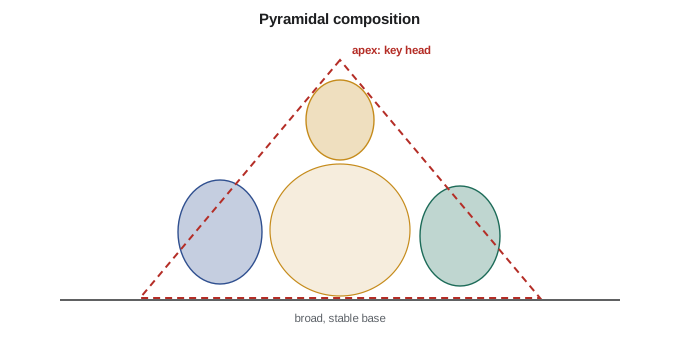
Group photographs, wedding portraits and film tableaux still use pyramids, often without anyone naming them. Placing the tallest or most important person at the apex and arranging others descending to either side creates a stable, readable group.
Portraiture and the rise of the individual
The Renaissance also saw the growth of portraiture as an independent art. Early portraits often used strict profile views, echoing coins and medals. By the later fifteenth century, painters in Italy and Northern Europe favoured the three-quarter view, which shows more of the face and gives a stronger sense of personality and volume. Netherlandish painters such as Jan van Eyck, working in oil paint in the 1430s, achieved astonishing detail and luminous surfaces, from reflections in mirrors to the texture of fur.
The three-quarter view remains the default angle for most portrait photography, because it reveals the structure of the face better than a flat frontal or a profile view. Van Eyck's attention to small reflective details is echoed in commercial photography's fascination with texture and highlights.
Women artists of the Renaissance
Women had limited access to training, guild membership and the study of the nude, but several built significant careers. Sofonisba Anguissola, from Cremona, became a court painter in Spain in the 1560s and was admired for lively, informal family portraits. Lavinia Fontana in Bologna ran a successful practice and received major public commissions. Their work shows how portraiture, which did not require anatomy training from nude models, offered women a route into professional art.
Canadian and international collections increasingly highlight such artists; checking a gallery's online collection for women painters of the period is a useful research habit.
What image makers take from the Renaissance
Linear perspective is built into every lens, but understanding it lets you control it: choose camera height to set the horizon, place the vanishing point on your subject, decide between one-point symmetry and two-point dynamism, and watch for unwanted keystoning. Alberti's window reminds you that every frame is a choice of position and edges. Atmospheric perspective and sfumato translate into haze, diffusion and soft light. Pyramidal and symmetrical compositions offer stability and calm when you need them. And the three-quarter portrait remains a reliable default.
Common mistakes
MistakePlacing the camera at a random height without considering the horizon
InsteadRemember the horizon and vanishing point sit at camera height and set it deliberately for the effect you want
MistakeAssuming perspective is simply how the world looks
InsteadRecognize linear perspective as a fifteenth-century system based on one fixed eye point
MistakeTilting the camera up at buildings without noticing converging verticals
InsteadWatch for a third vanishing point and correct or exaggerate keystoning intentionally
MistakeConfusing atmospheric perspective with linear perspective
InsteadDistinguish geometric convergence from the paling, cooling and softening caused by air and distance
MistakeTreating sfumato as simple blur
InsteadUnderstand it as soft, gradual tonal transitions that model form without hard outlines
Summary and key terms
- Brunelleschi demonstrated linear perspective in Florence around 1415 to 1420, and Alberti codified it in 1435.
- Receding parallel lines converge to a vanishing point on the horizon, which always sits at the viewer's or camera's eye level.
- Alberti's open window defined the picture as a framed view from one position, a model inherited by cameras and screens.
- Two-point and three-point perspective handle objects at angles and tilted views, the source of keystoning.
- Placing the vanishing point on a key figure, as in the Last Supper, directs attention powerfully.
- Atmospheric perspective and sfumato add depth and softness, recreated today with haze, diffusion and soft light.
- Pyramidal, symmetrical compositions and the three-quarter portrait remain staples of photography and film.
- Linear perspective
- A geometric system that represents depth through converging lines and diminishing size from one eye point
- Vanishing point
- The point on the horizon toward which receding parallel lines appear to converge
- Horizon line
- The line at the viewer's eye level on which vanishing points for horizontal lines lie
- Picture plane
- The imaginary flat surface of the image, like Alberti's window
- Atmospheric perspective
- The effect of air making distant objects paler, bluer, softer and lower in contrast
- Sfumato
- Very soft, smoky transitions between light and shadow without hard outlines
- Keystoning
- The convergence of vertical lines when a camera tilts up or down
- Pyramidal composition
- An arrangement of figures forming a stable triangle with the key figure at the apex
- Three-quarter view
- A portrait angle between frontal and profile that shows the face's volume
- Fresco
- Painting on wet plaster, used for Renaissance wall paintings such as the Holy Trinity and School of Athens
Practice problems
Work each problem on paper first, then reveal the answer to check.
Where does the horizon line sit in a perspective image?
Show answer
At the eye level of the viewer, or the camera height.
What happens to the vanishing point if you lower the camera?
Show answer
It moves down, with the horizon, so ceilings loom and floors compress.
What did Alberti compare the picture to?
Show answer
An open window through which the story is seen.
How many vanishing points does a box seen corner-on have, with a level camera?
Show answer
Two, both on the horizon.
What causes keystoning?
Show answer
Tilting the camera up or down so that vertical lines converge toward a third vanishing point.
How does the Last Supper direct attention to its central figure?
Show answer
The room's receding lines converge on Christ's head at the vanishing point.
Name two signs of atmospheric perspective.
Show answer
Distant objects appear paler and bluer, and have less contrast and detail.
What is sfumato?
Show answer
Extremely soft transitions between light and shadow, without hard outlines.
Why is the three-quarter view common in portraits?
Show answer
It reveals more of the face's structure and volume than a frontal or profile view.
Give a modern use of the pyramidal composition.
Show answer
Group or wedding portraits with the key person at the apex.
Lesson quiz · 5 questions
Score 60% or more to complete this lesson.
Create a free account to save your progress, take quizzes and earn a certificate.