
VIS-130 · Lesson 9 of 12 · 25 min
Surrealism, the avant-garde and early experimental film
The First World War shattered European confidence in reason and progress. In its aftermath, artists turned to chance, absurdity, dreams and the unconscious. Dada mocked the art world and the society that had produced the war; Surrealism explored the strange logic of dreams; and filmmakers in France, Germany and the Soviet Union treated cinema as an art form capable of things painting could never do. This lesson traces these avant-garde movements and shows how their ideas, from the readymade to dream imagery and montage, run through music videos, advertising, fashion photography, horror films and experimental video today.
Dada: anti-art after the war
Dada began in Zurich in 1916, at the Cabaret Voltaire, where artists and poets who had fled the war staged chaotic performances, nonsense poetry and provocations. The movement spread to Berlin, Cologne, Hanover, Paris and New York. Its members rejected conventional art and logic, which they associated with the nationalism and rationalism that had led to mass slaughter.
Dada artists used chance, collage, photomontage and found objects. Jean Arp dropped scraps of paper and glued them where they fell. Kurt Schwitters in Hanover built collages from tickets, wrappers and scraps he called Merz. In Berlin, as Lesson 8 noted, Hannah Höch and Raoul Hausmann made satirical photomontages.
Duchamp and the readymade
Marcel Duchamp, a French artist who spent much of his career in New York, posed the most radical challenge. In 1917, under a pseudonym, he submitted a mass-produced porcelain urinal, turned on its side and signed "R. Mutt", to an exhibition that had promised to accept any work whose artist paid the fee. Titled Fountain, it was rejected and disappeared, but a photograph by Alfred Stieglitz survives. Duchamp called such objects readymades: ordinary manufactured items chosen and presented as art.
The readymade argued that art could be defined by the artist's choice and the context of presentation rather than by skill or beauty. This idea underlies much later conceptual art and has a direct parallel in photography and found-footage film: the photographer selects and frames rather than draws, and the found-footage filmmaker selects and recontextualizes existing material.
Surrealism: the logic of dreams
In Paris in 1924, the poet André Breton published the first Surrealist manifesto, defining Surrealism as pure psychic automatism, the expression of thought without the control of reason. Influenced by Sigmund Freud's theories of dreams and the unconscious, Surrealists explored desire, fear, chance and the strange juxtapositions of dreams.
Surrealist painting took two broad directions. Some artists, such as Joan Miró and André Masson, used automatic drawing, letting the hand move freely to generate forms. Others, such as Salvador Dalí and René Magritte, painted dream images in a precise, realistic style, which made the impossible look convincing. Dalí's melting clocks in a desert landscape, from 1931, and Magritte's painting of a pipe with the caption "this is not a pipe" in French, from 1929, are among the most widely recognized images of the century. Magritte's pipe makes a simple, profound point about images: a picture of a pipe is not a pipe, but a representation.
Women Surrealists, long marginalized in histories of the movement, made major contributions. Leonora Carrington, born in England, worked in Mexico from the 1940s, painting mysterious, alchemical worlds. Dorothea Tanning painted uncanny domestic interiors. Lee Miller, a photographer who worked with Man Ray and later became a war photographer, produced surreal images of strange juxtapositions. The Mexican painter Frida Kahlo was claimed by Breton as a Surrealist, though she insisted she painted her own reality, not dreams.
Surrealist photography
Photography suited Surrealism surprisingly well, because a photograph's apparent objectivity makes strange images feel real. Man Ray, an American working in Paris, made rayographs, his version of photograms, and used solarization, an effect in which partially re-exposing a print reverses some tones and creates dark outlines, a technique he developed with Lee Miller around 1929. Photographers found the surreal in everyday city streets: shop windows with mannequins, odd signs and accidental juxtapositions. Eugène Atget's photographs of empty Paris streets and shop windows, made decades earlier for practical purposes, were admired by the Surrealists for their haunting strangeness.
| Technique | Description | Modern descendant |
|---|---|---|
| Juxtaposition | unexpected combinations of objects | conceptual advertising, album covers |
| Change of scale | ordinary objects made giant or tiny | product photography, surreal digital art |
| Automatism | drawing or writing without conscious control | improvisation, generative art |
| Precise dream realism | impossible scenes rendered realistically | visual effects, composited photography |
| Solarization and photograms | experimental darkroom effects | digital filters, experimental photography |
| The uncanny | familiar things made strange | horror cinema, eerie fashion imagery |
The avant-garde turns to film
Early cinema, from 1895, was largely a popular entertainment. In the 1920s, avant-garde artists recognized film as an art form with unique powers: movement, time, editing and the ability to make the impossible visible. Three broad strands emerged.
- Abstract film: German artists such as Hans Richter, Viking Eggeling and Walter Ruttmann made films of moving geometric shapes in the early 1920s, extending abstract painting into time. Oskar Fischinger later made visual music, abstract animation synchronized to sound.
- Dada and Surrealist film: films that used absurdity, chance and dream logic, such as Un Chien Andalou, made in 1929 by Luis Buñuel and Salvador Dalí, a sixteen-minute film of disconnected, shocking dream images famous for its opening image of a razor and an eye.
- Montage cinema: Soviet filmmakers developed theories of editing as a way to create meaning, as described below.
German Expressionist film
In Germany after the war, filmmakers created Expressionist cinema, in which distorted sets, dramatic shadows and stylized acting expressed inner states of fear and madness. The Cabinet of Dr. Caligari, directed by Robert Wiene and released in 1920, used painted sets with jagged, slanting walls, painted shadows and impossible angles to depict a world seen through a disturbed mind. F. W. Murnau's Nosferatu, from 1922, used shadows and real locations to create dread.
German Expressionist film drew on Expressionist painting, which had used distorted forms and intense colour to express emotion, and on the long chiaroscuro tradition. Many of its artists emigrated to Hollywood, and its shadows and angles shaped horror films and film noir.
Worked problem
Reading Expressionist set design
A described film set shows a narrow street whose buildings lean inward at sharp angles, with doorways shaped as irregular triangles and shadows painted directly onto the walls in jagged streaks. What does this design communicate, and what tradition does it belong to?
Show solution
- Note the distortion: walls leaning inward and irregular shapes reject realistic architecture.
- Note the painted shadows: light and shadow are not produced by real lights but designed to express mood.
- Interpret the effect: the space feels unstable, threatening and claustrophobic, suggesting a disturbed or fearful mental state.
- Identify the tradition: German Expressionist cinema, exemplified by The Cabinet of Dr. Caligari in 1920.
Answer: The set expresses an inner state rather than a real place: the leaning walls, jagged openings and painted shadows create instability, threat and claustrophobia. This is the approach of German Expressionist cinema, in which the design of the world mirrors a character's fear or madness.
Soviet montage
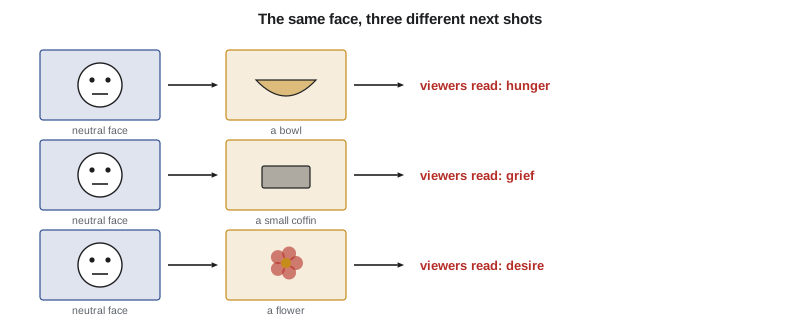
In the Soviet Union in the 1920s, filmmakers developed the idea that the meaning of a film is created by the collision of shots in editing. Lev Kuleshov ran experiments in which the same shot of an actor's neutral face, intercut with different images, such as a bowl of soup, a child in a coffin or a woman, led audiences to perceive different emotions in the face. This Kuleshov effect showed that viewers construct meaning from the relationship between shots.
Sergei Eisenstein, influenced by Constructivism and by ideas of dialectical conflict, argued that montage should create collisions between shots that generate new ideas. His Battleship Potemkin, released in 1925, includes a famous sequence on the Odessa steps in which soldiers advance on civilians, edited with rhythmic shots, close-ups and contrasting movements. Dziga Vertov's Man with a Movie Camera, from 1929, celebrated the camera itself, showing a day in Soviet cities with dazzling editing, split screens, slow motion and shots of the filming process. FILM-101 and FILM-220 explore montage in detail.
From avant-garde to mainstream
Avant-garde ideas rarely stayed on the margins. Surrealist imagery entered advertising, fashion photography and window displays within a decade. Alfred Hitchcock hired Dalí to design a dream sequence for Spellbound, released in 1945. Montage became a standard tool of commercial cinema and later of music videos. Expressionist lighting shaped film noir and horror. Experimental film continued as an independent tradition, from American avant-garde filmmakers such as Maya Deren, whose Meshes of the Afternoon of 1943 explores dream logic, to video art.
In Canada, the National Film Board, founded in 1939, became a home for experimental animation. Norman McLaren, who joined in 1941, drew and scratched directly onto film, made abstract visual music, and used pixilation in his anti-war film Neighbours of 1952, which won an Academy Award. Arthur Lipsett's collage films of the early 1960s, built from found footage and sound, influenced filmmakers far beyond Canada.
What image makers take from the avant-garde
The avant-garde shows that images can follow the logic of dreams, chance and emotion rather than everyday reality. The readymade teaches that selection and context can create meaning, a principle at the heart of photography and found footage. Surrealist juxtaposition and changes of scale remain powerful tools for advertising and conceptual imagery. Expressionist design shows that a world can mirror a character's mind. And Soviet montage reveals that meaning lives in the relationships between images, which is the foundation of editing in every moving-image medium.
Practising dream logic and montage
You can test these avant-garde ideas with simple exercises. For a Surrealist exercise, photograph two ordinary objects that never appear together, such as a teacup and a garden hose, and arrange them so that one seems to grow from or replace the other, then compare versions shot with flat, documentary light and with strong, theatrical light. Most people find that the more realistic the lighting and focus, the stranger the impossible combination feels, which is exactly why Dalí and Magritte painted their dreams so precisely. For a montage exercise, film a friend looking at something off-screen with a neutral expression, then cut that same shot after three different images: food, an empty chair and a sunset. Show the three sequences to viewers and ask what the person seems to feel. You will be repeating, in a small way, the experiment that convinced Soviet filmmakers that meaning lives between shots.
These exercises also show why avant-garde techniques remain useful in commercial work. Advertisers use unexpected juxtapositions to make products memorable, music video directors use dream logic to suggest emotion without plot, and editors rely on the Kuleshov effect every time they cut from a reaction shot to the thing a character sees. Knowing the origins of these tools helps you use them with intention rather than as tricks.
Common mistakes
MistakeTreating Dada as random nonsense with no purpose
InsteadUnderstand it as a deliberate protest against the logic and values that produced the First World War
MistakeAssuming Surrealism means any weird image
InsteadConnect Surrealism to dreams, the unconscious, automatism and uncanny juxtaposition
MistakeOverlooking women Surrealists
InsteadInclude artists such as Leonora Carrington, Dorothea Tanning, Lee Miller and Frida Kahlo's complex relationship to the movement
MistakeThinking montage simply means a fast sequence of shots
InsteadUnderstand Soviet montage as a theory that meaning arises from the relationship and collision between shots
MistakeUsing distorted sets or angles only as decoration
InsteadUse Expressionist design to express a character's inner state, as in Caligari
Summary and key terms
- Dada began in Zurich in 1916 as anti-art protest after the First World War, using chance, collage and provocation.
- Duchamp's readymades argued that selection and context can define art, a principle shared by photography and found footage.
- Surrealism, launched by Breton's 1924 manifesto, explored dreams and the unconscious through automatism and precise dream imagery.
- Women Surrealists such as Carrington, Tanning and Miller made major contributions long underrecognized.
- Avant-garde film included abstract animation, Surrealist dream films such as Un Chien Andalou and German Expressionism.
- Soviet montage, from the Kuleshov effect to Eisenstein and Vertov, showed that meaning arises from joining shots.
- Avant-garde devices moved into advertising, fashion, horror, film noir, music video and experimental animation.
- Dada
- An anti-art movement begun in 1916 that used chance, absurdity and provocation
- Readymade
- A manufactured object chosen and presented as art, as in Duchamp's Fountain
- Surrealism
- A movement launched in 1924 exploring dreams, the unconscious and unexpected juxtaposition
- Automatism
- Making art without conscious control to reveal unconscious thought
- Juxtaposition
- Placing unrelated things together to create new meaning
- Solarization
- A darkroom effect reversing some tones and creating dark outlines
- Expressionism
- Art that distorts form and colour to express emotion and inner states
- Montage
- Editing that creates meaning through the combination and collision of shots
- Kuleshov effect
- The finding that viewers read different emotions into the same face depending on adjacent shots
- Uncanny
- The unsettling feeling produced when something familiar becomes strange
Practice problems
Work each problem on paper first, then reveal the answer to check.
Where and when did Dada begin?
Show answer
In Zurich in 1916, at the Cabaret Voltaire.
What was Duchamp's Fountain?
Show answer
A mass-produced urinal signed "R. Mutt" and submitted as art in 1917, a readymade.
How does the readymade relate to photography?
Show answer
Both create meaning through selection and context rather than drawing by hand.
Who published the first Surrealist manifesto, and when?
Show answer
André Breton, in 1924.
What point does Magritte's pipe painting make?
Show answer
A picture of an object is a representation, not the object itself.
Name two women associated with Surrealism.
Show answer
Examples include Leonora Carrington, Dorothea Tanning and Lee Miller.
What is solarization?
Show answer
A darkroom effect where partial re-exposure reverses some tones and creates dark outlines.
How did The Cabinet of Dr. Caligari express madness?
Show answer
Through distorted, slanting sets and painted shadows mirroring a disturbed mind.
Describe the Kuleshov effect.
Show answer
The same neutral face seems to show different emotions depending on the shot it is joined to.
Name an avant-garde technique now common in advertising.
Show answer
Surreal juxtaposition or dramatic changes of scale.
Lesson quiz · 5 questions
Score 60% or more to complete this lesson.
Create a free account to save your progress, take quizzes and earn a certificate.