
ACCT-101 · Lesson 10 of 12 · 27 min
Cash and internal control
Cash is the most liquid asset and the easiest to steal, lose or misrecord. Every business needs to know exactly how much cash it has, to protect it, and to make sure every receipt and payment is recorded. This lesson introduces internal control, the policies and procedures that protect assets and make records reliable; applies it to cash receipts and payments; explains how cash and cash equivalents are reported; and works through the two classic cash procedures, the bank reconciliation and the petty cash fund. ACCT-240 and ACCT-331 go much deeper into controls and auditing; BUS-310 discusses fraud from a governance perspective.
What internal control is
Internal control is a process, designed and carried out by a business's owners, managers and staff, to provide reasonable assurance that the business achieves its objectives in three areas: effective and efficient operations, reliable reporting, and compliance with laws and regulations. The most widely used framework is the Internal Control—Integrated Framework published by the Committee of Sponsoring Organizations of the Treadway Commission (COSO), most recently updated in 2013. It describes five components: the control environment (the tone at the top, integrity and competence), risk assessment, control activities, information and communication, and monitoring.
In the United States, the Sarbanes-Oxley Act of 2002, passed after the Enron and WorldCom failures, requires public company management to assess and report on internal control over financial reporting (section 404), and larger public companies must have their auditor attest to that assessment. Private companies have no such requirement, but lenders, insurers and owners still expect sound controls, and auditors assess them.
Control activities
Control activities are the specific practices that prevent or detect errors and fraud. The most important for a small business are these. Establish responsibility: each task, such as handling a cash drawer, is assigned to one person, so problems can be traced. Segregate duties: no single person should both handle an asset and record it, or authorize a transaction and record it, because that combination allows theft to be concealed. Document procedures: use pre-numbered sales receipts, invoices and purchase orders so missing documents are noticed. Apply physical and digital controls: safes, locked cash registers, passwords, two-factor authentication and backups. Perform independent checks: someone who does not handle cash reconciles the bank account, counts petty cash and reviews unusual entries. Rotate duties and require vacations, which brings concealed schemes to light. Bond and screen employees who handle cash.
| Control principle | Example at Birchwood Bikes | Risk it addresses |
|---|---|---|
| Establish responsibility | Each employee has a separate till login | Shortages cannot be traced |
| Segregation of duties | Maya reconciles the bank account; the bookkeeper records receipts | One person steals cash and hides it in the records |
| Documentation | Pre-numbered repair work orders and sales receipts | Unrecorded sales |
| Physical and digital controls | Locked safe, card terminal, two-factor bank access | Theft, unauthorized payments |
| Independent checks | Monthly bank reconciliation, surprise petty cash counts | Errors and fraud go undetected |
| Human resource controls | Reference checks, required holidays, cross-training | Concealed schemes that need constant attention |
Every control has a cost, and controls can only give reasonable, not absolute, assurance. Two or more employees can collude to defeat segregation of duties; managers can override controls; and people make mistakes. A tiny business with one or two people cannot fully segregate duties, so the owner's personal involvement, especially reviewing bank statements and signing or approving payments, becomes the key control.
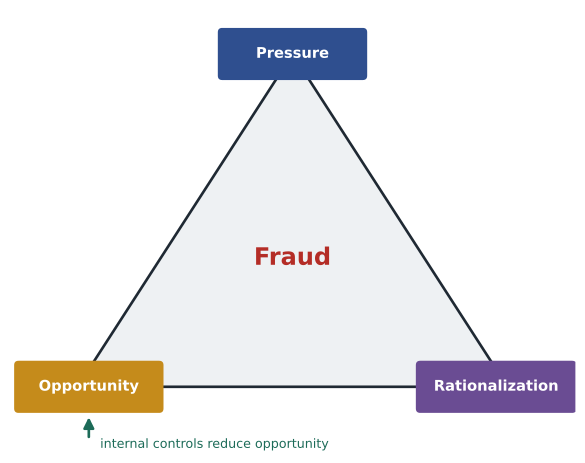
The fraud triangle, developed from the work of criminologist Donald Cressey, explains why fraud happens: a person feels pressure (financial trouble, targets to meet), sees an opportunity (weak controls), and rationalizes the act ('I'll pay it back'). Internal control attacks the opportunity side. Surveys by the Association of Certified Fraud Examiners consistently find that tips from employees, customers and suppliers detect more frauds than any other method, which is why many organizations set up confidential reporting lines.
Controls over cash receipts and payments
For cash receipts, the goal is to record every receipt and deposit it intact. Customers should receive a receipt from a register or point-of-sale system that records the sale; registers are counted against their records at shift end by someone other than the cashier; mail and electronic receipts are listed by one person and recorded by another; and deposits are made daily. Card and electronic payments reduce the risks of handling notes and coins but introduce others, such as refunds processed to an employee's own card, so refunds should require a supervisor's approval.
For cash payments, the goal is to make sure every payment is authorized, for goods or services actually received, and recorded. Payments are made by ACH transfer or check rather than in cash, except small petty cash amounts. A voucher system matches the purchase order, the receiving report and the supplier's invoice before payment is approved (a three-way match). The person who approves payment should not be the person who records it or the one who reconciles the bank. Online banking should require two people to release large payments, and many businesses use the bank's positive pay service, which rejects checks that do not match the business's list of issued checks. Common electronic methods in the US include ACH transfers, wires and services such as Zelle.
Reporting cash
On the balance sheet, cash includes currency, coins, balances in bank accounts and amounts in transit from card processors. Cash equivalents are short-term, highly liquid investments that are readily convertible to known amounts of cash and subject to an insignificant risk of changes in value, generally with maturities of three months or less from the date acquired: treasury bills, money market funds and short-term deposits. Cash and cash equivalents are usually reported as one line. Bank overdrafts that are repayable on demand and form part of cash management may be netted against cash under IFRS and ASPE; otherwise they are reported as liabilities. Cash that is restricted, such as a deposit held as security, is reported separately.
The bank reconciliation
The bank statement and the business's Cash account record the same cash, but rarely show the same balance on a given day. Timing differences arise because the business records some items before the bank does, and the bank records some items before the business knows about them. Errors can also occur on either side. A bank reconciliation explains the difference and identifies entries the business must make. It is one of the most effective controls a small business has, and should be done monthly by someone who does not record cash receipts or payments.
| Adjust the bank balance for | Adjust the book (ledger) balance for |
|---|---|
| Deposits in transit: recorded by the business, not yet by the bank (add) | Collections by the bank not yet recorded, such as an electronic customer payment or interest earned (add) |
| Outstanding checks: issued and recorded, not yet cashed (deduct) | Bank service charges and NSF checks returned unpaid (deduct) |
| Bank errors (add or deduct) | Errors in the business's records (add or deduct) |
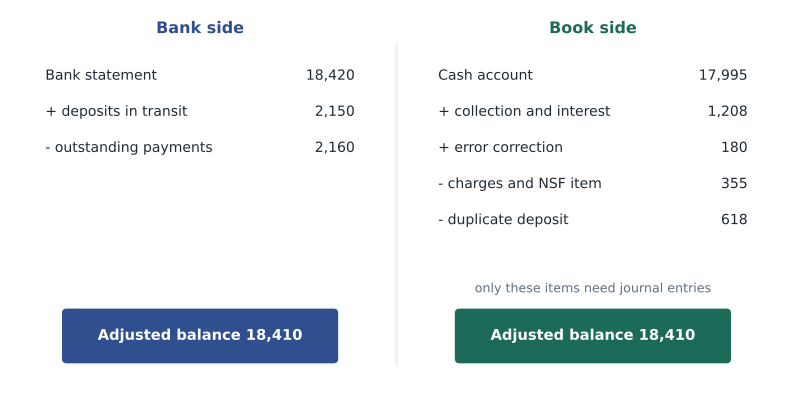
Only the items on the book side require journal entries, because they are things the business has not yet recorded. Items on the bank side will clear on their own when the bank catches up; bank errors are reported to the bank.
Worked problem
Birchwood Bikes reconciles June
The 30 June bank statement shows $18,420. The Cash account shows $17,995. Deposits in transit total $2,150. Outstanding checks are #104 for $1,300 and #107 for $860. The statement shows a $45 service charge, an NSF check of $310 from a customer, an ACH payment of $1,200 from the courier company for the May repairs, and $8 of interest. The bookkeeper recorded check #105 for supplies as $530; the bank correctly paid $350.
Show solution
- Bank side: 18,420 + 2,150 − 1,300 − 860 = $18,410.
- Book side: 17,995 + 1,200 (collection) + 8 (interest) − 45 (service charge) − 310 (NSF) + 180 (error: 530 − 350 overstated the payment) = $19,028.
- The sides do not agree: 18,410 versus 19,028, a difference of $618. Recheck the data. Suppose the bookkeeper finds that a $618 cash sale deposited on 29 June was recorded in the ledger twice.
- Book side corrected: 19,028 − 618 = $18,410. Both sides now agree.
- Journal entries are needed for every book-side item: the collection, interest, service charge, NSF item, the 180 error correction and the 618 duplicate.
Answer: Adjusted cash balance is $18,410; record six book-side entries.
# Bank reconciliation for June (illustrative)
bank = 18420
deposits_in_transit = [2150]
outstanding = [1300, 860]
book = 17995
book_adjustments = {
    "Collection by bank (courier)": 1200,
    "Interest earned": 8,
    "Service charge": -45,
    "NSF customer payment": -310,
    "Error: payment recorded 530, actual 350": 180,
    "Duplicate deposit entry": -618,
}
adj_bank = bank + sum(deposits_in_transit) - sum(outstanding)
adj_book = book + sum(book_adjustments.values())
print(f"Adjusted bank balance {adj_bank:,}")
print(f"Adjusted book balance {adj_book:,}")
print("Reconciled" if adj_bank == adj_book else f"Difference {adj_bank - adj_book:,}")
print("Entries needed:")
for item, amt in book_adjustments.items():
print(f" {'Dr Cash' if amt > 0 else 'Cr Cash'} {abs(amt):>5,} {item}")Adjusted bank balance 18,410 Adjusted book balance 18,410 Reconciled Entries needed: Dr Cash 1,200 Collection by bank (courier) Dr Cash 8 Interest earned Cr Cash 45 Service charge Cr Cash 310 NSF customer payment Dr Cash 180 Error: payment recorded 530, actual 350 Cr Cash 618 Duplicate deposit entry
| Entry | Debit | Credit |
|---|---|---|
| Cash / Accounts receivable (courier payment) | 1,200 | 1,200 |
| Cash / Interest revenue | 8 | 8 |
| Bank charges expense / Cash | 45 | 45 |
| Accounts receivable / Cash (NSF check: customer still owes) | 310 | 310 |
| Cash / Supplies (correct overstated payment) | 180 | 180 |
| Sales revenue / Cash (remove duplicate) | 618 | 618 |
Look at the NSF (not sufficient funds) entry: the customer's payment bounced, so the receivable is reinstated and the business tries to collect again. Note also that the courier's payment clears the receivable that was accrued in May (lesson 6); no revenue is recorded now.
Petty cash
Small payments such as postage, a courier fee or coffee for a customer event are impractical to pay electronically. A petty cash fund is a small amount of cash, often $100 to $500, kept in a locked box under the responsibility of one custodian. When the fund is set up, Cash is credited and Petty cash debited. Payments are made from the box in exchange for signed receipts. When the fund runs low, and always at period end, it is replenished: the receipts are totaled, expenses are debited, and a payment to the custodian brings the fund back to its set amount. The Petty cash account itself changes only when the fund size is changed. Any shortage or overage is recorded in a Cash over and short account.
Worked problem
Replenishing petty cash
Birchwood set up a $200 petty cash fund. At the end of June the box contains $41.50 and receipts for postage $38.00, delivery $65.00 and cleaning supplies $54.00.
Show solution
- Receipts total 38 + 65 + 54 = $157.00.
- Cash needed to restore the fund = 200 − 41.50 = $158.50. The extra $1.50 is a shortage.
- Entry: debit Postage expense 38.00; debit Delivery expense 65.00; debit Supplies 54.00; debit Cash over and short 1.50; credit Cash 158.50.
- Petty cash remains at $200 in the ledger.
Answer: Replenish with $158.50; record $1.50 short.
Common mistakes
MistakeRecording journal entries for deposits in transit and outstanding payments.
InsteadThose are bank-side timing differences that clear on their own; only book-side items need entries.
MistakeLetting the person who records cash also reconcile the bank account.
InsteadReconciliation is an independent check and should be done by someone who does not handle or record cash.
MistakeDebiting Petty cash each time the fund is replenished.
InsteadReplenishment debits the expenses; Petty cash changes only when the fund size changes.
MistakeWriting off an NSF check as an expense immediately.
InsteadReinstate the receivable; write it off only if it proves uncollectible (lesson 11).
MistakeIncluding a 12-month term deposit in cash equivalents.
InsteadCash equivalents generally have maturities of three months or less from acquisition.
Summary and key terms
- Internal control provides reasonable assurance about operations, reporting and compliance; COSO lists five components.
- Key control activities: establish responsibility, segregate duties, document, physical and digital controls, independent checks, HR controls.
- The fraud triangle: pressure, opportunity, rationalization; controls reduce opportunity.
- Cash and cash equivalents include short-term, highly liquid investments with maturities of three months or less.
- A bank reconciliation adjusts the bank balance for timing items and bank errors and the book balance for unrecorded items and book errors.
- Only book-side reconciling items require journal entries.
- Petty cash is replenished by debiting expenses; the Petty cash account changes only when the fund size changes.
- Internal control
- Processes that provide reasonable assurance about effective operations, reliable reporting and compliance.
- Segregation of duties
- Dividing responsibilities so no one person controls all phases of a transaction.
- Fraud triangle
- A model explaining fraud through pressure, opportunity and rationalization.
- Cash equivalents
- Short-term, highly liquid investments readily convertible to known amounts of cash with insignificant risk of value change.
- Bank reconciliation
- A schedule explaining the difference between the bank statement balance and the book balance of cash.
- Deposit in transit
- A deposit recorded by the business but not yet by the bank.
- Outstanding payment
- A check issued and recorded by the business but not yet paid by the bank.
- NSF payment
- A customer payment returned unpaid because of not sufficient funds.
- Petty cash fund
- A small amount of cash kept on hand for minor payments, under one custodian.
- Three-way match
- Matching the purchase order, receiving report and supplier invoice before approving payment.
Practice problems
Work each problem on paper first, then reveal the answer to check.
Name the five components of the COSO framework.
Show answer
Control environment, risk assessment, control activities, information and communication, monitoring.
Why should the person who opens the mail not also record receipts?
Show answer
Combining them would let one person steal a payment and hide it in the records.
Bank balance $9,600; deposits in transit $1,400; outstanding payments $2,250. Find the adjusted bank balance.
Show answer
$8,750.
Book balance $8,920; service charge $30; NSF item $140. Find the adjusted book balance.
Show answer
$8,750.
Which items in the previous two questions need journal entries?
Show answer
The service charge and the NSF item.
A payment of $480 was recorded as $840. Is the book balance overstated or understated, and by how much?
Show answer
Understated by $360; add 360 on the book side.
A $150 petty cash fund has $22 left and receipts of $125. Record replenishment.
Show answer
Debit expenses 125, debit Cash over and short 3, credit Cash 128.
Is a 60-day treasury bill a cash equivalent? A 9-month term deposit?
Show answer
Yes; no.
Give one control that a two-person business can use when duties cannot be fully segregated.
Show answer
The owner reviews the bank statement and approves all payments personally.
In the reconciliation program, remove the duplicate-deposit adjustment. What does the program report?
Show answer
A difference of $618, signaling an unexplained item to investigate.
Lesson quiz · 5 questions
Score 60% or more to complete this lesson.
Create a free account to save your progress, take quizzes and earn a certificate.