
ACCT-101 · Lesson 7 of 12 · 26 min
Completing the cycle: financial statements and closing entries
With the adjusted trial balance in hand, the accountant can prepare the financial statements and then close the books for the period. This lesson prepares Birchwood Bikes' May income statement, statement of changes in equity and classified balance sheet; explains how a worksheet organizes the work; shows the closing entries that reset revenue, expense and dividend accounts to zero; and prepares the post-closing trial balance. It ends by putting the whole accounting cycle together. The statement of cash flows, the fourth statement, is prepared in lesson 12 because it needs comparative balance sheets.
The order of preparation
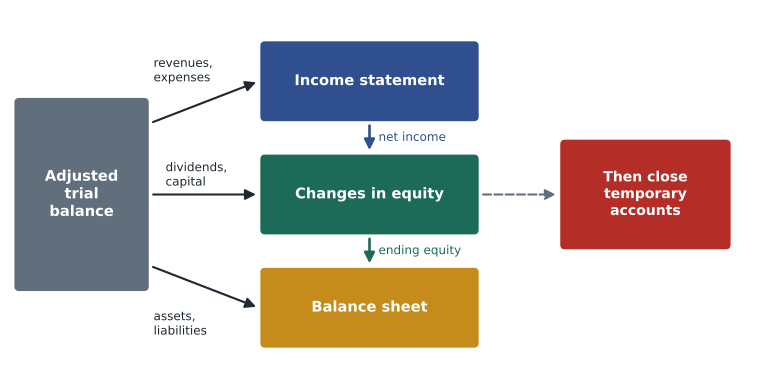
The statements are prepared in a set order because each feeds the next. The income statement comes first, because its net income is needed for the statement of changes in equity. That statement comes second, because its ending retained earnings are needed for the balance sheet. The balance sheet comes third. The cash flow statement uses information from all three.
The income statement
The income statement lists revenues and expenses for the period and reports net income or net loss. For a service business like Birchwood Bikes in May, a single-step format, which lists all revenues and then all expenses, is clear. Merchandising businesses usually use a multiple-step format that shows gross profit first (lesson 8). Under IFRS the statement may be titled the statement of profit or loss; under ASPE and US GAAP, income statement or statement of operations are common. Expenses may be classified by nature (wages, rent, depreciation) or by function (cost of sales, selling, administrative); small businesses usually present by nature.
| Birchwood Bikes Inc. | ||
|---|---|---|
| Revenue | ||
| Service revenue | $8,200 | |
| Expenses | ||
| Wages expense | $3,520 | |
| Rent expense | 2,000 | |
| Supplies expense | 600 | |
| Utilities expense | 350 | |
| Insurance expense | 300 | |
| Depreciation expense | 300 | |
| Interest expense | 100 | |
| Total expenses | 7,170 | |
| Net income | $1,030 |
The statement of changes in equity
The statement of stockholders' equity shows each component of equity at the start of the period, the changes during the period, and the balance at the end. Many small companies present a simpler statement of retained earnings, with changes in contributed capital disclosed in the notes. A sole proprietorship prepares a statement of owner's equity: opening capital, plus investments and net income, less withdrawals, equals ending capital.
| Common stock | Retained earnings | Total equity | |
|---|---|---|---|
| Balance, 1 May | $0 | $0 | $0 |
| Shares issued | 40,000 | 40,000 | |
| Net income | 1,030 | 1,030 | |
| Dividends | (500) | (500) | |
| Balance, 31 May | $40,000 | $530 | $40,530 |
The classified balance sheet
A classified balance sheet groups assets and liabilities into current and non-current categories, which helps users judge liquidity. Current assets are cash and other assets expected to be converted to cash, sold or used up within one year or the operating cycle, whichever is longer: receivables, inventory, supplies, prepaid expenses and short-term investments. Non-current assets include property, plant and equipment, intangible assets and long-term investments. Current liabilities are obligations due within one year: accounts payable, wages payable, interest payable, unearned revenue, sales taxes payable and the current portion of long-term debt. Non-current liabilities include long-term loans, bonds and lease obligations due after more than a year.
| Assets | Liabilities and equity | |||
|---|---|---|---|---|
| Current assets | Current liabilities | |||
| Cash | $37,800 | Accounts payable | $850 | |
| Accounts receivable | 2,200 | Wages payable | 420 | |
| Supplies | 900 | Interest payable | 100 | |
| Prepaid insurance | 3,300 | Total current liabilities | 1,370 | |
| Total current assets | 44,200 | Non-current liabilities | ||
| Property, plant and equipment | Note payable, due in three years | 20,000 | ||
| Equipment | $18,000 | Total liabilities | 21,370 | |
| Less accumulated depreciation | (300) | 17,700 | Common stock | 40,000 |
| Retained earnings | 530 | |||
| Total equity | 40,530 | |||
| Total assets | $61,900 | Total liabilities and equity | $61,900 |
US companies almost always list current assets first and liabilities before stockholders' equity, in order of liquidity. Companies reporting under IFRS, including many Canadian and European companies, sometimes list non-current assets first and equity before liabilities. The content is the same; only the order changes.
Two quick measures come straight from the classified balance sheet. Working capital is current assets minus current liabilities: $44,200 − $1,370 = $42,830. The current ratio is current assets divided by current liabilities: 44,200 ÷ 1,370 ≈ 32.3. A ratio that high is typical of a business that has just raised cash and not yet spent it; most established businesses have current ratios between about 1 and 3. Lesson 12 interprets ratios properly.
The worksheet
Before software, accountants used a worksheet, a large spreadsheet with columns for the unadjusted trial balance, adjustments, adjusted trial balance, income statement and balance sheet, to organize end-of-period work and catch errors before entries were journalized. Accountants still build worksheets in spreadsheet software for complex closes, for year-end working papers, and when they need to test proposed adjustments before posting them. The worksheet is a tool, not a statement; adjustments shown on it must still be journalized and posted.
Closing entries
Revenue, expense and dividend accounts are temporary accounts. They collect amounts for one period only, so that the income statement shows that period's results. At the end of the period their balances are transferred to retained earnings and they are reset to zero, ready to start the next period. Asset, liability and equity accounts other than dividends are permanent accounts; their balances carry forward. The entries that transfer temporary balances are closing entries.
Closing is often done in four steps through a temporary Income summary account, which makes the net income figure visible in the ledger. Step 1: debit each revenue account and credit Income summary for total revenues. Step 2: debit Income summary for total expenses and credit each expense account. Income summary now has a credit balance equal to net income. Step 3: debit Income summary and credit Retained earnings for net income (reverse for a loss). Step 4: debit Retained earnings and credit Dividends. Many businesses, and accounting software, close revenues and expenses directly to retained earnings without an Income summary account; the result is identical.
| Step | Entry | Debit | Credit |
|---|---|---|---|
| 1 | Service revenue / Income summary | 8,200 | 8,200 |
| 2 | Income summary / each expense account | 7,170 | 7,170 |
| 3 | Income summary / Retained earnings | 1,030 | 1,030 |
| 4 | Retained earnings / Dividends | 500 | 500 |
For a sole proprietorship, steps 3 and 4 close Income summary and the owner's Withdrawals account to the owner's Capital account instead of Retained earnings. For a partnership, net income is divided among the partners' capital accounts according to their agreement.
# Closing entries and the post-closing trial balance (illustrative)
adjusted = {"Cash": 37800, "Accounts receivable": 2200, "Supplies": 900,
            "Prepaid insurance": 3300, "Equipment": 18000,
            "Accumulated depreciation": -300,      # credit balance shown negative
            "Accounts payable": -850, "Wages payable": -420,
            "Interest payable": -100, "Note payable": -20000,
            "Share capital": -40000, "Retained earnings": 0,
            "Dividends": 500, "Service revenue": -8200,
            "Rent expense": 2000, "Wages expense": 3520,
            "Utilities expense": 350, "Insurance expense": 300,
            "Supplies expense": 600, "Depreciation expense": 300,
            "Interest expense": 100}
temporary = [k for k in adjusted if "revenue" in k or "expense" in k]

income_summary = 0
for acct in temporary:                # steps 1 and 2
    income_summary += adjusted[acct]  # revenues are negative (credits)
    adjusted[acct] = 0
net_income = -income_summary
adjusted["Retained earnings"] -= net_income          # step 3 (credit RE)
adjusted["Retained earnings"] += adjusted["Dividends"]  # step 4 (debit RE)
adjusted["Dividends"] = 0

print("Net income closed:", net_income)
post = {k: v for k, v in adjusted.items() if v != 0}
for k, v in post.items():
    print(f"{k:<26}{v if v > 0 else '':>8}{-v if v < 0 else '':>8}")
print("Debits", sum(v for v in post.values() if v > 0),
"Credits", -sum(v for v in post.values() if v < 0))Net income closed: 1030 Cash 37800 Accounts receivable 2200 Supplies 900 Prepaid insurance 3300 Equipment 18000 Accumulated depreciation 300 Accounts payable 850 Wages payable 420 Interest payable 100 Note payable 20000 Share capital 40000 Retained earnings 530 Debits 62200 Credits 62200
The post-closing trial balance
After closing, a post-closing trial balance lists only permanent accounts. It confirms that the ledger is in balance at the start of the new period and that every temporary account is zero. For Birchwood Bikes, debits and credits each total $62,200: total assets of $61,900 plus the $300 of accumulated depreciation, which appears on the credit side rather than as a deduction. Retained earnings now shows $530, matching the statement of changes in equity.
| Account | Debit | Credit |
|---|---|---|
| Cash | 37,800 | |
| Accounts receivable | 2,200 | |
| Supplies | 900 | |
| Prepaid insurance | 3,300 | |
| Equipment | 18,000 | |
| Accumulated depreciation | 300 | |
| Accounts payable | 850 | |
| Wages payable | 420 | |
| Interest payable | 100 | |
| Note payable | 20,000 | |
| Common stock | 40,000 | |
| Retained earnings | 530 | |
| Totals | 62,200 | 62,200 |
The accounting cycle
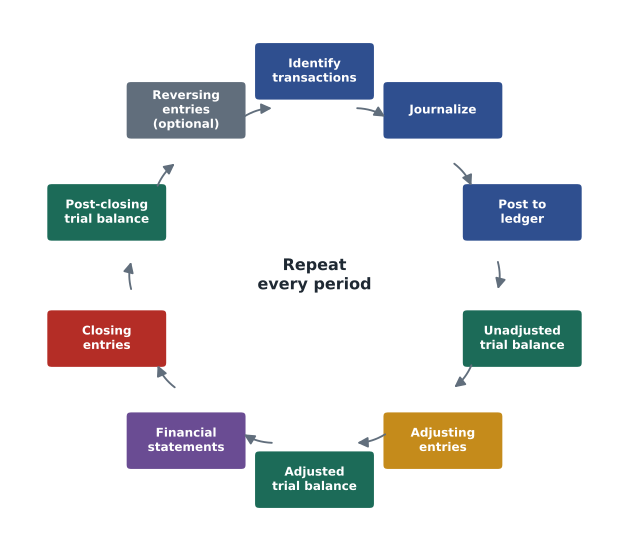
The steps covered in lessons 2 to 7 make up the accounting cycle, repeated every period: analyze transactions from source documents; journalize; post to the ledger; prepare an unadjusted trial balance; journalize and post adjusting entries; prepare an adjusted trial balance; prepare the financial statements; journalize and post closing entries; prepare a post-closing trial balance; and, optionally, record reversing entries at the start of the next period. Most businesses close monthly for management reporting and formally once a year, when the books are locked and, for many, audited or reviewed.
Worked problem
Closing for a net loss
At year end a business has revenues of $64,000, expenses of $71,500 and dividends of $2,000. Opening retained earnings were $18,000. Give the closing entries and ending retained earnings.
Show solution
- Step 1: debit Revenues 64,000; credit Income summary 64,000.
- Step 2: debit Income summary 71,500; credit Expenses 71,500. Income summary now has a debit balance of 7,500, a net loss.
- Step 3: debit Retained earnings 7,500; credit Income summary 7,500.
- Step 4: debit Retained earnings 2,000; credit Dividends 2,000.
- Ending retained earnings = 18,000 − 7,500 − 2,000 = $8,500.
Answer: Ending retained earnings are $8,500.
Worked problem
Classifying debt
A business has a $60,000 bank loan repayable in equal annual installments of $12,000, the next due in eight months. How is it presented?
Show solution
- The $12,000 due within a year is a current liability, the current portion of long-term debt.
- The remaining $48,000 is a non-current liability.
- Interest accrued to the balance sheet date is a separate current liability.
Answer: Current liabilities $12,000; non-current liabilities $48,000.
Common mistakes
MistakePreparing the balance sheet before the statement of changes in equity.
InsteadEnding retained earnings come from the equity statement, which needs net income from the income statement.
MistakeShowing dividends as an expense on the income statement.
InsteadDividends appear on the statement of changes in equity as a reduction of retained earnings.
MistakeClosing asset or liability accounts.
InsteadOnly temporary accounts (revenues, expenses, dividends, Income summary) are closed; permanent accounts carry forward.
MistakeClassifying the whole of a long-term loan as non-current.
InsteadThe portion due within a year is current.
MistakeExpecting the post-closing trial balance total to equal total assets.
InsteadContra accounts such as accumulated depreciation appear on the credit side, so the total can differ.
Summary and key terms
- Prepare statements in order: income statement, statement of changes in equity, balance sheet.
- A classified balance sheet separates current and non-current assets and liabilities.
- Working capital = current assets − current liabilities; current ratio = current assets ÷ current liabilities.
- Revenues, expenses and dividends are temporary accounts closed to retained earnings each period.
- Closing can use an Income summary account or go directly to retained earnings; results are the same.
- The post-closing trial balance contains only permanent accounts.
- The accounting cycle runs from transaction analysis to the post-closing trial balance and repeats every period.
- Income statement
- A statement of revenues, expenses and net income or loss for a period.
- Statement of changes in equity
- A statement showing changes in each component of equity for a period.
- Classified balance sheet
- A balance sheet that groups assets and liabilities into current and non-current categories.
- Current asset
- An asset expected to be converted to cash, sold or used within one year or the operating cycle.
- Current liability
- An obligation due within one year or the operating cycle.
- Working capital
- Current assets minus current liabilities.
- Temporary account
- A revenue, expense or dividend account that is closed at the end of each period.
- Permanent account
- An asset, liability or equity account whose balance carries forward.
- Closing entries
- Entries that transfer temporary account balances to retained earnings and reset them to zero.
- Post-closing trial balance
- A trial balance of permanent accounts prepared after closing.
Practice problems
Work each problem on paper first, then reveal the answer to check.
Revenues are $95,000, expenses $81,000 and dividends $6,000; opening retained earnings $30,000. Find ending retained earnings.
Show answer
30,000 + 14,000 − 6,000 = $38,000.
Which accounts appear on a post-closing trial balance?
Show answer
Assets, contra assets, liabilities, share capital and retained earnings.
Classify: unearned revenue; equipment; current portion of a mortgage; prepaid rent; long-term investment.
Show answer
Current liability; non-current asset; current liability; current asset; non-current asset.
Current assets are $84,000 and current liabilities $56,000. Find working capital and the current ratio.
Show answer
Working capital $28,000; current ratio 1.5.
Write the four closing entries for a business with revenue $12,000, expenses $9,500 and dividends $1,000.
Show answer
Dr Revenue 12,000 / Cr Income summary 12,000; Dr Income summary 9,500 / Cr Expenses 9,500; Dr Income summary 2,500 / Cr Retained earnings 2,500; Dr Retained earnings 1,000 / Cr Dividends 1,000.
Why are revenue accounts closed but not cash?
Show answer
Revenue measures one period's performance; cash is a resource that carries forward.
How does closing differ for a sole proprietorship?
Show answer
Income summary and drawings are closed to the owner's capital account.
What does a worksheet help an accountant do?
Show answer
Organize the trial balance, adjustments and statements and catch errors before journalizing.
List the steps of the accounting cycle in order.
Show answer
Analyze, journalize, post, unadjusted trial balance, adjust, adjusted trial balance, statements, close, post-closing trial balance, (reverse).
In the Python program, change dividends to 1,500. What is ending retained earnings?
Show answer
1,030 − 1,500 = −470, a deficit of $470.
Lesson quiz · 5 questions
Score 60% or more to complete this lesson.
Create a free account to save your progress, take quizzes and earn a certificate.