
ACCT-101 · Lesson 12 of 12 · 25 min
Cash flows, financial statement analysis and capstone: a full accounting cycle
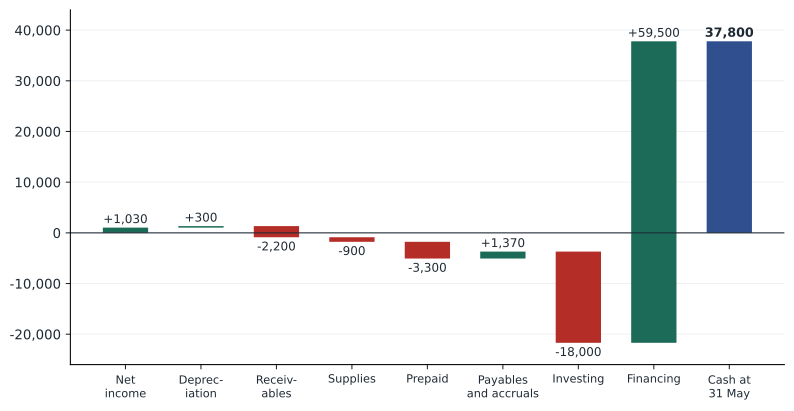
This final lesson completes the set of financial statements with the statement of cash flows, shows how users analyze statements with ratios, and closes the course with a capstone that takes a new small business through a complete accounting cycle. The cash flow statement matters because profit and cash are different things: Birchwood Bikes earned $1,030 of net income in May, yet its operating activities used cash. Ratios matter because a single number, such as $21,500 of profit, means little until it is compared with something: sales, assets, last year, or a competitor.
The statement of cash flows
The statement of cash flows reports cash receipts and payments for a period, classified into three activities. Operating activities are the principal revenue-producing activities: cash from customers, cash paid to suppliers and employees, and other cash flows that are not investing or financing. Investing activities are the purchase and sale of long-term assets and investments not held as cash equivalents: buying equipment, selling a building, making a loan to another business. Financing activities change the size and composition of equity and borrowings: issuing shares, borrowing and repaying loans, and paying dividends.
Under US GAAP, interest paid and received and dividends received are operating activities, and dividends paid are financing activities. Under IFRS, which you will see in Canadian and international statements, companies have some choice about classifying interest and dividends. This course classifies interest paid as operating and dividends paid as financing.
Operating cash flow can be presented by the direct method, which lists the main classes of operating receipts and payments, or by the indirect method, which starts with net income and adjusts it for non-cash items and for changes in working capital. Standards encourage the direct method, but most companies use the indirect method, and it is the one that shows most clearly why profit and cash differ.
The indirect method
Start with net income. Add back expenses that did not use cash, chiefly depreciation and amortization, and remove gains or add losses on the sale of long-term assets (their cash effect belongs in investing). Then adjust for changes in current operating assets and liabilities. An increase in a current asset such as receivables, inventory or prepaid expenses means cash was tied up, so it is subtracted; a decrease is added. An increase in a current liability such as accounts payable, wages payable or unearned revenue means cash was conserved, so it is added; a decrease is subtracted.
| Change during the period | Adjustment to net income |
|---|---|
| Depreciation and amortization | Add |
| Loss on sale of equipment | Add |
| Gain on sale of equipment | Subtract |
| Increase in accounts receivable, inventory or prepaid expenses | Subtract |
| Decrease in accounts receivable, inventory or prepaid expenses | Add |
| Increase in accounts payable, accrued liabilities or unearned revenue | Add |
| Decrease in accounts payable, accrued liabilities or unearned revenue | Subtract |
# Statement of cash flows for Birchwood Bikes, May (indirect method)
net_income = 1030
noncash = {"Depreciation": 300}
opening = {"Accounts receivable": 0, "Supplies": 0, "Prepaid insurance": 0,
           "Accounts payable": 0, "Wages payable": 0, "Interest payable": 0}
closing = {"Accounts receivable": 2200, "Supplies": 900, "Prepaid insurance": 3300,
           "Accounts payable": 850, "Wages payable": 420, "Interest payable": 100}
current_assets = {"Accounts receivable", "Supplies", "Prepaid insurance"}

operating = net_income + sum(noncash.values())
lines = [("Net income", net_income)] + list(noncash.items())
for k in closing:
    change = closing[k] - opening[k]
    adj = -change if k in current_assets else change
    operating += adj
    lines.append((f"Change in {k.lower()}", adj))
investing = -18000                                  # equipment purchased
financing = 40000 + 20000 - 500                     # shares, note, dividends
for name, amt in lines:
    print(f"  {name:<34}{amt:>8,}")
print(f"Cash from operating activities    {operating:>8,}")
print(f"Cash from investing activities    {investing:>8,}")
print(f"Cash from financing activities    {financing:>8,}")
print(f"Net change in cash {operating + investing + financing:>8,}")Net income 1,030 Depreciation 300 Change in accounts receivable -2,200 Change in supplies -900 Change in prepaid insurance -3,300 Change in accounts payable 850 Change in wages payable 420 Change in interest payable 100 Cash from operating activities -3,700 Cash from investing activities -18,000 Cash from financing activities 59,500 Net change in cash 37,800
Birchwood's operating activities used $3,700 of cash in May even though net income was $1,030. The main reasons are that it paid a year of insurance in advance ($3,300 still prepaid), bought supplies it had not yet used, and had not yet collected $2,200 of revenue. Those are normal start-up effects, but a business that grows quickly can run out of cash for exactly these reasons while reporting profits. Investing used $18,000 for equipment, and financing provided $59,500. The net increase in cash of $37,800 equals the cash balance on the 31 May balance sheet, since the business started with none.
| Birchwood Bikes Inc., month ended 31 May | ||
|---|---|---|
| Operating activities | ||
| Net income | $1,030 | |
| Depreciation | 300 | |
| Increase in accounts receivable | (2,200) | |
| Increase in supplies | (900) | |
| Increase in prepaid insurance | (3,300) | |
| Increase in accounts payable | 850 | |
| Increase in wages payable | 420 | |
| Increase in interest payable | 100 | |
| Net cash used by operating activities | $(3,700) | |
| Investing activities: purchase of equipment | (18,000) | |
| Financing activities | ||
| Issue of common stock | 40,000 | |
| Bank loan | 20,000 | |
| Dividends paid | (500) | |
| Net cash provided by financing activities | 59,500 | |
| Net increase in cash | 37,800 | |
| Cash, 1 May | 0 | |
| Cash, 31 May | $37,800 |
As a check, the direct method gives the same operating total: cash received from customers $6,000 ($4,200 + $1,800), less cash paid to suppliers $1,000, for insurance $3,600, and for rent and wages $5,100, equals −$3,700. Significant non-cash investing and financing activities, such as buying equipment by issuing a note, are not in the statement but are disclosed in the notes.
Analyzing financial statements
Analysts compare a company's figures over time (horizontal or trend analysis), express each item as a percentage of a base such as sales or total assets (vertical or common-size analysis), and compute ratios that link related figures. Ratios are grouped by the question they answer: liquidity (can the business pay its short-term obligations?), activity or efficiency (how well does it use its assets?), profitability (how much does it earn?) and solvency (can it survive in the long run and service its debt?). A ratio is only meaningful in context: compared with the business's own history, with budgets, or with similar businesses.
Here are Birchwood's illustrative results for its first eight months, to 31 December. Because this is the first year, the ratios use year-end balances instead of averages; with two years of data, average balances should be used for turnover and return ratios.
| Item | Amount | Item | Amount |
|---|---|---|---|
| Net sales (merchandise) | $190,000 | Cash | $14,400 |
| Service revenue | 58,000 | Accounts receivable (net) | 14,600 |
| Cost of goods sold | 112,000 | Inventory | 31,800 |
| Operating expenses | 108,400 | Prepaid expenses and supplies | 4,000 |
| Interest expense | 1,200 | Equipment (net) | 36,200 |
| Income tax expense | 4,900 | Total assets | 101,000 |
| Net income | 21,500 | Current liabilities | 28,000 |
| Dividends | 4,500 | Long-term note payable | 16,000 |
| Total equity | 57,000 |
# Key ratios for Birchwood Bikes at 31 December (illustrative, year-end balances)
f = dict(sales=190000, service=58000, cogs=112000, net_income=21500,
         cash=14400, ar=14600, inventory=31800, other_ca=4000,
         total_assets=101000, current_liab=28000, total_liab=44000,
         equity=57000)
revenue = f["sales"] + f["service"]
current_assets = f["cash"] + f["ar"] + f["inventory"] + f["other_ca"]
ratios = {
    "Current ratio": current_assets / f["current_liab"],
    "Quick ratio": (f["cash"] + f["ar"]) / f["current_liab"],
    "Receivables turnover (all revenue on credit)": revenue / f["ar"],
    "Days sales outstanding": 365 / (revenue / f["ar"]),
    "Inventory turnover": f["cogs"] / f["inventory"],
    "Days in inventory": 365 / (f["cogs"] / f["inventory"]),
    "Gross margin on merchandise": (f["sales"] - f["cogs"]) / f["sales"],
    "Net profit margin": f["net_income"] / revenue,
    "Return on assets": f["net_income"] / f["total_assets"],
    "Debt-to-equity": f["total_liab"] / f["equity"],
}
pct = {"Gross margin on merchandise", "Net profit margin", "Return on assets"}
for name, v in ratios.items():
print(f"{name:<46}{v:>8.1%}" if name in pct else f"{name:<46}{v:>8.2f}")Current ratio 2.31 Quick ratio 1.04 Receivables turnover (all revenue on credit) 16.99 Days sales outstanding 21.49 Inventory turnover 3.52 Days in inventory 103.63 Gross margin on merchandise 41.1% Net profit margin 8.7% Return on assets 21.3% Debt-to-equity 0.77
| Ratio | Formula | Birchwood | What it says |
|---|---|---|---|
| Current ratio | Current assets ÷ current liabilities | 2.31 | Comfortable short-term coverage |
| Quick ratio | (Cash + short-term investments + receivables) ÷ current liabilities | 1.04 | Can meet current liabilities without selling inventory |
| Days sales outstanding | 365 ÷ receivables turnover | 21.5 days | Customers pay well within 30-day terms |
| Inventory turnover | COGS ÷ inventory | 3.52 times | Stock sits about 104 days; seasonal for a bicycle shop |
| Gross margin | Gross profit ÷ net sales | 41.1 % | Pricing covers merchandise cost well |
| Net profit margin | Net income ÷ revenue | 8.7 % | Healthy for a small retailer |
| Return on assets | Net income ÷ total assets | 21.3 % | High, partly because assets are new and modest |
| Debt-to-equity | Total liabilities ÷ total equity | 0.77 | Moderate use of borrowing |
The ratios tell a reasonable story: Birchwood is liquid, collects promptly, prices well and is profitable. The weak spot is inventory: 104 days of stock is a lot of cash tied up, which matters for a business that must also pay for spring stock in late winter. A lender reviewing these figures would likely ask about seasonal cash needs and might offer a line of credit secured on receivables and inventory. Ratios also have limits: they depend on accounting choices such as inventory method and depreciation estimates, a single year can be unusual, and year-end figures may not represent the rest of the year.
Capstone: a full accounting cycle
Lakeshore Paddle Co. is a new corporation in a lakeside town in a state with an illustrative combined sales tax rate of 7 %. It rents and sells kayaks. The following is a compact version of the cycle you have practiced; the full capstone exercise in the practice section asks you to prepare every schedule yourself.
Worked problem
Lakeshore Paddle Co., June
Transactions: (1) owners invest $30,000 for shares; (2) buy 10 kayaks for resale at $900 each on account, using a resale certificate; (3) buy rental kayaks (equipment) for $12,000 plus $840 sales tax, paying cash; (4) rent kayaks for $5,000 plus 7 % tax, cash; (5) sell 6 kayaks at $1,400 plus 7 % tax, cash; (6) pay June wages $2,600 and dock rent $1,500; (7) pay the supplier for the resale kayaks. Adjustments at 30 June: depreciation $200; wages accrued $300. Kayaks are costed FIFO; all were bought at the same price.
Show solution
- Revenue: rentals 5,000 + kayak sales 8,400 = 13,400. Sales tax collected = 7 % × 13,400 = 938, a liability.
- Equipment cost includes the tax paid as final consumer: 12,000 + 840 = 12,840. No tax on resale kayaks.
- COGS = 6 × 900 = 5,400; inventory left 4 × 900 = 3,600.
- Expenses: COGS 5,400 + wages 2,900 + rent 1,500 + depreciation 200 = 10,000. Net income = 13,400 − 10,000 = 3,400.
- Cash: 30,000 − 12,840 + 5,350 + 8,988 − 4,100 − 9,000 = 18,398.
- Balance sheet: cash 18,398; inventory 3,600; equipment 12,840 less 200 = 12,640; total assets 34,638. Liabilities: sales tax payable 938 + wages payable 300 = 1,238. Equity: stock 30,000 + retained earnings 3,400 = 33,400. Total 34,638.
Answer: Net income for June is $3,400 in both versions; the balance sheets differ only in how sales tax is treated.
Work through the capstone in full by journalizing each transaction, posting to T-accounts or a spreadsheet, preparing the unadjusted trial balance, recording the two adjustments, preparing the adjusted trial balance, the income statement, the statement of changes in equity, the balance sheet and the statement of cash flows, and finally closing the books. Then compute three ratios and write two sentences on what they show. That is the whole of this course in one exercise, and it is the foundation for every accounting course that follows: ACCT-102 for managerial accounting, ACCT-211 and 212 for intermediate financial accounting, and ACCT-240 for systems and controls.
Common mistakes
MistakeAssuming profit means cash.
InsteadIncreases in receivables, inventory and prepaid expenses absorb cash; operating cash flow can be negative while net income is positive.
MistakeSubtracting depreciation in the indirect method.
InsteadDepreciation reduced net income without using cash, so it is added back.
MistakeClassifying equipment purchases as operating activities.
InsteadPurchases and sales of long-term assets are investing activities.
MistakeInterpreting a ratio in isolation.
InsteadCompare with prior periods, budgets and similar businesses, and consider accounting choices.
MistakeUsing year-end balances for turnover ratios when averages are available.
InsteadUse average balances when two balance sheets exist; year-end figures can mislead for seasonal businesses.
Summary and key terms
- The statement of cash flows classifies cash flows as operating, investing and financing.
- The indirect method adjusts net income for non-cash items and working capital changes.
- Increases in current operating assets reduce operating cash; increases in current operating liabilities increase it.
- US GAAP classifies interest paid as operating and dividends paid as financing.
- Ratio analysis covers liquidity, activity, profitability and solvency.
- Ratios need context: trends, budgets, peers and accounting choices.
- The full accounting cycle links transactions, adjustments, statements and closing into one repeatable process.
- Statement of cash flows
- A statement reporting cash receipts and payments classified by operating, investing and financing activities.
- Operating activities
- The principal revenue-producing activities and other activities that are not investing or financing.
- Investing activities
- The acquisition and disposal of long-term assets and investments not included in cash equivalents.
- Financing activities
- Activities that change the size and composition of equity and borrowings.
- Indirect method
- Presenting operating cash flow by adjusting net income for non-cash items and working capital changes.
- Direct method
- Presenting operating cash flow as major classes of gross cash receipts and payments.
- Quick ratio
- Cash, short-term investments and receivables divided by current liabilities.
- Inventory turnover
- Cost of goods sold divided by average inventory.
- Return on assets
- Net income divided by average total assets.
- Debt-to-equity ratio
- Total liabilities divided by total equity.
Practice problems
Work each problem on paper first, then reveal the answer to check.
Net income is $40,000; depreciation $8,000; receivables rose $5,000; inventory fell $3,000; payables rose $2,000. Find operating cash flow.
Show answer
40,000 + 8,000 − 5,000 + 3,000 + 2,000 = $48,000.
Classify: purchase of a delivery van; repayment of a bank loan; cash paid to suppliers; dividends paid.
Show answer
Investing; financing; operating; financing.
Equipment with a carrying amount of $7,000 is sold for $9,000. How is the gain treated in the indirect method?
Show answer
Subtract the $2,000 gain from net income; report $9,000 proceeds under investing.
Current assets $60,000 (inventory $25,000); current liabilities $40,000. Find current and quick ratios (no investments; prepaids $5,000).
Show answer
Current 1.5; quick (60,000 − 25,000 − 5,000) ÷ 40,000 = 0.75.
COGS $300,000; average inventory $60,000. Find turnover and days in inventory.
Show answer
5 times; 73 days.
Why might a growing business with high profits run short of cash?
Show answer
Growth ties up cash in receivables and inventory before customers pay.
Net income $18,000; average total assets $150,000. Find return on assets.
Show answer
12 %.
Total liabilities $90,000; total equity $60,000. Find debt-to-equity and comment.
Show answer
1.5; the business relies more on creditors than owners.
Capstone: journalize the seven Lakeshore Paddle transactions and two adjustments, then prepare all four statements.
Show answer
Net income $3,400; compare your balance sheet with the worked example for your country.
Change the Birchwood program so inventory is $24,000. What happens to inventory turnover and days in inventory?
Show answer
Turnover 4.67 times; about 78 days.
Lesson quiz · 5 questions
Score 60% or more to complete this lesson.
Create a free account to save your progress, take quizzes and earn a certificate.