
BAR-101 · Lesson 1 of 12 · 19 min
Who admits lawyers in the United States
▶ Video coming soon A video version of this lesson is on the way.
On Tuesday evening, September 8, 2026, six faces appear in small boxes on a video call. Hollis Marchetti, who has coached bar candidates for fifteen years and once graded essays for a Uniform Bar Exam jurisdiction, shares her screen and types a single question at the top of a blank page: *Who decides whether you get to practice law?* Then she waits.
Dana Whitfield, a new graduate clerking in Austin, answers first. 'The bar association?' Ngozi Adeyemi, a lawyer qualified in Nigeria who has just finished an LLM in the United States, guesses the federal government. Eddie Boudreaux, from Lafayette, says the Louisiana Supreme Court, and Camila Ortiz Rivera, from San Juan, says the same about Puerto Rico. Sofia Reyes says the State Bar of California, and Marcus Bell, who sat the brand-new NextGen bar exam in Missouri in July, says he has spent the summer learning that the answer is 'more complicated than it looks.'
Marchetti smiles. 'Eddie and Camila are closest. In almost every American jurisdiction, the power to admit lawyers belongs to the highest court. Everyone else you named plays a part, but the court holds the key. If you remember one thing from tonight, remember that there is no national law license in the United States. You are admitted in a jurisdiction, by that jurisdiction, under its rules.'
This course is the first in a program that ends with a preparation course for every state, the District of Columbia and the US territories. It explains the parts of bar admission that are shared everywhere: who sets the rules, who is eligible, how applications and character reviews work, what the MPRE, the Uniform Bar Exam and the new NextGen bar exam test, how scores are scaled and transferred, and how to plan your study. Later courses go deep on each exam and each jurisdiction.
Fifty-six jurisdictions, not one
The National Conference of Bar Examiners counts 56 jurisdictions that admit lawyers: the 50 states, the District of Columbia, and five territories (Guam, the Northern Mariana Islands, Palau, Puerto Rico and the US Virgin Islands). Palau is an independent country in free association with the United States, but its bar admission works closely with NCBE and it appears in NCBE's charts, which is why the count is 56. Each jurisdiction writes its own admission rules, decides its own exam, sets its own passing score and runs its own character and fitness review.
The consequence is practical. A license from Missouri lets Marcus practice Missouri law and appear in Missouri courts. It does not let him open an office in Illinois or represent clients in a Kansas state court. To do that, he would need to be admitted in those jurisdictions too, by transferring a score, qualifying for admission on motion after some years of practice, or passing another exam. Lawyers near state borders, in national firms and in government often hold two or three licenses.
The highest court holds the power
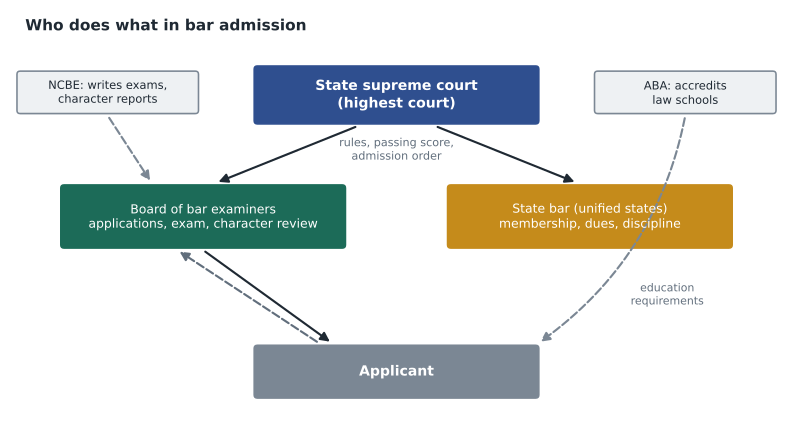
In most states the authority to regulate the practice of law comes from the state constitution and from the inherent power of the judiciary. Courts have long treated deciding who may appear before them, and who may give legal advice to the public, as part of the judicial function. The highest court therefore adopts the rules for admission, appoints the people who run the process and signs the final order admitting each new lawyer. In New York, for example, the Court of Appeals adopts the admission rules and its Board of Law Examiners runs the exam, while the Appellate Division actually admits successful applicants. In Louisiana the Supreme Court acts through its Committee on Bar Admissions.
A few jurisdictions share the power with the legislature or have unusual structures. California's Business and Professions Code gives the State Bar of California a statutory role, and the Supreme Court of California approves its admission rules and admits applicants. In the District of Columbia the Court of Appeals, the jurisdiction's highest local court, runs admission through its Committee on Admissions. But the pattern is consistent: when you read your jurisdiction's admission rules, you are usually reading court rules, and when a hard question arises, such as an appeal from a character and fitness denial, it goes to the court.
Boards of bar examiners
The day-to-day work belongs to a board or committee of bar examiners, usually appointed by the court. Names vary: Board of Law Examiners, Board of Bar Examiners, Committee of Bar Examiners, Board of Bar Admissions. Its staff takes applications, checks education, collects fees, arranges testing accommodations, runs the exam sites, grades or arranges grading of the written answers, investigates character and fitness and recommends applicants for admission.
Board members are typically experienced lawyers and sometimes judges, often with a few non-lawyer members. In many jurisdictions they write or select state-specific essay questions, approve grading guides and set or recommend the passing score, which the court then adopts. Marchetti tells the group to find their own board's website before the end of the week, bookmark its rules and its frequently asked questions, and sign up for any email updates. 'Boards change deadlines, fees and procedures more often than you would expect. The board's own pages beat any blog, any commercial course and anything I say.'
The National Conference of Bar Examiners
NCBE is a nonprofit organization based in Madison, Wisconsin. It is not a regulator and it admits no one. Its role is to develop tests and services that jurisdictions choose to use. It writes the Multistate Bar Examination, the Multistate Essay Examination and the Multistate Performance Test, which together make up the Uniform Bar Exam; it writes the Multistate Professional Responsibility Examination; and it developed the NextGen bar exam, first given in July 2026. It also prepares character and fitness investigation reports for many jurisdictions, publishes the Comprehensive Guide to Bar Admission Requirements, and runs the score-transfer system that lets a Uniform Bar Exam score move between jurisdictions.
Because NCBE's tests are used so widely, it is easy to think of NCBE as the national licensing body. Marchetti corrects that gently when Ngozi uses the phrase. 'NCBE builds the measuring tools. The jurisdiction decides whether to use them, how to combine them with its own requirements and where to set the passing line. That's why two people with the same score can be admitted in one state and not in another.'
The American Bar Association
The American Bar Association is the largest voluntary association of lawyers in the country. For bar admission, its most important role is accrediting law schools through its Section of Legal Education and Admissions to the Bar, which the US Department of Education recognizes as the accreditor for JD programs. For decades almost every jurisdiction has required a JD from an ABA-approved school, or something close to it, before an applicant can sit the bar exam. The ABA also writes the Model Rules of Professional Conduct, which nearly every jurisdiction has adopted in some form and which the MPRE tests.
That central role is changing. In January 2026 the Supreme Court of Texas finalized rules ending the requirement that Texas bar applicants graduate from an ABA-accredited school, and the Supreme Court of Florida has opened its rules to other accreditors recognized by the Department of Education, beginning the process on October 1, 2026. Graduates of ABA-approved schools remain eligible in both states. Lesson 2 looks at what this means for eligibility. For now, the point is that the ABA's influence comes through the rules that courts choose to adopt; the ABA itself does not license anyone.
State bar associations
The phrase 'the bar' causes endless confusion. In about thirty states the bar is unified, also called integrated or mandatory: every licensed lawyer must belong to the state bar, which is an arm of the court and often handles registration, dues, discipline and continuing legal education. Texas, Florida and California are examples. In the other states, bar associations are voluntary professional groups, and registration and discipline are handled by court offices. Whether unified or voluntary, a state bar association does not usually decide who is admitted, although in some states it supports the board's work.
For Dana, this means that after she passes the Texas exam and is licensed by the Supreme Court of Texas, she will automatically become a member of the State Bar of Texas and pay its dues. For Ngozi in New York, there is no mandatory state bar; she will register with the court system every two years and can choose whether to join the New York State Bar Association.
| Organization | What it does in admission | What it does not do |
|---|---|---|
| State supreme court (or highest court) | Adopts admission rules, sets the passing score, admits applicants, hears appeals | Run exam sites itself in most states |
| Board of bar examiners | Takes applications, runs and grades the exam, investigates character and fitness, recommends admission | Make the final admission decision |
| NCBE | Writes the MBE, MEE, MPT, MPRE and NextGen exam; prepares character reports; transfers scores | Admit anyone or set any passing score |
| American Bar Association | Accredits law schools; writes the Model Rules of Professional Conduct | License lawyers |
| State bar association | In unified states: membership, dues, discipline, continuing education | Usually decide who is admitted |
Federal courts are separate
Admission to a state bar does not by itself let a lawyer appear in federal court. Each federal district court, each court of appeals and the Supreme Court of the United States keeps its own roll of attorneys. Most federal district courts admit lawyers who are in good standing in the bar of the state where the court sits, sometimes with a short application, a fee and an oath; some admit lawyers licensed in any state. Federal agencies such as the Patent and Trademark Office have their own registration for certain kinds of practice. Marcus has already been admitted to the federal district court in Kansas City after his Missouri swearing-in, a step that took a form, a fee and an oath.
This matters for candidates who expect to practice federal law. A lawyer who handles only immigration matters, for example, needs a license from some state but can usually represent clients before federal immigration agencies from anywhere. That flexibility is one reason some lawyers choose where to sit the bar based on cost, timing or score portability rather than where they live.
Territories and their courts
The territories have their own high courts and admission systems. Puerto Rico's Supreme Court admits lawyers through its Board of Bar Examiners, and Puerto Rico gives its own exam in Spanish, does not require the MPRE and does not offer admission on motion. Puerto Rico also gives a separate notarial law exam, because in Puerto Rico, a civil-law jurisdiction, notaries are lawyers with significant legal duties. Camila plans to take both. Guam, the Northern Mariana Islands, Palau and the US Virgin Islands gave the NextGen bar exam in July 2026, alongside six states. Lesson 10 returns to jurisdictions with their own exams.
The path in outline
Marchetti draws the path every applicant follows, whatever the jurisdiction. It has more steps than most graduates expect, and several run at the same time. Graduates who wait until after law school to think about character and fitness, or who miss an application deadline by a day, can lose six months.
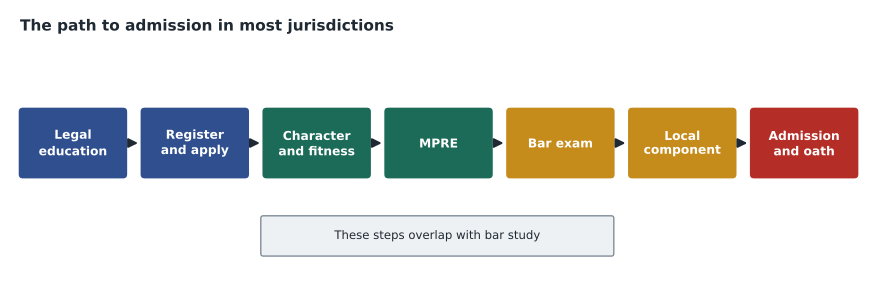
- Legal education. Usually a JD from an ABA-approved law school; some jurisdictions accept other routes (Lesson 2).
- Application. Filed months before the exam, with fees, fingerprints in many states, and an NCBE account (Lesson 3).
- Character and fitness. A detailed questionnaire and investigation that runs alongside study (Lesson 4).
- The MPRE. A separate ethics exam, usually taken during law school (Lesson 5).
- The bar exam. The Uniform Bar Exam, the NextGen exam or a jurisdiction's own exam (Lessons 6, 7 and 10).
- Jurisdiction-specific requirements. A local law course or test, pro bono hours or skills requirements in some places (Lessons 6 and 10).
- Admission. The court's order and the oath of admission, after which you can practice.
Why the details differ
Ngozi asks why the system is so fragmented. Marchetti gives three reasons. First, legal practice is local. Property, family, estates, civil procedure and many crimes are governed by state law, and courts want new lawyers to be ready for the law they will actually practice. Second, regulating lawyers has always been a state power, protected by courts that guard their independence. Third, history: the movement toward common exams began only in the 1970s with the MBE and accelerated in 2011, when Missouri and North Dakota first gave the Uniform Bar Exam.
The trend for fifty years has been toward more uniformity, and the NextGen exam continues it. By mid-2026, 52 jurisdictions had announced that they would give the NextGen exam, with only Arkansas, Louisiana, Nevada and Puerto Rico not adopting it. But uniform tests sit inside a framework of local rules: local components, local passing scores, local character standards and local decisions about which transferred scores to accept. That is why the second half of this program has a course for each jurisdiction.
Marchetti ends the first session with homework. Each member must write down their target jurisdiction, find its admission rules and board website, and list three things they did not know before tonight. 'Next week we start where every application starts: whether you're eligible to sit at all.'
Summary and key terms
- There is no national law license; each of 56 jurisdictions admits lawyers under its own rules.
- The highest court of each jurisdiction holds the power to admit lawyers; a board of bar examiners runs the process.
- NCBE writes widely used exams and prepares character reports but admits no one.
- The ABA accredits law schools and writes the Model Rules; Texas (January 2026) and Florida (from October 2026) have loosened ABA-only eligibility.
- Unified state bars, found in about thirty states, handle membership and discipline; federal courts keep separate rolls.
- Board of bar examiners
- The court-appointed body that runs applications, the exam and character review in a jurisdiction.
- NCBE
- The National Conference of Bar Examiners, a nonprofit that develops the MBE, MEE, MPT, MPRE and NextGen bar exam.
- Unified bar
- A state bar to which every licensed lawyer must belong; also called an integrated or mandatory bar.
- Jurisdiction
- A state, the District of Columbia or a territory that admits lawyers under its own rules.
- Admission on motion
- Admission without a new exam, based on years of practice elsewhere.
Practice problems
Work each problem on paper first, then reveal the answer to check.
Why can a Missouri-licensed lawyer not simply open an office in Illinois?
Show answer
Because there is no national license; Illinois admits lawyers under its own rules, so the lawyer must transfer a score, qualify on motion or pass another exam.
Which body usually makes the final decision to admit an applicant?
Show answer
The highest court of the jurisdiction, acting on the board of bar examiners' recommendation.
What is the difference between NCBE and a board of bar examiners?
Show answer
NCBE develops tests and services; a board is the jurisdiction's official body that runs admission and recommends applicants to the court.
What changed in Texas in January 2026?
Show answer
The Supreme Court of Texas finalized rules ending the requirement that bar applicants graduate from an ABA-accredited law school.
Common mistakes
MistakeNCBE licenses lawyers.
InsteadNCBE writes exams and prepares reports; jurisdictions decide who is admitted.
MistakePassing the bar exam makes you a lawyer everywhere in the United States.
InsteadAdmission is jurisdiction by jurisdiction.
MistakeThe state bar association grades the exam in every state.
InsteadBoards of bar examiners run and grade exams; unified bars mostly handle membership and discipline.
Lesson quiz · 5 questions
Score 60% or more to complete this lesson.
Create a free account to save your progress, take quizzes and earn a certificate.