
BAR-101 · Lesson 4 of 12 · 20 min
Character and fitness
▶ Video coming soon A video version of this lesson is on the way.
Eddie sends Marchetti a private message before the fourth session. In his second year of college he was cited for underage drinking at a campus party and went through the university's conduct process, ending with a warning and an alcohol education course. He disclosed it on his law school application. Does he have to put it on his bar application, and will it stop him? Marchetti asks his permission to use it, without his name, as tonight's first example. He agrees, and then decides he doesn't mind his name being used at all.
Every jurisdiction requires applicants to show that they have the character and fitness to practice law. The bar exam tests whether you know enough law; the character and fitness review asks whether clients, courts and the public can trust you with that knowledge. For most applicants it is a long form, a background check and a letter saying they have been cleared. For some it involves questions, an interview or a hearing. Very few applicants are denied, and most of those denials involve dishonesty during the process rather than the underlying events.
The standard
Jurisdictions express the standard in slightly different words, usually requiring good moral character and fitness to practice law. Many follow the approach in NCBE's Comprehensive Guide, which describes a lawyer who should be licensed as someone whose record of conduct justifies the trust of clients, adversaries, courts and others with respect to the professional duties owed to them. The question is forward-looking: does the applicant's past conduct suggest a risk that they will harm clients or the justice system in the future?
The Constitution limits how boards apply the standard. In Schware v. Board of Bar Examiners of New Mexico (1957), the Supreme Court of the United States held that a state cannot exclude an applicant from the bar in a way that offends due process, and that any qualification must have a rational connection with the applicant's fitness to practice law. New Mexico had relied on the applicant's past membership in the Communist Party, his use of aliases and old arrests that never led to convictions; the Court found no basis in that record to infer bad character. The same year, Konigsberg v. State Bar of California made a related point. Boards still have wide discretion, but their decisions must rest on evidence connected to the practice of law, and applicants are entitled to notice and a chance to be heard.
The process
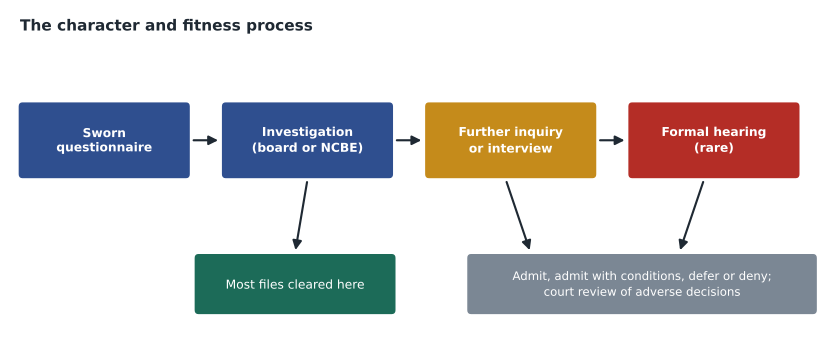
The process starts with a detailed questionnaire, completed under oath, often through NCBE's online character application. It asks about every school attended, every job held for a set number of years, every address, every bar or professional license, any academic or employment discipline, any arrests, charges and convictions (often including sealed or expunged matters, depending on the jurisdiction), traffic violations above a minor threshold, civil lawsuits, bankruptcies and debts in default, and court orders such as child support. Applicants list references and authorize the board to obtain records.
Investigators then check the answers against outside sources: school and employer records, court and police records, credit reports, licensing authorities and the references. Where NCBE investigates for the board, it prepares a report summarizing what it found, and the board decides. Investigations take months. That is one reason boards and law schools urge students to file early, and some jurisdictions ask students to register during law school so the review can start sooner.
Most files are cleared without further contact. If something needs explanation, the board writes to the applicant asking for documents or a statement. If concerns remain, the applicant may be invited to an informal interview with a board member or committee. A small number of applicants receive a formal hearing, with the right to counsel, to present evidence and witnesses, and to a written decision. The board then recommends admission, admission with conditions, a deferral, or denial, and the applicant can ask the court to review an adverse decision.
What boards look at
Boards look for conduct that bears on honesty, trustworthiness, diligence and respect for the law, because those are the qualities clients and courts depend on. NCBE's guide and many jurisdictions' rules list categories that may call for further inquiry. A record in one of these categories is not disqualifying in itself; it starts a conversation.
| Category | Examples | Why it matters |
|---|---|---|
| Unlawful conduct | Criminal convictions, pending charges, conduct that was never charged | Respect for the law and for others |
| Academic misconduct | Plagiarism, cheating, falsifying records | Honesty in academic and professional work |
| Employment problems | Dismissal for cause, discipline for dishonesty | Reliability and trustworthiness |
| Dishonesty or fraud | Lies on applications, forged documents, financial fraud | The core of a lawyer's duties |
| Financial irresponsibility | Neglected debts, defaults, unpaid taxes or support | Clients trust lawyers with money |
| Neglect of obligations | Ignoring court orders, licensing rules or deadlines | Diligence and respect for courts |
| Lack of candor in the process | Omissions or misleading answers on the bar application | Often treated as the most serious concern of all |
Financial issues surprise many applicants. Having debt, even a great deal of student debt, is not a concern. What boards look at is how applicants handle their obligations: whether they have ignored accounts sent to collection, defaulted without making arrangements, or failed to pay taxes or child support. Dana discovered an old store credit card balance that had gone to collection while she was in law school. She paid it off in October 2026, kept the letter confirming payment, and disclosed both the account and the payment on her application. 'That's exactly the right way to handle it,' Marchetti says. 'Disclose, explain, document.'
Mental health and substance use
Bar applications once routinely asked applicants whether they had ever been diagnosed with or treated for mental health conditions. Those questions deterred law students from getting help, and they raised concerns under the Americans with Disabilities Act. In 2015 the ABA House of Delegates urged jurisdictions to stop asking about diagnosis and treatment and to focus instead on conduct. Many jurisdictions have done so, and several, including New York in 2020, removed broad mental health questions from their applications.
Today most applications focus on conduct: whether the applicant has engaged in behavior that would raise questions about fitness, whatever its cause. Some still ask whether a condition currently affects the applicant's ability to practice, or whether conduct in the applicant's record was related to a condition, often so that the applicant can raise it as an explanation. Seeking treatment is not conduct that boards hold against applicants, and law schools and bar programs actively encourage students to get help. Substance use questions focus similarly on conduct, such as impaired driving or drug offenses, and on rehabilitation.
Rehabilitation
When an applicant's record includes past misconduct, boards weigh it against evidence of rehabilitation. Factors commonly considered include the applicant's age at the time, how long ago it happened, how serious it was, whether it was isolated or part of a pattern, the applicant's candor in discussing it, whether restitution was made, and positive conduct since: education, work, community service and the views of people who know the applicant now.
Eddie's college citation fits the pattern that boards see constantly. He was nineteen, it was seven years ago, it was minor, he completed the sanction, and there has been nothing since. He must disclose it, because his jurisdiction's application asks about school discipline and charges, and he will attach the university's letter showing how it was resolved. It is very unlikely to delay his admission. What would turn it into a real problem is leaving it off the form.
Candor above all
Marchetti puts one sentence on her screen and leaves it there for the rest of the session: *The cover-up is almost always worse than the conduct.* Model Rule of Professional Conduct 8.1, adopted in some form in nearly every jurisdiction, says that an applicant for admission must not knowingly make a false statement of material fact and must not fail to disclose a fact needed to correct a misapprehension. A lawyer who lied on a bar application can be disciplined, even disbarred, years later when the lie comes out.
Boards see the same pattern again and again. An applicant leaves off a minor arrest, a dismissed charge, a school discipline matter or an old debt, perhaps from embarrassment or because they think it doesn't count. The investigation finds it. The board's question changes from 'Is this minor event a concern?' to 'Why did this applicant fail to disclose it under oath?' Many denials and conditional admissions rest on that second question.
When in doubt, disclose. If a question is ambiguous, answer it broadly and explain. If records have been sealed or expunged, read the application's instructions carefully, because some jurisdictions require disclosure of sealed matters to the bar even where employers cannot ask about them. And keep updating: an arrest, a lawsuit or a new job after you file must be reported.
Outcomes
Most applicants are simply cleared. Some are admitted with conditions, often called conditional admission, which a number of jurisdictions use for applicants who have shown rehabilitation from substance use or financial problems but whose recovery is recent. Conditions might include monitoring, treatment, reporting or financial counseling for a set period, after which the conditions end. Conditional admission lets boards admit applicants who would otherwise be deferred.
A small number of applicants are denied. A denial usually comes with a period before the applicant can reapply and a written explanation, and the applicant can ask the court to review it. Courts give boards considerable deference but do reverse decisions unsupported by the record. Applicants facing a hearing are well advised to consult a lawyer who handles bar admission matters, many of whom also represent lawyers in discipline cases.
Worked problem
Answering a difficult question
An applicant was arrested at age twenty for shoplifting. The charge was dismissed after she completed a diversion program, and the record was later sealed. Her jurisdiction's application asks about all arrests, 'including matters that have been sealed, expunged or dismissed.' What should she do?
Show solution
- Read the question and its instructions; here they expressly include sealed and dismissed matters.
- Disclose the arrest, the dismissal, the diversion program and the sealing.
- Write a short, factual explanation: what happened, her age, what she did to complete the program, and what she has done since.
- Attach the court records she can obtain, and if they are sealed, explain how the board can verify them.
Answer: She must disclose. Handled openly, a single dismissed charge from years ago rarely prevents admission; concealing it, when the question expressly covers it, would be a serious problem.
Ngozi asks whether her conduct in Nigeria counts. It does, Marchetti says; the questionnaire covers conduct anywhere, and foreign-educated applicants must provide proof of good standing from bars where they are admitted. Camila asks whether Puerto Rico's process is different. In its detail, yes, but the principles are the same everywhere: tell the truth, document it, and show who you are now.
Getting help early
Applicants who know they have something difficult to disclose do best when they start early. Many law schools have a dean of students or a bar admissions adviser who has seen hundreds of applications and can explain how the board in their state usually handles common issues. Some boards offer law students a way to ask about character issues before applying, or start the review when students register during law school. Applicants with serious issues, such as a felony conviction, a past bar or professional discipline matter, or allegations of fraud, often consult a lawyer who handles bar admission matters before filing, so that the application is complete, accurate and supported from the start.
Gathering documents takes time. Court records may need to be ordered from the court where a case was heard, sometimes in another state; police reports may need a separate request; school conduct records come from the dean of students' office; and credit reports are free from the major bureaus at regular intervals. Applicants should collect these before filing rather than after the board asks, so that each disclosure arrives with its supporting paper.
Character and fitness after admission
The duties do not end with admission. Lawyers must report to their licensing authority in many jurisdictions if they are charged with or convicted of certain crimes, and every lawyer is subject to discipline for conduct involving dishonesty, fraud, deceit or misrepresentation. If a lawyer is later found to have made a false statement on the bar application, the admission itself can be revoked. The habits that carry an applicant through character and fitness, honesty, prompt attention to obligations and openness about mistakes, are the same habits that keep lawyers out of trouble for a whole career.
Summary and key terms
- Every jurisdiction requires character and fitness, judged by whether past conduct suggests a risk to clients or the justice system.
- Schware v. Board of Bar Examiners (1957) requires a rational connection to fitness to practice and due process.
- The process runs from a sworn questionnaire through investigation, often by NCBE, to clearance, inquiry, interview or hearing.
- Boards look at honesty, financial responsibility and respect for the law, and weigh rehabilitation; most now focus on conduct rather than mental health diagnosis.
- Candor is critical: nondisclosure is often treated more seriously than the underlying conduct, and Model Rule 8.1 applies to applicants.
- Character and fitness
- The requirement that a bar applicant's record shows they can be trusted with a lawyer's duties.
- Model Rule 8.1
- The rule forbidding knowingly false statements of material fact in bar admission matters.
- Conditional admission
- Admission subject to conditions, such as monitoring or reporting, for a set period.
- Rehabilitation
- Evidence that an applicant has changed since past misconduct, weighed in the character review.
- Schware v. Board of Bar Examiners
- A 1957 Supreme Court case requiring that bar qualifications rationally relate to fitness to practice.
Practice problems
Work each problem on paper first, then reveal the answer to check.
Why is nondisclosure often worse than the underlying conduct?
Show answer
It shows dishonesty under oath in the very process that tests honesty, and it is hard to explain away.
Is having large student loans a character and fitness concern?
Show answer
No; the concern is neglecting obligations, such as ignored collections or unarranged defaults.
What did the ABA urge jurisdictions to do in 2015 about mental health questions?
Show answer
Stop asking about diagnosis and treatment and focus on conduct.
Name four factors boards weigh when considering rehabilitation.
Show answer
Any four of: age at the time, time since, seriousness, pattern or isolated, candor, restitution, positive conduct since.
Common mistakes
MistakeSealed records never need to be disclosed to the bar.
InsteadSome jurisdictions expressly require it; read the instructions.
MistakeA past arrest means you will be denied admission.
InsteadBoards weigh conduct and rehabilitation; most applicants with minor records are admitted.
MistakeOnce the application is filed, later events don't matter.
InsteadApplicants must update the application until admission.
Lesson quiz · 5 questions
Score 60% or more to complete this lesson.
Create a free account to save your progress, take quizzes and earn a certificate.