
BAR-101 · Lesson 11 of 12 · 20 min
Building a bar study plan
▶ Video coming soon A video version of this lesson is on the way.
By the eleventh session, on Tuesday November 17, 2026, the group's February candidates have about fourteen weeks left. Dana will study part time around her clerkship until the end of December and then full time. Ngozi will study full time from the start of December. Sofia, retaking in California, is working three days a week. Eddie is studying full time for Louisiana. Marchetti asks each of them to bring a draft plan, and spends the session tearing them apart, kindly.
There is no single right way to prepare for a bar exam, but there are patterns that work and patterns that don't. This lesson covers how much time to plan, how to divide it, which resources to use, how to practice, how to track progress and how to stay healthy. The jurisdiction courses add the content specific to each exam.
How much time
Most full-time bar candidates study for about eight to ten weeks before the exam, at roughly forty to fifty hours a week, for a total in the range of four hundred to five hundred hours. These are typical figures, not rules. Candidates who work need longer, usually fourteen to sixteen weeks at fewer hours per week. Repeat takers can often build on what they already know but should not assume they need less time; they need different time, aimed at their weaknesses.
The hours matter less than what fills them. Marchetti sees two common failures. The first is passive study: weeks of watching lectures and rereading outlines with little practice, so that the candidate knows the law in a general way but cannot apply it quickly. The second is cramming practice without building knowledge, so that each wrong answer teaches nothing because the rule behind it was never learned. A good plan mixes learning and practice from the first week, with the balance shifting steadily toward practice.
Three phases
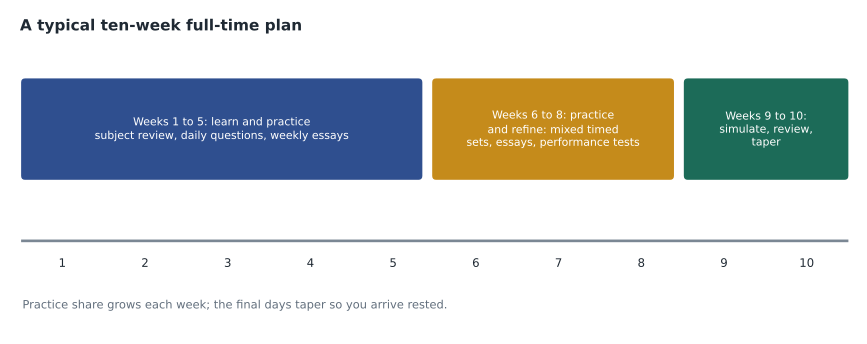
In the first phase, roughly the first half of a full-time plan, candidates work through the subjects one or two at a time: learn the rules from a course or outline, test themselves with practice questions on that subject the same day, and write at least one essay or short written answer a week. In the second phase, they mix subjects, because the exam does, and shift to timed practice: mixed multiple-choice sets, timed essays and full performance tests. In the final phase, they take full-length simulated exams under exam conditions, review weak areas and taper in the last few days so that they arrive rested.
For the legacy UBE, a common target is somewhere around 1,500 to 2,000 practice MBE questions over the whole period, reviewed carefully, along with twenty to thirty timed essays and at least four to six performance tests. These are typical ranges that commercial courses and coaches recommend, not requirements. For the NextGen exam, practice should include integrated question sets and performance tasks from the start, because they are new to most candidates and draw on skills, not just recall.
Choosing resources
Candidates can choose a commercial bar review course, a lower-cost or free program, a law school program, or a self-built plan, and many combine them. Commercial courses provide lectures, outlines, practice questions with explanations, graded essays and a schedule, and some offer coaching. They are expensive, but many employers pay for them. Lower-cost options vary widely in quality. Whatever the choice, the official practice materials from the people who write the exam are essential.
NCBE sells practice MBE exams made of previously used questions, offers NextGen sample questions and study aids, and publishes past MEE questions and analyses and past MPTs with point sheets, many of them free. Jurisdictions with their own exams publish past essay questions and selected answers: California, for example, publishes past essay questions and selected answers, and Louisiana and Florida publish past questions or study materials. Released official questions show what the examiners actually ask and how they phrase it, which no commercial course can fully replicate.
| Resource | Best for | Watch out for |
|---|---|---|
| Commercial bar review course | Structure, outlines, many practice questions, graded essays | Cost; following the schedule passively |
| NCBE official practice materials | Real MBE questions, past MEEs and MPTs, NextGen samples | Limited NextGen volume; MBE practice exams cost money |
| Jurisdiction-released questions | State essays and local components | Older questions may reflect old law |
| Law school bar programs | Coaching, feedback, community | Varies by school |
| Study group or tutor | Accountability and feedback on writing | Time spent talking instead of practicing |
Practicing well
The value of a practice question lies in the review afterward. For every question answered wrongly, or answered rightly by a guess, the candidate should identify the rule tested, understand why the right answer is right and why their choice was wrong, and record the lesson in an error log. Over weeks, the error log reveals patterns: a subject that keeps causing trouble, a recurring misreading of the call of the question, or a habit of changing correct answers. Ngozi's log already shows that most of her wrong answers in Real Property come from future interests, so she schedules an extra session on that topic each week.
Written practice works the same way. Write essays under timed conditions, compare them with the published analysis or model answer, and note what was missed: an issue, a rule, a fact, or organization. Get feedback from someone experienced at least occasionally. Marchetti offers each February candidate feedback on one essay a week until the exam. Performance tests need full-length practice, because the hardest skill is managing ninety minutes, or a full NextGen task block, from reading to finished product.
Memory techniques help with the knowledge side. Active recall, testing yourself rather than rereading, produces much stronger memory, and spaced repetition, revisiting material at increasing intervals, keeps early subjects fresh while you study later ones. Many candidates use flashcards for rules, short written rule statements for essay subjects, and attack outlines that list the issues to spot in each subject.
A sample week
Marchetti shows a sample full-time week from the middle of a plan. Each weekday morning starts with a timed set of thirty-three or thirty-four mixed multiple-choice questions, about an hour, followed by an hour of review. Late morning is new learning or review in one subject. The afternoon alternates between two timed essays, a performance test, and a set of subject-specific questions, each followed by review. The evening is short: flashcards and an update to the error log. Saturday has a longer timed set or simulated half-exam; Sunday is mostly off, with a light review in the evening.
Dana's part-time version stretches the same pattern over evenings and weekends until the end of December, with her full-time phase starting on January 2. Sofia's plan puts a timed California essay on each of her four non-working days and a performance test every other week, because her score report showed that was where her points were lost.
Worked problem
Fixing a draft plan
Eddie's draft plan for Louisiana spends seven weeks reading outlines of all nine subjects, then three weeks doing practice essays. What should change?
Show solution
- Too much passive study and too little practice: seven weeks of reading before writing anything.
- Practice essays should start in week one, on each subject as it is reviewed.
- Because the code tests count double, Civil Code subjects deserve proportionately more time.
- Add timed full-day simulations in the final weeks to build stamina for three exam days.
Answer: Eddie should interleave review and timed practice from the start, weight Civil Code subjects more heavily and finish with full-day simulations.
Tracking progress
Candidates should measure progress against the exam, not against effort. Useful measures include percentage correct on timed mixed multiple-choice sets, estimated scaled scores from official practice exams, essay self-grades against model answers and feedback scores, and completion of planned practice. A simple weekly check-in, comparing results with the previous week and adjusting the plan, keeps the plan honest. A plan that is falling behind should be cut back to the essentials, usually practice in the highest-weight areas, rather than abandoned.
Plateaus are normal. Many candidates see their practice scores stall in the middle weeks, and some see them dip as they move from single-subject to mixed practice. Marchetti tells the group that scores typically rise again in the final weeks as knowledge consolidates, provided the candidate keeps practicing and reviewing rather than switching to frantic rereading.
Health and wellbeing
Bar study is a sustained test of stamina. Candidates who sleep regularly, exercise, eat properly and take at least part of one day a week off tend to study more effectively than those who do not. Anxiety is common, and for some candidates it becomes overwhelming. Every state has a lawyer assistance program, and many serve law students and bar applicants confidentially; law schools have counseling services that graduates can often use during bar study. Seeking help is not something boards hold against applicants, and Lesson 4 explained why.
Marchetti adds the practical steps that reduce stress: settle money for the study period in advance, tell family and friends when you will be unavailable, plan exam week logistics early, including a hotel near the site if travel is needed, and do at least one full practice day in conditions as close to the exam as possible, from the alarm clock to the lunch you will bring.
The final week
In the last week, stop learning new material in depth. Review your rule statements, attack outlines and error log, do short timed sets to stay sharp, and rest more. Check the board's instructions one last time, confirm your laptop and software, print or download your admission ticket and plan your route. The night before, prepare your bag and go to bed at your usual time. On exam day, focus on one session at a time; a bad session does not decide the result, because scoring is compensatory.
Studying while working
Many candidates cannot stop working, and some prefer not to. A part-time plan typically stretches over fourteen to sixteen weeks, with fifteen to twenty-five hours of study a week, rising sharply in the final month, ideally with some time off work for the last two to four weeks. The pattern is the same as a full-time plan, with less in each week: daily multiple-choice practice, a few essays a week, regular performance tests and full simulations near the end. Candidates should be realistic about energy after a working day and use mornings, lunch breaks and weekends well.
Talking to an employer early helps. Many firms and government offices give new graduates paid study leave; others allow reduced hours or flexible schedules. Even employers who cannot offer leave often agree to limit overtime or travel in the weeks before the exam. Sofia arranged to work three days a week from January to February, and Dana's clerkship ends on December 31, which gives her a clean full-time phase.
Group study
Study groups help some candidates and distract others. A good group, like Marchetti's, meets briefly and regularly, keeps members accountable to their plans, trades essays for feedback and explains difficult rules to each other, which is one of the best ways to learn. A poor group spends its time comparing anxiety or discussing rumors about the exam. Candidates who join a group should set a clear purpose and leave if it stops serving them.
Repeat takers
Repeat takers need a plan that differs from their first. They should start from the score report, identify what fell short and why, and change the method, not just the effort. Many repeaters benefit from more written practice with feedback, from timed full simulations, or from addressing test anxiety directly. They should also recheck rules: filing periods for repeaters may differ, and during the 2026 to 2028 transition, a retake may be on a different exam.
Money and logistics
A study plan without a budget is incomplete. Candidates should add up their costs for the whole period, including fees, any course, living expenses while not working and exam-week travel, and decide how they will cover them before they start. Some lenders offer bar study loans, but they usually carry higher interest than law school loans, so candidates should compare them with savings, family help, employer support and grants from their law school or a bar foundation. Settling the money question early removes a major source of stress from the final weeks, when concentration matters most.
Summary and key terms
- Full-time candidates typically study eight to ten weeks at forty to fifty hours a week; working candidates need fourteen to sixteen weeks.
- Mix learning and practice from the start, shifting to mixed timed practice and then full simulations, and taper before the exam.
- Use official practice materials from NCBE and the jurisdiction alongside any course.
- Review every wrong answer, keep an error log, and use active recall and spaced repetition.
- Protect sleep, health and finances; lawyer assistance programs help bar applicants confidentially.
- Active recall
- Testing yourself to retrieve information, which builds stronger memory than rereading.
- Spaced repetition
- Reviewing material at increasing intervals to keep it in memory.
- Error log
- A record of wrong answers and the lessons drawn from each.
- Attack outline
- A short checklist of the issues to spot in a subject when writing an essay.
- Lawyer assistance program
- A confidential support service for lawyers, and often law students and bar applicants, dealing with stress, mental health or substance use.
Practice problems
Work each problem on paper first, then reveal the answer to check.
What are the two common failures in bar study plans?
Show answer
Too much passive study with little practice, and practice without building the underlying knowledge.
Why do released official questions matter?
Show answer
They show what the examiners actually ask and how they phrase questions.
What should a candidate do when the plan falls behind?
Show answer
Cut back to the essentials, usually practice in the highest-weight areas, rather than abandon the plan.
Why does a bad session on exam day not decide the result?
Show answer
Scoring is compensatory, so stronger parts can offset a weaker one.
Common mistakes
MistakeWatching every lecture is the core of bar preparation.
InsteadPractice and review do more to raise scores than passive study.
MistakeMore hours always mean a better score.
InsteadWhat fills the hours matters more than the count.
MistakeThe last week is for learning the subjects you skipped.
InsteadThe last week is for review, light practice and rest.
Lesson quiz · 5 questions
Score 60% or more to complete this lesson.
Create a free account to save your progress, take quizzes and earn a certificate.