
BAR-110 · Lesson 12 of 12 · 55 min
Capstone: mixed MBE practice set
▶ Video coming soon A video version of this lesson is on the way.
After the November 21 drill, Hollis Marchetti sends the group a final assignment for the Saturday series: a mixed set of 30 questions across civil procedure, constitutional law and contracts, to be done under time before the next session. Dana, Ngozi and Sofia will take it as a timed block; Marcus volunteers to take it cold to show the others what a passing score feels like a few months after the exam. Eddie and Camila say they will try the constitutional law questions.
'This is not a test of how much you remember,' Marchetti writes in her email. 'It is a test of whether you can apply the method under time. Do the set in 54 minutes, the same 1.8 minutes a question you will have on the real MBE. Then spend at least twice as long reviewing it.' This lesson is that set. Every question is original and written for this course; none is taken from NCBE's released questions. The questions are mixed, as they will be on the exam, so you must identify the subject and issue from the facts.
How to take the set
Find a quiet place and a timer. Read each question using the five steps from Lesson 1: read the call first, read the facts actively, predict the answer, eliminate wrong choices and choose. Do not look up rules. Answer every question, because there is no penalty for wrong answers. Flag anything that takes more than three minutes, choose your best answer and move on. When time is up, stop, and note how far you got.
After the timed sitting, score the set by subject, then review every question, including those you got right. For each miss, write down the rule, the fact that triggered it and which of the four error types it was: did not know the rule, misapplied the rule, misread the facts or call, or fell for a trap answer. For each correct guess, write the rule too.
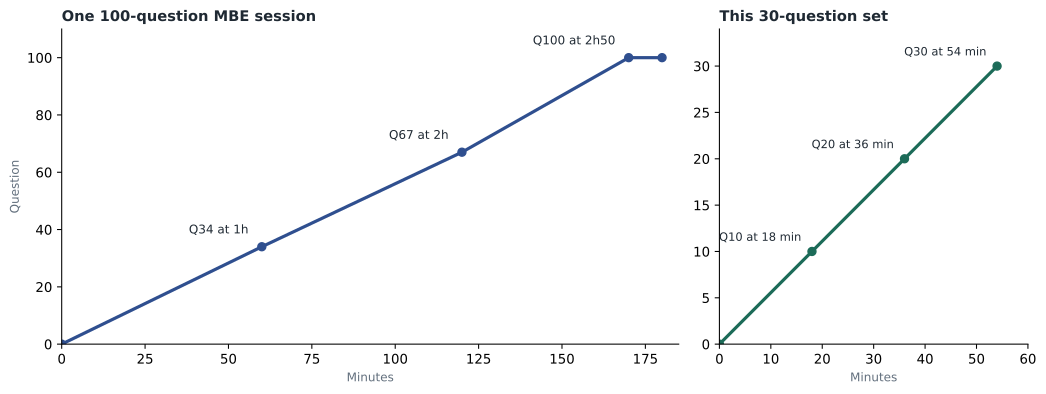
What the questions test
The set has ten questions in each subject, weighted toward the areas the MBE Subject Matter Outline emphasizes. The civil procedure questions focus on jurisdiction, venue, pleadings and motions, which produce about two thirds of the real questions. The constitutional law questions mix structure and individual rights, roughly half and half, as the outline does. The contracts questions lean on formation and performance, with a few on UCC Article 2, remedies and third parties. Several questions test the points where the UCC and common law differ, because those are favorite traps.
| Subject | Topics in this set |
|---|---|
| Civil Procedure | Diversity and citizenship; supplemental jurisdiction; personal jurisdiction; Rule 12 waiver; Erie (Berk v. Choy); discovery limits; preclusion; Rule 50; jury right; transfer |
| Constitutional Law | Commandeering; dormant Commerce Clause; removal power; time, place and manner; religious speech in a forum; right to travel; procedural due process; commerce power; standing; licensing |
| Contracts | Mailbox rule; UCC 2-207; past consideration; substantial performance; cure; satisfaction clauses; frustration; seller's resale damages; third-party beneficiaries |
The practice set
Answer all 30 questions before reading the explanations. Each question is followed by the correct answer and a short explanation.
Practice problems
Work each problem on paper first, then reveal the answer to check.
A homeowner who is a citizen of Ohio sues a roofing company in federal court in Ohio for 80,000 dollars in damages from a leaking roof. The company is incorporated in Delaware and has its headquarters in Ohio. The company moves to dismiss for lack of subject-matter jurisdiction. Should the court grant the motion? (A) No, because the company is incorporated in Delaware. (B) No, because the amount in controversy exceeds 75,000 dollars. (C) Yes, because the company is a citizen of Ohio. (D) Yes, because roofing disputes belong in state court.
Show answer
(C). A corporation is a citizen of its state of incorporation and its principal place of business. The company is a citizen of Ohio, so diversity is not complete, and no federal claim is pleaded.
A plaintiff sues in federal court on a federal antitrust claim and a related state-law unfair competition claim arising from the same conduct. Both parties are citizens of the same state. The court dismisses the federal claim early on summary judgment. What may the court do with the state claim? (A) It must decide the state claim, because it had jurisdiction when the case was filed. (B) It may decline supplemental jurisdiction and dismiss the state claim without prejudice. (C) It must dismiss the state claim with prejudice. (D) It must transfer the state claim to state court.
Show answer
(B). Section 1367(c)(3) lets a court decline supplemental jurisdiction after dismissing all claims within its original jurisdiction. Federal courts do not transfer cases to state courts.
A software company based and incorporated in California sells subscriptions nationwide through its website and advertises in Nevada. A Nevada customer sues in Nevada federal court, claiming the software corrupted her business files in Nevada. Nevada's long-arm statute reaches as far as due process permits. Does the court have personal jurisdiction over the company? (A) No, because the company has no office in Nevada. (B) No, because the company is not at home in Nevada. (C) Yes, because the company purposefully served the Nevada market and the claim relates to those contacts. (D) Yes, because the company's website can be viewed in Nevada.
Show answer
(C). Specific jurisdiction exists when a defendant purposefully avails itself of the forum and the claim arises out of or relates to those contacts. Mere accessibility of a website would not be enough; deliberate sales and advertising to Nevada residents are.
A defendant files a motion to dismiss for failure to state a claim. After it is denied, she files an answer that asserts improper venue for the first time. How should the court rule on the venue defense? (A) It is waived because it was omitted from the Rule 12 motion. (B) It is timely because it appears in the answer. (C) It is timely because venue can be raised at any time. (D) It must be decided before the merits.
Show answer
(A). Under Rule 12(g)(2) and (h)(1), a party who makes a Rule 12 motion waives the defenses of personal jurisdiction, venue, process and service that were available but omitted.
In a diversity case in federal court, the state's law requires a plaintiff suing a doctor to file an expert affidavit with the complaint. The plaintiff files none. The doctor moves to dismiss. Under the Supreme Court's 2026 decision in Berk v. Choy, how should the court rule? (A) Grant the motion, because state law governs the elements of a malpractice claim. (B) Deny the motion, because the Federal Rules govern what a complaint must contain. (C) Grant the motion, because the requirement is outcome-determinative. (D) Deny the motion only if the plaintiff later files an affidavit.
Show answer
(B). Berk v. Choy held that a state affidavit-of-merit requirement does not apply in federal court because the Federal Rules answer the question of what a complaint must contain.
A plaintiff serves a defendant with 30 interrogatories, each with a single part, without leave of court or a stipulation. The defendant objects. How should the court rule? (A) The defendant must answer all 30. (B) The defendant need answer only the first 25 unless the court grants leave. (C) Interrogatories are not permitted without a court order. (D) The defendant must answer all of them if they are relevant.
Show answer
(B). Rule 33 limits a party to 25 interrogatories, including discrete subparts, absent leave or stipulation.
After a full trial, a jury finds a railroad negligent in a crash that injured many passengers. A passenger who could easily have joined the first suit, but chose to wait, sues the railroad and moves for partial summary judgment on negligence based on the first verdict. Which is the strongest argument for denying the motion? (A) Issue preclusion requires mutuality of parties. (B) The second plaintiff could easily have joined the earlier action. (C) Negligence was not actually litigated. (D) The first judgment was not final.
Show answer
(B). Parklane Hosiery lets courts refuse offensive nonmutual issue preclusion when the plaintiff could easily have joined the earlier action; mutuality is no longer required in federal court.
A defendant moved for judgment as a matter of law at the close of all evidence, arguing there was no proof of causation. The jury found for the plaintiff. Twenty days after entry of judgment, the defendant files a renewed motion arguing for the first time that there was no proof of duty. How should the court rule? (A) Grant it if no reasonable jury could find duty. (B) Deny it, because a renewed motion may raise only grounds raised before submission to the jury. (C) Deny it, because it is untimely. (D) Treat it as a motion for a new trial.
Show answer
(B). A Rule 50(b) motion renews the Rule 50(a) motion; it is limited to grounds raised before the case went to the jury. The motion was timely (within 28 days).
A plaintiff seeks only an injunction requiring a neighbor to remove a fence. The neighbor demands a jury trial in federal court. Should the demand be granted? (A) Yes, because the Seventh Amendment guarantees a jury in all civil cases. (B) Yes, if the fence is worth more than twenty dollars. (C) No, because the only relief sought is equitable. (D) No, because property disputes are always tried to the judge.
Show answer
(C). The Seventh Amendment preserves the jury right for legal claims; an injunction is equitable relief.
A plaintiff sues in federal court in State A. Venue is proper there. The defendant moves to transfer the case to State B for the convenience of witnesses, and the court grants the motion under 28 U.S.C. section 1404(a). Which state's choice-of-law rules will the transferee court apply? (A) State A's. (B) State B's. (C) Federal choice-of-law rules. (D) The rules of the state where the defendant is domiciled.
Show answer
(A). After a 1404(a) transfer from a proper venue, the transferee court applies the law, including the choice-of-law rules, that the transferor court would have applied.
Congress passes a statute requiring each state to designate a state official to enforce a new federal registry for drone pilots. A state challenges the law. Is it constitutional? (A) Yes, under the Commerce Clause. (B) Yes, under the Supremacy Clause. (C) No, because Congress may not commandeer state officers to administer a federal program. (D) No, because drones are not commerce.
Show answer
(C). Printz v. United States forbids Congress from commanding state officers to administer federal programs, even if the program itself is within the commerce power.
A state imposes a tax on all milk sold in the state and uses the proceeds to pay subsidies only to in-state dairy farmers. Out-of-state dairies sue. Is the scheme constitutional? (A) Yes, because the tax applies equally to all milk. (B) Yes, because states may subsidize their own industries. (C) No, because together the tax and subsidy discriminate against interstate commerce. (D) No, because states may not tax milk.
Show answer
(C). A neutral tax paired with a subsidy for in-state producers works like a discriminatory tariff and violates the dormant Commerce Clause (West Lynn Creamery).
A federal statute allows the Speaker of the House to remove the head of a federal enforcement agency for any reason. Is the removal provision constitutional? (A) Yes, because Congress created the agency. (B) Yes, because the Speaker is third in line for the presidency. (C) No, because Congress may not reserve for itself the power to remove an executive officer. (D) No, because only the Senate may remove officers.
Show answer
(C). Bowsher v. Synar: Congress may not keep removal power over officers who execute the laws, except through impeachment.
A city ordinance prohibits all residential picketing focused on a single residence, regardless of message. A protester who picketed outside an official's home challenges it. What is the most likely result? (A) Unconstitutional, because it is a content-based restriction. (B) Unconstitutional, because streets are public forums where picketing cannot be limited. (C) Constitutional, as a content-neutral regulation narrowly tailored to protect residential privacy that leaves open other channels. (D) Constitutional, because picketing is unprotected conduct.
Show answer
(C). A content-neutral time, place and manner rule in a public forum is valid if narrowly tailored to a significant interest and leaving ample alternatives (Frisby v. Schultz).
A state university denies a recognized student religious group access to meeting rooms that are open to all other student groups, citing the Establishment Clause. The group sues. What is the likely result? (A) The university wins, because it must avoid endorsing religion. (B) The group wins, because excluding it from a generally open forum because of its religious viewpoint violates the Free Speech Clause. (C) The university wins, because the rooms are a nonpublic forum. (D) The group wins only if it pays rent.
Show answer
(B). Excluding religious speech from a forum otherwise open to student groups is viewpoint discrimination, and equal access does not violate the Establishment Clause (Widmar v. Vincent).
A state law gives a hiring preference for state government jobs to applicants who have lived in the state for five years. A recent resident challenges it. What is her strongest argument? (A) The law burdens her fundamental right to interstate travel by penalizing new residents. (B) The law violates the Contracts Clause. (C) The law is a bill of attainder. (D) The law violates the dormant Commerce Clause.
Show answer
(A). Durational residency requirements that penalize recent movers for important benefits burden the right to travel and get strict scrutiny (Attorney General of New York v. Soto-Lopez).
A state environmental agency revokes a company's operating permit, which under state law may be revoked only for cause, without notice or a hearing, citing the company's alleged violations. The situation presents no emergency. Which is the company's strongest claim? (A) A taking without just compensation. (B) A violation of procedural due process. (C) A violation of equal protection. (D) A violation of the Contracts Clause.
Show answer
(B). A permit revocable only for cause is a property interest; due process requires notice and a hearing before deprivation absent an emergency (Mathews balancing).
A federal law makes it a crime to possess a gun within 1,000 feet of a public park. The law contains no jurisdictional element and Congress made no findings about commerce. A defendant challenges it as beyond Congress's commerce power. What is the most likely result? (A) Upheld, because guns move in interstate commerce. (B) Upheld, under the aggregation principle. (C) Struck down, because possession of a gun near a park is noneconomic activity without a substantial effect on commerce. (D) Struck down, because criminal law belongs only to the states.
Show answer
(C). Like the law in United States v. Lopez, it regulates noneconomic activity without a jurisdictional hook; aggregation applies only to economic activity.
A citizen sues to enjoin enforcement of a federal regulation requiring warning labels on a product she does not make, buy or use. She says the regulation is unconstitutional and harms the public. How should the court rule? (A) Dismiss for lack of standing. (B) Decide the merits because the question is important. (C) Dismiss as a political question. (D) Dismiss as moot.
Show answer
(A). A generalized grievance without a concrete, particularized injury does not support Article III standing.
A city requires a permit to hold any parade, and the city manager may deny a permit if he thinks the parade is "not in the public interest." A group is denied a permit without explanation. Is the scheme constitutional? (A) Yes, because cities may require parade permits. (B) Yes, because parades disrupt traffic. (C) No, because it gives an official unbridled discretion over speech. (D) No, because cities may never require permits for speech.
Show answer
(C). A licensing scheme for speech must have narrow, objective, definite standards; unbridled discretion is facially invalid.
On May 1, a seller mails a buyer an offer to sell a used tractor for 15,000 dollars. On May 3, the buyer mails an acceptance. On May 4, before the acceptance arrives, the seller phones the buyer to revoke. The acceptance arrives on May 5. Is there a contract? (A) No, because the revocation came before the acceptance arrived. (B) No, because the seller is not a merchant. (C) Yes, because the acceptance was effective when mailed on May 3. (D) Yes, but only if the buyer had begun performance.
Show answer
(C). Under the mailbox rule, the acceptance was effective on dispatch, before the attempted revocation.
A merchant buyer sends a purchase order for goods. The merchant seller responds with an acknowledgment form that accepts and adds a term requiring arbitration of all disputes. The buyer does not respond, and the goods are shipped and paid for. A dispute arises. Is the arbitration clause part of the contract? (A) Yes, because the seller sent the last form. (B) Yes, because both parties are merchants and the buyer did not object. (C) It depends on whether the clause materially alters the contract, and many courts treat a new arbitration clause as material. (D) No, because acceptance must mirror the offer.
Show answer
(C). Under UCC 2-207(2), additional terms between merchants become part of the contract unless, among other things, they materially alter it. Courts frequently treat added arbitration clauses as material alterations.
A homeowner promises her neighbor 500 dollars because the neighbor rescued her dog from a flood the week before. She later refuses to pay. Is her promise enforceable as a contract? (A) Yes, because the neighbor conferred a benefit. (B) Yes, because the promise was made voluntarily. (C) No, because past consideration is not bargained for. (D) No, because the amount is too small.
Show answer
(C). A benefit already conferred when the promise is made is not bargained-for consideration. Some courts enforce such promises under Restatement section 86, but the general rule is no.
A builder contracts to build a house according to specifications that require Brand X windows. The builder installs Brand Y windows of identical quality and appearance by mistake. The owner refuses to pay the final installment. What is the most likely result in the builder's suit? (A) The builder recovers nothing, because it breached an express term. (B) The builder recovers the final installment minus any difference in value, because it substantially performed. (C) The builder recovers the full installment plus damages. (D) The owner may require replacement of every window at the builder's cost.
Show answer
(B). Under Jacob & Youngs v. Kent, substantial performance with a minor, good-faith deviation entitles the builder to the price minus the difference in value.
A retailer orders 200 televisions, delivery by October 30. On October 10, the manufacturer delivers 200 televisions, five of which have cracked screens. The retailer rejects the entire shipment the same day. On October 12, the manufacturer notifies the retailer that it will deliver 200 conforming televisions by October 25. Must the retailer accept the new delivery? (A) No, because the first tender was a material breach. (B) No, because the retailer validly canceled the contract. (C) Yes, because the seller has a right to cure before the time for performance expires. (D) Yes, but only at a reduced price.
Show answer
(C). UCC 2-508(1): the seller may cure a rejected tender within the contract time after seasonable notice.
A painter agrees to paint a portrait of a client "to the client's complete satisfaction." The portrait is skillful, but the client honestly dislikes it and refuses to pay. Must the client pay? (A) Yes, because a reasonable person would be satisfied. (B) No, because the condition of personal satisfaction was not met and the client acted honestly. (C) Yes, because conditions are disfavored. (D) No, because portrait contracts are unenforceable.
Show answer
(B). For matters of personal taste, a satisfaction clause is judged by the honest subjective satisfaction of the party.
A caterer agrees to provide food for a wedding at a specific hall. The hall burns down without fault two days before the wedding, and the wedding is canceled. The caterer has bought nonreturnable supplies. Which doctrine best excuses the couple's duty to pay the full price? (A) Frustration of purpose. (B) Unilateral mistake. (C) Unconscionability. (D) Lack of consideration.
Show answer
(A). The principal purpose of the contract was substantially frustrated by an event whose nonoccurrence was a basic assumption; the caterer may still recover in restitution or reliance for some expenditures in many courts.
A seller agrees to sell a buyer a machine for 50,000 dollars. The buyer wrongfully repudiates. The seller resells the machine in a commercially reasonable private sale for 42,000 dollars, spending 1,000 dollars on storage and advertising. The seller saved no expenses because of the breach. What can the seller recover? (A) 8,000 dollars. (B) 9,000 dollars. (C) 50,000 dollars. (D) 1,000 dollars.
Show answer
(B). UCC 2-706: contract price minus resale price (8,000 dollars) plus incidental damages (1,000 dollars).
On February 1, an employer orally hires a manager for a fixed term of 18 months beginning March 1. In May, the employer fires the manager without cause and argues the contract is unenforceable. What is the employer's best argument, and does it succeed? (A) The statute of frauds, and it succeeds, because the contract could not be performed within one year of its making. (B) The parol evidence rule, and it succeeds, because there is no writing. (C) Lack of consideration, and it fails, because the manager worked. (D) Indefiniteness, and it succeeds, because no salary was stated.
Show answer
(A). A contract that by its terms cannot be performed within one year of its making falls within the statute of frauds and must be evidenced by a signed writing. Here performance would end about 19 months after the contract was made. The manager may still recover the value of services already rendered in restitution.
A woman contracts with a builder to construct a wheelchair ramp at her elderly father's house, telling the builder that the ramp is a gift to her father, who will use it. The builder takes payment but never builds the ramp. The father sues the builder. What is the most likely result? (A) The father wins as an intended beneficiary. (B) The father loses as an incidental beneficiary. (C) The father loses because he gave no consideration. (D) The father wins only if he paid part of the price.
Show answer
(A). The promisee intended to give the father the benefit of the performance, which runs directly to him, so he is an intended (donee) beneficiary who may enforce the contract. Beneficiaries need not give consideration.
Reviewing your results
When the group meets after the set, Marchetti asks each member to read out their scores by subject. Dana scores eight of ten in civil procedure, seven in constitutional law and nine in contracts; her two civil procedure misses are the Rule 12 waiver question, where she chose 'timely because it appears in the answer', and the renewed motion question. Ngozi scores well across the board but misses the battle of the forms question, choosing the last-shot answer, a common law instinct that does not fit Article 2. Sofia gets every contracts question right, which she credits to her spreadsheet, but misses three constitutional law questions on standards of review. Marcus, taking it cold, scores 23 of 30 and says the questions felt about as hard as the real MBE.
Marchetti points out that a raw score of 60 to 65 percent on hard practice questions is consistent with passing in most jurisdictions, because the real exam is scaled and contains a mix of difficulties. But she warns against reading too much into one set. What matters is the trend over hundreds of questions, and whether the errors shrink in the areas you have targeted. She asks each member to write a two-week plan based on their error logs: Dana will do 60 more civil procedure questions focused on motions and waiver; Ngozi will drill UCC differences; Sofia will rewrite her constitutional law outline around the three tiers.
Common traps in this set
Several questions use traps that recur across the MBE. In the corporate citizenship question, the attractive wrong answer focuses on the state of incorporation and ignores the principal place of business. In the renewed motion question, the trap is to treat the post-verdict motion as a fresh start rather than a renewal limited to earlier grounds. In the dormant Commerce Clause question, the tax looks neutral on its own, and the trap is to analyze it without the subsidy. In the residential picketing question, the trap is to assume any restriction on speech in a public forum gets strict scrutiny. In the battle of the forms question, the trap is the common law last-shot rule. And in the frustration question, the trap is impossibility: the couple could still pay, so the better doctrine is frustration of purpose.
Watch also for answers that state true rules that do not apply. The aggregation principle is real, but it does not apply to noneconomic activity. The Supremacy Clause is real, but it does not let Congress commandeer state officers. Recognizing a correct rule in the wrong place is one of the most common reasons strong students miss questions.
What comes next
This course covered three of the seven MBE subjects. BAR-111 covers the other four: criminal law and procedure, evidence, real property and torts. BAR-120 and BAR-121 cover the essay and performance tests, BAR-130 covers the NextGen bar exam for candidates in jurisdictions that have switched, and BAR-140 covers the MPRE. Each jurisdiction course explains how your jurisdiction uses the MBE, its passing score and any state-specific component. In the weeks before the exam, take full-length timed practice exams, preferably the official ones licensed by NCBE, and keep your error log going until the end.
Marchetti closes the Saturday series with her usual advice. 'Trust the method,' she says. 'Read the call, predict, eliminate, choose. The law in this course will be the same in February. What changes between now and then is how quickly and calmly you can find it.'
Summary and key terms
- Take the 30 questions in 54 minutes, the MBE pace of about 1.8 minutes per question, then review at least twice as long.
- Score by subject and classify every miss: unknown rule, misapplied rule, misread facts or call, or trap answer.
- Recurring traps: incomplete citizenship analysis, treating Rule 50(b) as a fresh motion, analyzing a tax without its subsidy, assuming strict scrutiny for neutral rules, and common law instincts in UCC questions.
- Watch for true rules applied in the wrong place, such as aggregation for noneconomic activity.
- Use trends over hundreds of questions, not single sets, to judge readiness, and finish with official timed practice.
- Mixed set
- A practice set that combines subjects in random order, as the real MBE does.
- Raw score
- The number of questions answered correctly before scaling.
- Trap answer
- A wrong choice designed to attract test-takers who miss a key fact or rule.
- Error log
- A record of each missed question's rule, triggering fact and error type.
- Blind review
- Reworking flagged questions before checking answers, to separate knowledge from luck.
Lesson quiz · 5 questions
Score 60% or more to complete this lesson.
Create a free account to save your progress, take quizzes and earn a certificate.