
BAR-110 · Lesson 8 of 12 · 22 min
The First Amendment
▶ Video coming soon A video version of this lesson is on the way.
On Halloween, October 31, the group meets in costume at Marcus Bell's insistence; Marchetti appears as a gavel. Ngozi notes that the First Amendment generates more MBE questions than any other single provision. Marchetti agrees: free speech and religion questions reward a structured approach, because the analysis depends on sorting the law into the right category before applying the test. This lesson covers freedom of speech, the press and association, and the two religion clauses. All of these apply to the states through the Fourteenth Amendment.
Content-based and content-neutral regulation
The first question in nearly every speech case is whether the law regulates speech because of its content. A content-based law, one that applies to speech because of the topic discussed or the idea or message expressed, is presumptively invalid and receives strict scrutiny, Reed v. Town of Gilbert (2015). Viewpoint discrimination, singling out a particular opinion on a subject, is the most serious form and is almost never allowed. In City of Austin v. Reagan National Advertising (2022), the Court held that a rule distinguishing on-premises from off-premises signs was content-neutral because it turned on location, not topic or message.
A content-neutral law regulating the time, place or manner of speech is valid if it is narrowly tailored to serve a significant government interest and leaves open ample alternative channels for communication, Ward v. Rock Against Racism (1989). Narrow tailoring here does not require the least restrictive means, only that the law not burden substantially more speech than necessary. Regulation of expressive conduct, such as burning a draft card, is judged under United States v. O'Brien (1968): it is valid if it is within government power, furthers an important interest unrelated to the suppression of expression, and the incidental restriction on speech is no greater than essential. Flag burning as political protest is protected, Texas v. Johnson (1989), because laws against it target the message.
In Chiles v. Salazar (2026), the Court held that Colorado's ban on conversion therapy for minors, as applied to a counselor's talk therapy, regulated speech based on viewpoint and violated the First Amendment. Earlier, in Free Speech Coalition v. Paxton (2025), it applied intermediate scrutiny to and upheld a Texas law requiring age verification for websites with substantial sexual content that is obscene for minors, treating the law as an incidental burden on adults' protected speech.
Unprotected and less protected categories
Some categories of speech receive no protection or reduced protection. The Court has refused to create new categories, United States v. Stevens (2010), so the list is closed for practical purposes.
Incitement is unprotected if it is directed to inciting or producing imminent lawless action and is likely to produce it, Brandenburg v. Ohio (1969). Abstract advocacy of violence is protected. True threats, statements meant to communicate a serious intent to commit violence against a particular person or group, are unprotected; Counterman v. Colorado (2023) requires proof that the speaker at least recklessly disregarded a substantial risk that the communication would be viewed as threatening. Fighting words, personally abusive words likely to provoke an immediate violent reaction from the person addressed, are unprotected, but laws aimed at them are often struck down as vague or overbroad, and R.A.V. v. St. Paul (1992) held that the government may not single out only some fighting words based on their viewpoint.
Obscenity is unprotected under Miller v. California (1973) if the average person, applying contemporary community standards, would find that the work appeals to the prurient interest, it depicts sexual conduct in a patently offensive way as defined by law, and, taken as a whole, it lacks serious literary, artistic, political or scientific value, judged by a national reasonable person standard. Child pornography is unprotected even if not obscene, but virtual images not involving real children are protected, Ashcroft v. Free Speech Coalition (2002). Private possession of obscene material at home is protected, Stanley v. Georgia (1969), except for child pornography.
Defamation receives limited protection. Under New York Times v. Sullivan (1964), a public official or public figure must prove actual malice, meaning the defendant knew the statement was false or acted with reckless disregard for its truth, by clear and convincing evidence. A private figure on a matter of public concern must prove at least negligence and actual malice to recover presumed or punitive damages, Gertz v. Robert Welch (1974). Opinion that cannot reasonably be read as stating facts is protected. Intentional infliction of emotional distress claims by public figures also require actual malice, Hustler v. Falwell (1988), and Snyder v. Phelps (2011) protected offensive picketing on a matter of public concern.
Commercial speech, speech proposing a commercial transaction, receives intermediate protection under Central Hudson (1980). False or misleading commercial speech and speech about illegal activity are unprotected. Otherwise, a regulation is valid if it directly advances a substantial government interest and is not more extensive than necessary, meaning a reasonable fit rather than the least restrictive means. Required disclosures of factual, uncontroversial information in advertising are reviewed more leniently, Zauderer (1985).
Forums
When the government restricts speech on its own property, the type of forum matters. Traditional public forums, such as streets, sidewalks and parks, and designated public forums the government has opened to speech generally, receive the full test: content-based restrictions get strict scrutiny, and content-neutral time, place and manner restrictions must be narrowly tailored to a significant interest with ample alternatives. In limited public forums, opened for certain groups or topics, and nonpublic forums, such as military bases, airport terminals, jails and the inside of most government offices, restrictions need only be reasonable and viewpoint-neutral, Minnesota Voters Alliance v. Mansky (2018). Schools may regulate student speech that would materially and substantially disrupt school activities, Tinker v. Des Moines (1969), but have limited authority over off-campus speech, Mahanoy Area School District v. B.L. (2021).
Prior restraints, vagueness and overbreadth
A prior restraint, government action preventing speech before it occurs, carries a heavy presumption of invalidity, New York Times v. United States (1971). Licensing schemes for speech must have narrow, definite standards and procedural safeguards, including prompt judicial review; a scheme giving officials unbridled discretion is void on its face, and a person may ignore it and speak without a permit. Injunctions against speech must be tailored narrowly, though a person must generally obey a court injunction until it is overturned.
A law is void for vagueness if a person of ordinary intelligence cannot tell what it prohibits. A law is overbroad if it prohibits a substantial amount of protected speech relative to its legitimate sweep, and a person whose own speech could be regulated may still challenge the law on behalf of others. In Moody v. NetChoice (2024), the Court explained that a facial challenge requires comparing the law's unconstitutional applications to its constitutional ones, and it recognized that a platform's curation of content in its feeds is protected editorial activity.
Compelled speech, government speech and public employees
The government may not compel people to express messages they disagree with, West Virginia State Board of Education v. Barnette (1943) and Wooley v. Maynard (1977). In 303 Creative v. Elenis (2023), the Court held that Colorado could not require a web designer to create custom wedding websites expressing messages she disagreed with. Requiring public employees who are not union members to pay agency fees violates the First Amendment, Janus v. AFSCME (2018). When the government itself speaks, the Free Speech Clause does not apply, so it may choose its messages, Pleasant Grove City v. Summum (2009), though Shurtleff v. City of Boston (2022) held that a flag-raising program open to private groups was not government speech.
Public employees speaking as citizens on matters of public concern are protected unless the government's interest in efficient operations outweighs their interest, Pickering v. Board of Education (1968). Speech made pursuant to their official duties is not protected, Garcetti v. Ceballos (2006). Freedom of association protects joining groups for expressive purposes; the government may not punish membership unless the person actively affiliated with knowledge of the group's illegal aims and specific intent to further them. Laws compelling disclosure of membership or donor lists face exacting scrutiny, Americans for Prosperity Foundation v. Bonta (2021). A private expressive group may exclude members whose presence would significantly burden its message, Boy Scouts v. Dale (2000).
Campaign finance rules also come up. Limits on contributions to candidates are valid if closely drawn to prevent corruption or its appearance, but limits on independent expenditures, including by corporations and unions, violate the First Amendment, Citizens United v. FEC (2010).
Establishment Clause
The Establishment Clause bars government from establishing religion. For decades courts applied the Lemon test, but Kennedy v. Bremerton School District (2022) confirmed that the Court has abandoned it and that the clause must be interpreted by reference to historical practices and understandings. Under that approach, the government may not coerce religious participation, and it may not prefer one religious denomination over another, Larson v. Valente (1982); laws that discriminate among religions receive strict scrutiny. Official prayers led by public school staff at school events remain unconstitutional because of their coercive effect, Lee v. Weisman (1992), while legislative prayer has a long historical tradition, Town of Greece v. Galloway (2014). Kennedy itself held that a coach's brief private prayer on the field after games was protected speech and religious exercise, not government coercion. A long-standing monument with religious and secular meaning may remain, American Legion v. American Humanist Association (2019).
Free Exercise Clause
Under Employment Division v. Smith (1990), a neutral law of general applicability that incidentally burdens religion receives only rational basis review, so a state could deny unemployment benefits to workers fired for sacramental peyote use. A law that targets religion, or is not neutral or generally applicable, receives strict scrutiny, Church of Lukumi Babalu Aye v. Hialeah (1993). A law is not generally applicable if it allows individualized exemptions, Fulton v. Philadelphia (2021), or treats comparable secular activity more favorably than religious activity, Tandon v. Newsom (2021). The government may not exclude religious organizations or schools from generally available public benefits because of their religious character or use, Trinity Lutheran (2017), Espinoza (2020) and Carson v. Makin (2022). In Mahmoud v. Taylor (2025), the Court held that parents were likely entitled to notice and the opportunity to opt their children out of instruction that substantially interfered with their religious upbringing.
Religious institutions may choose their ministers without government interference, under the ministerial exception, Hosanna-Tabor (2012) and Our Lady of Guadalupe School v. Morrissey-Berru (2020). Courts may not decide whether religious beliefs are true, but they may ask whether a belief is sincerely held. Statutes such as the federal Religious Freedom Restoration Act give more protection than Smith against federal action, but on the MBE, constitutional claims follow Smith unless the question cites a statute.
| Situation | Test |
|---|---|
| Content-based speech restriction | Strict scrutiny |
| Content-neutral time, place, manner (public forum) | Narrowly tailored to significant interest; ample alternatives |
| Nonpublic or limited forum | Reasonable and viewpoint-neutral |
| Commercial speech (lawful, not misleading) | Central Hudson: substantial interest, directly advances, not more extensive than necessary |
| Neutral, generally applicable law burdening religion | Rational basis (Smith) |
| Law targeting religion or not generally applicable | Strict scrutiny (Lukumi, Fulton, Tandon) |
Worked problem
A sound ordinance
A city bans the use of amplified sound in a public park after 10 p.m. A band arrested for playing amplified music at 11 p.m. claims a First Amendment violation. What result?
Show solution
- A park is a traditional public forum.
- The ban applies to all amplified sound regardless of message, so it is content-neutral.
- Apply the time, place and manner test: protecting residents from noise at night is significant; the ban does not burden substantially more speech than necessary; the band can play unamplified, elsewhere or earlier.
Answer: The ordinance is valid and the band's claim fails.
Practice problems
Work each problem on paper first, then reveal the answer to check.
What test applies to a content-based restriction on speech?
Show answer
Strict scrutiny: necessary to a compelling interest and narrowly tailored.
What did Counterman v. Colorado require for true threats?
Show answer
Proof that the speaker at least recklessly disregarded a substantial risk that the statement would be viewed as threatening.
What must a public figure prove in a defamation suit?
Show answer
Falsity and actual malice, by clear and convincing evidence.
Is speech by a public employee made under her official duties protected?
Show answer
No, under Garcetti v. Ceballos.
Which test for the Establishment Clause has the Court abandoned?
Show answer
The Lemon test; courts now look to historical practices and understandings.
What standard applies to a neutral, generally applicable law burdening religious practice?
Show answer
Rational basis, under Employment Division v. Smith.
Common mistakes
MistakeOffensive or hateful speech is unprotected.
InsteadOffensive speech is protected unless it falls in an unprotected category such as true threats or incitement.
MistakeTime, place and manner rules must use the least restrictive means.
InsteadThey need not burden substantially more speech than necessary; least restrictive means is the strict scrutiny test.
MistakeThe Lemon test still governs Establishment Clause cases.
InsteadKennedy v. Bremerton confirmed the Court has abandoned it.
MistakeAny burden on religion gets strict scrutiny.
InsteadNeutral, generally applicable laws get rational basis under Smith.
A quick checklist for speech questions
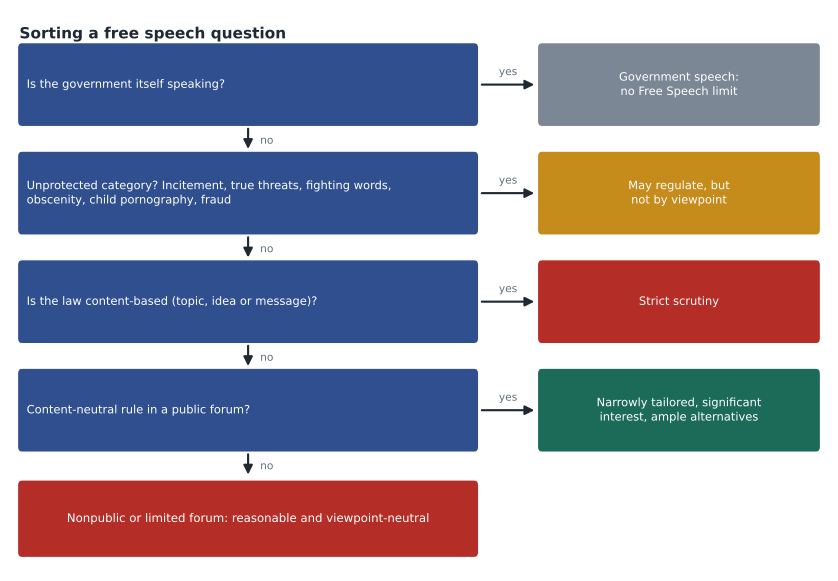
Marchetti's order of questions for any speech problem: Is there state action? Is it the government's own speech? Does the speech fall in an unprotected category? Is the law content-based or content-neutral? Where is the speech, and what kind of forum is it? Is the law a prior restraint, vague or overbroad? Working through the list in order prevents the most common mistake, which is to jump to strict scrutiny before checking whether the government is regulating speech at all or whether the forum allows only a reasonableness test.
Summary and key terms
- Sort first: government speech is outside the clause; unprotected categories may be regulated without viewpoint discrimination; content-based laws get strict scrutiny; content-neutral laws get the time, place and manner test or O'Brien.
- Know incitement, true threats (Counterman), fighting words, obscenity (Miller), defamation (Sullivan, Gertz) and commercial speech (Central Hudson).
- Forum type controls restrictions on government property; prior restraints, vague and overbroad laws are disfavored; compelled speech is barred (Barnette, 303 Creative).
- Public employee speech uses Pickering and Garcetti; association protects expressive groups and donor privacy.
- Establishment: history and tradition, no coercion, no denominational preference (Kennedy). Free exercise: Smith for neutral laws; strict scrutiny if not neutral or generally applicable; no exclusion from public benefits because of religion.
- Content-based law
- A law that applies to speech because of its topic, idea or message.
- Traditional public forum
- Streets, sidewalks and parks, where speech receives the most protection.
- Prior restraint
- Government action that prevents speech before it occurs.
- Actual malice
- Knowledge of falsity or reckless disregard for the truth.
- General applicability
- A law's even treatment of religious and comparable secular conduct, without individualized exemptions.
Lesson quiz · 5 questions
Score 60% or more to complete this lesson.
Create a free account to save your progress, take quizzes and earn a certificate.