
BAR-110 · Lesson 3 of 12 · 23 min
Erie, pleadings, joinder and discovery
▶ Video coming soon A video version of this lesson is on the way.
Ngozi Adeyemi arrives at the September 26 drill with a question from her practice set. 'A federal court sitting in diversity applied the state statute of limitations but the federal rule on how to serve the defendant. Why does it get to mix the two?' Marchetti smiles. 'That,' she says, 'is the Erie doctrine, and it is the one civil procedure topic that scares people more than it should.' This lesson covers the law federal courts apply and the pretrial stages that follow the complaint: pleadings, amendments, joinder and discovery. Pretrial procedures are one of the three heaviest civil procedure areas.
The Erie doctrine
In Erie Railroad v. Tompkins (1938), the Supreme Court held that a federal court hearing a state-law claim must apply state substantive law, including state court decisions, because there is no general federal common law. The Rules of Decision Act, 28 U.S.C. section 1652, points the same way. Federal courts apply federal procedural law. The difficulty is deciding what counts as substantive and what counts as procedural.
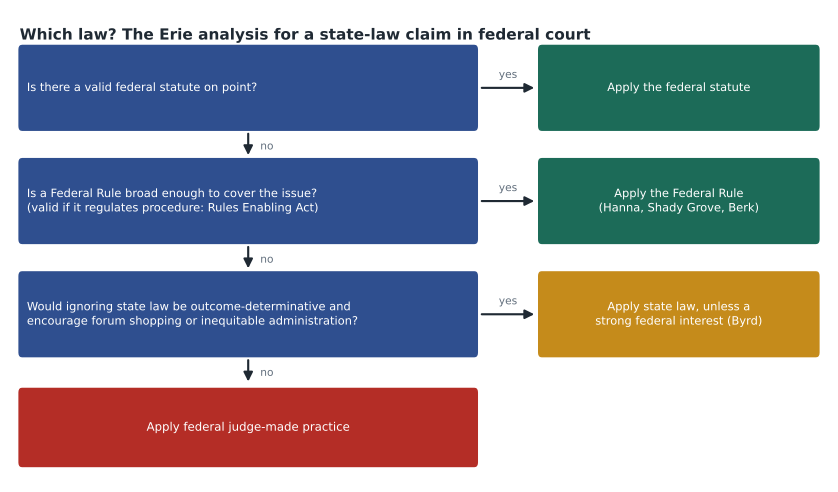
The first question is whether a valid federal statute or Federal Rule of Civil Procedure directly covers the issue. If a federal statute covers it and is constitutional, the federal statute applies. If a Federal Rule is sufficiently broad to control the issue, it applies as long as it is valid under the Rules Enabling Act, 28 U.S.C. section 2072, meaning it really regulates procedure and does not abridge, enlarge or modify any substantive right. Hanna v. Plumer (1965) applied Rule 4 on service instead of a Massachusetts rule requiring in-hand service on an executor. In Shady Grove Orthopedic Associates v. Allstate (2010), Rule 23 controlled over a New York statute barring class actions for statutory penalties. The Supreme Court has never held a Federal Rule invalid under the Rules Enabling Act. In Berk v. Choy (2026), the Court held that a Delaware affidavit-of-merit requirement for medical malpractice suits does not apply in federal court, because the Federal Rules on pleading answer the question of what a complaint must contain.
If no federal statute or rule covers the issue, the court applies a judge-made analysis. It asks whether the matter is outcome-determinative, under Guaranty Trust v. York (1945), in light of the twin aims of Erie: discouraging forum shopping and avoiding inequitable administration of the laws. Under Byrd v. Blue Ridge Rural Electric Cooperative (1958), the court may also weigh strong federal interests, such as the allocation of functions between judge and jury. Gasperini v. Center for Humanities (1996) shows a blend: a federal court applied New York's standard for reviewing excessive verdicts, but federal appellate courts applied it through federal review practice.
Some issues are settled. Federal courts in diversity apply state law on statutes of limitations, including when an action is commenced for limitations purposes if no federal rule covers it (Walker v. Armco Steel, 1980), on the elements of claims and defenses, on burdens of proof on the merits, and on choice of law: under Klaxon Co. v. Stentor Electric (1941), a federal court applies the choice-of-law rules of the state where it sits. Federal law governs the right to a jury trial, the time to answer and procedural matters covered by the Federal Rules.
Pleadings
Rule 8(a) requires a complaint to contain a short and plain statement of the grounds for the court's jurisdiction, a short and plain statement of the claim showing that the pleader is entitled to relief, and a demand for the relief sought. Bell Atlantic Corp. v. Twombly (2007) and Ashcroft v. Iqbal (2009) require enough factual matter, accepted as true, to state a claim to relief that is plausible on its face. Legal conclusions and formulaic recitations of elements are not accepted as true. The court disregards conclusions, assumes the truth of well-pleaded facts, and asks whether they plausibly suggest liability, drawing on judicial experience and common sense.
Rule 9 requires more for some matters. Fraud and mistake must be pleaded with particularity, meaning the who, what, when, where and how, though malice, intent and knowledge may be alleged generally. Special damages must be specifically stated.
The defendant responds by answer or by Rule 12 motion. An answer is due 21 days after service, or 60 days after the request was sent if the defendant waived service. In the answer, the defendant must admit or deny each allegation; a party without enough knowledge may say so, which operates as a denial. An allegation not denied, other than one about damages, is deemed admitted. Affirmative defenses, such as statute of limitations, res judicata and contributory negligence, must be pleaded in the answer under Rule 8(c), or they may be waived.
Rule 12(b) lists seven defenses that may be raised by motion: lack of subject-matter jurisdiction, lack of personal jurisdiction, improper venue, insufficient process, insufficient service of process, failure to state a claim, and failure to join a party under Rule 19. The waiver rules are heavily tested. Personal jurisdiction, venue, process and service are waived if they are omitted from a pre-answer motion that raises any Rule 12 defense, or if they are not included in the answer when no motion is filed. Failure to state a claim and failure to join a required party survive until trial, and may be raised in a later pleading, a motion for judgment on the pleadings or at trial. Subject-matter jurisdiction can be raised at any time.
| Defense | When it is lost |
|---|---|
| Lack of personal jurisdiction, improper venue, insufficient process, insufficient service | Waived if left out of the first Rule 12 motion or, if no motion, the answer |
| Failure to state a claim; failure to join a Rule 19 party | Preserved through trial |
| Lack of subject-matter jurisdiction | Never lost; raise any time, even on appeal |
Rule 11 requires that every pleading, motion or other paper be signed, and the signature certifies that, after a reasonable inquiry, the paper is not presented for an improper purpose, the legal contentions are warranted by existing law or a nonfrivolous argument for changing it, and the factual contentions have or will likely have evidentiary support. A party seeking sanctions must serve the motion and give the other side 21 days to withdraw or correct the paper before filing it, the so-called safe harbor. Sanctions must be limited to what suffices to deter repetition.
Amendments
Under Rule 15(a), a party may amend once as a matter of course within 21 days after serving it, or, if a responsive pleading is required, within 21 days after service of the response or of a Rule 12(b), (e) or (f) motion, whichever is earlier. Otherwise, amendment requires the opposing party's written consent or leave of court, which should be freely given when justice so requires, though a court may deny it for undue delay, bad faith, repeated failure to cure, undue prejudice or futility.
Relation back under Rule 15(c) lets an amendment filed after the limitations period count as filed on the original date. An amendment adding a claim relates back if it arises out of the conduct, transaction or occurrence set out in the original pleading. An amendment changing the party or the name of the party relates back if that test is met and, within the Rule 4(m) period for service, the new party received such notice that it will not be prejudiced and knew or should have known that the action would have been brought against it but for a mistake about the proper party's identity. Krupski v. Costa Crociere (2010) held that the focus is on what the new party knew or should have known, not on the plaintiff's diligence.
Joinder of claims and parties
Rule 18 lets a party join as many claims as it has against an opposing party, related or not, though each claim still needs subject-matter jurisdiction. Rule 13(a) makes a counterclaim compulsory if it arises out of the same transaction or occurrence as the opposing party's claim; a compulsory counterclaim not asserted is lost. Permissive counterclaims under Rule 13(b) need their own jurisdictional basis. Crossclaims against a co-party under Rule 13(g) are always permissive and must arise from the same transaction or occurrence.
Rule 20 permits plaintiffs to join together, or defendants to be joined, if the claims arise out of the same transaction, occurrence or series of transactions or occurrences and there is a question of law or fact common to all. Rule 19 requires joinder of a person who is required, because complete relief cannot be given without the person, or because the person claims an interest that may be impaired or that exposes an existing party to multiple or inconsistent obligations. If joinder is feasible, the person must be joined. If joinder is not feasible, for example because it would destroy diversity, the court decides whether in equity and good conscience the case should proceed without the person or be dismissed, weighing prejudice, ways to lessen it, adequacy of a judgment and whether the plaintiff has another forum.
Rule 14 impleader lets a defending party bring in a third party who is or may be liable to it for all or part of the claim against it, such as through indemnity or contribution. Rule 24 intervention of right is available to a person who claims an interest that the action may impair and that existing parties do not adequately represent; permissive intervention requires a common question. Rule 22 interpleader and the statutory version, 28 U.S.C. section 1335, let a stakeholder facing multiple claims to the same property deposit it and make the claimants litigate among themselves; statutory interpleader needs only minimal diversity among claimants and 500 dollars or more.
Class actions under Rule 23 require numerosity, commonality, typicality and adequacy of representation under 23(a), and fit within one of the 23(b) types: (b)(1) to avoid inconsistent adjudications, (b)(2) for injunctive or declaratory relief for the class as a whole, or (b)(3) where common questions predominate and a class action is superior, with notice and the right to opt out. Wal-Mart Stores v. Dukes (2011) held that commonality requires a common contention whose resolution will resolve an issue central to each claim in one stroke. Settlement or dismissal of a certified class requires court approval after a fairness hearing.
Discovery
Rule 26(b)(1) permits discovery of any nonprivileged matter relevant to any party's claim or defense and proportional to the needs of the case, considering the importance of the issues, the amount in controversy, the parties' access to information, their resources, the importance of the discovery and whether its burden outweighs its benefit. Information need not be admissible to be discoverable.
Before formal discovery, Rule 26(a)(1) requires initial disclosures without a request: names of people likely to have discoverable information the party may use, documents and things the party may use, a computation of damages, and insurance agreements. Expert disclosures under Rule 26(a)(2) follow, with written reports for retained experts. Pretrial disclosures of witnesses and exhibits come at least 30 days before trial. The parties must confer and develop a discovery plan under Rule 26(f), and since the amendments effective December 1, 2025, the Rule 26(f) conference and the Rule 16(b) scheduling order must address the timing and method of complying with the obligation to describe privileged materials withheld. A new Rule 16.1, effective the same day, guides initial management of multidistrict litigation.
The discovery tools are depositions under Rules 30 and 31, limited to ten per side and one day of seven hours each without leave or stipulation; interrogatories to parties under Rule 33, limited to 25 including discrete subparts; requests for production of documents, electronically stored information and things under Rule 34, including from nonparties by subpoena under Rule 45; physical and mental examinations under Rule 35, only when the condition is in controversy, on court order for good cause; and requests for admission under Rule 36, which are deemed admitted if not answered within 30 days.
Work product, under Rule 26(b)(3) and Hickman v. Taylor (1947), protects documents prepared in anticipation of litigation by or for a party. Ordinary work product is discoverable only on a showing of substantial need and inability to obtain the equivalent without undue hardship. Opinion work product, meaning mental impressions, conclusions, opinions and legal theories of a lawyer, is almost absolutely protected. A party withholding information as privileged must expressly claim the privilege and describe what is withheld so others can assess the claim.
Rule 37 enforces discovery. A party must confer in good faith before moving to compel, and the loser of a motion to compel usually pays the winner's expenses. Failure to obey a discovery order can lead to sanctions ranging from treating facts as established to striking pleadings, dismissal, default and contempt. For electronically stored information that should have been preserved but was lost because a party failed to take reasonable steps, the court may order measures to cure prejudice, and only on finding intent to deprive may it presume the information was unfavorable, instruct the jury so, or dismiss or enter default.
Worked problem
A relation-back problem
On May 1, the last day of the limitations period, a passenger sues "Seaway Cruises Inc." for an injury on a ship. The ticket, which the passenger had, identified the carrier as Seaway Cruises Ltd., a related company that shares a registered agent with Inc. and received the complaint the week it was filed. In August, the passenger moves to substitute Ltd. Does the amendment relate back?
Show solution
- The claim arises from the same occurrence.
- Within the Rule 4(m) period, Ltd. received notice through the shared agent and would not be prejudiced.
- Ltd. knew or should have known that it would have been sued but for a mistake about the proper party's identity; under Krupski, the plaintiff's own knowledge of the ticket does not defeat relation back.
Answer: Yes. The amendment relates back to May 1 and is timely.
Practice problems
Work each problem on paper first, then reveal the answer to check.
In a diversity case, does a federal court apply the state statute of limitations?
Show answer
Yes. Limitations periods are substantive for Erie purposes.
What pleading standard applies under Twombly and Iqbal?
Show answer
Facts that make a claim plausible on its face; legal conclusions are not accepted as true.
A defendant files a Rule 12(b)(6) motion and omits a personal jurisdiction defense. Can she raise it in her answer?
Show answer
No. It was waived by omission from the first Rule 12 motion.
Is a counterclaim arising from the same transaction optional?
Show answer
No. It is compulsory and lost if not asserted.
How many interrogatories may a party serve without leave?
Show answer
25, including discrete subparts.
What protects a lawyer's mental impressions?
Show answer
Opinion work product, which is nearly absolutely protected.
Common mistakes
MistakeErie means state procedural rules apply in diversity cases.
InsteadFederal procedure applies; state substantive law applies.
MistakeNotice pleading means any conclusory statement suffices.
InsteadTwombly and Iqbal require plausible factual allegations.
MistakeAll Rule 12 defenses can be raised any time before trial.
InsteadPersonal jurisdiction, venue, process and service are waived if not raised first.
MistakeDiscovery is limited to admissible evidence.
InsteadRelevant, proportional, nonprivileged matter is discoverable even if inadmissible.
Summary and key terms
- Erie: federal courts in diversity apply state substantive law; a valid Federal Rule or statute on point controls; otherwise weigh outcome-determination, Erie's aims and federal interests. Klaxon makes state choice-of-law rules apply.
- Pleadings need plausible facts; fraud needs particularity; answers within 21 days; affirmative defenses go in the answer; Rule 12 waiver rules and Rule 11's safe harbor are heavily tested.
- Amend once as of course within 21 days; relation back depends on the same occurrence and, for new parties, timely notice and knowledge of a mistake.
- Know compulsory counterclaims, Rule 19 required parties, impleader, intervention, interpleader and class action requirements.
- Discovery reaches relevant, proportional, nonprivileged matter; know the tool limits, work product and Rule 37 sanctions.
- Erie doctrine
- Federal courts apply state substantive law to state-law claims and federal procedural law.
- Plausibility
- The Twombly-Iqbal standard requiring factual allegations that plausibly show liability.
- Relation back
- Treating an amended pleading as filed on the date of the original.
- Compulsory counterclaim
- A counterclaim from the same transaction or occurrence that must be asserted or is lost.
- Work product
- Materials prepared in anticipation of litigation, protected from discovery to varying degrees.
Lesson quiz · 5 questions
Score 60% or more to complete this lesson.
Create a free account to save your progress, take quizzes and earn a certificate.