
BAR-217 · Lesson 2 of 12 · 16 min
Eligibility, education, deadlines and fees
▶ Video coming soon A video version of this lesson is on the way.
At their second session, Hollis Marchetti asked Jolene to pull up the Attorney Admissions office's application page and read the dates aloud. Jolene had already filed for the February 2027 examination, but Marchetti wanted her to see the whole calendar. 'Half the trouble I see in Kansas is not on the exam,' Marchetti said. 'It is someone who filed on time but sent the fingerprint card late, or whose transcript reached Topeka a week after the due date, or who assumed a degree from a law school abroad would count. Kansas is generous in some ways and strict in others. The strict parts are the eligibility rule and the dates.'
This lesson covers who may sit the Kansas bar examination, the education the court requires, the filing windows and supporting-document deadlines, the fees and what happens when something goes wrong. Everything here comes from the Kansas Supreme Court's admission rules and the Attorney Admissions office's published instructions as of late 2026; both can change, and the office's current instructions control.
The education requirement
Kansas requires every applicant for admission by examination to hold a J.D. from a law school approved by the American Bar Association. The requirement is firm in three ways.
First, there is no foreign-education route. Many jurisdictions let graduates of law schools outside the United States sit the examination after an LL.M. or an evaluation of their legal education. NCBE's jurisdiction chart for Kansas records that foreign law graduates are not eligible to sit, and Kansas's rules contain no LL.M. substitute. A lawyer trained abroad who wants to practice in Kansas generally needs to earn a J.D. from an ABA-approved school.
Second, there is no route for graduates of law schools that are not ABA-approved. A graduate of a state-accredited school in California or an online school, for example, cannot sit in Kansas on that degree. Graduates of such schools sometimes reach Kansas later through admission without examination, but Rule 719 has its own conditions, discussed in Lesson 11.
Third, there is no route through law office study. A few states let applicants qualify by reading law under a supervising lawyer. Kansas does not.
Within those limits the requirement is simple. A J.D. from any ABA-approved school in any state qualifies, and the school does not have to be in Kansas. Kansas has two ABA-approved law schools, the University of Kansas School of Law in Lawrence and Washburn University School of Law in Topeka, and many Kansas applicants come from schools in Missouri, Nebraska, Oklahoma, Colorado and further afield.
Applying before graduation
Most applicants file before they graduate. A third-year student who expects to graduate in May files for the July examination during the window that opens on November 2 of the third year and closes on March 1. The application is accepted on the expectation that the degree will be conferred; the degree itself is proved by the law school transcript, which must reach the Attorney Admissions office by June 15 for the July examination. An applicant who graduates in December follows the same pattern for the February examination, with the transcript due January 15.
If the degree is not conferred in time, the applicant cannot sit. There is no provisional seat for someone who is a course short. Applicants who are unsure whether they will finish should talk to their law school registrar early, because a missed transcript date usually means moving to the next examination.
The filing windows
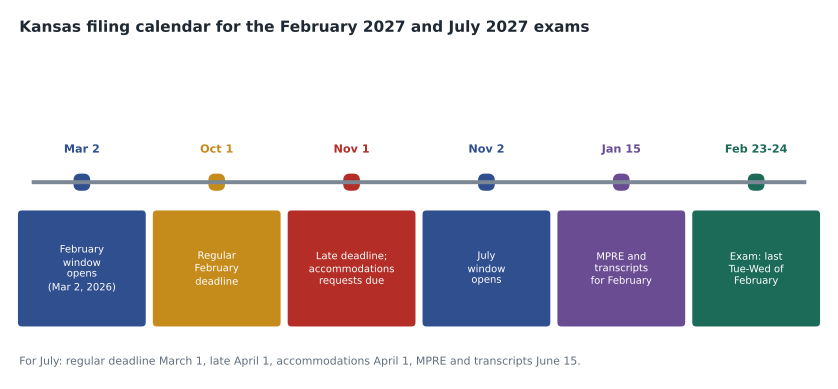
The Kansas application is filed online through the Attorney Admissions office's portal. Each examination has a regular filing window and a late filing period.
| Examination | Window opens | Regular deadline | Late deadline | MPRE score and transcript due | Accommodation requests due |
|---|---|---|---|---|---|
| February | March 2 | October 1 | November 1 | January 15 | November 1 |
| July | November 2 | March 1 | April 1 | June 15 | April 1 |
Two features of the calendar trip people up. The first is that the windows are long and open early. The February window opens almost a full year before the examination, on March 2 of the preceding year. Applicants who expect a lengthy character and fitness review, for example because of a criminal record, debt problems or a prior bar application elsewhere, benefit from filing near the start of the window. The Board's review takes time, and an application filed on the last regular day leaves little room before the examination.
The second is that the late deadline and the accommodation deadline are the same day. An applicant who needs testing accommodations must file the accommodation request by November 1 for February or April 1 for July. That is the last day of late filing. An applicant who files late and also needs accommodations is working against a single date for both.
When an application is complete
Filing the online application is not the same as having a complete application. Kansas will not accept an application until the completed fingerprint packet arrives. The packet includes a fingerprint card taken by a law enforcement agency or approved fingerprinting service and the signed authorizations and waivers the Board needs to collect records about you. The Attorney Admissions office's instructions say the application is not accepted until the fingerprints are received.
The practical lesson is to schedule the fingerprinting immediately after filing. Fingerprint appointments can take days or weeks to get, cards can be rejected for poor quality and mail can be slow. An applicant who files on September 30 for February and mails the fingerprint card in mid-October may find that the card arrives after the regular deadline, with the late fee or worse at stake. Marchetti's rule is to have the fingerprints taken before filing if possible, so the packet can be mailed the same week.
The application itself is long. It asks for every residence, every job, every school, every court proceeding you have been a party to, every traffic citation above a minor threshold, every bar application and every license you have held, along with references. Lesson 3 covers how to approach the disclosure questions. Here the important point is time: the application takes most applicants several sittings to complete, and collecting old addresses and employer contacts can take longer than expected.
Supporting documents: MPRE and transcript
Two documents must reach the Attorney Admissions office by a fixed date before each examination: the MPRE score report and the law school transcript showing the J.D. The due dates are January 15 for the February examination and June 15 for the July examination.
The MPRE score is sent by NCBE at the examinee's request, not by the examinee. An applicant who took the MPRE years ago must make sure the score is reported to Kansas. Because the MPRE is offered only a few times a year, an applicant who has not yet passed the MPRE needs to plan the test date so that the score is released and reported before the due date. The transcript comes from the law school registrar and must show that the degree was conferred.
The fees
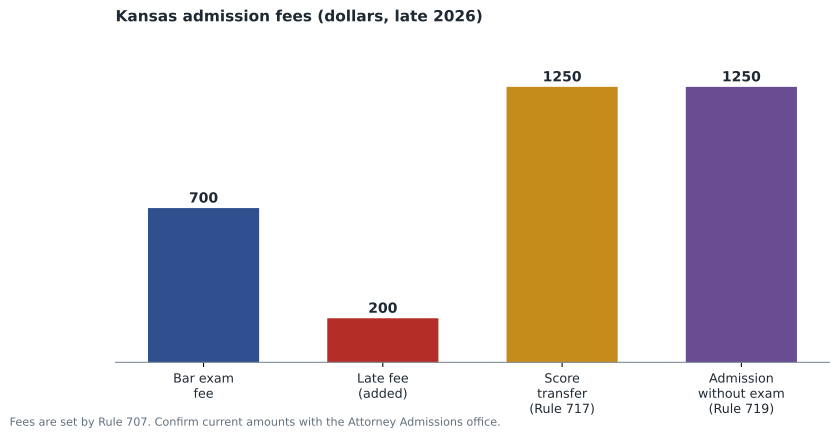
Kansas's admission fees are set by court rule and published by the Attorney Admissions office. As of late 2026 the main fees are these.
| Fee | Amount | When it applies |
|---|---|---|
| Bar examination | 700 dollars | Every applicant for admission by examination |
| Late filing | 200 dollars, added | Applications filed after the regular deadline and by the late deadline |
| Score transfer | 1,250 dollars | Applicants under Rule 717 using a UBE or NextGen score from another jurisdiction |
| Admission without examination | 1,250 dollars | Experienced lawyers under Rule 719 |
Several costs fall outside these fees. Fingerprinting is paid to whoever takes the prints. The MPRE fee is paid to NCBE when you register for that test. Score transfers out of Kansas, or into Kansas from another UBE jurisdiction, involve an NCBE score transfer request with its own charge. Applicants should also budget for travel to the examination and, for most, a commercial review course.
Other eligibility points
A few other questions come up often.
Residency. Kansas has no residency requirement for admission. Applicants may live in Missouri, Colorado or anywhere else. Many Kansas City lawyers live on one side of State Line Road and practice on both.
Number of attempts. NCBE's chart records that Kansas sets no limit on the number of times an applicant may sit the examination. Each attempt requires a new application or a reapplication according to the office's instructions, and each carries the fee.
Courtesy seating. Kansas does not offer courtesy seating, the arrangement under which some states let an applicant for another jurisdiction sit the UBE at their site. An applicant who wants a Kansas license sits in Kansas or transfers a score.
Concurrent applications. Kansas allows an applicant to pursue admission by examination and admission by score transfer at the same time under the rules that govern each. An examinee who sat the February examination in Missouri, for example, might apply to Kansas under Rule 717 while waiting for results. The Attorney Admissions office's instructions say how concurrent applications are handled.
What happens when something goes wrong
The rules give some flexibility, but less than applicants hope.
A missed regular deadline can be cured by filing during the late period and paying the late fee. A missed late deadline cannot be cured for that examination; the applicant files for the next one.
A missing fingerprint packet keeps the application from being accepted. If the packet never arrives, the application is not complete, and the applicant cannot be seated.
A missing MPRE score or transcript by the due date ordinarily means the applicant cannot sit that examination. The Attorney Admissions office can tell an applicant whether a short delay can be accommodated, but the rule is the due date.
A change in circumstances after filing, such as a new address, a new job, a new arrest or a new lawsuit, must be reported. The duty to update continues until admission.
An applicant who wants to withdraw or move to a later examination should contact the office in writing. The rules and instructions say whether any part of the fee can be credited.
A working checklist
Marchetti hands every Kansas candidate the same one-page checklist and asks them to date each line as it is done. It is worth reproducing in your own words, because the steps that cause trouble are the boring ones.
Before the window opens, confirm that your law school is ABA-approved and that you will have the J.D. conferred before the transcript due date. Register for the MPRE on a date that leaves at least two months before the January 15 or June 15 due date, and ask NCBE to report the score to Kansas once it is released. Collect your residence, employment and school history for the past decade, with addresses and supervisor names, and pull copies of any court records, citations and disciplinary records you will need to explain.
When the window opens, schedule fingerprinting first, then complete and file the online application, and mail the fingerprint card and signed waivers within days. Keep a copy of everything you submit, including the confirmation page and the date the packet was delivered. If you need accommodations, assemble the medical or educational documentation early, because the request has its own form and its own due date.
After filing, calendar every remaining date: the late deadline as a backstop, the accommodation deadline, the MPRE and transcript due date, the date seating information is expected and the examination itself. Update the application promptly when anything changes. Check the Attorney Admissions office portal every few weeks for messages, because a request for an additional document is easy to miss and the clock keeps running while it sits unanswered.
Jolene added one line of her own: tell the partners at the firm the examination dates now, so nobody schedules a pretrial conference for February 23. It was, Marchetti agreed, the most practical entry on the list.
Worked problem
A late fingerprint card
Tomas, a hypothetical applicant, filed his online application for the February 2027 examination on September 29, 2026, two days before the regular deadline. He had his fingerprints taken on October 6 and the packet arrived in Topeka on October 9. The office told him his application was accepted on October 9. Does he owe the late fee, and what should he watch next?
Show solution
- The regular deadline was October 1, 2026; the late deadline was November 1, 2026.
- The application is not accepted until the fingerprint packet arrives, so his application was accepted after the regular deadline.
- Whether the late fee applies depends on how the office treats an online filing completed by fingerprints after the deadline; its instructions control, and he should ask in writing.
- His next dates are January 15, 2027, when his MPRE score and transcript are due, and the examination on February 23 and 24, 2027.
Answer: Tomas should confirm in writing whether the late fee applies, then make sure his MPRE score and transcript arrive by January 15, 2027. The safer practice is to have the fingerprints taken before filing.
Common mistakes
MistakeAn LL.M. from a US law school qualifies a foreign-trained lawyer to sit in Kansas.
InsteadKansas requires a J.D. from an ABA-approved law school; foreign law graduates are not eligible to sit.
MistakeFiling the online application by October 1 makes it complete.
InsteadThe application is not accepted until the fingerprint packet arrives.
MistakeThe MPRE score can be sent any time before results.
InsteadThe MPRE score is due by January 15 for February and June 15 for July.
MistakeAccommodation requests can be made after the late deadline.
InsteadAccommodation requests are due November 1 for February and April 1 for July, the same day as the late deadline.
MistakeKansas requires applicants to live in Kansas.
InsteadKansas has no residency requirement for admission.
Summary and key terms
- Kansas requires a J.D. from an ABA-approved law school, with no route for foreign or non-approved law graduates.
- The February window runs March 2 to October 1 (late to November 1); the July window runs November 2 to March 1 (late to April 1).
- The application is not accepted until the fingerprint packet arrives.
- The MPRE score and transcript are due January 15 for February and June 15 for July; accommodation requests are due November 1 and April 1.
- The exam fee is 700 dollars, the late fee adds 200 dollars, and score transfer and admission without examination each cost 1,250 dollars.
- ABA-approved law school
- A law school accredited by the American Bar Association; Kansas requires a J.D. from such a school.
- Filing window
- The period during which applications for a particular examination may be filed.
- Late filing period
- The month after the regular deadline during which an application may still be filed with a late fee.
- Fingerprint packet
- The fingerprint card and signed waivers Kansas requires before it accepts an application.
- Courtesy seating
- An arrangement in some states allowing an applicant for another jurisdiction to sit there; Kansas does not offer it.
Lesson quiz · 5 questions
Score 60% or more to complete this lesson.
Create a free account to save your progress, take quizzes and earn a certificate.