
BAR-217 · Lesson 6 of 12 · 16 min
What the exam tests and how Kansas law appears
▶ Video coming soon A video version of this lesson is on the way.
At the Hays firm, Jolene had spent the summer drafting a petition in a pickup-and-semi collision on U.S. Highway 183, researching whether a county could be sued over a washed-out culvert and helping with the estate of a widow who left her farm to her children and nothing to her second husband. In the evenings she was studying torts, property and wills for the bar examination. 'The two never match,' she complained. 'My MBE book says one thing about comparative fault and the partners say another. My wills outline talks about holographic wills, and the partner says Kansas does not have them. Which one am I supposed to learn?'
'Both,' Marchetti said, 'but for different days. On February 23 and 24 you answer the exam's questions with the exam's rules. On every other day of your career you answer the client's questions with Kansas's rules. The trick is to keep two rulebooks and know which one you are holding.'
Kansas adds no Kansas component to its examination. This lesson explains what that means for study, what rules the UBE actually tests, where Kansas law departs from those rules in ways that matter in practice and how to keep the two straight. The four lessons that follow take the most important areas of Kansas law in detail.
No Kansas component
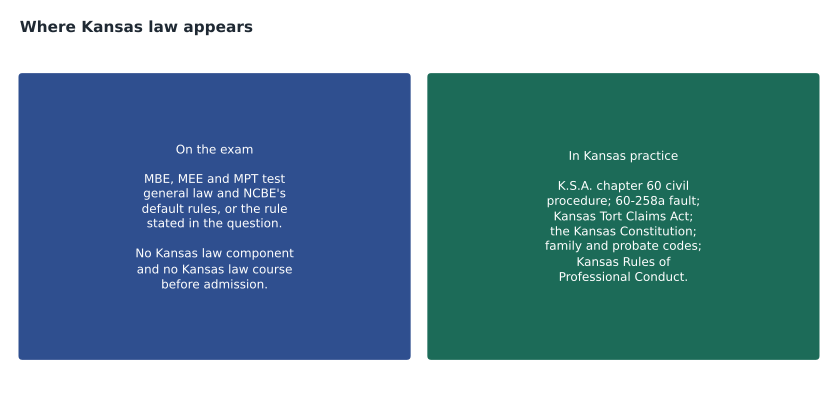
Many jurisdictions add something of their own to the national examination: a state law essay, a state law multiple-choice section, an online state law course or a state ethics test. Kansas adds none of these. NCBE's jurisdiction chart for Kansas lists no jurisdiction-specific component, and the Kansas Supreme Court's admission rules require no Kansas law course before or after admission.
The consequence for study is direct. A Kansas examinee prepares for the UBE in the same way as an examinee in any other UBE jurisdiction, using the same subject outlines, practice questions and essay materials. Kansas statutes and cases are not tested. An examinee who writes an essay applying a Kansas rule where it conflicts with the generally accepted rule loses points rather than gaining them.
The consequence for practice is just as direct. Nothing in the admission process ensures that a new Kansas lawyer knows Kansas law. That knowledge comes from law school courses, clerkships, continuing legal education and the first years of practice. The remaining lessons of this course are designed to give a new Kansas lawyer a head start on the Kansas rules met most often.
What rules the UBE tests
Each part of the UBE tells the examinee which body of law governs, either in general instructions or in the question.
On the MBE, civil procedure questions are governed by the Federal Rules of Civil Procedure and the statutes on federal jurisdiction and venue. Evidence questions are governed by the Federal Rules of Evidence. Contracts questions involving the sale of goods are governed by Article 2 of the Uniform Commercial Code, and other contracts questions by the common law as reflected in the general consensus of courts. Constitutional law questions are governed by the federal Constitution as interpreted by the United States Supreme Court. Criminal law, torts and real property questions follow the generally accepted or majority rules unless a question states that a particular statute or rule applies.
NCBE also tells examinees what to assume in torts when nothing else is stated. Its published MBE subject matter outline tells examinees that joint and several liability and pure comparative fault are the relevant rules unless otherwise indicated, and that survival actions and wrongful death claims are available. That default is the first place a Kansas lawyer's two rulebooks diverge, because Kansas has neither pure comparative negligence nor joint and several liability for negligence.
On the MEE, NCBE's grading materials state the generally accepted rules and, where jurisdictions differ significantly, note the alternatives. Some questions tell the examinee to apply a particular rule, such as the Uniform Probate Code or the Revised Uniform Partnership Act. An examinee who discusses the majority rule and notes a significant minority rule where the facts make it matter will usually receive full credit.
On the MPT, the law is in the Library. The jurisdiction is the fictional state of Franklin, and its cases and statutes may differ from any real state's. The examinee's task is to apply what the Library says, not what any state, including Kansas, actually does.
Where Kansas law differs: a map
Kansas law departs from the examination's default rules in many places. The following table shows the departures a new Kansas lawyer is most likely to meet early, with the lesson of this course that covers each.
| Topic | What the exam assumes | Kansas law | Lesson |
|---|---|---|---|
| Comparative fault | Pure comparative negligence unless otherwise stated | Modified comparative fault: the plaintiff recovers only if less at fault than the defendants (K.S.A. 60-258a) | 8 |
| Joint and several liability | Joint and several liability unless otherwise stated | Several liability only for negligence; each defendant pays its share | 8 |
| Caps on damages | No statutory caps unless stated | Noneconomic personal injury cap struck down in 2019; other limits remain | 7 and 8 |
| Claims against government | General sovereign immunity principles | Kansas Tort Claims Act: liability is the rule, with listed exceptions and a 500,000-dollar cap per occurrence | 9 |
| Civil procedure | Federal Rules of Civil Procedure | Kansas Code of Civil Procedure, K.S.A. chapter 60, modeled on the federal rules with differences | 7 |
| Evidence | Federal Rules of Evidence | Kansas Code of Evidence, K.S.A. 60-401 and following, a statutory code | 7 |
| Will execution | Generally accepted rules; holographic wills discussed | Written, signed and attested by two witnesses; unwitnessed holographic wills are not valid | 10 |
| Spousal rights at death | Elective share discussed generally | Augmented-estate elective share rising with length of marriage to 50 percent | 10 |
| Homestead | Varies by state | Constitutional homestead of 160 acres of farmland or one acre in town, without a dollar limit | 10 |
| Professional conduct | ABA Model Rules (on the MPRE) | Kansas Rules of Professional Conduct, with Kansas variations | 11 |
Civil procedure and evidence
Kansas civil procedure is governed by the Kansas Code of Civil Procedure, which makes up most of chapter 60 of the Kansas Statutes Annotated. Its general rules follow the structure and numbering of the Federal Rules of Civil Procedure, so that K.S.A. 60-212 corresponds to federal Rule 12, K.S.A. 60-256 to federal Rule 56 and so on. That design makes federal decisions persuasive in Kansas courts on many procedural questions. But the Kansas code differs from the federal rules in important details, and Kansas appellate decisions control in Kansas courts.
Kansas evidence law is also statutory, but it is not modeled on the Federal Rules of Evidence. The Kansas Code of Evidence, found in article 4 of chapter 60, was adopted in the 1960s from an earlier uniform code and has its own numbering and its own structure for hearsay and its exceptions. Many Kansas rules reach results similar to the federal rules, and the legislature has amended the code over the years to bring parts of it closer, for example in the treatment of expert testimony. But a Kansas litigator must cite and apply the Kansas code, not the Federal Rules of Evidence, in state court.
Expert testimony shows how the two systems have moved together and still differ in form. In 2014 the Kansas Legislature amended K.S.A. 60-456 so that an expert's opinion must rest on sufficient facts or data, be the product of reliable principles and methods and reflect a reliable application of those principles and methods to the facts. That language tracks federal Rule 702 and the reliability standard associated with the Daubert decision, which Kansas courts had not previously applied. A Kansas lawyer challenging an expert now makes an argument a federal litigator would recognize, but cites the Kansas statute and Kansas cases interpreting it.
The hearsay rules are a good place to see the difference in structure. The Kansas code states a general hearsay rule and then lists exceptions in a single long section, K.S.A. 60-460, organized by letter rather than the federal division between exceptions that apply regardless of the declarant's availability and exceptions that require unavailability. Many exceptions reach familiar results, but the conditions, the wording and the numbering are Kansas's own. On the MBE, Jolene answers hearsay questions under the federal rules; at the Ellis County courthouse she will cite the Kansas section and its lettered subsections.
Lesson 7 covers the Kansas courts and the features of Kansas procedure a new lawyer meets first.
Torts and claims against government
The largest practical gap between the exam's rules and Kansas law is in torts. Kansas has modified comparative fault under K.S.A. 60-258a: a plaintiff recovers only if the plaintiff's causal negligence is less than the causal negligence of the parties against whom the claim is made, and the recovery is reduced by the plaintiff's share. A plaintiff found 50 percent at fault recovers nothing. Kansas also abolished joint and several liability among negligent defendants, so each defendant pays only its own share, and fault can be allocated to people who are not parties. Lesson 8 explains these rules and how Kansas courts treat damages, including the 2019 decision striking down the statutory cap on noneconomic damages in personal injury cases.
Claims against Kansas governmental entities run through the Kansas Tort Claims Act, which makes governmental entities liable for their employees' negligence as a private person would be, subject to a list of exceptions and a cap of 500,000 dollars per occurrence. Claims against cities, counties and other municipalities require written notice before suit. Lesson 9 covers the Act.
Family, property and estates
Kansas property and estates law departs from the exam's generic rules in several ways a rural practice meets constantly. Kansas does not recognize unwitnessed holographic wills; a will must be in writing, signed at the end and attested by two competent witnesses. A surviving spouse's elective share is measured against an augmented estate and grows with the length of the marriage, reaching 50 percent after fifteen years. The Kansas Constitution protects a homestead of up to 160 acres of farming land or one acre within a city from forced sale, with no limit on value. And Kansas divorce law has its own grounds and a statutory limit on the length of maintenance. Lesson 10 covers these rules.
Professional conduct
The MPRE tests the ABA Model Rules. Kansas lawyers practice under the Kansas Rules of Professional Conduct, adopted by the Kansas Supreme Court as Rule 226. The Kansas Rules follow the Model Rules closely but not completely, and Kansas has not adopted every Model Rule amendment. Lesson 11 notes the variations that matter most.
Keeping two rulebooks
Marchetti teaches a few habits for living with two rulebooks during the study period.
First, study the exam's rules as the exam states them. When a review course outline says that the MBE assumes pure comparative negligence and joint and several liability, learn that, and answer MBE questions that way. Do not let a summer of Kansas car-wreck cases pull your answers toward modified comparative fault.
Second, keep a short list of Kansas differences, separate from your study materials. Jolene kept hers on a single index card taped inside her MBE book: modified comparative fault at 50 percent; several liability; two witnesses, no holographic wills; elective share by years of marriage; homestead 160 acres. Writing the differences down in one place makes it easier to keep them out of exam answers.
Third, read every question for the rule it tells you to apply. Many MBE and MEE questions say something like in a jurisdiction that has adopted modified comparative negligence or the jurisdiction has a statute providing. When a question states a rule, apply that rule, even if it is not the default.
Fourth, after the exam, switch rulebooks deliberately. The first weeks of practice after admission are when the exam's defaults are freshest and most dangerous. A new lawyer who tells a client that a co-defendant will have to pay the whole judgment if the trucking company is insolvent has carried the exam's joint and several liability rule into a Kansas courtroom.
Worked problem
One accident, two answers
A pickup driven by Dale collides with a semi on a Kansas highway. Dale is found 30 percent at fault, the trucking company 50 percent and a road contractor 20 percent. Dale's damages are 200,000 dollars. The trucking company is insolvent. How much can Dale collect from the road contractor under the MBE's default rules, and how much under Kansas law?
Show solution
- MBE default: pure comparative negligence reduces Dale's recovery by his 30 percent share, to 140,000 dollars.
- MBE default: joint and several liability makes each defendant liable for the whole 140,000 dollars, so Dale can collect it all from the contractor, which may seek contribution.
- Kansas: Dale's 30 percent is less than the defendants' combined 70 percent, so he may recover under K.S.A. 60-258a.
- Kansas: liability is several only, so each defendant pays its own share; the contractor owes 20 percent of 200,000, or 40,000 dollars.
- Kansas: the insolvent trucking company's 100,000-dollar share is not shifted to the contractor.
Answer: On the MBE, Dale can collect 140,000 dollars from the contractor. In Kansas, he can collect only 40,000 dollars from it.
Common mistakes
MistakeKansas tests Kansas law on its bar examination.
InsteadKansas gives the UBE with no Kansas component; Kansas law is not tested.
MistakeWriting the Kansas rule on an MEE essay earns extra credit.
InsteadMEE answers are graded on generally accepted rules; applying a conflicting Kansas rule usually costs points.
MistakeThe Kansas Code of Evidence mirrors the Federal Rules of Evidence.
InsteadThe Kansas Code of Evidence is a separate statutory code in K.S.A. chapter 60, article 4, with its own structure.
MistakeThe MBE's joint and several liability default applies in Kansas practice.
InsteadKansas uses several liability only for negligence claims.
MistakeThe MPT uses the law of the state where you sit.
InsteadThe MPT uses the law in its Library, set in the fictional state of Franklin.
Summary and key terms
- Kansas adds no Kansas component to the UBE and requires no Kansas law course; Kansas law is not tested.
- The MBE uses the federal rules for civil procedure and evidence and generally accepted rules elsewhere; in torts it assumes pure comparative negligence and joint and several liability unless stated otherwise.
- Kansas uses modified comparative fault and several liability, a statutory evidence code and the Kansas Tort Claims Act.
- Kansas wills require two witnesses, the elective share grows with years of marriage and the homestead has no dollar limit.
- Study the exam's rules for the exam, keep a separate list of Kansas differences and switch rulebooks deliberately after admission.
- Jurisdiction-specific component
- A state law part added to the national examination; Kansas has none.
- Kansas Code of Civil Procedure
- The Kansas civil procedure rules in K.S.A. chapter 60, modeled on the federal rules.
- Kansas Code of Evidence
- The statutory evidence code in article 4 of K.S.A. chapter 60.
- Default rule
- The rule an examination assumes applies unless a question states otherwise.
- Franklin
- The fictional jurisdiction in which MPT tasks are set.
Lesson quiz · 5 questions
Score 60% or more to complete this lesson.
Create a free account to save your progress, take quizzes and earn a certificate.