
BAR-217 · Lesson 4 of 12 · 16 min
The Kansas bar exam: format, scoring and passing score
▶ Video coming soon A video version of this lesson is on the way.
Jolene had taken a review course's diagnostic test and scored well on the multiple-choice section and poorly on the essays. 'I keep hearing that the MBE is half the score,' she told Marchetti. 'So if I just get the MBE up, do the essays even matter?'
Marchetti pulled up a spreadsheet she keeps for every candidate. 'The MBE is half,' she said. 'The other half is writing. Kansas does not care how you get to 266, but nobody I have coached got there by ignoring half the exam. What we will do is figure out how many points you need from each part, and then spend your hours where the points are cheapest.'
This lesson explains the format of the Kansas examination, how each part is graded and scaled, how the parts combine into a UBE score, what the passing score of 266 means in practice and how results and retakes work. The examination described here is the legacy UBE that Kansas will give through February 2028. Lesson 5 covers the NextGen examination that replaces it in July 2028.
The two days
Kansas gives the examination on the last consecutive Tuesday and Wednesday of February and July. For 2027 that means February 23 and 24 and July 27 and 28. The examination follows the standard UBE schedule.
Day one is the written day. In the morning, examinees complete two Multistate Performance Test (MPT) tasks, each allotted ninety minutes. In the afternoon, they write six Multistate Essay Examination (MEE) essays, each allotted about thirty minutes, in a single three-hour session.
Day two is the MBE. Examinees answer 200 multiple-choice questions in two three-hour sessions of 100 questions each. Of the 200 questions, 175 are scored and 25 are unscored pretest questions mixed in so that examinees cannot tell them apart.
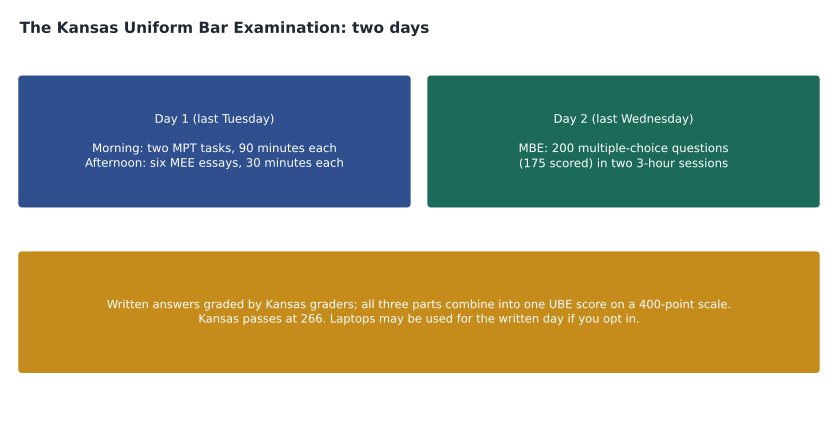
Kansas lets examinees use a laptop for the written day if they opt in and follow the Board's software instructions. Examinees who do not opt in, or whose laptops fail, write by hand. The Board's instructions set the deadlines for registering a laptop and installing the examination software, and those deadlines are separate from the application deadlines.
The MPT
The MPT tests lawyering skills rather than knowledge of substantive law. Each task gives the examinee a File, containing the facts in the form of documents such as a memo from a supervising partner, interview notes, letters, contracts or pleadings, and a Library, containing the cases, statutes and regulations needed to complete the task. The law in the Library may be real, modified or invented, and it is set in a fictional jurisdiction called Franklin. The examinee must complete a specific task, such as an objective memo, a persuasive brief, a client letter, a demand letter, a contract provision or a closing argument.
The MPT rewards three skills: following the instructions in the task memo precisely, organizing the analysis around the law in the Library rather than the law the examinee remembers and using the facts in the File. A ninety-minute task typically allows about forty-five minutes for reading and organizing and forty-five minutes for writing.
The MEE
The MEE consists of six thirty-minute essays. Each essay presents a fact pattern and asks one or more questions. The subjects that may be tested are business associations (agency and partnership, corporations and limited liability companies), civil procedure, conflict of laws, constitutional law, contracts and sales, criminal law and procedure, evidence, family law, real property, torts, trusts and estates (decedents' estates, trusts and future interests) and secured transactions under Article 9 of the Uniform Commercial Code. An essay may combine subjects.
MEE answers are graded against NCBE's model analysis, which states the generally accepted rules and how they apply to the facts. Where jurisdictions differ on a rule, the MEE either tells the examinee which rule to apply or expects a discussion of the majority approach. Examinees in Kansas are not graded on Kansas law.
The MBE
The MBE tests seven subjects: civil procedure, constitutional law, contracts, criminal law and procedure, evidence, real property and torts. Questions are roughly evenly distributed across the subjects. Each question has four answer choices, and examinees are not penalized for wrong answers, so every question should be answered.
The MBE tests generally accepted rules. For civil procedure and evidence, the rules are the Federal Rules of Civil Procedure and the Federal Rules of Evidence, along with federal jurisdiction statutes. For contracts, sales questions follow Article 2 of the Uniform Commercial Code. For criminal law and torts, the questions follow the majority approach unless the question states a different rule.
How the parts are graded and scaled
The MBE is scored by NCBE. Each examinee's raw score, the number of scored questions answered correctly, is converted to a scaled score through equating, a statistical process that adjusts for small differences in difficulty between administrations. The MBE scaled score is reported on a scale on which 200 is the maximum in practice.
The MEE and MPT are graded in Kansas by graders the Board selects and trains. Graders use NCBE's grading materials and attend calibration sessions so that they grade consistently. Each answer receives a raw grade on the Board's scale. The raw written grades are then scaled to the MBE: the distribution of written scores among Kansas examinees is matched to the distribution of their MBE scores. That process means a written score depends on how an examinee performed relative to others in Kansas at the same administration, measured on the MBE's scale.
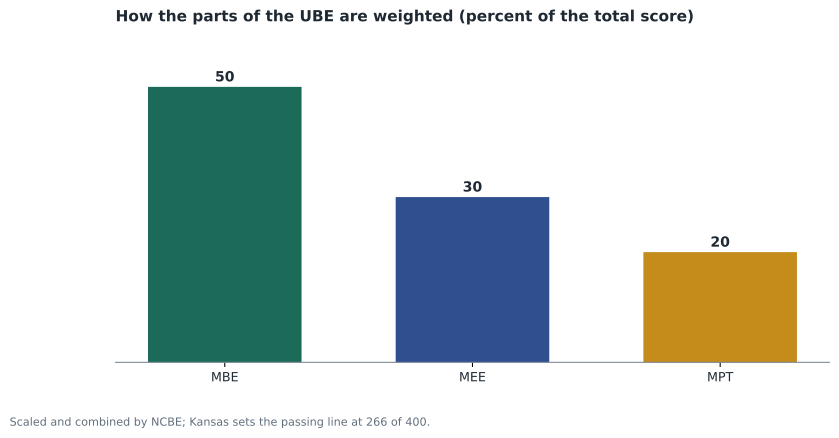
The total UBE score is the sum of the scaled MBE score and the scaled written score, with the parts weighted as follows.
| Part | Weight | What it measures |
|---|---|---|
| MBE | 50 percent | Seven subjects tested in 200 multiple-choice questions |
| MEE | 30 percent | Six essays on up to twelve subjects |
| MPT | 20 percent | Two performance tasks testing lawyering skills |
What 266 means
Kansas passes an examinee whose total UBE score is 266 or higher. There is no minimum score on any part. An examinee with an MBE scaled score of 140 and a scaled written score of 126 passes with 266, and so does an examinee with 126 on the MBE and 140 on the written portion.
Because the written score is scaled to the MBE and doubled to reach the 400-point scale, a convenient way to think about 266 is as an average of 133 across the two halves. An examinee whose MBE scaled score is 133 needs written work worth 133 on the MBE scale. Each point the examinee gains on the MBE reduces the written score needed by the same amount, and the reverse.
Kansas's 266 is in the middle of the UBE range. UBE jurisdictions set passing scores from 260 to 270, with Alaska higher, and 266 is shared by a large group of states. A score of 266 to 269 earned in Kansas passes in Kansas but falls short in jurisdictions that require 270. That matters to examinees who plan to transfer their score, a topic in Lesson 11.
Worked problem
How many points from each part?
Jolene's diagnostic suggests an MBE scaled score of about 138 and a written performance that would scale to about 122. Does she pass, and how should she use her study time?
Show solution
- Total estimated score: 138 plus 122 equals 260, which is 6 points short of 266.
- She needs 6 more points from some combination of the MBE and the written portion.
- Raising the written score by 6 points may be easier than raising the MBE by 6, because she has more room to improve on essays.
- MEE structure and issue spotting, and MPT time management, are likely the cheapest points.
- She should keep MBE practice going so that score does not fall while she works on the written day.
Answer: At the diagnostic level Jolene would miss by 6 points. Her plan is to protect her MBE score and spend extra hours on the MEE and MPT, where she has the most room to gain.
Writing an essay graders can score
Because Kansas graders read hundreds of essays against the same grading materials, an essay earns points when the grader can find each issue, rule and conclusion quickly. Marchetti teaches a plain structure for every MEE answer. Each question in the call gets its own heading that repeats the question in a few words. Under each heading, the answer states the conclusion in one sentence, then the rule, then the application to the specific facts, then the conclusion again. The structure is IRAC with the conclusion moved to the front, and graders reward it because it lets them award points without searching.
The rule statement matters more than examinees expect. A grader looking for the elements of adverse possession, the test for personal jurisdiction or the requirements for a valid holographic will gives credit for each element stated accurately. A vague rule statement followed by good analysis earns less than a precise rule statement followed by adequate analysis.
Application is where most points are won or lost. Graders want to see the facts in the essay used to decide each element. A sentence such as the facts show possession was open and notorious earns little. A sentence explaining that the fence was visible from the county road and the neighbor mowed inside it every summer for twelve years earns the point.
Time discipline holds the day together. Six essays in three hours leaves thirty minutes each. Spending forty-five minutes on a favorite subject means a rushed or unfinished essay later, and an unfinished essay is the most expensive mistake on the written day. Examinees should move on when the time is up, leaving a note of the remaining issues if necessary.
Working an MPT under time pressure
The MPT rewards a disciplined reading order. Marchetti's approach is to read the task memo first and twice, because it states exactly what to produce and often tells the examinee what not to address. Then the examinee reads the Library, taking notes on the rules and the factors courts have weighed, and only then reads the File, matching facts to the rules just learned. Reading the File first tempts examinees to analyze the facts with law they remember rather than the law they are given.
The format of the product is part of the grade. If the task memo asks for a persuasive brief with point headings, the answer needs point headings that state the argument. If it asks for a client letter, the answer must be written for a client, without legal jargon. An answer that is analytically strong but ignores the requested format leaves points on the table.
Results
After the examination, the Board grades the written answers and NCBE equates and scales the scores. Results are released by the Board on the date it announces, usually a few months after the examination. Examinees receive their own results through the Attorney Admissions office, and the Board publishes statistics on pass rates.
The Attorney Admissions office's instructions make one point clearly: a failing score is final. Kansas does not regrade answers or entertain appeals of a failing score. An examinee who fails must apply for a later examination.
Examinees who fail receive their scaled scores, which tell them how far they were from 266 and which half of the examination was stronger. Those numbers are the starting point for the next study plan.
Retakes and the reuse of scores
Kansas sets no limit on the number of times an applicant may sit. A retaker files a new application for the next examination, meets the deadlines and pays the fee again. Kansas, like other UBE jurisdictions, does not let examinees combine the best MBE from one administration with the best written score from another; each UBE score is the combined score from a single administration.
Kansas does allow examinees to use an MBE score earned at another administration in limited circumstances under its rules, and NCBE's chart for Kansas lists MBE score transfers as permitted. An examinee considering that option should read the rule and ask the Attorney Admissions office before relying on it.
Planning the study period
Most successful Kansas examinees study full time for eight to ten weeks before the examination, or part time for a longer period. Marchetti's plan for Jolene, who works at the Hays firm, has three phases: a content phase for the MBE and MEE subjects, a practice phase built around timed questions and essays and a final phase of full-length simulations.
The plan balances the parts according to their weight. About half of study time goes to MBE subjects and practice questions. About a third goes to the MEE, with heavy emphasis on writing practice essays under time limits and comparing them with model analyses. The rest goes to the MPT, including at least four full practice tasks under ninety-minute limits.
Exam-day rules
The Board's exam-day instructions cover admission tickets and identification, prohibited items, breaks, the use of laptops and what happens if an examinee is late or ill. They are strict and enforced. Electronic devices other than an approved laptop are prohibited in the testing room. Examinees should read the instructions when they arrive and again a week before the examination. Lesson 12 builds a full exam-day plan.
Common mistakes
MistakeThe MBE is the only part that matters.
InsteadThe MBE is half the score; the MEE and MPT together are the other half.
MistakeKansas requires a minimum score on each part.
InsteadKansas passes examinees on the combined score of 266, with no minimum on any part.
MistakeMEE essays are graded on Kansas law.
InsteadMEE answers are graded on generally accepted rules using NCBE's grading materials.
MistakeA failing score can be appealed or regraded.
InsteadIn Kansas a failing score is final; the examinee must retake.
MistakeA Kansas score of 266 passes everywhere.
InsteadJurisdictions set their own passing scores; 266 falls short of 270 in some states.
Summary and key terms
- Kansas gives the UBE on the last consecutive Tuesday and Wednesday of February and July: two MPT tasks and six MEE essays on day one, the 200-question MBE on day two.
- The MBE counts for 50 percent, the MEE for 30 percent and the MPT for 20 percent of the 400-point score.
- Kansas graders grade the MEE and MPT, and the written score is scaled to the MBE.
- Kansas passes examinees with a combined score of 266 and sets no minimum on any part.
- A failing score is final; Kansas sets no limit on attempts.
- MPT
- The Multistate Performance Test, which tests lawyering skills using a File of facts and a Library of law.
- MEE
- The Multistate Essay Examination, six thirty-minute essays on generally accepted rules.
- MBE
- The Multistate Bar Examination, 200 multiple-choice questions on seven subjects.
- Scaling
- Converting raw written scores to the MBE's scale so that the parts can be combined.
- Equating
- The statistical process that adjusts MBE scores for differences in difficulty between administrations.
Lesson quiz · 5 questions
Score 60% or more to complete this lesson.
Create a free account to save your progress, take quizzes and earn a certificate.