
BAR-222 · Lesson 11 of 12 · 17 min
Score transfer, admission on motion, the Rules of Professional Conduct and practice after admission
▶ Video coming soon A video version of this lesson is on the way.
Maureen Tobin was thinking about hiring. Her firm wanted a second associate in 2027, and two candidates had written to her. One had passed the UBE in New Hampshire in July 2025 and was working for a legal aid office in Manchester. The other was a lawyer admitted in Connecticut in 2018 who had practiced at a Hartford firm ever since and wanted to move closer to family in Springfield. Tobin asked Declan, who had just spent three months reading Rule 3:01, how each could become a Massachusetts lawyer, and what the firm would need to teach either one about practicing in Massachusetts.
This lesson covers admission by score transfer, admission on motion and other ways out-of-state lawyers work in Massachusetts, then turns to what follows admission: registration, the absence of mandatory continuing education, the Massachusetts Rules of Professional Conduct and the discipline system.
Admission by UBE or NextGen score transfer
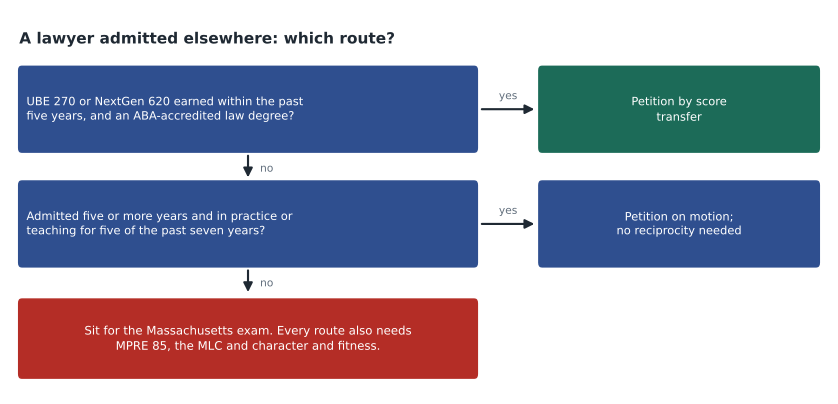
A candidate who earned a qualifying score on the UBE in another jurisdiction may petition for admission in Massachusetts without sitting for the Massachusetts exam. The board's eligibility requirements for transfer are these.
The total UBE score must be 270 or higher. For NextGen scores, which Massachusetts has accepted beginning with the July 2026 exam, the total must be 620 or higher.
The score must have been earned at an exam within five years. The board's eligibility page and Rule 3:01 both state the five-year limit. One older board page has described the period as 36 months; where the two differ, the rule controls, and a candidate close to either line should confirm with the board in writing before filing.
The candidate must have passed the MPRE with a scaled score of 85 or higher, must have graduated from an ABA-accredited law school, and must request that NCBE transfer the score to Massachusetts, including confirmation of the request with the petition.
The candidate must also pass the Massachusetts Law Component, as soon as the board invites them, and satisfy the board's character and fitness review. The petition fee for transfer is 815 dollars as of November 2026.
Tobin's New Hampshire candidate fit the transfer route neatly: a UBE score from July 2025 would be well within five years, and his score report showed 276. He would need to confirm his MPRE score of at least 85, file the petition with the transfer confirmation, take the MLC promptly and wait for the character and fitness review.
Admission on motion
Section 6 of Rule 3:01 allows experienced lawyers to be admitted without examination. A petitioner must have been admitted to practice in the highest court of another state, the District of Columbia or a United States territory for at least five years, and must have been actively engaged in the practice or teaching of law for at least five of the seven years immediately before filing. The board will decline to waive the exam if it is not satisfied that the petitioner was actively engaged in practice or teaching for that period.
Qualifying practice is defined broadly. It includes private practice, work as a government lawyer, service as a judge or law clerk in some circumstances, in-house counsel work, military legal service and full-time teaching at an approved law school. It must have been the lawful practice of law where it was performed.
Massachusetts does not require reciprocity. A lawyer from a state that does not admit Massachusetts lawyers on motion may still be admitted on motion in Massachusetts if they meet the requirements. That is a meaningful difference from the many states that admit on motion only lawyers from states that return the favor.
Motion petitioners must also pass the MPRE with 85, pass the MLC, meet the education requirements, supply three letters of recommendation and certificates of good standing, and complete character and fitness review. The petition fee is 1,015 dollars as of November 2026. A foreign-educated lawyer must first obtain a determination of educational sufficiency from the board, which the board says takes at least four months after it receives the documents. Rule 3:01 also contains a separate provision for lawyers admitted in Canada. The board asks that eligibility questions be sent in writing to its executive director before filing.
Tobin's Connecticut candidate, admitted in 2018 and in practice continuously since, met the five-years-admitted and five-of-seven-years tests easily. She would petition on motion, with three recommendation letters, a Connecticut certificate of good standing, her MPRE score and the MLC.
| Candidate | Best route | What remains |
|---|---|---|
| UBE 276 in New Hampshire, July 2025 | Score transfer | MPRE confirmation, transfer request, MLC, character and fitness |
| Connecticut lawyer admitted 2018, practicing since | Admission on motion | Three letters, good standing, MPRE, MLC, character and fitness |
| UBE 268 in a 266 jurisdiction, 2024 | Neither: score below 270 | Sit for the Massachusetts exam, or wait for motion eligibility |
| Lawyer admitted three years ago in a non-UBE state | Not yet motion-eligible | Sit for the exam, or wait until five years admitted |
Other ways to work in Massachusetts
A lawyer admitted elsewhere may appear in a particular Massachusetts case by leave of the court, known as admission pro hac vice, under the court's rules, usually with a Massachusetts lawyer as local counsel. Law students may practice under supervision under the Supreme Judicial Court's student practice rule. These limited authorizations are not a substitute for admission for anyone who plans to practice in Massachusetts regularly.
After admission: registration
Every Massachusetts lawyer must register with the Board of Bar Overseers each year and pay the annual registration fee, which funds the discipline system, the Clients' Security Board and other programs. Registration requires current contact information and disclosures, including whether the lawyer maintains client trust accounts. A lawyer who fails to register may be administratively suspended.
Massachusetts lawyers who hold client funds must comply with the trust account rules in Rule 1.15 of the Rules of Professional Conduct, including the use of IOLTA accounts for nominal or short-term client funds.
No mandatory CLE
Massachusetts is one of the few states that do not require continuing legal education. The Supreme Judicial Court once required newly admitted lawyers to complete a one-day Practicing with Professionalism course under SJC Rule 3:16, but the court repealed that rule effective August 14, 2024. A lawyer admitted in Massachusetts today has no mandatory course to take.
That does not mean Massachusetts lawyers stop learning. The Rules of Professional Conduct require competence, and the voluntary bar associations and Massachusetts Continuing Legal Education, a nonprofit, offer a wide range of programs. Marchetti's advice to Declan was to choose his own first-year curriculum: trial practice, chapter 93A, probate and trust accounting, at a minimum.
The Massachusetts Rules of Professional Conduct
The Massachusetts Rules of Professional Conduct are Supreme Judicial Court Rule 3:07. They follow the numbering and much of the text of the ABA Model Rules, but they differ in places that matter in daily practice. Because the MPRE tests the Model Rules, Massachusetts lawyers must learn the differences separately, and the MLC tests them.
Fees. Rule 1.5 is the clearest example. The Massachusetts rule prohibits a fee that is illegal or clearly excessive, keeping a standard from the older Code of Professional Responsibility, whereas the Model Rule speaks of unreasonable fees. Massachusetts also requires that the scope of the representation and the basis or rate of the fee and expenses be communicated to the client in writing before or within a reasonable time after commencing the representation, with exceptions for a regularly represented client charged on the same basis, a single-session consultation, a fee expected to be under 500 dollars, and certain court-appointed indigent representation. Changes in the fee basis must also be in writing.
Contingent fees. A Massachusetts contingent fee agreement must be in writing and signed in duplicate by both the lawyer and the client within a reasonable time after the representation begins, and it must contain specific terms, including the names and addresses of the parties, the nature of the claim, the method of calculating the fee, how expenses are handled and what happens if the representation ends early. The lawyer must keep a copy for six years after the matter concludes and give the client a written statement at the end. The rule includes model forms.
Fee division. Lawyers in different firms may divide a fee only if the client is told before or at the time of the fee agreement, consents in writing, and the total fee is reasonable. Unlike the Model Rule, the Massachusetts rule does not require the division to be in proportion to the services performed or require each lawyer to assume joint responsibility.
The 2022 amendments. By an order of July 13, 2022, effective October 1, 2022, the Supreme Judicial Court made a large set of amendments. They added a definition of confidential information to Rules 1.0 and 1.6, added a prohibition in Rule 1.8(j) on coercing or requiring sexual relations with clients, added Rule 4.4(a)(3), which bars conduct in representing a client that manifests bias or prejudice based on protected characteristics, revised the rules on financial assistance to indigent clients, and replaced the advertising rules with a shorter Rules 7.1 to 7.3. The court has amended Rule 3:07 again since, and a new lawyer should read the current text rather than rely on a summary.
| Topic | ABA Model Rule | Massachusetts Rule 3:07 |
|---|---|---|
| Fee standard | Unreasonable fee prohibited | Illegal or clearly excessive fee prohibited |
| Written fee terms | Preferably in writing | Must be in writing, with listed exceptions including fees under 500 dollars |
| Contingent fee | In writing, signed by client | In writing, signed in duplicate by lawyer and client, with prescribed contents and six-year retention |
| Fee division | Proportional or joint responsibility, client agreement in writing | Client told in advance and consents in writing; no proportionality requirement |
| Bias in representation | Rule 8.4(g) in the Model Rules | Rule 4.4(a)(3), effective October 1, 2022 |
Discipline
Complaints against Massachusetts lawyers go to the Office of Bar Counsel, which screens and investigates them under the Board of Bar Overseers. Most complaints are resolved without discipline. When bar counsel brings formal charges, a hearing committee or special hearing officer hears the case and reports to the board, which may impose or recommend a sanction. The Supreme Judicial Court decides cases involving suspension or disbarment. Public reprimand, suspension and disbarment are public sanctions; an admonition is a lesser sanction.
Declan's memo
Declan's memo to Tobin was a page and a half. The New Hampshire candidate could transfer his 276 UBE score; the Connecticut candidate could be admitted on motion without reciprocity; both would need the MLC and character and fitness clearance. Either new associate would need to learn the Massachusetts fee rules before signing a single engagement letter or contingent fee agreement, since the firm's injury practice ran on contingent fees. Tobin circled that last line and asked Declan to prepare a short training session on Rule 1.5 for whoever joined.
Common mistakes
MistakeTransferring a UBE score below 270.
InsteadMassachusetts requires 270 on the UBE or 620 on NextGen.
MistakeAssuming admission on motion requires reciprocity.
InsteadMassachusetts admits on motion without regard to whether the other state admits Massachusetts lawyers.
MistakePlanning for mandatory CLE or the Practicing with Professionalism course.
InsteadMassachusetts has no mandatory CLE, and Rule 3:16 was repealed effective August 14, 2024.
MistakeUsing an oral fee agreement for an ordinary matter.
InsteadRule 1.5(b) requires written fee terms except in listed situations.
MistakeUsing a contingent fee agreement signed only by the client.
InsteadMassachusetts requires a writing signed in duplicate by lawyer and client, with prescribed contents.
Practice problems
Work each problem on paper first, then reveal the answer to check.
What UBE score and age does Massachusetts require for transfer?
Show answer
270 or higher, earned within five years.
What practice record does admission on motion require?
Show answer
At least five years admitted elsewhere and active practice or teaching in five of the seven years before filing.
Does Massachusetts require mandatory CLE?
Show answer
No; it is one of the few states that do not.
What fee standard does Massachusetts Rule 1.5(a) use?
Show answer
Illegal or clearly excessive.
Choosing between routes
Some lawyers qualify for more than one route. A lawyer admitted in another UBE jurisdiction four years ago with a 280 score could transfer the score now or wait a year and petition on motion. Transfer is usually faster and cheaper, and it avoids the need to document five years of practice. Motion may suit a lawyer whose score is too old or too low to transfer. Either way, the MPRE, the MLC and character and fitness review apply, so the choice turns on the score, the dates and the lawyer's practice record.
Summary and key terms
- Score transfer requires UBE 270 or NextGen 620 within five years, an ABA-accredited law degree, MPRE 85, the MLC and character and fitness.
- Admission on motion requires five years of admission and practice or teaching in five of the past seven years, without reciprocity.
- After admission, lawyers register annually with the Board of Bar Overseers and follow the trust account rules.
- Massachusetts has no mandatory CLE; Rule 3:16 was repealed effective August 14, 2024.
- The Massachusetts Rules of Professional Conduct differ from the Model Rules, notably on fees, contingent fee agreements and fee division, and were broadly amended effective October 1, 2022.
- Score transfer
- Admission based on a qualifying UBE or NextGen score earned elsewhere.
- Admission on motion
- Admission without examination for experienced lawyers admitted elsewhere.
- Reciprocity
- A requirement that the other state admit the first state's lawyers on similar terms; Massachusetts does not impose it.
- SJC Rule 3:07
- The Massachusetts Rules of Professional Conduct.
- Office of Bar Counsel
- The office that investigates and prosecutes complaints against Massachusetts lawyers.
- IOLTA
- Interest on lawyers' trust accounts, used for nominal or short-term client funds.
Lesson quiz · 5 questions
Score 60% or more to complete this lesson.
Create a free account to save your progress, take quizzes and earn a certificate.