
BAR-222 · Lesson 4 of 12 · 19 min
The Massachusetts bar exam: the UBE, scoring and the 270 passing score
▶ Video coming soon A video version of this lesson is on the way.
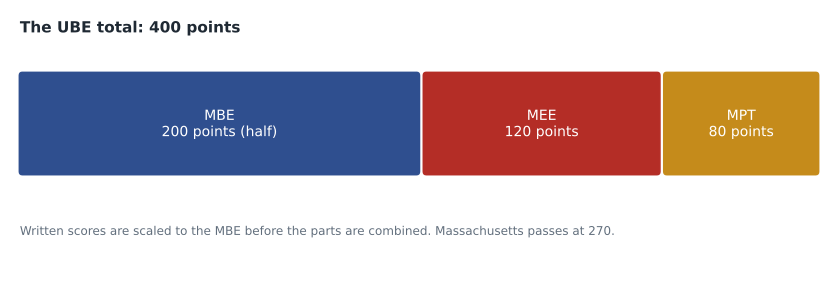
Declan's first practice MBE came back with a raw score he did not like, and he spent the next Tuesday asking Marchetti what it meant. Could he still pass? How much did the essays count? Was there a minimum on each part? Marchetti drew a single bar on the shared screen, split it into three pieces and wrote 270 above it. 'Everything you need to know about scoring is in this picture,' she said, 'and everything you need to do about it is in your study plan.'
This lesson explains what the Uniform Bar Examination is, how it is built, how it is scored and scaled, and what Massachusetts's passing score of 270 means in practice.
Massachusetts and the UBE
Massachusetts adopted the Uniform Bar Examination and first administered it in July 2018. Before then, the Massachusetts exam combined the MBE with essay questions written in Massachusetts and tested on Massachusetts law. The move to the UBE replaced those essays with the national Multistate Essay Examination and added the Multistate Performance Test. To keep a Massachusetts element in the admission process, the Supreme Judicial Court created the Massachusetts Law Component at the same time, as a separate requirement outside the exam itself. Lesson 6 covers it.
The UBE is prepared by the National Conference of Bar Examiners and administered, graded and scored by each jurisdiction that uses it. Every UBE jurisdiction gives the same questions on the same days, weights the parts the same way and reports scores on the same scale. That uniformity is what makes UBE scores portable: a score earned in Massachusetts can be transferred to another UBE jurisdiction, and a score earned elsewhere can be transferred into Massachusetts, subject to each jurisdiction's own passing score and time limits.
The three parts
The Multistate Bar Examination is a 200-question multiple-choice test given in two three-hour sessions on the second day. Of the 200 questions, 175 are scored and 25 are unscored pretest questions mixed in among them, so a candidate cannot tell which questions count. The MBE covers seven subjects: civil procedure, constitutional law, contracts, criminal law and procedure, evidence, real property and torts.
The Multistate Essay Examination is six 30-minute essay questions given in the afternoon of the first day. MEE questions may test any of the MBE subjects and also business associations, conflict of laws, family law, secured transactions, and trusts and estates. A single question can mix subjects, and the general principles of American law, not the law of any one state, supply the answer.
The Multistate Performance Test is two 90-minute tasks given in the morning of the first day. Each task gives the candidate a File of facts and documents and a Library of legal authorities, often from a fictional jurisdiction, and asks for a practical piece of legal writing such as an objective memo, a persuasive brief, a client letter or a demand letter. The MPT tests lawyering skills rather than memorized law: everything needed to answer is in the packet.
| Part | Format | Time | Weight in total score |
|---|---|---|---|
| MPT | Two performance tasks | 90 minutes each, first morning | 20 percent |
| MEE | Six essay questions | 30 minutes each, first afternoon | 30 percent |
| MBE | 200 multiple-choice questions (175 scored) | Two three-hour sessions, second day | 50 percent |
From raw answers to a scaled score
A candidate's MBE answers produce a raw score, the number of scored questions answered correctly. NCBE then converts the raw score to a scaled score through a statistical process called equating. Equating adjusts for small differences in difficulty between exam forms, so that a scaled score means the same level of performance whether a candidate sat in an easier or a harder administration. MBE scaled scores run from roughly 40 to 200, and the national average typically falls in the low 140s, varying from one administration to another.
The written parts, the MEE and MPT, are graded by graders in each jurisdiction. Massachusetts graders read each answer and assign a raw grade using NCBE's grading materials and a calibration process designed to keep grading consistent. The raw written grades are then scaled to the MBE. Scaling to the MBE means that the written scores are converted so that they have the same mean and spread as the MBE scores of the same group of candidates in that jurisdiction. The process ties the written scores to the equated MBE, so that a strong essay performance in a strong group is not penalized and a weak group does not get an easy ride.
The scaled MBE and the scaled written score are then combined. On the 400-point UBE scale, the MBE contributes half, the MEE 30 percent and the MPT 20 percent. In practice, a candidate's total is close to the sum of the scaled MBE score and the scaled written score, each on a 200-point scale.
Compensatory scoring and the 270 line
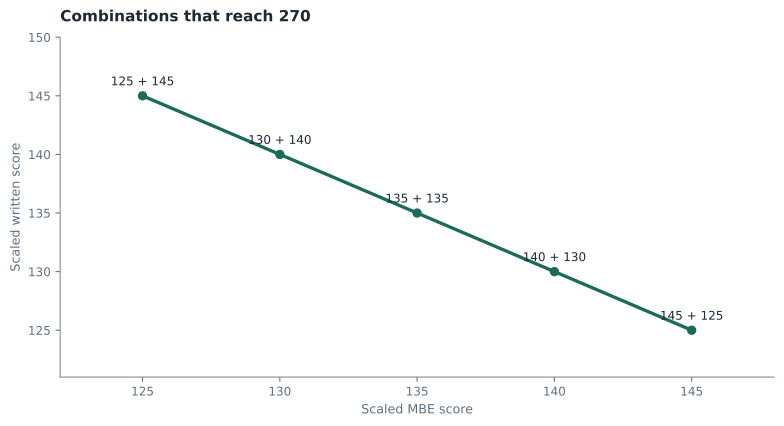
Massachusetts requires a total UBE score of 270 to pass. The UBE is scored compensatorily: there is no minimum score on any part. A strong MBE can make up for weaker essays, and strong essays can make up for a weaker MBE. Only the total counts.
That has two consequences for study. First, no part can be neglected. A candidate who writes off the MPT because it is only 20 percent is giving away points that are among the easiest on the exam to earn with practice. Second, a candidate who is weak in one part should look for gains in the others as well. A few extra MBE points are often easier to find than a large jump in essay grades.
Marchetti's rough rule of thumb is to think of 270 as 135 plus 135. A candidate whose scaled MBE score is 135 needs a scaled written score of about 135. A candidate with an MBE of 145 needs a written score of only about 125, and a candidate with an MBE of 128 needs a written score of about 142. The scaled written score for a given candidate is hard to predict precisely before results, so candidates should aim comfortably above the line rather than at it.
How 270 compares
UBE jurisdictions set their own passing scores, which currently range from 260 to 270. Massachusetts is at the top of that range, along with several other jurisdictions. A candidate who earns 266 might pass in a jurisdiction that requires 266 but not in Massachusetts. The difference also matters for transfer: a candidate who passed in a 260 jurisdiction with a 262 cannot transfer that score into Massachusetts, while a Massachusetts candidate who earns 270 or more can transfer the score anywhere that accepts it within that jurisdiction's time limit.
| Total UBE score | Massachusetts (270) | A 266 jurisdiction | A 260 jurisdiction |
|---|---|---|---|
| 258 | Fail | Fail | Fail |
| 263 | Fail | Fail | Pass |
| 268 | Fail | Pass | Pass |
| 274 | Pass | Pass | Pass |
What a score report shows
Massachusetts reports a total scaled score to each candidate. Unsuccessful candidates receive more detail, including the scaled MBE score and information about written performance, and may obtain copies of their MEE and MPT answers for a small fee. NCBE separately reports MBE scores and maintains each candidate's UBE score record, which is what another jurisdiction will check if the candidate later seeks to transfer the score.
Massachusetts does not accept MBE scores earned in another jurisdiction as a substitute for sitting for the MBE in Massachusetts. A candidate either sits for the whole UBE in Massachusetts or transfers a whole UBE score earned elsewhere. Massachusetts also does not limit the number of attempts.
What the exam rewards
The UBE rewards three abilities, and a study plan should build each one deliberately.
Rule knowledge. The MBE and MEE test the general rules of American law in the tested subjects. A candidate must know them well enough to state them precisely and apply them quickly. Flashcards and outlines help, but the test is application, not recitation.
Issue spotting and application. Most MBE questions and every MEE question turn on recognizing which rule a set of facts raises and then applying it to those facts. The best practice is timed questions followed by careful review of every answer, right and wrong, to see why the correct choice is correct.
Organization and time. The MEE allows 30 minutes per question and the MPT 90 minutes per task. Candidates who run out of time lose points they could have earned. The fix is practice under real time limits, with a consistent structure for every answer.
Declan's diagnostic
Declan's first full practice MBE, taken under timed conditions in October, gave him a raw score that his commercial course estimated at a scaled score in the low 130s. His first three practice essays, graded by a tutor, were solid on the law but short on application. Marchetti looked at the numbers and gave him a plan built on the compensatory scoring rule. Raise the MBE into the high 130s with daily timed sets and full review of every miss. Write two essays a week under real time and compare each one with the released analysis, point by point. Do one full MPT every week, because the MPT rewards practice faster than any other part. 'If your MBE lands at 138 and your written score at 135, you have 273,' she said. 'That is not a margin to coast on, but it is a pass.'
Common mistakes
MistakeAssuming there is a minimum score on each part.
InsteadThe UBE is compensatory; only the total of 270 counts.
MistakeIgnoring the MPT because it is 20 percent.
InsteadThe MPT is one of the most practice-responsive parts of the exam.
MistakeEquating raw practice scores with scaled scores.
InsteadScaled scores depend on equating and on the group; treat practice estimates as rough.
MistakeAssuming a passing score elsewhere will transfer into Massachusetts.
InsteadOnly UBE scores of 270 or more, earned within five years, transfer into Massachusetts.
Practice problems
Work each problem on paper first, then reveal the answer to check.
When did Massachusetts first give the UBE?
Show answer
July 2018.
What is the Massachusetts passing score?
Show answer
270 on the 400-point UBE scale.
How is the UBE weighted?
Show answer
MBE 50 percent, MEE 30 percent, MPT 20 percent.
What does scaling the written score to the MBE mean?
Show answer
Converting written scores so they share the mean and spread of the same group's equated MBE scores.
A worked example
Worked problem
Estimating a total
In a practice exam, a hypothetical candidate, Theo, earns a scaled MBE estimate of 132. His essays and MPT answers, graded by a tutor, are judged to be roughly average for a passing candidate, which his course translates into a scaled written estimate of about 134. Is he on track for 270?
Show solution
- Add the two estimates on the 200-point scales: 132 plus 134 is 266.
- Compare with 270: he is about four points short.
- Identify where four points are most likely to come from. On the MBE, about four more scaled points usually requires several more correct answers out of 175.
- On the written side, one MPT moved from below average to above average can be worth more than several MBE questions.
- Set a plan with both: daily timed MBE sets and a weekly MPT under real time.
Answer: Theo is close but not yet safe. Because scoring is compensatory, he should look for gains on both sides, and the MPT is often the quickest place to find them.
Grading the written work in Massachusetts
Massachusetts graders read MEE and MPT answers using NCBE's grading materials, which identify the issues each question raises and how answers of different quality address them. Before grading begins, graders calibrate by reading and discussing sample answers so that they apply the same standards. Graders look for a correct statement of the rule, a careful application to the facts, and a clear conclusion. They do not expect a perfect answer, and an answer that reaches the wrong conclusion with strong reasoning can still earn substantial credit.
Marchetti, who graded essays for another UBE jurisdiction for six years, gave Declan three grader's-eye tips. Use headings that match the call of the question, so the grader can find each issue. State each rule in a sentence before applying it. And never leave a question blank: a short answer that identifies the issues and states the rules earns points, and a blank earns none.
Time on exam day
Timing is part of the test. The MEE's 30 minutes per question and the MPT's 90 minutes per task are tight, and a candidate who spends 45 minutes on one essay has stolen 15 from another. On the MBE, the pace is about 1.8 minutes per question. A watch, a plan for checkpoints and practice under real time are the only reliable fixes.
Marchetti closed the session with a reminder that the passing line is a total, not a target. Candidates who aim exactly at 270 leave no room for an off day; candidates who aim at 280 usually clear 270 with room to spare.
Summary and key terms
- Massachusetts has given the UBE since July 2018 and requires a total score of 270.
- The UBE has three parts: the MPT and MEE on the first day and the MBE on the second.
- The MBE is equated; the written scores are scaled to the MBE; the parts are combined on a 400-point scale.
- Scoring is compensatory, with no minimum on any part.
- Massachusetts does not accept MBE-only transfers and does not limit attempts.
- UBE
- The Uniform Bar Examination: the MBE, MEE and MPT, scored on a common 400-point scale.
- MBE
- The Multistate Bar Examination, 200 multiple-choice questions, of which 175 are scored.
- MEE
- The Multistate Essay Examination, six 30-minute essays.
- MPT
- The Multistate Performance Test, two 90-minute practical writing tasks.
- Equating
- The statistical adjustment that makes MBE scaled scores comparable across exam forms.
- Compensatory scoring
- Scoring in which strength on one part can offset weakness on another; only the total matters.
Lesson quiz · 5 questions
Score 60% or more to complete this lesson.
Create a free account to save your progress, take quizzes and earn a certificate.