
BAR-222 · Lesson 8 of 12 · 17 min
Massachusetts torts: modified comparative negligence and the Massachusetts Tort Claims Act
▶ Video coming soon A video version of this lesson is on the way.
Two files landed on Declan's desk in the same week. In the first, the ladder case from Lesson 7, the client had walked under an unsecured ladder while reading her phone. In the second, a client's fence and mailbox in a western Massachusetts town had been flattened by a municipal snowplow, and the driver had backed into the client's parked car while trying to turn around. Maureen Tobin asked Declan two questions. How much would the client's phone reduce her recovery in the ladder case? And what had to happen, and by when, before the firm could sue the town? The answers came from two Massachusetts statutes that every new litigator in the Commonwealth learns early: chapter 231, section 85, and chapter 258.
This lesson covers Massachusetts comparative negligence, the rules on joint liability and contribution that go with it, the main limitation periods, and the Massachusetts Tort Claims Act, which governs negligence claims against public employers.
Comparative negligence under chapter 231, section 85
At common law, a plaintiff's own negligence was a complete defense. Massachusetts abandoned that rule by statute in 1969 and adopted comparative negligence. The current version of G.L. c. 231, section 85 provides that contributory negligence does not bar recovery in an action for negligence causing death, personal injury or property damage, if the plaintiff's negligence was not greater than the total amount of negligence attributable to the person or persons against whom recovery is sought. Any damages allowed are diminished in proportion to the plaintiff's own negligence.
That makes Massachusetts a modified comparative negligence jurisdiction of the 51 percent type. A plaintiff who is 50 percent at fault, exactly as negligent as the defendants combined, still recovers half of the damages. A plaintiff who is 51 percent at fault, more negligent than the defendants combined, recovers nothing. Between zero and 50 percent, the plaintiff's recovery is reduced by the plaintiff's own percentage.
Two features of the statute deserve emphasis. First, the comparison is between the plaintiff and the defendants as a group, the total negligence of the persons against whom recovery is sought, not between the plaintiff and each defendant separately. A plaintiff who is 40 percent at fault, suing two defendants who are each 30 percent at fault, recovers 60 percent of the damages, even though the plaintiff is more at fault than either defendant individually. Second, the statute puts the burden of alleging and proving the plaintiff's negligence on the defendant, and the jury typically answers special questions assigning percentages, with the judge then calculating the judgment.
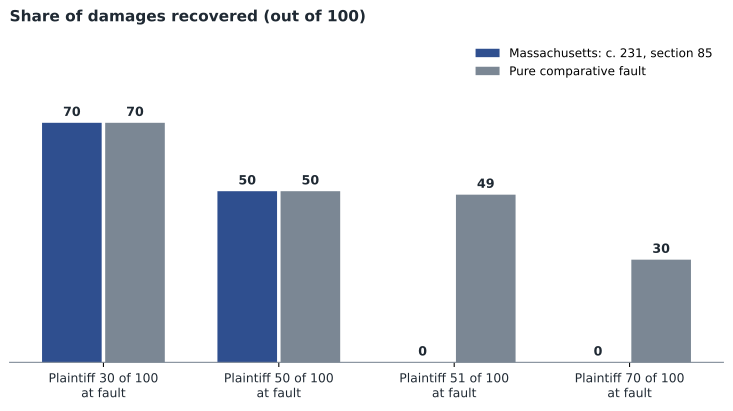
| Plaintiff fault | Defendants combined | Massachusetts recovery | Pure comparative fault |
|---|---|---|---|
| 20 percent | 80 percent | 80 percent of damages | 80 percent of damages |
| 50 percent | 50 percent | 50 percent of damages | 50 percent of damages |
| 51 percent | 49 percent | Nothing | 49 percent of damages |
| 70 percent | 30 percent | Nothing | 30 percent of damages |
In the ladder case, Declan expected a jury might put some fault on the client for walking under the ladder while reading her phone, but far less than on the contractor who left an unsecured ladder in a parking area. If the jury found the client 20 percent at fault and damages of 100,000 dollars, she would recover 80,000 dollars. The danger zone would be a finding above 50 percent, which seemed unlikely on these facts but would wipe out the recovery entirely. Tobin's advice: build the liability case so that the jury sees the contractor's choices first.
Joint and several liability and contribution
Massachusetts retains joint and several liability for joint tortfeasors who cause a single indivisible injury. A plaintiff who recovers a judgment against several defendants may collect the whole judgment from any one of them. That rule pairs with the contribution statute, G.L. c. 231B, which lets a defendant who has paid more than its share recover contribution from the others.
The Massachusetts contribution statute has a feature that surprises lawyers trained on comparative fault elsewhere: as a general rule it divides contribution shares pro rata, equally among the joint tortfeasors, rather than in proportion to their relative fault. Comparative fault percentages determine the plaintiff's recovery under section 85, but they do not ordinarily determine how the defendants divide the burden among themselves. A settlement with one tortfeasor in good faith discharges that tortfeasor from contribution liability and reduces the plaintiff's claim against the others by the amount of the settlement.
Limitation periods
Most Massachusetts tort actions for personal injury or property damage must be brought within three years after the cause of action accrues, under G.L. c. 260, section 2A. Massachusetts applies a discovery rule: a claim generally accrues when the plaintiff knew or reasonably should have known that they were harmed and that the defendant's conduct caused the harm. Medical malpractice claims have their own three-year period, with a seven-year statute of repose in most cases, and they must first go before a medical malpractice tribunal that screens the claim. Wrongful death actions, under chapter 229, must generally be brought within three years after the death or after the executor or administrator knew or should have known of the factual basis for the claim.
Massachusetts does not generally permit punitive damages unless a statute authorizes them. The wrongful death statute is the most important example: it allows punitive damages where the death was caused by malicious, willful, wanton or reckless conduct or by gross negligence. Chapter 93A, discussed in Lesson 9, authorizes multiple damages.
Claims against public employers: the Massachusetts Tort Claims Act
Until the 1970s, Massachusetts public entities were largely immune from tort liability. In Whitney v. Worcester, 373 Mass. 208 (1977), the Supreme Judicial Court announced that it would abolish governmental immunity if the Legislature did not act. The Legislature responded in 1978 with the Massachusetts Tort Claims Act, General Laws chapter 258.
The Act makes public employers, including the Commonwealth, cities, towns, counties and many public agencies, liable for injury, loss of property, or death caused by the negligent or wrongful act or omission of a public employee acting within the scope of employment, in the same manner and to the same extent as a private individual under like circumstances. In exchange, the Act imposes conditions and limits that do not apply to claims against private defendants.
The claim runs against the employer, not the employee. Public employees are generally not personally liable for negligence within the scope of their employment; the public employer is the proper defendant. Intentional torts are treated differently, as discussed below.
Damages are capped. A public employer is not liable for more than 100,000 dollars to any one plaintiff. The Act also bars punitive damages and interest before judgment.
Many claims are excluded. Section 10 of chapter 258 lists exceptions. Among the most important are claims based on the exercise of a discretionary function, claims arising from intentional torts such as assault, battery, false imprisonment and defamation, and a group of exceptions protecting public employers from liability for failing to prevent harm caused by others unless the condition or situation was originally caused by the public employer. The exceptions generate a large body of case law, and a new lawyer should research them carefully for any claim against a public body.
Presentment
The most distinctive feature of chapter 258, and the one that most often defeats claims, is presentment. Under section 4, a civil action may not be brought against a public employer unless the claimant has first presented the claim in writing to the executive officer of the public employer within two years after the cause of action arose.
For a claim against the Commonwealth or one of its agencies, presentment to the Attorney General is sufficient. For a claim against a city or town, the Act names the officials who count as the executive officer, such as the mayor, city manager or board of selectmen, depending on the form of government. Presentment to the wrong official, or to an insurer or a department employee, may not satisfy the statute, and the Supreme Judicial Court has applied the presentment requirement strictly.
After presentment, the public employer has six months to respond. If the executive officer denies the claim in writing, or fails to act within six months, the claim is deemed finally denied, and the claimant may sue. The action must be commenced within three years after the cause of action arose.
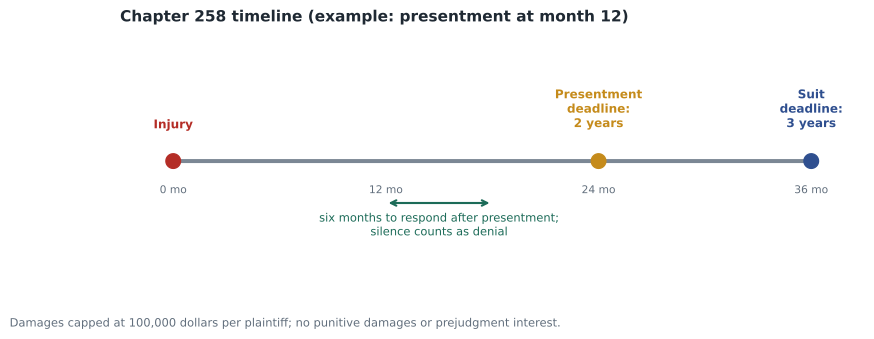
| Step | Deadline or limit | Source |
|---|---|---|
| Written presentment to the executive officer | Within two years after the cause of action arose | G.L. c. 258, section 4 |
| Response period | Six months; silence counts as denial | G.L. c. 258, section 4 |
| Lawsuit | Within three years after the cause of action arose | G.L. c. 258, section 4 |
| Damages | Not more than 100,000 dollars per plaintiff; no punitive damages or prejudgment interest | G.L. c. 258, section 2 |
| Exceptions | Discretionary functions, intentional torts, and others | G.L. c. 258, section 10 |
The snowplow claim
Declan's snowplow file required two separate analyses, because the client's fence and mailbox damage and the damage to the parked car arose from the same incident but raised different questions.
First, was this a chapter 258 claim? The snowplow belonged to the town and the driver was a town employee clearing a public road, so yes. Any negligence claim would run against the town, not the driver personally.
Second, did an exception apply? Snow and ice removal on public ways raises questions under the Act's exceptions and under separate statutes about defects in public ways, and some claims arising from snow and ice conditions are excluded. But the claim here was not about a slippery road. It was about a driver who backed a plow into a parked car and knocked down a fence through ordinary careless driving, which looks like the kind of operational negligence the Act covers. Declan flagged the exceptions for research rather than assuming either way.
Third, presentment. The incident occurred in early 2026, so the two-year presentment deadline was well ahead, but Tobin's rule is to present promptly. Declan identified the town's form of government, confirmed which officials counted as its executive officer under section 1 of the Act, and drafted a presentment letter describing the date, place, facts, injury and amount claimed, with photographs and repair estimates attached. The letter went by certified mail and by hand delivery, with a copy to the town clerk, and Declan saved proof of delivery.
Fourth, the cap. The client's damages, a few thousand dollars for the car and the fence, were far below 100,000 dollars, so the cap would not matter. In a serious injury case it would, and a lawyer must also look for other defendants, such as a private contractor, who are not protected by the cap.
Intentional torts and civil rights claims
Because chapter 258 excludes most intentional torts, a claim for assault and battery or false imprisonment by a public employee usually runs against the employee personally, not the employer, and the cap does not apply. Such cases often come with claims under the Massachusetts Civil Rights Act, G.L. c. 12, sections 11H and 11I, or under the federal civil rights statute, 42 U.S.C. section 1983, which have their own rules. A new lawyer should treat any claim against a public body or official as a research project, not a routine negligence case.
Common mistakes
MistakeApplying pure comparative fault in Massachusetts.
InsteadSection 85 bars a plaintiff whose negligence is greater than the defendants' combined negligence; at 51 percent the plaintiff recovers nothing.
MistakeComparing the plaintiff with each defendant separately.
InsteadThe plaintiff is compared with the total negligence of the defendants against whom recovery is sought.
MistakeSuing a town without presentment.
InsteadChapter 258 requires written presentment to the executive officer within two years before suit.
MistakeSuing the public employee personally for negligence.
InsteadChapter 258 makes the public employer the defendant for negligence within the scope of employment.
MistakeExpecting punitive damages in an ordinary tort case.
InsteadMassachusetts allows punitive damages only where a statute authorizes them, such as the wrongful death statute.
Practice problems
Work each problem on paper first, then reveal the answer to check.
A plaintiff is 50 percent at fault and suffers 60,000 dollars in damages. What does she recover under section 85?
Show answer
30,000 dollars; a plaintiff whose negligence is not greater than the defendants' recovers, reduced by her share.
What is the presentment deadline under chapter 258?
Show answer
Within two years after the cause of action arose, in writing to the executive officer of the public employer.
What is the damages cap under chapter 258?
Show answer
100,000 dollars per plaintiff, with no punitive damages or prejudgment interest.
How are contribution shares among joint tortfeasors generally divided under chapter 231B?
Show answer
Pro rata, equally, rather than by relative fault.
Summary and key terms
- G.L. c. 231, section 85 adopts modified comparative negligence: a plaintiff recovers, reduced by her share, if her negligence is not greater than the defendants' combined negligence.
- Massachusetts keeps joint and several liability, with pro rata contribution under chapter 231B.
- Most tort claims must be brought within three years under c. 260, section 2A, subject to a discovery rule.
- Chapter 258 makes public employers liable for employees' negligence, capped at 100,000 dollars per plaintiff, with section 10 exceptions.
- Presentment in writing to the executive officer within two years is a condition of suit; suit must follow within three years.
- Modified comparative negligence
- A system in which a plaintiff's recovery is reduced by her fault and barred if her fault exceeds a threshold.
- Chapter 231, section 85
- The Massachusetts comparative negligence statute.
- Chapter 231B
- The Massachusetts contribution among joint tortfeasors statute.
- Massachusetts Tort Claims Act
- G.L. c. 258, which waives immunity for public employers' negligence with conditions and caps.
- Presentment
- The written claim to a public employer's executive officer required before suit under chapter 258.
- Whitney v. Worcester
- The 1977 SJC decision that prompted the Legislature to enact chapter 258.
Lesson quiz · 5 questions
Score 60% or more to complete this lesson.
Create a free account to save your progress, take quizzes and earn a certificate.