
BUS-220 · Lesson 12 of 12 · 33 min
Marketing ethics, sustainability and capstone: a marketing plan
Marketing is a powerful force. It can help people find products that improve their lives, support innovation and competition, and fund much of the media people enjoy. It can also encourage overconsumption, mislead, exploit the vulnerable and damage the environment. Responsible marketers must judge not only whether a marketing action is legal and profitable but also whether it serves customers and society over the long run. This final lesson examines common criticisms of marketing, ethical frameworks and tests, the special care required with vulnerable consumers, sustainable marketing and environmental claims. It then brings the whole course together in a capstone: a complete marketing plan for an invented product, with the calculations a manager would expect to see.
Social criticisms of marketing
Critics charge that marketing practices harm individual consumers in several ways. High prices are blamed on high costs of distribution, advertising and promotion and on excessive markups; defenders reply that intermediaries perform necessary work, that advertising informs and adds brand value, and that competition limits markups. Deceptive practices, including misleading pricing, promotion and packaging, lead customers to believe they will get more value than they actually do. High-pressure selling persuades people to buy things they had no thought of buying. Shoddy, harmful or unsafe products, planned obsolescence (designing products to become outdated or stop working before they need replacement) and poor service to disadvantaged consumers are also criticized.
Critics also charge that marketing harms society as a whole by promoting materialism and a culture that measures people by what they own, by creating too few social goods relative to private goods, and by cultural pollution, the constant assault on people's senses by advertising. And marketing practices can harm other businesses through acquisitions that reduce competition, barriers to entry created by heavy promotional spending and unfair competitive practices such as predatory pricing. Some criticisms are exaggerated, but enough have merit that every marketer should take them seriously.
Citizen and public actions have arisen in response. Consumerism is an organized movement of citizens and government agencies to improve the rights and power of buyers in relation to sellers. Traditional seller rights include introducing products that are not hazardous, pricing as the seller chooses and promoting products as the seller wishes. Traditional buyer rights include the right not to buy, to expect products to be safe and to expect them to perform as claimed. Consumer advocates have pressed for more: the right to adequate information, the right to protection against questionable products and practices, and the right to influence products and practices in ways that improve quality of life. Environmentalism is an organized movement of concerned citizens, businesses and government agencies to protect and improve people's current and future living environment.
Ethical frameworks and tests
Laws set a floor, not a ceiling. Many practices that are legal can still damage customers' trust or harm society. Marketers face ethical dilemmas regularly: should a product with a small but real safety risk be recalled at great cost? Should an app collect location data customers do not realize it is collecting? Should a lender target customers who are likely to miss payments because late fees are profitable? Two broad philosophies guide such decisions. One holds that such issues should be decided by the free market and the legal system; if something is legal and customers buy it, it is acceptable. The other puts responsibility not in the system but in the hands of individual companies and managers, who should follow a moral compass and consider the long-run interests of customers and society.
Professional codes give guidance. The American Marketing Association's statement of ethical norms and values asks marketers to do no harm, foster trust in the marketing system and embrace ethical values including honesty, responsibility, fairness, respect, transparency and citizenship. BBB National Programs runs the National Advertising Division, which resolves challenges to advertising claims between competitors, and the Children's Advertising Review Unit (CARU), which applies self-regulatory guidelines to advertising directed at children. Industry self-regulation works alongside, not instead of, the law.
Several practical tests help individual decisions. The publicity test asks: would I be comfortable if this practice were reported on the front page of a newspaper or went viral online? The customer test asks: would customers still buy if they fully understood what we are doing? The golden rule asks: would I want to be treated this way? The long-run test asks: will this practice build or erode the trust we need to keep customers for years? A useful distinction is between persuasion, which gives people accurate reasons and appeals and lets them choose, and manipulation, which exploits biases, hides information or creates pressure that bypasses people's judgment. Lesson 4's dark patterns fall on the wrong side of that line.
| Practice | Persuasion (acceptable) | Manipulation (unacceptable) |
|---|---|---|
| Urgency | A genuine limited-time sale with a real end date | A countdown timer that resets every time the page reloads |
| Social proof | Displaying genuine, unedited customer reviews | Posting fake reviews or hiding negative ones |
| Defaults | Pre-selecting the most popular plan, clearly labeled | Pre-ticking a box that adds a paid insurance product |
| Pricing | Showing the all-in price up front | Revealing mandatory fees only at the last checkout step |
| Cancellation | Canceling online as easily as signing up | Requiring a phone call during limited hours to cancel |
Vulnerable consumers
Some consumers are more easily harmed by marketing: children and teenagers, people with cognitive impairments, older people facing scams, people in financial distress and people with addictions. Marketing to these groups is not wrong in itself, but it demands special care. The question is whether the offer and the methods serve the target customers' interests.
US federal law regulates marketing to children mainly through the Children's Online Privacy Protection Act (COPPA), which requires verifiable parental consent before collecting personal information from children under 13 online; the FTC's updated COPPA rule took effect in 2025. The FTC Act's ban on unfair and deceptive practices applies with extra force where children are concerned, and the self-regulatory CARU guidelines set standards for advertising directed at children under 13. Several states have passed laws on children's and teens' online experiences and social media, some of which are being challenged in court; marketers should check the current status before planning campaigns.
Sustainable marketing
Sustainable marketing calls for socially and environmentally responsible actions that meet the present needs of consumers and businesses while also preserving or enhancing the ability of future generations to meet their needs. It goes beyond the marketing concept, which focuses on meeting customers' immediate wants, and beyond the societal concept in lesson 1, by emphasizing long-term consequences for the planet as well as for people. Five principles are often cited. Consumer-oriented marketing views marketing activities from the consumer's point of view. Customer-value marketing puts most resources into value-building investments rather than short-term promotions. Innovative marketing seeks real product and marketing improvements continually. Sense-of-mission marketing defines the company's mission in broad social terms rather than narrow product terms. Societal marketing makes decisions by considering consumers' wants and long-run interests, the company's requirements and society's long-run interests.
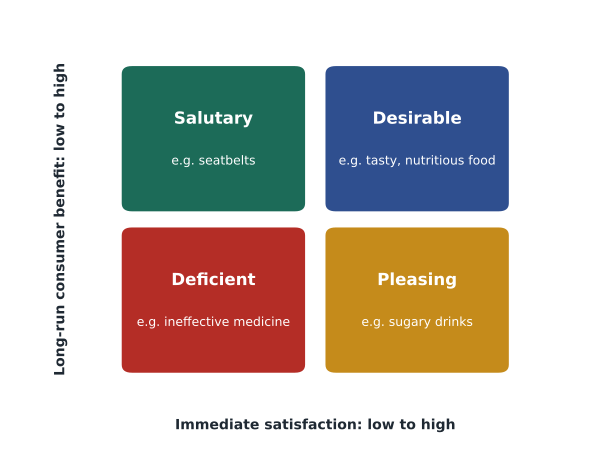
Products can be classified by their immediate satisfaction and their long-run consumer benefit. Deficient products, such as poor-tasting and ineffective medicine, have neither. Pleasing products give high immediate satisfaction but may hurt consumers in the long run, such as sugary drinks. Salutary products have low immediate appeal but benefit consumers in the long run, such as seatbelts. Desirable products give both high immediate satisfaction and high long-run benefits, such as a tasty and nutritious breakfast food. The challenge for sustainable marketers is to turn pleasing products into desirable ones without losing appeal, and to make salutary products more appealing.
Firms increasingly report their environmental and social performance alongside financial results, a practice sometimes summarized as the triple bottom line of people, planet and profit. Cause-related marketing links purchases to donations to a charitable cause; done well, it benefits both cause and company, but it can be criticized as cause-exploitative marketing if the donation is small relative to the promotional benefit or if the firm's main business conflicts with the cause.
Environmental claims and greenwashing
Greenwashing is making misleading claims about the environmental benefits of a product, service or company. Common examples include vague claims such as 'eco-friendly' or 'natural', claims that highlight one green attribute while ignoring larger harms, unverified 'carbon neutral' claims based on doubtful offsets, and images of leaves and forests that imply benefits the product does not deliver. Regulators in both countries have increased their scrutiny of such claims.
The FTC's Green Guides explain how the FTC applies its deception standard to environmental claims such as 'recyclable', 'compostable', 'biodegradable', 'carbon neutral' and 'eco-friendly'. They advise against broad, unqualified claims of general environmental benefit, which are very difficult to substantiate, and require that qualified claims be clear and specific and supported by competent and reliable evidence. The FTC began a review of the Guides in 2022; until any revision is issued, the existing Guides apply. Several states, notably California, have their own laws on recyclability and carbon-offset claims, and competitors can challenge green claims under the Lanham Act. Claims should be specific, accurate, supported by evidence gathered before the claim is made and reviewed by legal counsel.
| Vague or risky claim | Problem | Better approach |
|---|---|---|
| "Eco-friendly packaging" | General benefit claim that is almost impossible to substantiate | "Box made from 80 % recycled cardboard; recyclable where cardboard is collected" |
| "Carbon neutral" | Often relies on offsets of uncertain quality | Disclose emissions reductions and offset details, verified by a third party |
| "Biodegradable" | Many items do not break down in landfills within a reasonable time | State specific conditions and time frames, supported by testing |
| "Natural" | No set definition; implies health or environmental benefits | Describe specific ingredients and sourcing |
| Green imagery only | Implies benefits not stated or supported | Pair imagery with specific, substantiated claims |
Capstone: a marketing plan for Brightloop
The capstone applies the course tools to an invented product. Brightloop is a start-up that plans to sell a reusable smart water bottle with a built-in UV-C cleaning cap and a companion app that tracks hydration. The founders have $250,000 for the first year's marketing and want a plan for launch in one large metropolitan area of about 2.5 million adults before expanding. Each section below corresponds to the marketing plan structure introduced in lesson 2.
Situation analysis
Research (lesson 3) suggests that about 60 % of adults in the area own at least one reusable bottle, that bottles are replaced every two to three years on average, and that interest in self-cleaning bottles is highest among fitness-focused adults aged 22 to 40 and among commuters. Direct competitors include two established self-cleaning bottle brands priced at $90 to $110 and many plain insulated bottles at $25 to $50. A PESTEL scan (lesson 2) highlights consumer interest in health and in reducing single-use plastic, extended producer responsibility rules for packaging and electronics, and regulatory scrutiny of health and environmental claims. A SWOT shows strengths in design and app integration, weaknesses in brand awareness and cash, opportunities in gyms and corporate wellness programs, and threats from imitators and price competition.
Worked problem
Sizing the Brightloop opportunity
Using the research, estimate the annual TAM for reusable bottles in the metropolitan area, the SAM for premium self-cleaning bottles and a first-year SOM, assuming: 2.5 million adults; 60 % own a bottle; replacement every 2.5 years; 12 % of replacement buyers would consider a premium self-cleaning bottle; average premium price $85; and Brightloop can win 5 % of the SAM in year one.
Show solution
- Bottle owners = 2,500,000 × 0.60 = 1,500,000.
- Annual replacement purchases = 1,500,000 ÷ 2.5 = 600,000 bottles.
- At an average all-segment price of about $35, TAM ≈ 600,000 × $35 = $21 million a year.
- SAM (premium self-cleaning) = 600,000 × 0.12 = 72,000 bottles × $85 ≈ $6.1 million.
- SOM year one = 72,000 × 0.05 = 3,600 bottles, about $306,000 in revenue.
- The SOM is modest, which suggests the plan must also use online sales beyond the launch city or corporate deals to reach scale.
Answer: TAM ≈ $21 million, SAM ≈ $6.1 million and a first-year SOM of about 3,600 bottles (about $306,000). The numbers caution against overspending on the launch city alone.
Objectives, targeting and positioning
SMART objectives for year one: sell 6,000 bottles (3,600 in the launch city and 2,400 online elsewhere); reach aided awareness of 20 % among fitness-focused adults aged 22 to 40 in the launch city by month 12; achieve a 4.5-star average rating with at least 500 reviews; and sign three corporate wellness partners. Using segment scoring (lesson 6), the primary target is fitness-focused adults aged 22 to 40 who work out at least three times a week, with commuters as a secondary target and employers buying for wellness programs as a business segment (lesson 5).
Positioning statement: 'For active people who hate scrubbing bottles that smell, Brightloop is the smart water bottle that cleans itself every two hours and keeps you on track with your hydration goals, because its UV-C cap is independently tested to reduce bacteria in the bottle by 99 %.' The point of parity is insulation and leak-proof design comparable to premium bottles; the points of difference are automatic cleaning and app integration. Any health claim such as the 99 % figure must be backed by independent testing before it appears in marketing, and claims must avoid implying medical benefits.
The marketing mix
Product (lesson 7): one 600 mL (20 oz) model in four colors at launch, with replaceable cap batteries, a two-year warranty and an app with hydration reminders; packaging made from recycled cardboard with no plastic film. Services (lesson 8): live chat support with a human option, 60-day returns and a cap-replacement program that keeps the product in use longer. Price (lesson 9): a value-added price of $79, below the two established self-cleaning brands but well above plain bottles, with no permanent discounts; the all-in price is displayed, with sales taxes added at checkout. Place (lesson 10): direct sales through Brightloop's website, a marketplace listing to reach buyers outside the launch city, selective distribution through 25 independent fitness and outdoor stores, and gym partnerships. Promotion (lesson 11): short-form video ads, partnerships with 15 local fitness micro-influencers with clear disclosure, sampling at gyms and events, PR around the launch and an email welcome series for buyers.
Worked problem
Unit economics and break-even
Brightloop's bottle costs $28 to make and pack. On direct sales at $79, payment processing and shipping cost $9 a unit. Retailers buy at $47.40 (a 40 % margin on the $79 price), and the brand pays $3 a unit to ship to them. Expected mix in year one: 50 % direct, 25 % marketplace (fees and fulfillment of $22 a unit) and 25 % retail. Fixed costs for the year are $250,000 of marketing and $150,000 of other overhead. Calculate the weighted contribution per bottle and the break-even volume.
Show solution
- Direct contribution = $79 − $28 − $9 = $42.
- Marketplace contribution = $79 − $28 − $22 = $29.
- Retail contribution = $47.40 − $28 − $3 = $16.40.
- Weighted contribution = 0.50 × $42 + 0.25 × $29 + 0.25 × $16.40 = $21.00 + $7.25 + $4.10 = $32.35.
- Break-even volume = ($250,000 + $150,000) ÷ $32.35 ≈ 12,365 bottles.
- The year-one objective of 6,000 bottles is about half of break-even, so the plan expects a first-year loss and depends on growth in years two and three.
Answer: Weighted contribution is about $32 a bottle and break-even is about 12,400 bottles a year. A first-year loss is planned; the founders must confirm they have funding to reach break-even.
Budget, forecast and controls
The $250,000 marketing budget is built with the objective-and-task method (lesson 11): about $95,000 for paid social and search, $40,000 for influencer partnerships, $30,000 for sampling and events, $25,000 for PR and launch, $20,000 for content and creative, $20,000 for retailer support and $20,000 held in reserve for the best-performing channels. The forecast below projects three years, assuming unit sales grow as the brand expands to new cities and online, that the marketing budget rises more slowly than sales, and that unit costs fall slightly with volume.
# Brightloop three-year forecast (illustrative assumptions)
years = [1, 2, 3]
units = [6000, 15000, 30000]
contribution_per_unit = [32.35, 33.50, 34.75]   # scale lowers unit costs
marketing = [250000, 330000, 420000]
overhead = [150000, 190000, 240000]

cumulative = 0
print("Year   Units  Contribution  Marketing  Overhead     Profit  Cumulative")
for y, u, c, m, o in zip(years, units, contribution_per_unit, marketing, overhead):
    contrib = u * c
    profit = contrib - m - o
    cumulative += profit
    print(f"{y:4d} {u:7,d} {contrib:13,.0f} {m:10,.0f} {o:9,.0f} {profit:10,.0f} {cumulative:11,.0f}")
print(f" marketing as % of revenue: {m / (u * 79):.0%}")Year Units Contribution Marketing Overhead Profit Cumulative
1 6,000 194,100 250,000 150,000 -205,900 -205,900
marketing as % of revenue: 53%
2 15,000 502,500 330,000 190,000 -17,500 -223,400
marketing as % of revenue: 28%
3 30,000 1,042,500 420,000 240,000 382,500 159,100
marketing as % of revenue: 18%Under these assumptions Brightloop loses money in year one, roughly breaks even in year two and becomes clearly profitable in year three, with the cumulative position turning positive during that year. The founders must stress-test the plan: what if unit sales in year two are 30 % lower, or if marketplace fees rise? Controls (lesson 2) will track monthly sales by channel, customer acquisition cost by channel, conversion rates, return rates, average rating, NPS (lesson 4), repeat and accessory purchases and awareness surveys at months 6 and 12. If paid social CAC exceeds $35 for two consecutive months, budget will shift to the better-performing channels, and the team will run incrementality tests (lesson 11) before scaling any channel.
Ethics and sustainability review
Finally, the plan is reviewed against this lesson. Health claims will be limited to what independent tests support, with no suggestion that the bottle prevents illness. Environmental claims will be specific (recycled-content packaging, replaceable batteries, cap-replacement program) rather than general. Influencer posts will carry clear disclosure, reviews will be genuine and unfiltered, and the website will offer easy cancellation of any optional subscription for replacement filters. The app will collect only the data needed for hydration tracking, with plain-language consent and no sale of personal data. A brief check against the persuasion-versus-manipulation table finds no dark patterns in the checkout flow. These choices cost little and protect the brand's most valuable asset: customers' trust.
Common mistakes
MistakeAssuming legal means ethical.
InsteadApply the publicity, customer and long-run tests as well as the law.
MistakeTargeting vulnerable groups with offers that do not serve them.
InsteadAsk whether the offer and methods serve the target customers' interests; take special care with children.
MistakeUsing vague green claims such as "eco-friendly".
InsteadMake specific, substantiated claims and keep the evidence on file before publishing.
MistakeWriting a marketing plan without numbers.
InsteadInclude market sizing, unit economics, break-even, a budget and a forecast.
MistakeTreating the plan's forecast as a promise.
InsteadStress-test assumptions and set controls that trigger changes when results differ.
Summary and key terms
- Critics charge marketing with harming consumers, society and other businesses; some criticisms have merit.
- Consumerism and environmentalism are organized responses that have shaped law and practice.
- Professional codes and practical tests guide ethical decisions; persuasion differs from manipulation.
- Vulnerable consumers, especially children, require special care and are protected by specific laws and codes.
- Sustainable marketing follows consumer-oriented, customer-value, innovative, sense-of-mission and societal principles.
- Products can be deficient, pleasing, salutary or desirable; the aim is desirable products.
- Greenwashing is regulated under the Competition Act and the FTC Act and Green Guides; claims need evidence before use.
- A complete marketing plan combines situation analysis, SMART objectives, targeting and positioning, a consistent mix, a budget, a forecast and controls.
- Consumerism
- An organized movement to improve the rights and power of buyers in relation to sellers.
- Environmentalism
- An organized movement to protect and improve the living environment.
- Planned obsolescence
- Designing products to become outdated or stop working before they need replacement.
- Sustainable marketing
- Marketing that meets present needs while preserving the ability of future generations to meet theirs.
- Societal marketing
- Considering consumers' wants and long-run interests, company requirements and society's long-run interests.
- Desirable product
- A product offering both high immediate satisfaction and high long-run benefit.
- Cause-related marketing
- Linking purchases to donations to a charitable cause.
- Greenwashing
- Making misleading claims about environmental benefits.
- Triple bottom line
- Reporting on people, planet and profit.
- Manipulation
- Influence that exploits biases, hides information or bypasses judgment.
Practice problems
Work each problem on paper first, then reveal the answer to check.
Give two common criticisms of marketing's impact on individual consumers.
Show answer
Deceptive practices and high-pressure selling, among others.
State the publicity test.
Show answer
Would I be comfortable if this practice were reported publicly?
Is a pre-ticked box adding paid insurance persuasion or manipulation?
Show answer
Manipulation.
Classify sugary soft drinks in the societal product matrix.
Show answer
Pleasing products.
Why is "eco-friendly" a risky claim?
Show answer
It is a general benefit claim that is very hard to substantiate.
What changed in Canada's greenwashing provisions in March 2026?
Show answer
Business-level claims no longer need internationally recognized methodology, and private access to challenge them was removed.
Weighted contribution is $25 and fixed costs $300,000. What is break-even volume?
Show answer
12,000 units.
List five sections of a marketing plan.
Show answer
Executive summary, situation analysis, objectives, targeting and positioning, mix, budget, implementation, controls (any five).
Name three metrics Brightloop will track.
Show answer
Any three of sales by channel, CAC, conversion, returns, rating, NPS, repeat purchases, awareness.
Portfolio task: write a one-page marketing plan summary for a product idea of your own.
Show answer
Answers vary; a good plan includes sizing, target, positioning, mix, budget and metrics.
Lesson quiz · 5 questions
Score 60% or more to complete this lesson.
Create a free account to save your progress, take quizzes and earn a certificate.