
BUS-220 · Lesson 4 of 12 · 34 min
Consumer behavior
Why does one shopper choose a store-brand cereal and another a premium organic granola? Why do people spend weeks researching a car but grab the same toothpaste without thinking? Why do some new products spread quickly while others languish? Consumer buyer behavior is the buying behavior of individuals and households who buy goods and services for personal consumption. This lesson looks at the factors that shape consumers' choices, the different types of buying decision, the stages of the decision process, how new products are adopted and what behavioral economics adds to the picture. BUS-130 examined perception and attitudes in the workplace; here the same psychology is applied to people as buyers.
A model of consumer behavior
A simple way to think about consumer behavior is a stimulus–response model. Marketing stimuli (the four Ps) and other stimuli (economic, technological, social and cultural forces) enter the buyer's black box, where they are processed by the buyer's characteristics and decision process, producing observable responses: the choice of product, brand, retailer, timing and amount. Marketers can see the stimuli and the responses; their challenge is to understand what happens inside the box.
Cultural factors
Culture is the set of basic values, perceptions, wants and behaviors learned by a member of society from family and other important institutions. It is the most fundamental influence on wants and behavior. Marketers try to spot cultural shifts, such as growing interest in health and wellness, sustainability or convenience, to anticipate new products. Culture also varies by country, so products, messages and even colors and numbers that work in one market can fail or offend in another.
Each culture contains subcultures, groups of people with shared values based on common life experiences and situations, such as nationality, religion, ethnicity and region. Many large brands now run dedicated multicultural marketing programs, but effective programs go beyond translating advertisements; they reflect genuine understanding of the group's values, occasions and media habits.
In the United States, Hispanic Americans are the largest ethnic minority, with spending power in the trillions of dollars, and they are diverse in national origin, generation and language preference; many marketers reach them with bilingual or culturally specific campaigns rather than simple translation. African American consumers, Asian Americans and multiracial Americans are also large and influential markets, and marketers are expected to represent them authentically rather than through stereotypes. Regional cultures matter too, from the South to the Midwest to the West Coast.
Social class refers to relatively permanent divisions of society whose members share similar values, interests and behaviors. In North America class is measured by a combination of occupation, income, education and wealth rather than by a single factor. People in different classes tend to show distinct preferences for clothing, home furnishings, leisure activities and media, although the lines are blurrier than in the past.
Social factors
Reference groups are groups that serve as direct or indirect points of comparison in forming a person's attitudes or behavior. They include membership groups (family, friends, co-workers), aspirational groups that a person would like to belong to, and dissociative groups whose values a person rejects. Reference group influence is strongest for products that are visible to others, such as cars, clothing and phones.
Opinion leaders are people within a reference group who, because of special skills, knowledge or personality, exert social influence on others. Word-of-mouth from trusted people is far more persuasive than advertising for many purchases. Influencer marketing builds on this by working with people who have large or highly engaged social media followings. Creator-side influencer marketing is covered in depth in the CRE courses; the marketer's perspective, including disclosure rules, appears in lesson 11.
The family is the most important consumer buying organization. Roles within the household vary by product and culture: one partner may dominate some decisions, others are joint, and children influence a surprising share of family spending, from food to holidays to technology. Life changes such as marriage, the birth of a child or a move create bursts of new buying, which is why marketers pay close attention to life events.
Personal factors
A buyer's decisions are also influenced by personal characteristics: age and life stage, occupation, economic situation, lifestyle and personality. Life-stage segmentation recognizes that needs change as people move from single young adults to couples, to families with young children, to empty nesters and retirees. Occupation affects the goods and services people buy; a construction worker and a lawyer buy different clothing and tools. Economic situation, including income, savings, debt and confidence about the future, shapes how much people spend and on what.
Lifestyle is a person's pattern of living as expressed in activities, interests and opinions. Measuring these psychographic dimensions helps marketers understand why people with similar demographics behave differently. Strategic Business Insights' VALS system in the US and Environics' Social Values research in Canada are examples of commercial tools that group consumers by values and lifestyle.
Personality refers to the unique psychological characteristics that distinguish a person or group. Brands also have personalities. Jennifer Aaker identified five dimensions of brand personality: sincerity (down-to-earth, honest), excitement (daring, imaginative), competence (reliable, intelligent), sophistication (glamorous, upper-class) and ruggedness (outdoorsy, tough). Consumers tend to choose brands whose personalities match their actual or desired self-image.
Psychological factors
Four major psychological factors shape choices: motivation, perception, learning, and beliefs and attitudes. A motive, or drive, is a need that is sufficiently pressing to direct the person to seek satisfaction. Abraham Maslow's hierarchy arranges needs from physiological and safety needs to belonging, esteem and self-actualization; a person tends to address the most pressing unmet need first. Although the strict hierarchy is debated, the framework helps marketers think about which needs a product serves. Motivation research, which uses in-depth techniques to uncover hidden motives, suggests that people buy for reasons they may not consciously recognize, such as reassurance or status.
Perception is the process by which people select, organize and interpret information to form a meaningful picture of the world. People are exposed to thousands of brand messages a day, and three processes filter them. Selective attention is the tendency to screen out most information; people notice messages related to current needs and those that are unusual or surprising. Selective distortion is the tendency to interpret information in a way that supports what people already believe; a loyal fan of one phone brand will read a neutral review as favorable to it. Selective retention means remembering information that supports existing attitudes. These filters explain why marketers repeat messages and make them distinctive.
Learning describes changes in behavior arising from experience. A consumer who has a good experience with a brand is likely to buy it again (reinforcement) and may generalize to other products with the same brand name, which is the logic of brand extensions. Discrimination occurs when the consumer learns to tell the difference between similar products and prefers one. A belief is a descriptive thought that a person holds about something; an attitude is a relatively consistent evaluation, feeling and tendency toward an object or idea. Attitudes are hard to change, so firms usually try to fit their products into existing attitudes rather than attempt to change them.
Types of buying decision
Buying behavior differs greatly between a box of salt, a smartphone and a house. Henry Assael classified buying behavior by the level of buyer involvement and the degree of difference among brands.
| High involvement | Low involvement | |
|---|---|---|
| Significant differences between brands | Complex buying behavior: extensive research, e.g. a car or laptop | Variety-seeking behavior: brand switching for variety, e.g. snack varieties |
| Few differences between brands | Dissonance-reducing behavior: quick purchase then reassurance-seeking, e.g. carpeting | Habitual buying behavior: little thought, e.g. salt or paper towels |
Each type calls for a different marketing approach. For complex buying, marketers provide detailed information comparing attributes and help buyers learn. For dissonance-reducing buying, after-sale communication should reassure buyers that they chose well. For habitual buying, price promotions, shelf presence and repetitive advertising that builds familiarity work better than detailed arguments. For variety-seeking buying, a market leader tries to encourage habitual buying by dominating shelf space, while challengers encourage switching with samples, coupons and new varieties.
The buyer decision process
For considered purchases, buyers typically move through five stages, although in routine purchases they may skip or reverse some. Need recognition occurs when the buyer recognizes a problem, triggered by internal stimuli such as hunger or by external stimuli such as an advertisement or a friend's new purchase. Information search draws on personal sources (family, friends), commercial sources (advertising, salespeople, websites), public sources (reviews, ratings, media) and experience. Increasingly, buyers also ask generative AI assistants for recommendations, which makes clear, accurate product information online more important.
In the evaluation of alternatives, consumers compare the brands in their consideration set, the small group of brands they actively consider. A useful way to model evaluation is the compensatory multi-attribute model: the consumer scores each brand on the attributes that matter, weights each attribute by its importance and adds up the weighted scores. A strong performance on one attribute can compensate for a weak one on another. Non-compensatory rules also exist; for example, a buyer may reject any car without all-wheel drive, however good it is in other ways.
Worked problem
Evaluating laptops with a multi-attribute model
A student is choosing among three laptops. She weights battery life at 0.40, weight (lightness) at 0.25, price at 0.20 and screen quality at 0.15. On a 1–10 scale, Laptop A scores 9, 6, 5, 7; Laptop B scores 6, 9, 8, 6; Laptop C scores 7, 7, 9, 5. Which laptop does the model predict she will choose, and what could the maker of the losing laptop do?
Show solution
- A = 0.40×9 + 0.25×6 + 0.20×5 + 0.15×7 = 3.60 + 1.50 + 1.00 + 1.05 = 7.15.
- B = 0.40×6 + 0.25×9 + 0.20×8 + 0.15×6 = 2.40 + 2.25 + 1.60 + 0.90 = 7.15.
- C = 0.40×7 + 0.25×7 + 0.20×9 + 0.15×5 = 2.80 + 1.75 + 1.80 + 0.75 = 7.10.
- A and B tie at 7.15; a small change will decide the choice.
- B's maker could improve actual battery life, change beliefs about it (if B is better than she thinks), shift the weights by stressing portability, or offer a student discount to raise the price score.
Answer: The model predicts a near tie between A and B, with C just behind. It shows marketers four levers: change the product, change beliefs, change attribute importance or change beliefs about competitors.
The purchase decision can be disrupted by two factors between intention and purchase: the attitudes of others (a partner who strongly prefers another brand) and unexpected situational factors (a job loss, a price rise or an out-of-stock item). Post-purchase behavior determines whether the buyer is satisfied, depending on how performance compares with expectations. Almost all major purchases create some cognitive dissonance, or post-purchase discomfort, as buyers worry about the drawbacks of the chosen brand and the benefits they gave up. Good follow-up, generous return policies and confirming messages reduce dissonance and support repeat purchase and positive word of mouth.
The Net Promoter Score (NPS), introduced by Fred Reichheld in 2003, is a popular measure of post-purchase loyalty. Customers rate their likelihood to recommend the brand from 0 to 10. Promoters score 9 or 10, passives 7 or 8 and detractors 0 to 6; NPS is the percentage of promoters minus the percentage of detractors. BUS-130 used the employee version, eNPS. NPS is simple and widely benchmarked, but critics note that one question cannot explain why customers feel as they do, so it should be paired with follow-up questions.
Worked problem
Calculating and using NPS
A home-internet provider surveys 1,200 customers. 384 rate it 9–10, 420 rate it 7–8 and 396 rate it 0–6. Among detractors, the most common comment concerns outages lasting more than an hour. Calculate the NPS and suggest a response.
Show solution
- Promoters = 384 ÷ 1,200 = 32 %.
- Detractors = 396 ÷ 1,200 = 33 %.
- NPS = 32 − 33 = −1.
- Passives (35 %) are a large group that could be converted with modest improvements.
- Response: prioritize network reliability, communicate proactively during outages and offer automatic credits, then track NPS among customers who experienced outages.
Answer: An NPS of −1 shows as many detractors as promoters. Fixing outage handling addresses the main complaint and could move many passives into promoters.
Adoption and diffusion of new products
The adoption process describes the stages an individual goes through from first hearing about an innovation to final adoption: awareness, interest, evaluation, trial and adoption. Marketers help consumers through each stage, for example by offering free samples or trial periods to move people from evaluation to trial.
People differ greatly in their readiness to try new products. Everett Rogers classified adopters into five groups by the time they take to adopt: innovators (the first 2.5 %), early adopters (the next 13.5 %), the early majority (34 %), the late majority (34 %) and laggards (16 %). Innovators are venturesome; early adopters are respected opinion leaders who adopt early but carefully; the early majority are deliberate; the late majority are skeptical; and laggards are tradition-bound. Geoffrey Moore later argued that high-technology products often struggle to cross the chasm between early adopters, who want breakthroughs, and the pragmatic early majority, who want proven solutions.
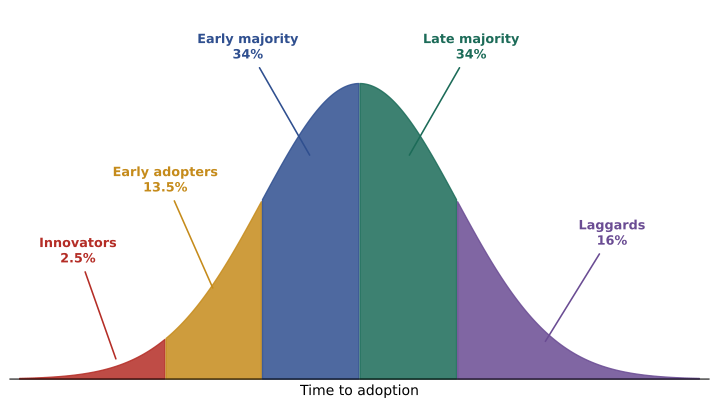
Five characteristics of an innovation affect how fast it is adopted. Relative advantage is how much better it seems than existing products. Compatibility is how well it fits existing values and experience. Complexity is how hard it is to understand or use. Divisibility, or trialability, is whether it can be tried on a limited basis. Communicability is how easily its benefits can be observed and described to others. Electric vehicles, for example, offered relative advantages in running costs but initially faced compatibility and complexity barriers around charging, which slowed adoption among the early majority.
Behavioral economics and choice architecture
Classical economics assumes people make rational choices that maximize their own interests. Behavioral economics, drawing on work by Daniel Kahneman, Amos Tversky and Richard Thaler, shows that people use mental shortcuts that create predictable biases. Loss aversion means losses loom larger than equivalent gains, so 'avoid a $10 fee' can motivate more than 'get a $10 discount'. Anchoring means the first number people see influences their judgment, which is why an original price shown next to a sale price shapes perceived value. Default effects mean people tend to stick with the pre-selected option. Social proof means people look to what others do, as in 'best-seller' tags and review counts.
The decoy effect, or asymmetric dominance, occurs when adding an option that is clearly worse than one existing option makes that option more attractive. A cinema that sells a small popcorn for $5 and a large for $9 may find that adding a medium for $8.50 causes many more people to buy the large, because the large now looks like a bargain compared with the medium.
Worked problem
A decoy in subscription pricing
A news site offers a digital-only subscription at $12 a month and a digital-plus-print subscription at $25. Most subscribers choose digital-only. The site adds a third option: print-only at $25. Explain what is likely to happen and why, and consider the ethics.
Show solution
- Print-only at $25 is dominated by digital-plus-print at $25, which offers more for the same price.
- The decoy makes digital-plus-print look like the best value, so more subscribers are likely to choose it.
- Average revenue per subscriber rises even though few people choose the decoy itself.
- Ethically, the decoy does not hide information or mislead about price, but firms should avoid designs that exploit biases to push people into choices that are clearly against their interests.
Answer: Adding a dominated print-only option is likely to shift many subscribers to the $25 bundle. It is a legitimate presentation choice if prices and terms are clear.
Choice architecture is the design of the environment in which people make decisions. Thaler and Cass Sunstein's concept of a nudge refers to changing the architecture to steer choices in a predictable way without forbidding options or significantly changing incentives, such as placing healthy food at eye level. The same techniques can be misused. Dark patterns are interface designs that trick or pressure users into decisions they would not otherwise make, such as hidden costs, pre-ticked boxes for add-ons, fake countdown timers and subscriptions that are easy to start but hard to cancel. Regulators in both Canada and the United States have taken action against such practices, and lesson 12 discusses the ethical line between persuasion and manipulation.
Common mistakes
MistakeAssuming consumers carefully evaluate every purchase.
InsteadMatch the approach to the type of buying behavior; habitual purchases respond to availability and familiarity, not arguments.
MistakeTranslating advertising word for word for a cultural community.
InsteadDevelop messages with genuine understanding of the group's values, occasions and media.
MistakeTreating a sale as the end of the process.
InsteadManage post-purchase dissonance with follow-up, reassurance and easy returns.
MistakeLaunching an innovation to the mass market immediately.
InsteadWin innovators and early adopters first, then adapt the offer and message to cross to the pragmatic majority.
MistakeUsing behavioral tricks that customers would resent if they noticed.
InsteadUse choice architecture transparently; avoid dark patterns such as hidden fees and hard-to-cancel subscriptions.
Summary and key terms
- Consumer behavior can be modeled as stimuli processed in the buyer's black box to produce responses.
- Cultural, social, personal and psychological factors shape buying.
- Reference groups and opinion leaders strongly influence visible products; the family is the key buying unit.
- Selective attention, distortion and retention filter marketing messages.
- Assael's four types of buying behavior depend on involvement and brand differences.
- The decision process runs from need recognition to post-purchase behavior; the multi-attribute model shows how buyers weigh attributes.
- NPS = % promoters − % detractors; it should be paired with diagnostic questions.
- Rogers' adopter categories and five innovation characteristics explain diffusion.
- Behavioral economics explains biases such as loss aversion, anchoring, defaults and decoys; dark patterns cross the ethical line.
- Consumer buyer behavior
- The buying behavior of individuals and households buying for personal consumption.
- Subculture
- A group sharing values based on common life experiences and situations.
- Reference group
- A group that serves as a point of comparison in forming attitudes or behavior.
- Opinion leader
- A person whose skills, knowledge or personality give them social influence over others.
- Selective distortion
- Interpreting information in a way that supports existing beliefs.
- Consideration set
- The brands a buyer actively considers for a purchase.
- Cognitive dissonance
- Post-purchase discomfort about whether a choice was right.
- Net Promoter Score
- The percentage of promoters minus the percentage of detractors among customers.
- Early adopters
- Respected opinion leaders who adopt new ideas early but carefully; 13.5 % of adopters.
- Dark pattern
- An interface design that tricks or pressures users into decisions they would not otherwise make.
Practice problems
Work each problem on paper first, then reveal the answer to check.
Give an example of a dissociative reference group.
Show answer
Answers vary; for example, a group whose style a teenager deliberately avoids.
Which type of buying behavior fits buying paper towels?
Show answer
Habitual buying behavior.
Name the five stages of the buyer decision process.
Show answer
Need recognition, information search, evaluation of alternatives, purchase decision, post-purchase behavior.
Weights are 0.5, 0.3, 0.2; a brand scores 8, 6, 10. What is its weighted score?
Show answer
4.0 + 1.8 + 2.0 = 7.8.
Of 500 customers, 200 are promoters and 100 detractors. What is the NPS?
Show answer
40 − 20 = +20.
What percentage of adopters are in the early majority?
Show answer
34 %.
Which innovation characteristic is improved by free trials?
Show answer
Divisibility, or trialability.
Explain loss aversion with a marketing example.
Show answer
Losses loom larger than gains; "don't lose your points" motivates more than "earn points".
What is a decoy option?
Show answer
An option clearly worse than another, added to make that other option look more attractive.
Portfolio task: map the decision process for your last major purchase and identify one point where a marketer influenced you.
Show answer
Answers vary; a good answer names the stage and the stimulus.
Lesson quiz · 5 questions
Score 60% or more to complete this lesson.
Create a free account to save your progress, take quizzes and earn a certificate.