
CINE-301 · Lesson 1 of 12 · 25 min
Visual language and style
Every shot in a film is a choice. Where the camera sits, how much of the world it shows, how long the shot lasts, whether it moves, and how it cuts to the next shot all shape what an audience sees, feels and understands. Over more than a century, filmmakers have developed a shared visual language: conventions that audiences read without thinking, such as a close-up signaling importance, a cut to an empty doorway suggesting someone has left, or a slow push toward a face suggesting a realization. Cinematographers and directors use this language to tell stories, and they shape it into a style that gives each film its own character. This course is about shot design and coverage: deciding which shots a scene needs, how they are staged and framed, and how they will cut together. This first lesson introduces visual language, the idea of visual grammar, how style emerges from consistent choices, and how to begin thinking about a film's visual approach.
Film as a language
Early film theorists often compared cinema to language. A single shot is like a word or phrase; a sequence of shots, joined by editing, is like a sentence; scenes and sequences build paragraphs and chapters. The comparison is imperfect, because images carry meaning directly in a way words do not, but it captures an important idea: meaning in film comes not only from what is in each shot but from how shots are combined. The Soviet filmmaker Lev Kuleshov demonstrated around 1920 that audiences interpret the same shot of an actor's neutral face differently depending on what it is cut with, such as a bowl of soup, a child in a coffin or a woman on a couch. This Kuleshov effect shows that viewers actively construct meaning from juxtaposition. Later directors such as Sergei Eisenstein developed theories of montage in which the collision of shots creates ideas that neither shot contains alone.
At the same time, a different tradition, associated with critics such as André Bazin, valued shots that preserved the continuity of space and time: long takes and deep focus that let viewers explore a scene and see relationships unfold without cutting. Most films combine both approaches, cutting freely in some scenes and holding long takes in others. Understanding both helps shot designers choose the right tool for each moment.
Continuity editing and the classical style
The dominant visual grammar of narrative film, developed in Hollywood and elsewhere in the 1910s and 1920s and still central today, is continuity editing. Its goal is to make cuts feel invisible, so that viewers follow the story without noticing the construction. It relies on conventions such as establishing the space with a wide shot before moving closer; keeping screen direction consistent; matching eyelines, so that characters appear to look at each other; matching action across cuts; and using shot-reverse-shot to cover conversations. These conventions are examined in detail in Lessons 7 to 9. Continuity editing is not the only way to make films, and many filmmakers deliberately break its rules, but knowing the rules makes it possible to break them with intent rather than by accident.
| Approach | Key idea | Typical techniques | Associated traditions |
|---|---|---|---|
| Continuity | Invisible construction, clear space and time | Establishing shots, shot-reverse-shot, matched action, 180-degree line | Classical Hollywood, most narrative film and TV |
| Montage | Meaning from collision of shots | Rapid cutting, graphic contrasts, intellectual montage | Soviet cinema, music videos, title sequences |
| Long take and deep focus | Preserve real space and time | Oners, staging in depth, minimal cutting | Renoir, Welles, Mizoguchi, contemporary slow cinema |
| Expressive or subjective | Show inner states | Point-of-view shots, unusual angles, distorted lenses | German Expressionism, horror, psychological drama |
Elements of visual language
Shot designers work with a set of variables, each of which carries meaning:
- Shot size: how much of the subject and setting the frame contains, from extreme wide to extreme close-up (Lesson 3).
- Angle and height: where the camera sits relative to the subject, from high to low, frontal to profile (Lesson 4).
- Lens and perspective: focal length, depth of field and how space is rendered (CINE-210).
- Composition: where subjects are placed in the frame, how lines, shapes and light lead the eye, and how the frame changes over time (Lessons 2 and 5).
- Movement: whether and how the camera moves (CINE-230).
- Duration and rhythm: how long shots last and how they are cut together.
- Light and color: how the image is lit and colored (CINE-220, CINE-221).
- Blocking: how actors move within the space and relative to the camera (Lesson 6).
None of these has a fixed meaning. A low angle might make a character look powerful in one film and menacing or absurd in another. Meaning comes from context, contrast and pattern.
Style as a system of choices
A film's visual style is the pattern that emerges when choices are made consistently. Some directors and cinematographers have instantly recognizable styles: the symmetrical, flat, centered compositions and lateral camera moves of Wes Anderson's films; the low camera height and static frames of Yasujirō Ozu; the long, choreographed takes of Alfonso Cuarón and cinematographer Emmanuel Lubezki; the precise one-point perspective and symmetrical corridors of Stanley Kubrick; the handheld intimacy of the Dardenne brothers. Other filmmakers adapt their style to each story, so that a war film, a romance and a thriller from the same director look different. Either way, style is most effective when it is motivated by the story and the characters' experience rather than imposed for decoration.
Style can also change within a film to mark shifts in story, perspective or emotion. A film might begin with stable, wide compositions that become tighter and more unstable as a character loses control, or shift from handheld to locked-off frames when a character finds peace. Planning these arcs is part of shot design (Lesson 11).
Rules, conventions and expectations
Visual conventions function because audiences have learned them through repeated exposure. They create expectations: after a wide shot of a house at night, we expect to go inside; after a character looks off screen, we expect to see what they see. Filmmakers can satisfy these expectations for clarity, delay them to build suspense, or subvert them to surprise. A horror film might hold on a character looking off screen without showing what they see, creating dread; a comedy might cut to an unexpected reveal. Because conventions differ somewhat across genres, cultures and eras, shot designers should understand the conventions of the genre and audience they are working in. Television, for example, has historically relied more heavily on close-ups and coverage than feature films, partly because of smaller screens, though large televisions and high-end streaming series have narrowed the gap.
Clarity, emotion and subtext
A useful way to evaluate any shot is to ask what it does for the scene. Shots can serve three broad purposes:
- Clarity: showing the audience where they are, who is present, what is happening and how characters relate in space.
- Emotion: bringing the audience close to a character's feelings, building tension, delivering a laugh or a shock.
- Subtext: suggesting meanings beneath the surface, such as a power shift, isolation, connection or foreshadowing, through composition, framing and juxtaposition.
Strong shot design balances all three. A scene shot only for clarity may feel flat; a scene shot only for emotion or subtext may confuse. A wide shot that shows two characters at opposite ends of a long table provides clarity about the space while expressing emotional distance; a close-up that isolates a character in the edge of the frame shows their expression and suggests their marginal position.
Worked problem
Reading a scene's visual language
In a scene, a manager fires an employee. The director films the manager from a slightly low angle behind a large desk, in a medium shot with a window behind him, and the employee from a high angle in a tighter close-up against a blank wall. Halfway through, after the employee stands up and argues back, the angles flatten to eye level and both are framed at the same size. What is the visual language communicating?
Show solution
- At first, the low angle and desk give the manager authority, while the high angle and tight framing make the employee smaller and trapped.
- The difference in background (a window versus a blank wall) suggests openness and power versus confinement.
- When the employee stands and argues, matching angles and shot sizes suggest that the power balance has shifted to equality.
- The change is motivated by the story beat, so the audience feels it without consciously noticing.
Answer: The shots first express the manager's dominance and then, by equalizing angle and size, show the employee reclaiming power.
Coverage as a concept
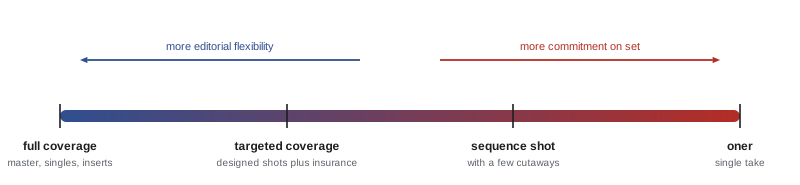
Coverage is the set of shots filmed for a scene that gives the editor material to build it. In the classical approach, a scene might be covered with a master shot showing the whole action, then medium shots and close-ups of each character, inserts of important objects and reaction shots. More coverage gives the editor more choices in pacing, performance and emphasis, but costs time and money and can lead to indecisive, generic filmmaking. Less coverage, such as a scene played in a single take, commits to a vision on set but leaves little flexibility. Lesson 7 examines coverage strategies in depth. Throughout this course, the central question will be: what is the minimum set of shots that tells this moment best, and how confident are we in that choice?
Developing a visual approach
Before designing individual shots, cinematographers and directors usually develop an overall visual approach for the project. This often starts with discussing the story's themes, the characters' arcs and the emotional journey the audience should take; then gathering references from films, photographs and paintings; then making decisions about broad parameters such as aspect ratio, lens choices, camera movement, color palette and coverage philosophy. These decisions are often recorded in a look book or visual bible, a document that communicates the approach to the crew, producers and studio. The approach then guides choices in each scene, giving the film coherence. The capstone in Lesson 12 asks you to develop such an approach for a short film.
The cinematographer's and director's roles
Shot design is usually a collaboration between the director and the director of photography (DP). Practices vary: some directors arrive with detailed shot lists and storyboards and rely on the DP to execute and refine them; others plan with the DP in prep, walking locations together and building the shot list jointly; others prefer to discover shots on set during rehearsal. The DP brings knowledge of how lenses, light and movement will render each idea, what is practical in the time available, and how choices affect the lighting and the schedule. The camera operator, the first assistant camera, the gaffer and the key grip contribute too. Good collaboration depends on a shared vocabulary, which this course aims to build.
Visual language beyond the West
Visual conventions are not universal. Japanese cinema of the 1930s to 1950s, for example in the films of Ozu and Mizoguchi, developed approaches to space, framing and duration different from Hollywood continuity: Ozu's cuts often ignored the 180-degree line and used still "pillow shots" of objects and landscapes between scenes; Mizoguchi favored long takes with a distant, moving camera. Indian popular cinema integrates song-and-dance sequences with their own visual logic, and many African, Latin American and Asian filmmakers have developed distinctive grammars. Studying films from many traditions expands the shot designer's vocabulary and challenges assumptions about what is "correct". Canadian filmmakers, such as Denis Villeneuve, Xavier Dolan and Sarah Polley, have each developed distinct visual approaches that draw on several traditions.
Common mistakes
MistakeChoosing shots because they look impressive.
InsteadChoose shots that serve clarity, emotion and subtext in the scene.
MistakeBreaking continuity conventions without knowing them.
InsteadLearn the conventions so that breaking them is deliberate.
MistakeImposing a style unrelated to the story.
InsteadMotivate style by the characters and themes.
MistakeAssuming a technique always means the same thing.
InsteadRemember that meaning depends on context and pattern.
MistakeShooting maximum coverage for every scene.
InsteadDecide how much coverage each scene really needs.
Summary and key terms
- Film meaning comes from shots and their combination, as the Kuleshov effect shows.
- Montage and long-take traditions offer different ways to build scenes.
- Continuity editing aims for invisible construction and clear space.
- Shot size, angle, lens, composition, movement, duration, light and blocking all carry meaning.
- Style is a consistent system of motivated choices.
- Shots serve clarity, emotion and subtext.
- Coverage is the set of shots that gives the editor material; its amount is a choice.
- Visual language
- Conventions by which images and editing convey meaning.
- Kuleshov effect
- Meaning created by juxtaposing shots.
- Montage
- Building meaning through the collision of shots.
- Continuity editing
- Editing that makes cuts feel invisible.
- Long take
- A shot of extended duration without a cut.
- Deep focus
- Sharp focus from foreground to background.
- Style
- A consistent pattern of visual choices.
- Coverage
- The set of shots filmed to build a scene.
- Subtext
- Meaning beneath the surface of the action.
- Look book
- Document communicating a film's visual approach.
Practice problems
Work each problem on paper first, then reveal the answer to check.
What did the Kuleshov experiment show?
Show answer
Viewers interpret a shot according to what it is cut with.
How do montage and long-take traditions differ?
Show answer
Montage builds meaning by cutting; long takes preserve space and time.
Name three continuity conventions.
Show answer
Establishing shots, eyeline matches, 180-degree line, matched action.
Name five variables of shot design.
Show answer
Size, angle, lens, composition, movement, duration, light, blocking.
Does a low angle always mean power?
Show answer
No, meaning depends on context.
What makes a style effective?
Show answer
Consistency and motivation by story.
Name the three purposes of a shot.
Show answer
Clarity, emotion and subtext.
What is coverage?
Show answer
The shots filmed so a scene can be edited.
What is a disadvantage of maximum coverage?
Show answer
Time, cost and indecisive filmmaking.
What does a look book contain?
Show answer
References and decisions about the visual approach.
Lesson quiz · 5 questions
Score 60% or more to complete this lesson.
Create a free account to save your progress, take quizzes and earn a certificate.