
CINE-301 · Lesson 3 of 12 · 25 min
Shot sizes and their grammar
Shot size, how much of a subject the frame contains, is the most basic and most powerful variable in shot design. Moving from a wide shot to a close-up is like moving from a description of a place to a whispered confidence: it changes what the audience notices, how close they feel to a character, and how much emotional weight a moment carries. Directors and cinematographers use a shared vocabulary of shot sizes to plan scenes, communicate on set and analyze films. This lesson covers the standard shot sizes, the meaning and uses of each, how shot sizes interact with lenses and distance, progression and escalation through a scene, matching shot sizes in coverage, and common mistakes in using size.
The standard shot sizes
Shot sizes are usually defined by how much of a human figure fills the frame:
| Shot size | Abbreviation | Framing of a person | Typical use |
|---|---|---|---|
| Extreme wide shot | EWS / ELS | Figure tiny in a vast landscape | Scale, isolation, establishing a world |
| Wide shot / long shot | WS / LS | Full figure with plenty of setting | Establishing space, action, relationships |
| Full shot | FS | Head to toe, filling the frame height | Body language, movement, costume |
| Medium long / cowboy | MLS | From about the knees or mid-thigh up | Groups, standing conversations, westerns |
| Medium shot | MS | From about the waist up | Conversation, gesture with face |
| Medium close-up | MCU | From mid-chest up | Dialogue, the workhorse of coverage |
| Close-up | CU | Head and shoulders, or face filling the frame | Emotion, reaction, emphasis |
| Extreme close-up | ECU / XCU | Part of a face or small object | Intensity, detail, tension |
| Insert | INS | An object or detail, often a hand | Information, plot details |
Terms vary between countries, companies and individuals: a close-up to one DP may be a medium close-up to another. On set, crews often clarify with references to the body, such as "cut at the chest" or "tight on the eyes". Some productions use additional terms, such as "choker" for a tight close-up from chin to forehead, or "big close-up".

Wide shots
Wide shots show the space and the relationships within it. Establishing shots, often wide or extreme wide, orient the audience at the start of a scene: where we are, what time of day, who is present. Wide shots also show action that involves the whole body or several people, such as dance, fights and chases, and they can express a character's relationship to their environment: dwarfed by mountains, lost in a crowd, alone in an empty room. Holding a scene in a wide shot can create observational distance, letting viewers watch behavior without being pushed toward one character's point of view, a strategy associated with directors such as Jacques Tati and Roy Andersson. Because wide shots contain more detail, they often need to be held longer for the audience to read them.
Medium shots
Medium shots show a person's body language and facial expression together, making them natural for conversation and interaction. The medium shot and medium close-up are the workhorses of dialogue coverage, close enough to read emotion but wide enough to show gesture and context. Two-shots, framing two characters together in medium or medium-wide size, show relationships, reactions and physical dynamics, and can carry entire scenes when performances are strong. Three-shots and group shots do the same for more characters. Medium shots are emotionally neutral compared with close-ups, which makes them useful for scenes where the audience should observe rather than be pulled into intimacy.
Close-ups
Close-ups bring the audience into intimate contact with a character's face and thoughts. They emphasize emotion, reveal reactions, mark important moments and direct attention to small details of performance: a glance, a tear, a tightening of the jaw. Because they are so powerful, many directors reserve close-ups for key moments, so that their arrival carries weight; using close-ups constantly reduces their impact, a tendency sometimes criticized in television drama. Extreme close-ups heighten intensity further, often in thrillers and westerns; Sergio Leone's extreme close-ups of eyes before gunfights are famous examples. Inserts, close shots of objects, convey information such as a letter, a clock, a gun in a drawer or a hand on a door handle.
Size, distance and lens
Shot size can be achieved by moving the camera closer or by using a longer lens, and these produce different images. A close-up made from near with a wide lens shows the face with more perspective distortion, a larger nose relative to the ears and more of the background, creating an intimate, sometimes uncomfortable proximity; a close-up made from far away with a long lens flattens features and compresses the background into a soft blur, creating a more flattering, detached view. Directors and DPs choose combinations deliberately: some prefer wide lenses close to actors for immediacy, others prefer longer lenses for isolation and elegance (CINE-210). Keeping lens choice consistent for similar sizes across a scene helps cuts feel natural.
Worked problem
Matching sizes in shot-reverse-shot
Two actors sit across a table. The A camera films a medium close-up of Actor 1 on a 50 mm lens at 1.8 m. The B camera films Actor 2 at the same nominal size but on an 85 mm lens from 3 m. In the edit, the cuts feel uneven. Why, and how could it be fixed?
Show solution
- Both shots show the same size, but different focal lengths and distances render perspective and background differently.
- Actor 1 appears with more depth and background; Actor 2 appears flatter, with a softer, larger-looking background.
- Viewers sense the mismatch as an imbalance between the characters.
- Use the same focal length and distance for both singles (for example 50 mm at about 1.8 m), unless the difference is a deliberate expression of the relationship.
Answer: Mismatched lenses and distances create unequal perspectives; match focal length and distance for balanced reverse shots.
Progression and escalation
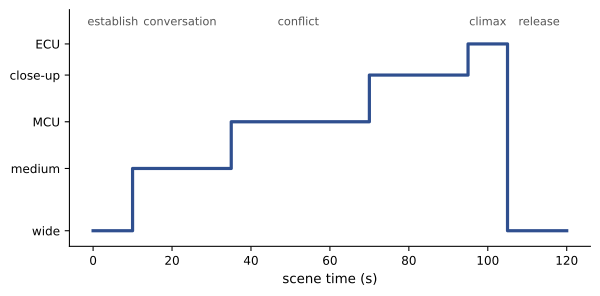
Within a scene, shot sizes often follow a progression from wider to tighter as the emotional intensity increases: an establishing wide shot, then medium coverage as the conversation begins, then close-ups as the conflict sharpens. This pattern mirrors how we focus attention in real life and gives the scene an arc. Cutting from wide to tight suddenly can create shock or emphasis; pulling back to wide at the end of an intense scene can release tension or show consequences. Some scenes reverse the pattern, beginning on a close-up to disorient or intrigue, then revealing the context with a wide shot. Planning the progression of sizes across a scene is a central part of shot design, and editors rely on having the right sizes available at each point.
Matching and contrasting sizes in coverage
In conversations, matching shot sizes between characters suggests equality and balance; mismatched sizes suggest imbalance. If one character is consistently in close-up and the other in medium shot, the audience is drawn to the closer character and may sense that they hold the emotional focus or are under pressure. Directors use this deliberately: in an interrogation scene, the suspect might be in increasingly tight close-ups while the detective remains in medium shots, suggesting mounting pressure on one side. When matching is the goal, the DP and operator agree on framing references, such as cutting each single at the same point on the body and using the same lens and height.
Size and screen size
The screen on which a film will be seen influences shot size decisions. On a large cinema screen, a wide shot reveals details and a close-up fills the audience's field of view; on a phone, wide shots can become unreadable, and close-ups carry more of the storytelling. Television drama historically relied on closer coverage for this reason. Today, many projects are seen on everything from cinema screens to phones, so shot designers often balance sizes, ensuring that important information is legible in medium and close shots while still using wide shots for scale. Vertical formats for mobile, discussed in other courses, change the grammar again by favoring single figures and close framings.
Communicating shot sizes on set
Clear communication avoids wasted time. Directors and DPs agree on terminology in prep, often using reference frames from earlier films or still photographs. On set, they may describe shots by size, lens and subject, such as "medium close-up on Sarah, 40 mm, over Tom's shoulder"; by body cut lines; or by referring to storyboards or shot list numbers. Operators often offer variations, such as a slightly tighter or looser version, which can give the editor options. Camera reports and slates record each shot's description for editorial.
The two-shot as a dramatic tool
Two-shots deserve special attention because they show relationships directly. A tight two-shot with characters close together suggests intimacy or conspiracy; a wide two-shot with distance between them suggests estrangement. A two-shot in which one character faces the camera while the other faces away, sometimes called an American two-shot or Hollywood two-shot when both are in profile, gives the audience a clear view of one reaction while keeping the other present. Holding a two-shot through an important exchange, rather than cutting to singles, lets the audience watch both performances at once and judge the relationship for themselves; many directors use it for moments where the reaction of the listener matters as much as the line.
Size and the human figure
Shot sizes are traditionally defined by the human body, and cutting points on the body matter. Crops at natural joints, such as the knees, waist or elbows, can look awkward because they suggest amputation; many cinematographers cut slightly above or below joints instead. In close-ups, cropping the top of the head is acceptable and often preferable to cropping the chin, which feels uncomfortable. Hands entering the frame in close-ups add expressiveness and can be planned with actors. For non-human subjects, such as animals, vehicles or objects, crews describe sizes by analogy, for example "medium on the car, from the wheels up".
Shot size and genre
Genres have tendencies in shot size. Westerns and epics favor wide and extreme wide shots that place characters in vast landscapes; romantic dramas favor close-ups that emphasize intimacy; comedies often use wider two-shots and full shots so that physical comedy and timing between characters are visible; horror alternates tight framings that limit what we can see with wide shots full of dark negative space. Understanding these tendencies helps shot designers meet expectations or deliberately depart from them.
Inserts and their design
Inserts are easy to underestimate. A well-designed insert has a clear purpose: delivering information, such as a name on a document or a time on a clock; emphasizing an object's emotional importance, such as a photograph or a wedding ring; or punctuating rhythm, such as a hand slamming a door. Inserts should match the lighting, color and lens style of the scene, and their framing should make the information readable in the time the editor will give it. Hand doubles, crew members or other performers whose hands substitute for the actor's, are often used, which requires matching skin tone, jewelry, nail polish and wardrobe. Many productions shoot inserts on a separate day or with a second unit, so a list of needed inserts, with continuity details, is essential.
Sizes for faces of different heights
When two characters of very different heights share a scene, matching shot sizes requires care. A medium close-up of a tall character and a short character may need different camera heights and distances to look equivalent, and two-shots may need the shorter actor on a box or the taller actor seated or leaning to keep both faces in frame without leaving awkward empty space. Cheating heights in this way is common and invisible to audiences when done subtly.
As a practical exercise, take a single page of dialogue and plan it three ways: in one wide shot, in medium coverage only, and with a progression to close-ups at the climax. Comparing the plans shows how strongly shot size alone shapes the scene's emotional effect.
Common mistakes
MistakeOverusing close-ups so they lose impact.
InsteadReserve close-ups for moments that need them.
MistakeMismatched lenses for matching singles.
InsteadKeep focal length and distance consistent unless the difference is deliberate.
MistakeCutting wide shots too short to read.
InsteadHold wide shots long enough for the audience to take in detail.
MistakeNo size progression through a scene.
InsteadPlan sizes to follow the emotional arc.
MistakeAssuming everyone uses the same terms.
InsteadAgree terminology and use body cut lines.
Summary and key terms
- Shot sizes range from extreme wide to extreme close-up and inserts.
- Wide shots establish space, action and relationships.
- Medium shots and two-shots carry conversation and body language.
- Close-ups deliver emotion and emphasis and should be used purposefully.
- Distance and lens change perspective even at the same size.
- Size progressions give scenes an arc; matching sizes suggest balance.
- Screen size and clear terminology influence size choices.
- Shot size
- How much of the subject the frame contains.
- Establishing shot
- Wide shot that orients the audience.
- Full shot
- Framing a person head to toe.
- Cowboy shot
- Framing from mid-thigh up.
- Medium close-up
- Framing from mid-chest up.
- Close-up
- Framing of the face, head and shoulders.
- Extreme close-up
- Framing a part of the face or a small detail.
- Insert
- Close shot of an object or detail.
- Two-shot
- Shot framing two characters together.
- Progression
- Change of shot sizes through a scene.
Practice problems
Work each problem on paper first, then reveal the answer to check.
What is a cowboy shot?
Show answer
From mid-thigh up.
What is the workhorse shot size of dialogue?
Show answer
Medium close-up.
Why hold wide shots longer?
Show answer
They contain more information to read.
Why reserve close-ups?
Show answer
To preserve their impact.
What does a wide lens close to a face do?
Show answer
Increases perspective distortion and intimacy.
What does a long lens from far away do?
Show answer
Flattens features and compresses background.
What is a typical progression of sizes?
Show answer
Wide to medium to close as intensity builds.
What do mismatched sizes in coverage suggest?
Show answer
Imbalance or pressure on one character.
How does phone viewing affect size choices?
Show answer
Wide shots become harder to read; closer sizes carry more.
How can crews avoid size confusion?
Show answer
Agree terms and use body cut lines.
Lesson quiz · 5 questions
Score 60% or more to complete this lesson.
Create a free account to save your progress, take quizzes and earn a certificate.