
CINE-302 · Lesson 4 of 12 · 25 min
Shooting plates and elements
Every visual effects shot begins with photography. Even fully computer-generated sequences are usually anchored by photographed plates or references, and the quality of the final shot depends heavily on how well those plates were shot. A good plate matches the intended composite in lens, perspective, light, color, motion and resolution, contains everything the artists need and nothing that will cost them days of cleanup. This lesson covers the kinds of plates, clean plates and reference passes, background and driving plates, array and tiled plates, shooting elements such as smoke and debris, matching camera settings across plates, resolution and format choices, and practical habits on set.
Types of plates
Plates fall into several categories:
- Principal or foreground plates contain the actors and the main action, often against a screen or in a partial set.
- Background plates provide the environment that will be composited behind foreground action: a city skyline, a moving road, a mountain view through a window.
- Clean plates repeat the frame or move without actors, rigs or other unwanted objects, giving artists the hidden background for removals.
- Reference passes repeat the shot with lighting references, such as gray and chrome balls, a color chart, or a stand-in for a CG character, to show how light falls in the scene.
- Element plates contain separate components: smoke, dust, sparks, splashes, debris, crowds or stunt actions.
- Tile or array plates combine several frames or cameras to cover a wider or higher-resolution area than one frame can.
Each plate should be slated and logged with its purpose, so that editors and vendors can find it later. Common conventions add a suffix or descriptor to the slate, such as "clean", "ref", "BG" or "element".
| Plate type | Purpose | Key requirement |
|---|---|---|
| Foreground | Actors and action | Lit to match the intended background |
| Background | Environment behind action | Matching lens height, angle and light direction |
| Clean plate | Background for removals | Identical frame or move without the object |
| Reference pass | Lighting and color reference | Gray and chrome balls, chart, stand-in |
| Element | Smoke, debris, splashes, crowds | Isolated against black or a screen, matching frame rate |
| Tile or array | Wide or high-resolution backgrounds | Overlap, consistent exposure, nodal rotation |
Clean plates and reference passes
A clean plate is the single most useful piece of VFX photography. For a locked-off shot, it means shooting a few seconds of the same frame after the actors and rigs have left, without moving the camera, changing focus or exposure, and ideally soon enough that the light has not changed. For a moving shot, clean plates require repeating the move, which is possible with motion control or with remote heads that record and replay moves (Lesson 8), and approximately possible with careful manual repeats. Even an imperfect clean plate, such as a slow pan across the background, gives artists texture and detail they would otherwise have to paint.
Reference passes show how light behaves in the scene. A typical pass includes a gray ball, a chrome ball and a color chart held where the CG element will be, filmed for a few seconds with the same lens and settings as the plate. For CG characters, a stand-in or a physical maquette may be filmed to show scale, shadows and reflections, and an actor may perform with a reference object, such as a tennis ball on a pole for eyelines. Lesson 7 covers gray and chrome balls and HDRIs in more detail.
Background and driving plates
Background plates must match the foreground in perspective and light. The key variables are lens focal length, camera height, camera tilt and distance, and the direction, quality and color of light. A background shot from a different height or with a different focal length than the foreground creates mismatched perspective that no compositing can fully fix. Light direction must also be consistent: if the background plate has sun from the left, the foreground must be lit from the left with sun-like hardness. Background plates are usually shot by a second unit, sometimes in a different country, so a detailed brief from the main unit, with lens, height, angle, time of day and frame rate, is essential.
Driving plates for car interiors are a special case, used on process trailers, poor man's process, rear projection or LED walls (Lesson 10). They are shot with multi-camera arrays mounted on a vehicle, covering forward, rear, side and three-quarter views, so that any interior angle can be matched later. Array vehicles often carry eight or nine cameras arranged in a ring, with overlap between neighbors, recording at high resolution. Plates must be shot at the time of day and in the weather that the scene requires, and at realistic speeds.
Worked problem
Matching a background plate
The main unit films an actor on a balcony set against blue screen with a 40 mm lens on full frame, camera 1.5 m above the balcony floor, tilted up 5°, with key light coming from frame left at about 30° above the horizon to imitate late-afternoon sun. What must the second unit record when shooting the city background plate from a real rooftop?
Show solution
- Use the same sensor format and a 40 mm lens, or a wider lens with enough resolution to reframe.
- Match the camera height relative to the imagined balcony floor and the 5° up tilt.
- Shoot when the real sun is from frame left at about 30° elevation, using a sun-position app.
- Record the same frame rate and shutter angle, and capture an HDRI and chart at the rooftop.
Answer: Same format and focal length, matching height and tilt, sun from frame left at about 30° elevation, same frame rate and shutter, plus HDRI and chart.
Tiled and array plates
Sometimes a single frame cannot cover the needed area or resolution: a wide panoramic background for a window, a background that the camera will pan across, or an ultra-high-resolution plate for an LED wall. Tiled plates are shot as overlapping frames from the same position, rotating the camera around the entrance pupil of the lens (the nodal point) to avoid parallax between near and far objects, with 20 to 30 % overlap and locked exposure, white balance and focus, then stitched in post. Camera arrays shoot several frames simultaneously with matched cameras, capturing motion in all tiles at once, essential when the background contains moving traffic, water or crowds. Stitching software and techniques from panoramic photography (PHOT-202) apply.
Shooting elements
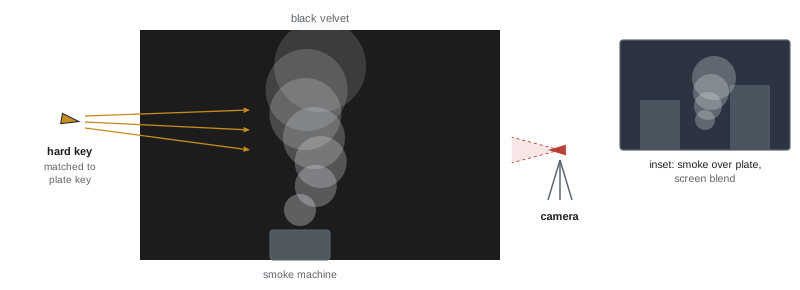
Elements are practical effects photographed separately to be composited into shots: smoke, steam, dust, fire, sparks, water splashes, rain, blood, debris, explosions, crowds or individual actions. Shooting elements well involves:
- Isolation: photographing the element against black velvet (for smoke, fire and sparks, which are added using screen or additive blending) or against a green or blue screen (for opaque elements such as debris and people).
- Matching lighting direction and quality to the shot the element will join.
- Matching frame rate and shutter angle, or shooting at higher frame rates to retime later, especially for elements that look more convincing slowed down, such as water at scale.
- Matching lens, distance and angle where perspective matters, or shooting at several distances for a library.
- Recording scale: a ruler or known-size object in a reference frame.
- Safety: fire, pyrotechnics and dust work are supervised by licensed special effects personnel, with appropriate ventilation, fire safety and protective equipment.
Many VFX vendors maintain element libraries, and productions sometimes shoot element days to build libraries specific to a film's look.
Matching camera settings across plates
Plates that will be combined must be photographically consistent. The checklist includes:
- Format, resolution and sensor area, so that grain, noise and sharpness match.
- Frame rate and shutter angle, so that motion blur matches; a CG element rendered with 180° motion blur looks wrong against a plate shot at 45°.
- Lens type and focal length; anamorphic and spherical lenses differ in distortion, bokeh and flare.
- Focus distance and aperture, so that depth of field is plausible across layers.
- Exposure index and color pipeline, recording in the same log and gamut.
- Filtration: diffusion, ND and polarizers affect contrast, halation and reflections, and should match or be documented.
Shooting at higher resolution than delivery gives compositors room to stabilize, reframe and match moves; many VFX-heavy productions shoot at 4.5K or more for 4K deliverables, or capture open gate. Raw or high-quality log recording preserves detail for keying.
Practical habits on set
Plates benefit from simple disciplines. Slate VFX takes clearly with the shot ID; announce clean plates and reference passes so the camera assistant and script supervisor log them; hold the frame for a few seconds before and after the action to provide handles; avoid moving the camera between a take and its clean plate; keep the light stable, or shoot the clean plate immediately; record notes about anything unusual, such as a light flicker, a change of filter or a lens swap. The VFX supervisor or data wrangler often checks each plate on a monitor before the company moves on, and the cinematographer should leave a few seconds in the schedule for these checks, which usually save hours later.
Plates for screen inserts and practical displays
Many scenes include screens: phones, laptops, car displays, monitors in a control room. Content can be played live on the screens during the shoot, which gives correct reflections and interactive light, or the screens can be shot as plates for replacement later. For replacement, productions often display a flat green or neutral gray on the screen with small tracking markers, set at a brightness that keeps the actors' faces correctly lit and avoids the screen clipping. Shooting with live content is often preferred where the content is final, because it avoids replacement costs and gives actors something to react to; refresh rates must be matched to the camera shutter to avoid flicker or rolling bars, just as with LED walls.
Reference passes in practice
After the main takes of a VFX shot, the crew often shoots additional passes without actors. A typical sequence is a clean plate repeating the camera move as closely as possible; a gray ball and chrome ball pass, with the balls held where the CG element will appear; a color chart in the same light; and sometimes a stand-in pass, in which a person or a maquette stands where a digital character will be, to show scale, light and shadow. These passes take only a few minutes each if planned in advance, and the assistant director should allow time for them in the schedule. The camera report should record which takes are plates and which are references, so editorial and VFX can find them quickly.
Plate quality checks
Before moving on from a plate setup, check focus and exposure on a calibrated monitor, confirm there is no unwanted motion blur or rolling-shutter skew, confirm the frame is free of crew, equipment and reflections that would need removal, and record lens, height, distance and tilt. A plate shot slightly soft or with a moving shadow from a crew member can cost far more to fix in post than to reshoot on the day.
Naming and logging plates
Plates are only useful if they can be found. Most productions add a VFX shot number to the slate for every effects take, for example a sequence code and shot number agreed with the VFX editor, and mark plate and reference takes clearly as such. The script supervisor notes which takes the director prefers, and the camera report records lens, stop, filters, frame rate and shutter. When the edit is locked, editorial uses these records to pull the correct plates for turnover. Missing or inconsistent shot numbers are one of the most common causes of delay at turnover, because someone must search through hours of footage to identify the right material.
Common mistakes
MistakeShooting backgrounds from a different height or lens.
InsteadMatch height, tilt, focal length and light direction.
MistakeMoving the camera before the clean plate.
InsteadShoot clean plates immediately with identical settings.
MistakeElement shots with mismatched shutter angle.
InsteadMatch frame rate and shutter or document retiming.
MistakeTiling without nodal rotation.
InsteadRotate around the entrance pupil with overlap.
MistakeUnlabeled VFX takes.
InsteadSlate shot IDs and plate types clearly.
Summary and key terms
- Plates include foreground, background, clean, reference, element and tiled plates.
- Clean plates and reference passes save enormous cleanup work.
- Background plates must match lens, height, tilt and light direction.
- Driving plates come from multi-camera arrays at the right time and speed.
- Tiled plates need nodal rotation, overlap and locked settings.
- Elements are isolated against black or screens and matched in light and motion.
- Consistent format, frame rate, shutter, lenses and pipeline make layers combine.
- Foreground plate
- Plate containing actors and main action.
- Background plate
- Plate providing the environment behind action.
- Reference pass
- Repeat of a shot with lighting references.
- Driving plate
- Background footage for vehicle interiors.
- Camera array
- Several matched cameras shooting simultaneously.
- Tiled plate
- Overlapping frames stitched into a larger image.
- Nodal point
- Rotation point that avoids parallax (entrance pupil).
- Element
- Separately photographed effect component.
- Screen blending
- Compositing mode that adds light elements.
- Open gate
- Recording the full sensor area.
Practice problems
Work each problem on paper first, then reveal the answer to check.
Name four types of plate.
Show answer
Foreground, background, clean, reference, element, tiled.
What does a reference pass include?
Show answer
Gray ball, chrome ball, chart, stand-in.
Name three things a background plate must match.
Show answer
Lens, height, tilt, light direction.
How are driving plates usually shot?
Show answer
With multi-camera arrays on a vehicle.
What overlap is typical for tiles?
Show answer
About 20–30 %.
Why shoot smoke against black?
Show answer
It can be added with screen blending.
Why match shutter angle?
Show answer
So motion blur matches between layers.
Why shoot above delivery resolution?
Show answer
Room to stabilize, reframe and match.
Who supervises fire elements?
Show answer
Licensed special effects personnel.
Why hold frame before and after action?
Show answer
To provide handles.
Lesson quiz · 5 questions
Score 60% or more to complete this lesson.
Create a free account to save your progress, take quizzes and earn a certificate.