
CINE-420 · Lesson 2 of 12 · 27 min
Roles in the camera department
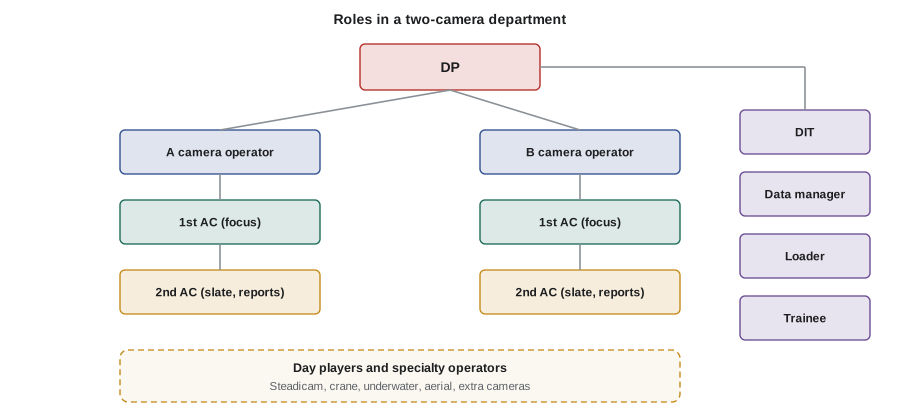
The camera department is a team of specialists with a clear chain of responsibility. Each role has its own skills, tools and duties, and each is a step on a career ladder that many crew members climb over years. Titles and exact duties vary between countries, unions, production sizes and individual DPs, but the core roles are recognizable on almost every professional set. This lesson describes each role, what it is responsible for, how the roles fit together and how a department grows from a two-person documentary crew to a multi-camera series unit. Knowing the boundaries of each job is part of professionalism: doing your own job well, and not doing someone else's, keeps a set running smoothly and safely.
The director of photography
The DP is the head of the department. The DP designs the look of the film with the director, chooses the camera, lenses and lighting approach, decides exposure and composition, leads the camera, grip and electric departments and supervises the image through to the final grade. On some productions, especially smaller ones, the DP also operates the camera. On larger productions the DP usually stands at the monitor, watching the frames from each camera and talking to the operators, the gaffer and the director. The DP hires or approves the key camera crew and is the camera department's link to producers and the director.
The camera operator
The camera operator frames and moves the camera during takes. Operators work the geared head, fluid head, dolly moves with the dolly grip, or handheld and body-mounted rigs. They rehearse with actors and the dolly grip, find the frame the DP and director want and repeat it accurately take after take. A good operator notices problems in the frame, such as a boom dipping in, a reflection, a missed mark or a continuity error, and reports them after the take. On multi-camera shows, each camera has its own operator, often called A camera and B camera operators, and the A camera operator may lead the operating team.
The first assistant camera
The first assistant camera (1st AC), also called the focus puller, keeps the camera working and the image sharp. The 1st AC builds and configures the camera, changes lenses, sets the frame lines and settings, measures distances to actors and pulls focus during takes. The 1st AC is responsible for the camera package: knowing every piece, keeping it clean and calibrated and reporting faults. Many 1st ACs run the department's logistics, such as equipment orders, lens choices for the next set-up and coordination with the rental house. Lesson 4 looks at the 1st AC's craft in more detail.
The second assistant camera
The second assistant camera (2nd AC), sometimes called the clapper loader, supports the 1st AC and handles the slate, camera reports, marks for actors, media and much of the department's communication. The 2nd AC slates every take with the correct scene, shot and take numbers, keeps camera reports that match the script supervisor's notes, lays tape marks for actors, manages batteries and media, and moves and organizes the camera cart. On many sets the 2nd AC is also the camera department's link to the ADs and other departments, passing on lens changes, set-up times and needs. Lesson 5 looks at the 2nd AC's work and data management.
The loader and the film loader
On film productions, the film loader loads and unloads magazines in a darkroom or changing bag, labels and cans exposed film and keeps inventory. On digital productions the loader manages media cards and batteries and often works with the data manager to move cards between cameras and the data station. Loaders are often entry-level crew learning the department from the inside. Under the US Local 600 rules, for example, film loader and digital utility work count together toward roster eligibility for that classification.
The digital imaging technician and data roles
The digital imaging technician (DIT) manages the digital image on set. Duties vary by production but often include setting camera settings and looks with the DP, monitoring exposure and image quality, applying on-set color corrections or LUTs, generating dailies and managing the data pipeline. Some productions also hire a separate data manager or data wrangler who copies camera media, verifies the copies with checksums and prepares drives for post-production. Video assist or playback operators manage monitors, wireless video and recordings for the director and producers. These roles grew with digital cinematography and are now standard on most professional productions.
Specialty operators
Some shots need operators with specialized skills and equipment, often hired by the day.
- Steadicam and other body-mounted stabilizer operators, who own expensive rigs and are hired for specific scenes or full shows.
- Remote head and crane operators, who control cameras on cranes, telescopic arms and cable systems.
- Underwater camera operators, who need diving qualifications and specialized housings.
- Aerial and drone camera teams, who need aviation certificates and permits.
- Motion control operators, who program and run robotic camera rigs.
- Unit still photographers, who take publicity stills on set and are often members of the camera unions.
Specialty operators are usually experienced camera crew who invested in a specialty and its equipment, and they often charge rental for that equipment along with their labor.
Trainees and utilities
Entry-level camera crew learn on the job.
- Camera trainees, in programs run by unions such as the Canadian camera locals, rotate through productions and learn camera systems, protocols and the slate.
- Camera utility or digital utility roles help with carts, cables, batteries and media and act as extra hands on busy days.
- Production assistants assigned to camera may help on non-union or smaller productions.
Trainees and utilities are watched closely by senior crew, who remember who was reliable, careful and willing to learn. Those memories decide who gets hired next.
How the department scales
The size of the camera department depends on the budget, schedule and style of production.
| Production | Typical camera crew | Notes |
|---|---|---|
| Documentary or news | 1 to 2 | The operator may also light and record sound |
| Small commercial or music video | 3 to 5 | DP, 1st AC, 2nd AC, possibly a DIT |
| Low-budget feature | 4 to 6 | Often one camera with a DP who may operate |
| Episodic series, two cameras | 8 to 12 | Operators, ACs, DIT, data, loader, trainee |
| Large feature or effects-heavy series | 12 or more | Extra cameras, second unit, specialty operators |
Additional cameras on busy days are covered by day players. Second units, which shoot action, inserts or scenery without the main cast, have their own DP or second unit director of photography and camera crew.
Worked problem
Ratio of assistants to cameras
A series adds a C camera for a week of action scenes. Each camera needs an operator, a 1st AC and a 2nd AC, and the department shares one DIT, one data manager and one loader. How many camera crew are working that week, excluding the DP?
Show solution
- Per camera: 3 people.
- Three cameras: 3 × 3 = 9.
- Shared roles: DIT 1 + data manager 1 + loader 1 = 3.
- Total: 9 + 3 = 12.
Answer: 12 camera crew, plus the DP. The C camera adds three day players for the week.
Worked problem
Hours for a 2nd AC on a long day
Camera call is 6:30, half an hour before general crew call, and the 2nd AC finishes 45 minutes after wrap, which is at 19:00. How long is the 2nd AC's day, assuming a 30-minute unpaid meal break?
Show solution
- From 6:30 to 19:45 is 13 h 15 min.
- Subtract the 30-minute meal: 12 h 45 min worked.
Answer: About 12.75 hours worked. Camera assistants often start before crew call and finish after wrap, which is why their pay is usually calculated from their own in and out times, not general call and wrap.
Boundaries between roles
Every role has boundaries. A 2nd AC does not change the frame lines; an operator does not change the stop; a trainee does not touch a lens without permission. When something is outside your role, tell the person responsible. When you are asked to cover another role, such as a 2nd AC pulling focus for a moment, make sure the 1st AC and DP know and agree. Clear boundaries prevent mistakes and protect everyone's reputation. They also matter under union agreements, which define classifications, and on some productions only a person hired in a classification may do that work.
How roles change on different productions
The same title can mean different work on different productions. On a fast television series, a 1st AC may pull focus on two or three set-ups an hour, keep detailed lens logs for visual effects and supervise a large team. On a small commercial, the same 1st AC may also handle the data, build the cameras alone and drive the camera truck. On documentaries, one person may operate, pull their own focus and record sound. Read the deal memo and ask the DP or production manager about the expected duties before accepting, so you can quote a fair rate and bring the right tools.
- Ask how many cameras will run and whether each will have its own assistants.
- Ask who handles data and dailies, and whether a DIT or data manager is booked.
- Ask about specialty days, such as Steadicam, crane or car work, which may need extra crew.
- Ask whether you are expected to supply equipment and, if so, what kit rental is offered.
Moving between roles
Many camera careers move up the ladder: trainee or loader, 2nd AC, 1st AC, operator and DP. Others move sideways into DIT, data, Steadicam, underwater or aerial work, or stay happily in one role for decades. A 1st AC with a strong reputation can earn as much as some DPs on smaller productions, and some assistants prefer the craft and teamwork of focus pulling to the pressure of leading a department. Each step usually starts with day-playing in the new role while still working in the old one, so the move is gradual and reversible.
Respecting classifications on union sets
On union productions, classifications define who may do which work, and they protect both jobs and quality. A loader may not be allowed to pull focus, and a crew member from another department may not be allowed to operate a camera, even for a moment. When the schedule calls for a task outside the hired roles, the department head asks the production to book the right person. Knowing the classifications in your agreement helps you avoid disputes and makes sure the production pays for the work it needs.
Common mistakes
MistakeDoing another person's job without asking
InsteadReport problems to the person responsible and cover another role only when asked and agreed
MistakeThinking the DIT is just a data copier
InsteadThe DIT manages image quality, looks, monitoring and the data pipeline in many productions
MistakeTreating trainees and utilities as invisible
InsteadSenior crew watch entry-level crew closely; reliability there builds careers
MistakeAssuming every production uses the same structure
InsteadCrew sizes and duties vary with budget, schedule, country and DP
MistakeAssuming a specialty operator brings only labor
InsteadSpecialty operators usually rent their own equipment to the production as well
Summary and key terms
- The DP designs the look, leads the department and directs grip and electric.
- The camera operator frames and moves the camera and reports problems in the frame.
- The 1st AC builds the camera, manages the package and pulls focus.
- The 2nd AC slates, keeps camera reports, lays marks and manages media and communication.
- DITs, data managers and video assist operators manage the digital image and data on set.
- Specialty operators bring skills and equipment for Steadicam, cranes, underwater, aerial and other work.
- Camera departments scale from one or two people to a dozen or more, and every role has clear boundaries.
- Camera operator
- The crew member who frames and moves the camera during takes
- First assistant camera (1st AC)
- The focus puller who builds the camera and manages the package
- Second assistant camera (2nd AC)
- The assistant who slates, keeps reports, lays marks and manages media
- Loader
- The crew member who loads film magazines or manages digital media and batteries
- Digital imaging technician (DIT)
- The technician who manages image quality, looks and data on set
- Data manager
- The crew member who copies and verifies camera media
- Video assist
- The operator who manages monitors, wireless video and playback
- Steadicam operator
- An operator who uses a body-mounted camera stabilizer
- Camera trainee
- An entry-level crew member learning the department through a training program
- Second unit
- A smaller unit that shoots action, inserts or scenery without the main cast
Practice problems
Work each problem on paper first, then reveal the answer to check.
Who pulls focus during takes?
Show answer
The first assistant camera
Who slates each take and keeps camera reports?
Show answer
The second assistant camera
Name two duties of a DIT.
Show answer
Any two of camera settings, looks or LUTs, exposure monitoring, dailies and data management
Why do specialty operators often charge rental as well as labor?
Show answer
They own expensive specialized equipment such as Steadicam rigs
How many crew are in a three-camera department where each camera has three people and three roles are shared?
Show answer
12, excluding the DP
What does a camera trainee program offer?
Show answer
Rotation through productions to learn camera systems, protocols and the slate
Why are camera assistants' hours often longer than general crew hours?
Show answer
They build cameras before call and finish media and equipment after wrap
What should you do if you notice a problem outside your role?
Show answer
Tell the person responsible
What is a second unit?
Show answer
A smaller unit that shoots action, inserts or scenery without the main cast
On a documentary, how large is the camera crew often?
Show answer
One or two people
Lesson quiz · 5 questions
Score 60% or more to complete this lesson.
Create a free account to save your progress, take quizzes and earn a certificate.