
CINE-420 · Lesson 7 of 12 · 30 min
Agreements, rates and working conditions
Pay on a film set is calculated differently from most jobs. Crew are usually paid by the hour with a guaranteed minimum day, overtime at rising multiples, penalties when meal breaks or rest periods are missed and separate fees for equipment they supply. Understanding how these pieces work lets camera crew check their pay, negotiate deals and plan their finances, and it helps department heads manage budgets and protect their crews from exhausting schedules. This lesson explains the main elements of pay and working conditions under typical agreements and non-union deals. All rates and penalty amounts in this lesson are illustrative; real figures are set by the agreement that applies to each production and change with every new agreement.
Guarantees, scale and the structure of pay
Most camera crew on scripted productions are paid an hourly rate with a guaranteed minimum number of hours per day or week.
- Scale rate: the minimum hourly rate for a classification under the agreement, which differs by classification, budget tier and region.
- Daily or weekly guarantee: the minimum hours paid, such as a 10-hour or 12-hour day, even if the crew wraps early.
- Overtime: hours beyond a threshold paid at a higher multiple, often 1.5 times and then 2 times the base rate.
- Premium days: sixth and seventh consecutive days, holidays and night work may be paid at higher rates under many agreements.
- Overscale: experienced crew may negotiate a higher base rate than scale.
Non-union productions are not bound by these agreements, but employment standards laws still set minimums for employees, and many non-union deals follow similar structures, often with a flat day rate for a set number of hours.
Worked problem
A long day with overtime
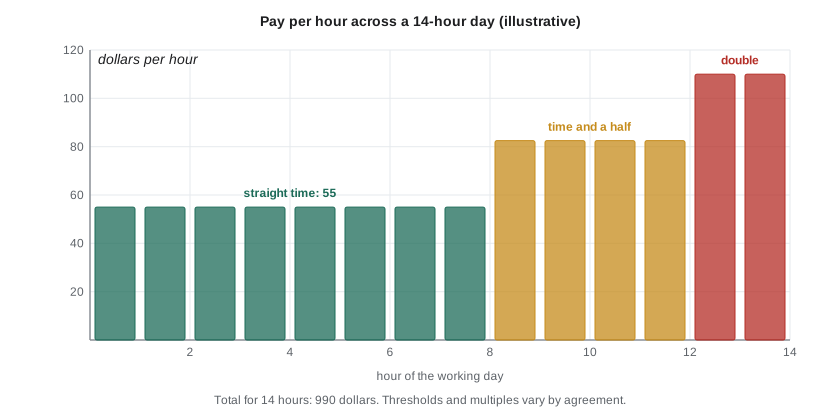
A 1st AC's illustrative base rate is 55 dollars an hour. The agreement pays straight time for the first 8 hours, 1.5 times for hours 9 to 12 and 2 times after 12 hours. The 1st AC works 14 hours, excluding an unpaid meal break. What is the day's pay?
Show solution
- Straight time: 8 × 55 = 440 dollars.
- Time and a half: 4 × 55 × 1.5 = 330 dollars.
- Double time: 2 × 55 × 2 = 220 dollars.
- Total: 440 + 330 + 220 = 990 dollars.
Answer: 990 dollars for 14 hours, or about 70.71 dollars an hour on average. Overtime makes long days expensive, which is one reason producers try to control the length of the day.
Meal periods and meal penalties
Agreements usually require a meal break within a set number of hours from call, commonly around six hours, and again within six hours after the first meal. When the break is late, the production pays a meal penalty for each period, often each half hour, that the meal is delayed, with amounts that increase the longer the delay. Productions sometimes provide a "walking meal" or grace period under rules set by the agreement. Meal penalties encourage productions to feed and rest crews on time, and they also make some productions reluctant to break when a scene is going well.
Worked problem
Calculating a meal penalty
Under an illustrative agreement, the first meal is due 6 hours after call. Penalties are 10 dollars for the first half hour of delay, 15 dollars for the second and 25 dollars for each half hour after that. Call is 7:00 and lunch is called at 14:15. What penalty does each crew member earn?
Show solution
- Meal due at 13:00; lunch called at 14:15, a delay of 1 hour 15 minutes.
- Count half-hour periods begun: 13:00 to 13:30, 13:30 to 14:00 and 14:00 to 14:15, so three periods.
- Penalty: 10 + 15 + 25 = 50 dollars.
Answer: 50 dollars per crew member. Across a crew of 150, the late lunch cost 7,500 dollars, before the overtime the delay may cause at the end of the day.
Turnaround and rest periods
Turnaround is the rest period between wrap one day and call the next. Long hours and short turnarounds are a major safety concern, because tired crew drive home and make mistakes on set. Agreements set minimum rest periods; under recent IATSE agreements in the US, for example, most crew get at least 10 hours between days and a weekend rest period of 54 hours after a five-day week, with penalties when rest is invaded. When a production calls crew back before turnaround is complete, called a forced call, it pays a penalty, often by paying the invaded hours at a higher rate. CINE-340 covers fatigue and safety in more detail.
Worked problem
A turnaround violation
An illustrative agreement requires 10 hours of rest. A 2nd AC wraps at 23:30, including camera wrap, and the next call is 8:00. The penalty is to pay the invaded rest hours at double the base rate of 40 dollars. Is turnaround met, and what is the penalty?
Show solution
- Rest from 23:30 to 8:00 = 8.5 hours.
- Invaded rest: 10 − 8.5 = 1.5 hours.
- Penalty: 1.5 × 40 × 2 = 120 dollars.
Answer: Turnaround is not met; the 2nd AC is owed about 120 dollars, though the real cost is the safety risk of a tired crew member working a full day on 8.5 hours of rest, including the drive home.
Kit rentals and box rentals
Camera crew often supply their own tools and equipment, from a 1st AC's tool kit and tape measures to monitors, wireless focus systems and complete camera packages. Productions pay a kit rental or box rental fee, usually per day or per week, separate from wages. Kit rentals are often paid without payroll deductions and reported as rental income, so crew must keep records and account for them in their taxes. Specialty operators may rent expensive rigs at substantial rates. Under the 2024 US IATSE agreements, for example, workers who voluntarily use approved AI tools of their own are entitled to a kit rental fee.
Worked problem
Kit rental over a series
A 1st AC rents a tool kit and wireless focus system to a series for an illustrative 250 dollars per week for 22 weeks. What is the gross rental income, and what should the 1st AC set aside?
Show solution
- Gross: 250 × 22 = 5,500 dollars.
- Expenses: repairs, insurance, depreciation and replacements reduce taxable income.
Answer: 5,500 dollars of rental income, which is taxable. Keep receipts and records of equipment costs, and set aside money for taxes on the net income. Lesson 10 covers taxes in more detail.
Working conditions in US agreements
US camera agreements, such as the Local 600 terms under the Basic Agreement and Area Standards Agreement, set minimum rates, guarantees, overtime, meal penalties, rest periods, holiday and vacation pay and contributions to pension and health plans. The 2024 agreements, for example, added triple-time pay for some hourly work beyond 15 hours, paid invaded rest periods at double time and expanded holiday and sick leave. Federal and state wage laws, such as the Fair Labor Standards Act and California's daily overtime rules, set minimums for non-union work. Check the agreement and the state rules that apply to the production.
Benefits contributions
On union productions, employers contribute to health and retirement plans for each hour worked, on top of wages. These contributions do not appear in the crew member's pay but build eligibility for health coverage and retirement benefits. Health plans often require a minimum number of hours in a qualifying period to stay covered. The US Motion Picture Industry Health Plan, for example, typically requires 400 hours in a qualifying period to maintain coverage, with higher hours to qualify for the first time and a bank for extra hours. In Canada, camera locals share a health and welfare plan and a retirement plan with their own rules. Freelancers need to track their hours to make sure coverage does not lapse between jobs.
| Element | Paid to the crew member? | Typical basis |
|---|---|---|
| Base wages and guarantee | Yes, through payroll | Hourly rate times guaranteed hours |
| Overtime | Yes, through payroll | Hours beyond thresholds at 1.5 or 2 times |
| Meal and rest penalties | Yes, through payroll | Per late period or invaded hour |
| Vacation and holiday pay | Yes, through payroll | Percentage of wages or set days |
| Kit or box rental | Yes, usually without deductions | Per day or week, reported as rental income |
| Health and retirement contributions | No, paid to the plans | Per hour worked or percentage of wages |
Checking your pay
Pay errors are common on productions with complex rules, and crew are responsible for checking their own pay stubs.
- Keep your own record of in and out times, meal breaks and travel each day.
- Compare your record with the approved timecard and the pay stub, line by line.
- Check that overtime, meal penalties, premium days and kit rentals are included at the correct rates.
- Report errors promptly to the production accountant or payroll company, and to the union on union productions.
Small errors add up: a missed hour of double time each week over a 20-week series can be worth well over a thousand dollars.
Travel, per diems and distant locations
When a production takes crew away from home, agreements and deal memos set rules for travel days, per diems for meals and incidentals, lodging and transportation. Travel days are usually paid, sometimes at a lower rate or a set number of hours. Per diems may be paid in cash or added to payroll, and their tax treatment depends on the country and the circumstances. Crew should confirm these terms before agreeing to distant locations and keep records of travel expenses that are not reimbursed.
Low-budget agreements and tiers
Many unions have low-budget agreements or tiers that set lower minimum rates, fewer staffing requirements and different conditions for productions below set budget levels. These agreements help independent films and smaller series hire union crew. For crew, low-budget work can mean less pay but valuable credits, union days and relationships with emerging directors and DPs. Check the tier and rates when offered a low-budget job, because the minimums can be very different from a large studio production.
Rate sheets and how to read them
Unions publish rate sheets showing the minimum rates for each classification, budget tier and period of the agreement, often with separate columns for daily and weekly employees and for different regions. Read the sheet for the right agreement, tier and date, and check whether rates are hourly or daily, whether vacation and holiday pay are included and when the next increase takes effect.
When the rules are unclear
Agreements are long and detailed, and their rules interact in complicated ways, especially for travel, night work and holidays. When you are unsure how a rule applies, ask the union business representative or the production accountant rather than guessing, and keep a note of the answer for next time.
Common mistakes
MistakeAssuming every hour is paid at the same rate
InsteadCheck thresholds for overtime, premium days and penalties in the agreement
MistakeIgnoring meal penalties on a long day
InsteadTrack meal times; penalties are owed when meals are late
MistakeAccepting short turnarounds as normal
InsteadRest periods protect safety; report forced calls and drive home rested
MistakeForgetting kit rental is taxable
InsteadRecord kit rental as income and keep receipts for related expenses
MistakeLosing health coverage between jobs
InsteadTrack qualifying hours and plan work to keep coverage
Summary and key terms
- Crew are usually paid hourly with guaranteed hours, overtime multiples and premium days.
- Meal penalties are owed when meal breaks are late, with amounts that rise with the delay.
- Turnaround rules protect rest between days, with penalties for forced calls.
- Kit and box rentals pay crew for their own equipment and are taxable rental income.
- Canadian and US agreements set rates and conditions, and employment standards set legal minimums.
- Employers contribute to health and retirement plans per hour worked, building eligibility.
- All rates in this lesson are illustrative; real figures come from the current agreement.
- Scale
- The minimum rate for a classification under an agreement
- Guarantee
- The minimum hours paid for a day or week
- Overtime
- Hours beyond a threshold paid at a higher multiple
- Meal penalty
- A payment owed when a meal break is late
- Turnaround
- The rest period between wrap and the next call
- Forced call
- A call before the required rest period is complete
- Kit rental
- A fee paid for a crew member's own tools or equipment
- Premium day
- A day paid at a higher rate, such as a seventh consecutive day or holiday
- Qualifying hours
- Hours needed in a period to earn or keep plan benefits
- Vacation pay
- Pay for vacation, often a percentage added to wages
Practice problems
Work each problem on paper first, then reveal the answer to check.
At a base of 55 dollars, 8 hours straight, 4 at 1.5 times and 2 at 2 times, what is the day's pay?
Show answer
990 dollars
Lunch is due at 13:00 and called at 14:15. How many half-hour periods are late?
Show answer
Three
Wrap is 23:30 and call is 8:00. How many hours of rest is that?
Show answer
8.5 hours
Why do agreements set turnaround rules?
Show answer
To protect rest and safety, including the drive home
How is kit rental usually paid?
Show answer
Per day or week, separately from wages and often without deductions
Why must kit rental be recorded?
Show answer
It is taxable income
What do employer benefits contributions build?
Show answer
Eligibility for health coverage and retirement benefits
What is a forced call?
Show answer
A call before the required rest period is complete
Name two kinds of premium days.
Show answer
Any two of sixth or seventh consecutive days, holidays and some night work
Why are figures in this lesson illustrative?
Show answer
Real rates and penalties are set by each agreement and change over time
Lesson quiz · 5 questions
Score 60% or more to complete this lesson.
Create a free account to save your progress, take quizzes and earn a certificate.