
CINE-420 · Lesson 4 of 12 · 27 min
The first assistant camera's craft
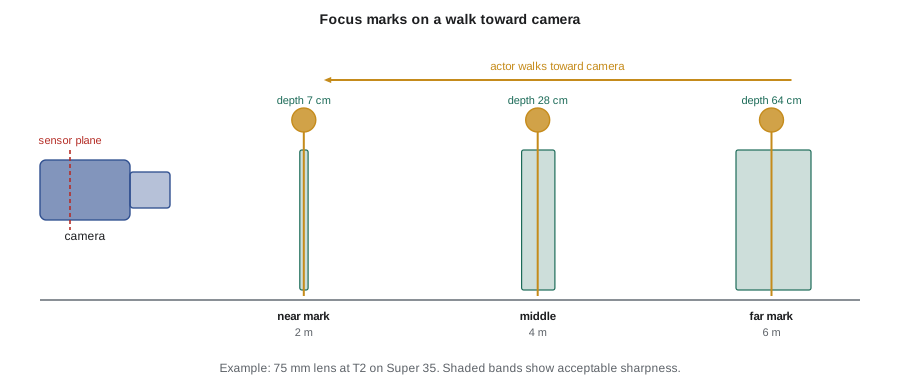
The first assistant camera keeps the image sharp and the camera working. Focus pulling is the most visible part of the job and one of the hardest skills in filmmaking: an actor walks toward a lens wide open at T2, the plane of sharp focus is a few centimeters deep, and the 1st AC must keep the eyes sharp without looking through the camera. Behind that skill sits a large body of routine work, from building cameras and managing lenses to keeping the department organized. This lesson describes the 1st AC's craft at an awareness level, so that anyone working in or around a camera department understands what the job involves. It does not replace years of hands-on training under experienced assistants.
Building and maintaining the camera
The 1st AC builds the camera each day from its cases: body, lens mount, matte box, follow focus or wireless focus motors, monitors, power, media and accessories. The build must be balanced for the operator, secure for every support (tripod, dolly, crane, Steadicam or handheld) and configured to the DP's settings for frame rate, shutter, resolution, codec, frame lines and look. The 1st AC keeps the camera clean, checks the sensor or film gate for dust, checks back focus and lens collimation when lenses come from the rental house, and reports faults immediately. Rental houses depend on 1st ACs to return packages complete and to describe faults accurately.
Lenses and lens changes
The 1st AC manages the lens set: choosing the next lens with the DP, changing lenses quickly and safely, cleaning glass, checking focus marks and keeping track of each lens's condition and serial number. A lens change on a busy set must take seconds, with the old lens capped and stored before the next goes on, and with a check that the lens data and focus marks match the new lens. Lens data, such as focal length, focus distance and iris, is recorded for visual effects and post-production, either by the 2nd AC or automatically through lens metadata systems.
How focus works on set
Focus pulling depends on distance. The lens is sharpest at one distance from the sensor, and depth of field, the range of distances that look acceptably sharp, depends on the focal length, the aperture, the focus distance and the format. Long lenses, wide apertures and close focus distances give very shallow depth of field. The 1st AC measures distances to actors and objects with tape measures, laser rangefinders or distance display units, places marks for key positions and adjusts the focus ring during the take to keep the subject sharp as distances change.
Here \(H\) is the hyperfocal distance, \(f\) the focal length, \(N\) the f-number, \(c\) the circle of confusion for the format and \(s\) the focus distance. These approximations are useful for understanding why some shots are much harder to pull than others; on set, assistants use depth of field apps and experience.
Worked problem
Depth of field for a close-up
A 1st AC uses a 75 mm lens at T2 on a Super 35 camera with a circle of confusion of 0.025 mm, focused at 2 m (about 6 ft 7 in) on an actor. Estimate the depth of field.
Show solution
- Hyperfocal distance: H = 75² ÷ (2 × 0.025) = 5,625 ÷ 0.05 = 112,500 mm = 112.5 m.
- Near limit: (112.5 × 2) ÷ (112.5 + 2) ≈ 1.965 m.
- Far limit: (112.5 × 2) ÷ (112.5 − 2) ≈ 2.036 m.
Answer: About 7 cm (under 3 in) of acceptable sharpness. A small lean by the actor can take the eyes out of focus.
Worked problem
Pulling focus on a walk toward camera
An actor walks from a mark 20 ft from the sensor to a mark 6 ft away in 4 seconds at a steady pace. How fast is the focus distance changing, and why is the pull harder at the end?
Show solution
- Distance change: 20 − 6 = 14 ft in 4 s, about 3.5 ft per second.
- Lens focus scales are not linear: close distances take up much more of the focus ring's rotation than far distances.
- Depth of field also shrinks as the actor comes closer, so small errors become visible.
Answer: The actor's speed is steady, but the focus ring must turn faster near the end and the margin for error is smallest there, so the final mark matters most.
Marks, rehearsals and communication
During blocking and rehearsals the 1st AC watches the actors' movements, notes the key positions and works with the 2nd AC to place marks on the floor. Marks are small pieces of colored tape or T-shaped marks that actors hit and assistants measure to. The 1st AC also notes distances to walls, furniture and props that the actor passes. Communication with the operator, the dolly grip and the DP is constant: changes in the dolly move, the actor's pace or the lens all change the focus plan. Experienced assistants ask for rehearsals with first team when a pull is difficult, and they tell the DP before a take if a shot is at risk.
Tools of the trade
| Tool | Use |
|---|---|
| Tape measure and cloth tape | Measuring distances from the sensor plane to marks |
| Laser rangefinder or distance display | Measuring or displaying distances to moving subjects |
| Wireless follow focus | Pulling focus remotely from a hand unit, often from a monitor |
| Focus monitor with peaking | Checking sharpness on a monitor during rehearsal and takes |
| Lens cleaning kit | Blower, brushes, lens tissue and approved cleaning fluid |
| Multimeter and tools | Checking power, cables and fixing small faults |
| Labels and marker pens | Marking lens rings, cases and media |
Many assistants own personal kits of tools and accessories, which they rent to productions as a kit or box rental. Lesson 7 covers kit rental fees.
Moving and protecting the camera
Cameras are expensive and fragile, and an accident with a camera or lens can injure people as well as damage equipment. Assistants carry cameras close to the body with a firm grip, call out when moving through crowded areas ("camera coming through"), never leave a camera unattended on a stand or apple box and lock heads and plates securely. Lenses are capped and stored in cases when not in use. In rain, dust, cold or heat, the camera department protects the equipment with covers, heaters and shade, and watches for condensation when moving between cold outdoors and warm interiors. Assistants also watch their own safety: working near dollies, cranes and moving vehicles, and lifting heavy cases with good technique.
Becoming a focus puller
Most 1st ACs learn the craft over years as trainees, loaders and 2nd ACs, practicing focus on rehearsals, watching experienced assistants and taking on easier pulls first. Many practice at home with a camera, a lens and moving subjects, and some take short courses run by rental houses, unions or professional societies. Reliability matters as much as skill: a 1st AC is trusted with the camera package, the department's logistics and a large share of the DP's success. DPs and producers remember assistants whose focus was consistently sharp under pressure.
Prepping the package at the rental house
Before shooting begins, the 1st AC usually spends one or more prep days at the rental house checking the camera package. A thorough prep follows a checklist.
- Inventory: every body, lens, accessory, cable and case is counted and matched to the order.
- Function tests: cameras are powered and tested at the production's settings, including frame rates, codecs and recording to every card.
- Lens tests: each lens is checked on a projector or test chart for sharpness, focus marks and flare, and shot on camera for the DP to review.
- Accessories: wireless focus and video systems are paired and tested for range and interference.
- Labels: cases, lenses and cables are labeled for quick work on set.
Problems found in prep are fixed or swapped by the rental house at no cost to the shooting schedule, which is why experienced 1st ACs insist on adequate prep time.
Keeping lens and camera records
Visual effects, continuity and the color grade all depend on accurate records of how each shot was made. The 1st AC and 2nd AC record lens focal lengths, T-stops, filters, frame rates and focus distances, often with lens metadata systems that send this information directly into the recorded files. Assistants also note camera heights and distances for visual effects shots and record changes to settings during the day. Good records save hours in post-production and protect the camera department when questions arise later about how a shot was made.
Common focus aids and their limits
Modern focus pullers use tools that would have seemed remarkable a generation ago: laser and lidar distance systems that display the distance to a subject in real time, wireless focus units with preset marks, and high-resolution focus monitors with peaking. These tools help, especially on long lenses and fast-moving subjects, but they have limits. Distance sensors can read the wrong object, such as a shoulder instead of the eyes, wireless links can drop out and monitors can mislead when they are not calibrated. Experienced 1st ACs combine technology with measurement, rehearsal and judgment, and they always know where the subject should be even when the screen says something else.
Mistakes that cost a 1st AC their job
Few single mistakes end a career, but some come close: losing or dropping a lens, damaging a camera through carelessness, repeatedly soft takes on key shots, hiding problems from the DP and poor returns to rental houses. Each of these is avoidable with care, preparation and honest communication. When a mistake happens, report it immediately, help fix it and learn from it. DPs forgive honest errors far more readily than they forgive concealment.
Working with the operator and dolly grip
Focus, framing and camera movement form a three-way partnership. The operator decides the frame, the dolly grip moves the camera and the 1st AC keeps the subject sharp. Rehearsals let the three agree on speeds, stopping points and marks, and small changes from any one of them affect the others. Good teams develop shorthand signals and trust built over many shows.
Common mistakes
MistakeMeasuring focus from the front of the lens
InsteadMeasure from the sensor or film plane, marked on the camera body
MistakeAssuming depth of field is the same at every distance
InsteadDepth of field shrinks rapidly as focus distance gets shorter and the aperture opens
MistakeLeaving a camera on a stand or apple box unattended
InsteadKeep a hand on the camera or secure it on a locked support
MistakeChanging lenses without checking marks and data
InsteadCheck the lens, focus marks and lens data after each change
MistakeHiding a soft take from the DP
InsteadTell the DP or operator immediately so the director can choose another take
Summary and key terms
- The 1st AC builds, configures and maintains the camera and manages the lens set.
- Lens changes must be fast, safe and followed by checks of marks and lens data.
- Depth of field depends on focal length, aperture, focus distance and format, and shrinks at close distances.
- Focus pullers measure distances, place marks with the 2nd AC and adjust focus during takes.
- Communication with the operator, dolly grip and DP is constant during rehearsals.
- Assistants protect the camera from accidents and weather and protect their own safety.
- Most focus pullers learn over years, and reliability matters as much as skill.
- Focus puller
- Another name for the first assistant camera
- Depth of field
- The range of distances that look acceptably sharp
- Hyperfocal distance
- The focus distance at which depth of field extends to infinity
- Circle of confusion
- The largest blur spot that still looks sharp for a given format and viewing
- Sensor plane mark
- The mark on a camera body showing the plane distances are measured from
- Follow focus
- A geared or wireless device used to turn a lens's focus ring
- Back focus
- The distance between the lens mount and the sensor, which must be correct for focus marks to be accurate
- Collimation
- Checking that a lens's focus marks match its true focus
- Rangefinder
- A device that measures distance, often with a laser
- Kit rental
- A fee paid to a crew member for the use of their own tools or equipment
Practice problems
Work each problem on paper first, then reveal the answer to check.
From where are focus distances measured?
Show answer
The sensor or film plane
Why are close-ups with long lenses wide open hard to pull?
Show answer
Depth of field is very shallow
Estimate the hyperfocal distance for a 50 mm lens at T2.8 with c = 0.025 mm.
Show answer
About 35.7 m (50² ÷ (2.8 × 0.025) ≈ 35,700 mm)
Why does the focus ring move faster at the end of a walk toward camera?
Show answer
Focus scales are compressed at close distances
Name two tools in a 1st AC's kit.
Show answer
Any two of tape measure, rangefinder, wireless follow focus, focus monitor, cleaning kit, multimeter and labels
What should happen after every lens change?
Show answer
Check the lens, focus marks and lens data
Why should a camera never be left unattended on an apple box?
Show answer
It can fall, injuring people and damaging the camera
What risk occurs when moving a cold camera into a warm room?
Show answer
Condensation on lenses and electronics
What is collimation?
Show answer
Checking that a lens's focus marks match its true focus
How do most focus pullers learn their craft?
Show answer
Over years as trainees, loaders and 2nd ACs, practicing and watching experienced assistants
Lesson quiz · 5 questions
Score 60% or more to complete this lesson.
Create a free account to save your progress, take quizzes and earn a certificate.