
CON-130 · Lesson 11 of 12 · 34 min
Money maths: interest, cash flow, retainage and sales tax
Construction is financed work. Contractors pay for labor, materials and equipment weeks or months before they are paid, owners borrow to fund projects, and payment rules hold back part of every invoice until the work is finished. The mathematics of money, interest, escalation, cash flow, retained amounts and sales taxes, therefore affects every project's profit as much as the mathematics of quantities. This lesson works through simple and compound interest, escalation of costs over time, the time value of money, progress payments with holdback or retainage, the cash flow gap that contractors must finance, and the sales taxes that apply to construction. It explains the arithmetic and the main rules; it is not legal, tax or accounting advice, and the rules change, so always confirm current requirements for a specific project.
Simple and compound interest
Interest is the price of borrowing money. Simple interest is calculated only on the original amount, the principal. Compound interest is calculated on the principal plus interest already earned or charged, so it grows faster. Construction loans, lines of credit and late-payment interest are usually compounded monthly or daily, while short-term calculations are often done with simple interest for convenience.
In the simple interest formula, P is the principal, r the annual rate and t the time in years. In the compound formula, F is the future amount, i the rate per compounding period and n the number of periods. An annual rate of 7.2 % compounded monthly has a monthly rate of 0.6 %. The effective annual rate, the true yearly cost after compounding, is (1 + i)ⁿ − 1 over one year, which for 0.6 % monthly is 1.006¹² − 1 = 7.44 %.
Worked problem
Interest on a construction loan
A contractor draws $250,000 on a line of credit at 7.2 % a year for 9 months. (a) What is the interest using simple interest? (b) What is it with monthly compounding? (c) What is the effective annual rate?
Show solution
- (a) Simple: I = 250,000 × 0.072 × (9 ÷ 12) = $13,500.
- (b) Compound: i = 0.072 ÷ 12 = 0.006 per month; F = 250,000 × 1.006⁹ = 250,000 × 1.05531 = $263,829; interest = $13,829.
- (c) Effective annual rate = 1.006¹² − 1 = 0.0744 = 7.44 %.
Answer: $13,500 simple; about $13,830 compounded monthly; effective rate 7.44 %.
Escalation
An estimate prepared today prices labor and materials at today's costs, but much of the work will be bought months or years later. Escalation is the expected increase in costs over that time, applied as a compound rate. Estimators usually escalate to the midpoint of construction, or to the expected purchase date of major items, because spending is spread across the construction period. Escalation rates come from cost indices, supplier forecasts and economic data, and can vary sharply by material and region.
Worked problem
Escalating an estimate to the midpoint of construction
A building is estimated at $4,200,000 in today's dollars. Construction starts in 12 months and lasts 12 months, so its midpoint is 18 months from now. Escalation is forecast at 4.5 % a year. (a) What is the escalated estimate? (b) How much is the escalation allowance? (c) If the forecast rose to 6 %, what would the allowance be?
Show solution
- (a) t = 1.5 years; factor = 1.045^1.5 = 1.0683; escalated estimate = 4,200,000 × 1.06825 = $4,486,670.
- (b) Allowance = 4,486,670 − 4,200,000 = $286,670.
- (c) Factor = 1.06^1.5 = 1.0913; allowance = 4,200,000 × 0.09134 = $383,600, about $97,000 more.
Answer: About $4.49 million escalated, an allowance of about $287,000 (about $384,000 at 6 %).
The time value of money
A dollar received later is worth less than a dollar today, because today's dollar could earn interest in the meantime. The present value of a future amount discounts it back to today at an interest rate, called the discount rate. Present value explains why holdback or retainage costs contractors money even when it is eventually paid in full, and why owners compare options with different payment timing using discounted values rather than raw totals.
Worked problem
The cost of waiting for retained money
A subcontractor has $100,000 retained on a project, to be released 14 months from now. The subcontractor's cost of borrowing is 8 % a year, compounded monthly. What is the present value of the retained amount, and what does the wait cost?
Show solution
- Monthly rate = 0.08 ÷ 12 = 0.006667; n = 14.
- PV = 100,000 ÷ 1.006667¹⁴ = 100,000 ÷ 1.0975 = $91,120.
- The wait costs about 100,000 − 91,120 = $8,880 in today's money, nearly 9 % of the retained amount.
Answer: The retained $100,000 is worth about $91,100 today; the wait costs about $8,900.
Progress payments
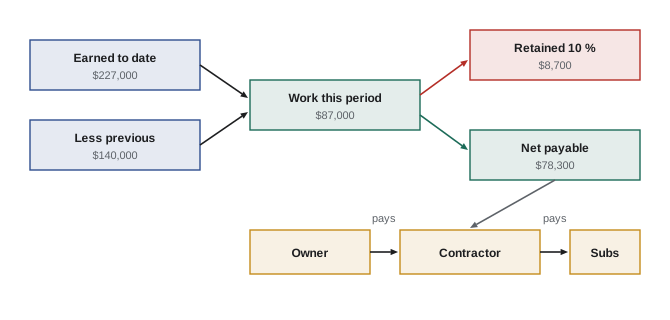
Most construction contracts pay monthly for work completed (Lesson 2). The contractor submits an application for payment showing the value of work done to date, often with materials stored on site, less previous payments and less a retained percentage. The owner or the owner's consultant certifies the amount, and the owner pays within the contract or statutory period. The contractor then pays its subcontractors their shares, and so on down the chain.
In the United States, the retained amount is called retainage. It is set by the contract and, on public work, by statute. Retainage is commonly 5 to 10 % of each progress payment; many contracts reduce it to 5 % or stop retaining once the work is 50 % complete. On federal contracts, the Federal Acquisition Regulation allows retainage of up to 10 % only when progress is unsatisfactory, and the federal Prompt Payment Act requires prime contractors to pay subcontractors within 7 days of receiving payment. Most states have prompt payment acts for public work, and many for private work, with payment deadlines, interest on late payments and limits on retainage, such as a 5 % cap on many public projects. Rules differ by state and by public or private work, so check the governing statute and the contract.
Worked problem
A progress payment with a retained amount
Using the schedule of values in Lesson 2, the work earned to date is $227,000 and previous payments certified totaled $140,000 before retainage. The contract provides 10 % retainage until the work is 50 % complete. (a) What is the value of work this period? (b) What is the retainage this period? (c) What amount is payable? (d) What payment rules apply?
Show solution
- (a) Work this period = 227,000 − 140,000 = $87,000.
- (b) The work is 45.4 % complete (227,000 ÷ 500,000), so full retainage still applies: 0.10 × 87,000 = $8,700. Total retainage to date = $22,700.
- (c) Payable = 87,000 − 8,700 = $78,300. Most states do not add sales tax to a construction contract invoice, because the contractor pays tax when buying materials, but some states tax contract services; check the state's rules.
- (d) Payment timing follows the contract and any applicable state prompt payment act; on federal work the prime must pay subcontractors within 7 days of receiving payment. Once the work passes 50 %, the contract in this example reduces or stops further retainage.
Answer: Work this period $87,000; retainage $8,700; $78,300 payable; timing set by the contract and statute.
The cash flow gap
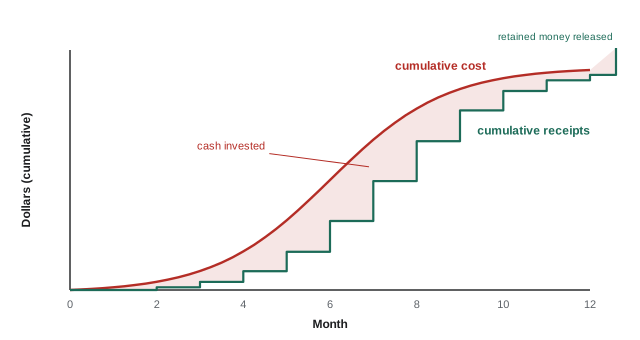
A contractor's costs are incurred as the work is done, but income arrives later: invoices are submitted at month end, certified, paid weeks later and reduced by the retained amount. The difference between cumulative costs and cumulative receipts is the contractor's negative cash position, which must be financed from working capital or borrowing. Plotting cumulative costs and cumulative receipts over time produces two S-shaped curves, with the gap between them showing the money the contractor has tied up in the project.
Worked problem
Financing the cash flow gap
A contractor incurs costs of $300,000 in each of months 1 to 3, bills cost plus a 10 % markup at the end of each month, and is paid 30 days after month end, less 10 % retainage. (a) What is the contractor's cash position at the end of month 3, just before the month-3 invoice is paid? (b) What is the approximate interest cost of carrying the gap for one month at 8 % a year?
Show solution
- Each monthly invoice = 300,000 × 1.10 = $330,000; payment received = 330,000 × 0.90 = $297,000.
- By the end of month 3: costs paid = 3 × 300,000 = $900,000. Payments received = invoices for months 1 and 2, received at the ends of months 2 and 3 = 2 × 297,000 = $594,000.
- (a) Cash position = 594,000 − 900,000 = −$306,000. The contractor is financing about $306,000.
- (b) Interest for one month ≈ 306,000 × 0.08 ÷ 12 = $2,040.
- Slow payment, high retainage and front-loaded costs all deepen the gap; that is why prompt payment laws, retainage limits and fair billing matter to contractors' finances.
Answer: About −$306,000 at the end of month 3, costing roughly $2,000 a month in interest.
Sales taxes on construction
In the United States, sales tax is imposed by states and many local governments, at combined rates that vary from zero in a few states to over 10 % in some cities. Most states treat construction contractors who install materials into real property as the consumers of those materials: the contractor pays sales or use tax when buying the materials and recovers it through its contract price, and does not charge sales tax on the contract. Some states instead tax the contract or certain services, some allow resale treatment for certain contract types, and exemptions for tax-exempt owners such as government agencies vary. Use tax applies when materials are bought tax-free out of state and used in a taxing state. Confirm the rules for each state and project with current guidance or a tax adviser.
Whatever the system, two arithmetic rules from Lesson 2 apply. Tax is calculated on the taxable amount, so check what the base includes. And to remove tax from a tax-inclusive total, divide by one plus the rate rather than subtracting the rate.
Worked problem
Sales tax in a material price
A contractor buys $16,500 of materials for installation in a building in a city where the combined state and local sales tax rate is 8.25 %. (a) What does the contractor pay for the materials? (b) What does that do to the material cost in the estimate? (c) A supplier's tax-inclusive quote of $17,861.25 arrives for the same materials. What is its pre-tax amount?
Show solution
- (a) Cost = 16,500 × 1.0825 = $17,861.25; tax = $1,361.25.
- (b) Because the contractor is usually the consumer of installed materials, the tax is a cost of the job and must be included in the material price in the estimate.
- (c) Pre-tax = 17,861.25 ÷ 1.0825 = $16,500.
Answer: $17,861.25 paid; the tax is a job cost; the pre-tax amount is $16,500.
Putting it together
These calculations interact. Escalation raises the costs that are financed; slow payment and retained amounts lengthen the financing period; interest rates set its cost; and sales taxes change what materials really cost. A contractor deciding whether to bid a project with slow-paying owners or high retainage, or an owner deciding whether to release retained money early in exchange for a lower price, can compare options by putting each cash flow on a timeline and discounting it to a present value. Spreadsheets, covered in Lesson 12, make that comparison quick and transparent.
Common mistakes
MistakeUsing an annual rate as a monthly rate.
InsteadDivide the annual rate by 12 for monthly compounding, and use the number of months.
MistakeEscalating to the start of construction.
InsteadEscalate to the midpoint of spending or to purchase dates of major items.
MistakeTreating retained money as costless.
InsteadDiscount it: money received later is worth less, and the gap must be financed.
MistakeCalculating tax on a retained amount before it is payable.
InsteadFollow the tax rules for retained amounts; in Canada GST/HST on holdback is generally due when it is paid.
MistakeRemoving tax by subtracting the rate.
InsteadDivide a tax-inclusive total by (1 + rate).
Summary and key terms
- Simple interest is P r t; compound interest uses F = P (1 + i)ⁿ with rate and periods matched.
- Escalate estimates with (1 + e)ᵗ to the midpoint of construction.
- Present value PV = F ÷ (1 + i)ⁿ measures the cost of waiting for money.
- Progress payments deduct previous payments and a retained percentage.
- Holdback in Canada and retainage in the US are governed by contract and statute, with prompt payment rules.
- The gap between cumulative cost and receipts must be financed.
- Sales tax treatment differs by province or state and changes what materials really cost.
- Principal
- Amount borrowed or invested.
- Compound interest
- Interest calculated on principal plus accumulated interest.
- Effective annual rate
- True yearly rate after compounding.
- Escalation
- Expected increase in costs over time.
- Present value
- Value today of a future amount.
- Discount rate
- Rate used to convert future amounts to present value.
- Application for payment
- Monthly request showing work completed and amount due.
- Retained amount
- Percentage withheld from progress payments until completion.
- Prompt payment
- Legislation setting deadlines for construction payments.
- Input tax credit
- Recovery of GST/HST paid on business purchases.
Practice problems
Work each problem on paper first, then reveal the answer to check.
Simple interest on $80,000 at 6 % for 5 months?
Show answer
$2,000.
$80,000 at 0.5 % a month compounded for 5 months: interest?
Show answer
80,000 × (1.005⁵ − 1) = $2,020.
Effective annual rate of 0.75 % a month?
Show answer
1.0075¹² − 1 = 9.38 %.
Escalate $1.5 million at 3.5 % a year for 2 years.
Show answer
$1,606,838.
Present value of $50,000 due in 1 year at 6 % a year?
Show answer
$47,170.
Earned to date $640,000, previous payments $510,000 (before retention), 10 % retained. Net payable?
Show answer
$117,000.
Total retained to date on $640,000 at 10 %?
Show answer
$64,000.
Remove 13 % tax from $5,650.
Show answer
$5,000.
Remove 8.25 % tax from $2,165.
Show answer
$2,000.
Costs $200,000 a month; paid one month later at 90 % of a 10 % markup invoice. Cash position at the end of month 2, before the month-2 invoice is paid?
Show answer
−400,000 + 198,000 = −$202,000.
Lesson quiz · 5 questions
Score 60% or more to complete this lesson.
Create a free account to save your progress, take quizzes and earn a certificate.