
CON-210 · Lesson 4 of 12 · 30 min
Sequencing and logic: dependencies, constraints and lags
Once the activities and their durations are known, they must be put in order. Logic, the network of relationships between activities, is what turns a list into a schedule. It records which work must finish before other work can start, which work can overlap, and by how much. Good logic reflects how the job will really be built. Bad logic, whether missing, wrong or forced with date constraints, makes the critical path meaningless and every forecast unreliable. This lesson covers the kinds of dependency, the four relationship types, lags and leads, constraints, and the diagramming conventions used in construction.
Why activities depend on each other
Dependencies in construction come from several sources, and a good scheduler knows which kind each link represents.
- Physical or mandatory dependencies come from the nature of the work: footings before foundation walls, structure before roofing, rough-in before drywall. They cannot be changed without changing the design or method.
- Resource dependencies arise because the same crew, crane or set of forms is used in sequence: the same forming crew moves from area A to area B, so B cannot start until A is done, even though B does not physically need A.
- Preferential or discretionary dependencies reflect the team's chosen method: finishing level 2 before level 3 so the drywall crew can work top-down, for instance. They can be changed if the plan changes.
- External dependencies involve parties outside the project team: a utility connection, a permit, an inspection, owner-supplied equipment.
- Safety and regulatory dependencies: work below must not proceed while overhead work continues, excavations must be inspected before entry, fire protection must be operational before occupancy.
Separating these matters because discretionary and resource logic can be changed to recover time, while physical logic generally cannot. When a schedule is under pressure, the first place to look for time is in the discretionary links.
The precedence diagramming method
Modern construction schedules use the precedence diagramming method, in which each activity is a box, or node, and arrows between boxes show relationships. It is sometimes called activity-on-node. An older method, activity-on-arrow or the arrow diagramming method, drew each activity as an arrow between event circles and needed dummy activities to show some logic. Activity-on-arrow is now mostly of historical interest, though its vocabulary, such as events and nodes, survives.
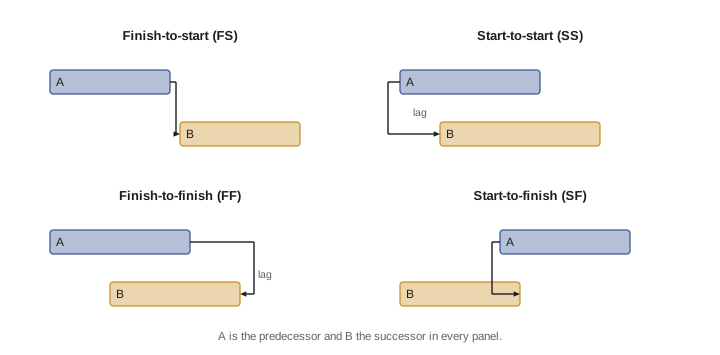
In the precedence method, the relationship between two activities is described by its type and an optional lag. The predecessor is the activity at the tail of the arrow, and the successor is at the head.
The four relationship types
| Type | Meaning | Construction example |
|---|---|---|
| Finish-to-start (FS) | The successor cannot start until the predecessor finishes | Footings must finish before foundation walls start |
| Start-to-start (SS) | The successor cannot start until the predecessor has started | Placing reinforcing can start once forming has started, with a lag |
| Finish-to-finish (FF) | The successor cannot finish until the predecessor has finished | Taping cannot finish until hanging finishes |
| Start-to-finish (SF) | The successor cannot finish until the predecessor has started | Temporary heating cannot stop until permanent heating starts |
Finish-to-start is the default and should make up most of a schedule's links. The Defense Contract Management Agency's 14-point schedule assessment, widely used as a quality benchmark in the United States and elsewhere, expects at least 90 % of relationships to be finish-to-start. Start-to-start and finish-to-finish are useful for overlapping work, especially on repetitive or linear tasks. Start-to-finish is rare and often confusing; many schedulers avoid it entirely.
Lags and leads
A lag is a delay added to a relationship. A finish-to-start relationship with a 7-day lag means the successor can start 7 days after the predecessor finishes, for example to allow concrete to cure before stripping forms. A start-to-start relationship with a 2-day lag means the successor can start 2 days after the predecessor starts, so that the first crew has opened up enough work for the second to follow.
A lead is a negative lag: the successor can start before the predecessor finishes. A finish-to-start relationship with a 3-day lead means the successor can start 3 days before the predecessor finishes. Leads are generally discouraged in professional scheduling practice and many specifications forbid them, because the same overlap can be shown more clearly with a start-to-start relationship and a positive lag, or by splitting the activity. The DCMA assessment expects no leads at all and lags on no more than about 5 % of relationships.
Lags are also abused. A long lag used to represent work, such as a 20-day lag standing in for fabrication, hides an activity that should be in the schedule, cannot be progressed, and makes the critical path hard to follow. Lags should represent waiting time, such as curing or drying, not work.
Worked problem
Overlapping slab work with SS and FF logic
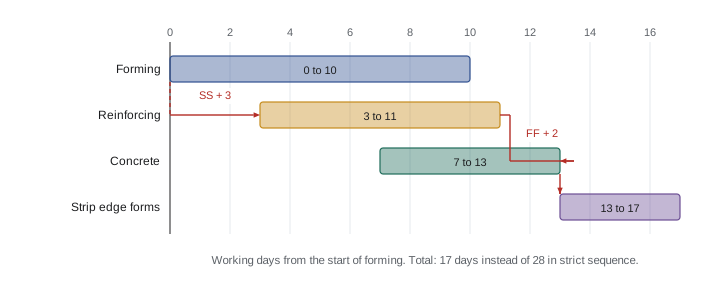
A slab on grade is built by three crews. Forming takes 10 days. Reinforcing takes 8 days and can start 3 days after forming starts (SS + 3). Placing concrete takes 6 days and cannot finish until 2 days after reinforcing finishes (FF + 2). Stripping edge forms takes 4 days and starts after both forming and concrete placement finish (FS). Calculate the early dates and the total duration, counting day 0 as the start of the work.
Show solution
- Forming: starts day 0, finishes day 10.
- Reinforcing: starts day 0 + 3 = day 3 (SS + 3), finishes day 3 + 8 = day 11.
- Concrete: its finish must be at least reinforcing finish + 2 = day 13 (FF + 2). Its duration is 6 days, so it starts day 13 − 6 = day 7, which is after reinforcing has started, so the logic is consistent.
- Stripping: starts after forming (day 10) and concrete (day 13), so day 13, and finishes day 17.
- Total duration: 17 days, compared with 10 + 8 + 6 + 4 = 28 days if every link were finish-to-start.
Answer: 17 days. Overlapping relationships save 11 days compared with strictly sequential work.
Constraints
A constraint is a date imposed on an activity instead of, or in addition to, logic. Scheduling software offers several kinds.
- Start no earlier than, and finish no earlier than: the activity cannot start or finish before a date, for example because a permit or access date is fixed. These are soft constraints: they still let logic push the activity later.
- Start no later than, and finish no later than: the activity must start or finish by a date, for example an interim milestone in the contract. If logic pushes the activity past the date, negative float appears, warning that the date will be missed.
- Mandatory start and mandatory finish, sometimes called must start on or must finish on: the activity is fixed to a date regardless of logic. These are hard constraints that break the logic of the network, and they can make a late schedule look on time.
Constraints have legitimate uses: contract milestones, access dates, and the delivery date of owner-supplied equipment. But they should be few. The DCMA assessment expects hard constraints on no more than about 5 % of activities, and many specifications prohibit mandatory constraints entirely in schedule submittals. Every constraint should be justified in the schedule narrative.
Worked problem
How a constraint hides a delay
Interior finishes on a project are linked by logic to the end of MEP rough-in, which is now forecast to finish on working day 140. Finishes take 30 days. The scheduler has given finishes a mandatory finish of day 160, the contract date. What does the schedule show, and what should it show?
Show solution
- By logic, finishes start day 140 and finish day 170.
- With a mandatory finish of day 160, the software forces finishes to end on day 160, showing them starting day 130, which is before rough-in finishes. The logic is broken and the schedule looks on time.
- With a finish-no-later-than constraint instead, finishes stay at days 140 to 170 and show −10 days of float, a clear warning.
- Best practice is to model the contract date as a milestone with a finish-no-later-than constraint and let the logic speak.
Answer: The mandatory constraint hides a 10-day delay. A finish-no-later-than milestone would show −10 days of float.
Open ends and dangling activities
In a well-built network every activity except the project start has at least one predecessor, and every activity except the project finish has at least one successor. An activity with no successor is an open end: if it slips, nothing downstream moves, so the schedule cannot show the effect of the delay. The DCMA assessment calls missing logic a key defect and expects it on no more than about 5 % of incomplete activities.
A subtler problem is a dangling activity: one that has a predecessor driving its start but no successor tied to its finish, or the reverse. Suppose drywall taping has a start-to-start link from hanging but nothing linked to its finish. If taping takes twice as long as planned, the painting that follows it does not move. Every activity should have logic driving its start and logic depending on its finish.
Logic for typical building work
Every project is different, but much building logic follows familiar patterns that experienced superintendents carry in their heads. A simplified sequence for a low-rise building shows how physical, resource and discretionary logic combine.
- Site: mobilization, clearing and layout, excavation, underground services.
- Substructure: footings, foundation walls, waterproofing and drainage, backfill, underslab services, slab on grade.
- Structure: columns and beams or walls, floor and roof decks, concrete toppings.
- Dry-in: roofing, exterior walls and windows, temporary closures, so that interior work is protected from weather.
- Rough-in: mechanical, electrical, plumbing and fire protection rough-in, often overlapping with interior framing.
- Close-in: inspections, insulation, drywall hanging, taping and finishing.
- Finishes: ceilings, painting, flooring, millwork, doors and hardware, specialties, with trim-out of MEP systems.
- Completion: testing and commissioning, cleaning, deficiency correction, occupancy permit, substantial completion and closeout.
Dry-in deserves special attention. Many interior finishes cannot proceed until the building is weathertight and heated, so roofing and windows often lie on or near the critical path, and late window deliveries are a classic cause of delay.
Worked problem
Choosing between FS and SS links
Interior framing on a floor takes 15 days. Electrical rough-in on the same floor takes 12 days, can start once the first third of the framing is complete, and must finish at least 2 days after framing finishes so that the last walls can be wired. How should the relationship be modeled, and when does rough-in finish if framing starts on day 0?
Show solution
- One third of framing is 15 ÷ 3 = 5 days, so use start-to-start with a 5-day lag: rough-in can start on day 5.
- Rough-in would then finish on day 5 + 12 = day 17.
- Add finish-to-finish with a 2-day lag: rough-in cannot finish before framing finish (day 15) + 2 = day 17.
- Both constraints are met on day 17, so rough-in runs from day 5 to day 17.
Answer: Use SS + 5 and FF + 2. Rough-in runs from day 5 to day 17, overlapping most of the framing.
Reviewing logic
Before the schedule is calculated, the logic should be reviewed with the people who will build the work. A practical review walks through the network area by area and asks the superintendent and trades: Can this really start then? What has to be in place first? Who else is in the space? Where are the inspections? What happens if this is late? Many errors, such as a missing inspection hold point, a trade that needs a crane already committed elsewhere, or a sequence that cannot work around a tower crane base, are caught only this way.
Common mistakes
MistakeUsing hard date constraints to force activities onto target dates.
InsteadDrive dates by logic and model contract dates as milestones with finish-no-later-than constraints.
MistakeLeaving activities with no successor.
InsteadGive every activity a predecessor and a successor tied to its finish, except the start and finish milestones.
MistakeUsing long lags to represent work such as fabrication.
InsteadCreate activities for work; use lags only for waiting time such as curing.
MistakeUsing leads (negative lags) to show overlap.
InsteadUse start-to-start relationships with positive lags, or split the activity.
MistakeBuilding logic without the superintendent and trades.
InsteadReview the logic area by area with the people who will build the work.
Summary and key terms
- Dependencies may be physical, resource-based, discretionary, external or regulatory.
- The precedence diagramming method shows activities as nodes linked by relationships.
- The four relationship types are FS, SS, FF and SF; most links should be FS.
- Lags represent waiting time; leads are discouraged; lags should not hide work.
- Soft constraints are acceptable for genuine dates; hard constraints break logic and hide delay.
- Every activity needs logic driving its start and logic depending on its finish.
- Logic should be reviewed with the people who will build the work.
- Logic
- The network of relationships that sets the order of activities.
- Predecessor
- An activity that controls the start or finish of another activity.
- Successor
- An activity whose start or finish depends on another activity.
- Finish-to-start
- A relationship in which the successor starts after the predecessor finishes.
- Start-to-start
- A relationship in which the successor starts after the predecessor starts.
- Finish-to-finish
- A relationship in which the successor finishes after the predecessor finishes.
- Lag
- A delay added to a relationship between activities.
- Lead
- A negative lag, allowing a successor to begin before its predecessor finishes.
- Constraint
- An imposed date on an activity, such as start no earlier than or finish no later than.
- Open end
- An activity missing a predecessor or successor, so delays do not flow through the network.
Practice problems
Work each problem on paper first, then reveal the answer to check.
Give an example of a resource dependency.
Show answer
One forming crew must finish area A before moving to area B.
Which relationship type should make up most of a schedule?
Show answer
Finish-to-start; the DCMA benchmark expects at least 90 %.
Model 'drywall taping can start 3 days after hanging starts'.
Show answer
Start-to-start with a 3-day lag from hanging to taping.
Why are leads discouraged?
Show answer
They are confusing and the overlap can be shown more clearly with SS logic and positive lags.
A cure period of 7 days is needed before stripping forms. How is it modeled?
Show answer
A finish-to-start relationship with a 7-day lag, on a 7-day calendar.
What is the danger of a mandatory finish constraint?
Show answer
It fixes the date regardless of logic and can hide delays.
What is an open end?
Show answer
An activity with no successor (or predecessor), so its delays do not affect later work.
A: 10 days. B: SS + 4 from A, 8 days. When does B finish if A starts day 0?
Show answer
Day 12.
Why does dry-in often lie near the critical path?
Show answer
Interior finishes cannot proceed until the building is weathertight and heated.
Which dependencies should be examined first when looking for time?
Show answer
Discretionary and resource dependencies, because they can be changed.
Lesson quiz · 5 questions
Score 60% or more to complete this lesson.
Create a free account to save your progress, take quizzes and earn a certificate.