
CON-210 · Lesson 5 of 12 · 30 min
The critical path method
The critical path method, or CPM, is the calculation at the heart of construction scheduling. Given a network of activities, durations and logic, it finds the earliest and latest dates each activity can start and finish, the amount of float each activity has, and the critical path: the chain of activities that determines the shortest possible project duration. Scheduling software performs the calculation in a fraction of a second, but every scheduler should be able to do it by hand on a small network. Understanding the arithmetic is the only way to check what the software is doing, to explain the results to a superintendent, and to see why a change in one activity moves the end date or does not.
The four dates and the conventions
Each activity has four calculated dates.
- Early start (ES): the earliest the activity can start, given its predecessors.
- Early finish (EF): the earliest it can finish, equal to early start plus duration.
- Late start (LS): the latest it can start without delaying the project finish.
- Late finish (LF): the latest it can finish without delaying the project finish, equal to late start plus duration.
This lesson uses the convention common in textbooks and in most software calculations: time is counted from zero, an early start of 0 means the beginning of the first working day, and an early finish of 5 means the end of the fifth working day. An activity with ES 5 and a duration of 3 starts at the beginning of day 6 and finishes at the end of day 8, which is written as EF 8. Some practitioners use a convention that starts at day 1, which shifts the start dates by one. Either convention works if it is used consistently; the float and the critical path do not change.
The forward pass
The forward pass works from the start of the network to the end and calculates early dates.
- The first activity, or activities with no predecessors, start at time 0.
- Each activity's early finish is its early start plus its duration.
- For a finish-to-start link, a successor's early start is the largest early finish among its predecessors, plus any lag.
- The project's early finish is the largest early finish of all activities.
The word largest is the key. An activity cannot start until all its predecessors are complete, so the latest-finishing predecessor controls. That predecessor is called the driving predecessor.
The backward pass
The backward pass works from the end of the network back to the start and calculates late dates.
- The last activity's late finish is set equal to the project finish from the forward pass (or to a required completion date, if one is imposed).
- Each activity's late start is its late finish minus its duration.
- For a finish-to-start link, a predecessor's late finish is the smallest late start among its successors, minus any lag.
Here the key word is smallest. An activity must finish in time for its earliest-needed successor, so the successor with the smallest late start controls.
Float
Float, also called slack, measures flexibility. Two kinds matter most.
- Total float is the amount of time an activity can be delayed without delaying the project finish. It equals late start minus early start, or late finish minus early finish.
- Free float is the amount of time an activity can be delayed without delaying the early start of any successor. For finish-to-start links, it equals the smallest early start among the successors minus the activity's early finish (less any lag).
Free float is never more than total float. An activity can have total float but no free float: delaying it would not move the project finish but would push its successors later, using up float they share. A chain of activities that all share the same total float is said to share float; once one activity uses it, the others lose it.
The critical path is the longest path through the network, and in a network with no imposed dates its activities have zero total float. Delay any critical activity by a day and the project finishes a day later. When a required completion date earlier than the calculated finish is imposed, float can be negative, telling the team how many days must be recovered.
A worked network
The following network represents the substructure and early structure of a small building, in working days.
| Activity | Description | Duration | Predecessors (FS) |
|---|---|---|---|
| A | Mobilize and lay out | 3 | — |
| B | Excavate | 5 | A |
| C | Form and pour footings | 4 | B |
| D | Install underground services | 6 | B |
| E | Build foundation walls | 7 | C |
| F | Backfill | 3 | D, E |
| G | Slab on grade | 4 | F |
| H | Steel shop drawings, fabrication and delivery | 15 | A |
| I | Erect structural steel | 8 | G, H |
Worked problem
Forward pass
Calculate the early start and early finish of each activity in the network above, and the project duration.
Show solution
- A: ES 0, EF 0 + 3 = 3.
- B: ES = EF of A = 3; EF = 3 + 5 = 8.
- C: ES 8, EF 12. D: ES 8, EF 14. H: ES 3, EF 18.
- E: ES = EF of C = 12; EF 19.
- F: predecessors D (EF 14) and E (EF 19); ES = largest = 19; EF 22.
- G: ES 22, EF 26.
- I: predecessors G (EF 26) and H (EF 18); ES = 26; EF 34.
Answer: The project takes 34 working days. E drives F, and G drives I.
Worked problem
Backward pass and float
Using a project finish of 34, calculate the late dates, total float and free float of each activity.
Show solution
- I: LF 34, LS 34 − 8 = 26.
- G: LF = LS of I = 26; LS 22. H: LF = 26; LS 26 − 15 = 11.
- F: LF = LS of G = 22; LS 19.
- E: LF = LS of F = 19; LS 12. D: LF = 19; LS 13.
- C: LF = LS of E = 12; LS 8.
- B: successors C (LS 8) and D (LS 13); LF = smallest = 8; LS 3.
- A: successors B (LS 3) and H (LS 11); LF = 3; LS 0.
- Total float (LS − ES): A 0, B 0, C 0, E 0, F 0, G 0, I 0; D 13 − 8 = 5; H 11 − 3 = 8.
- Free float: D = ES of F (19) − EF of D (14) = 5; H = ES of I (26) − EF of H (18) = 8; all others 0.
Answer: The critical path is A–B–C–E–F–G–I. D has 5 days of float and steel procurement (H) has 8.
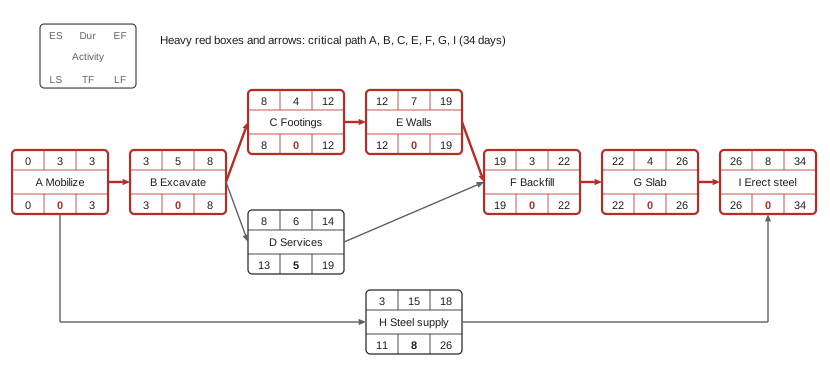
Consider what the float values mean in practice. The underground services crew (D) could start up to 5 days late, or take up to 5 extra days, without affecting anything. Steel procurement (H) has 8 days of float, which is less comfortable than it sounds: a two-week delay in shop drawing approval would make steel critical and delay the project by 2 days. Procurement activities on long chains often carry float that disappears quickly, which is why they need close tracking.
The activity box
Hand calculations and many printed network diagrams use a standard activity box. The arrangement varies, but a common layout shows early start, duration and early finish across the top, the activity identifier and name in the middle, and late start, total float and late finish across the bottom. Writing the numbers this way makes the forward pass (left to right along the top) and backward pass (right to left along the bottom) easy to follow.
Relationships other than finish-to-start
The same passes work for start-to-start and finish-to-finish links, with different rules for each type.
| Link | Forward pass rule for the successor | Backward pass rule for the predecessor |
|---|---|---|
| FS + lag | ES ≥ EF(pred) + lag | LF ≤ LS(succ) − lag |
| SS + lag | ES ≥ ES(pred) + lag | LS ≤ LS(succ) − lag |
| FF + lag | EF ≥ EF(pred) + lag | LF ≤ LF(succ) − lag |
Worked problem
Float with overlapping links
In the slab example from Lesson 4, forming (10 days) is followed by reinforcing (8 days, SS + 3 from forming), concrete (6 days, FF + 2 from reinforcing) and stripping (4 days, FS from both forming and concrete). The forward pass gave a finish of day 17. Calculate the late dates and float.
Show solution
- Stripping: LF 17, LS 13.
- Concrete: FS to stripping, so LF = 13; LS 7.
- Reinforcing: FF + 2 to concrete, so LF = 13 − 2 = 11; LS 3.
- Forming: SS + 3 to reinforcing gives LS ≤ 3 − 3 = 0; FS to stripping gives LF ≤ 13, so LS ≤ 3. The smaller controls: LS 0, LF 10.
- Early dates from Lesson 4: forming 0–10, reinforcing 3–11, concrete 7–13, stripping 13–17. Every activity has LS = ES.
Answer: All four activities have zero total float; the whole sequence is critical.
Near-critical paths
A schedule with one critical path and everything else carrying large float is rare. Most real schedules have several paths with small float, called near-critical paths. A path with 3 days of float on a 300-day project is effectively critical: any minor problem on it will make it the controlling path. Good practice is to report not only the critical path but also the paths with float below a threshold, often 10 working days or a percentage of the remaining duration, and to manage them nearly as closely.
Schedules also contain activities with very large float, which is often a sign of missing logic rather than real flexibility. The DCMA assessment flags incomplete activities with more than 44 working days of total float. When a scheduler sees an interior painting activity with 200 days of float, the usual cause is a missing successor.
Worked problem
Is the float real?
In a 260-day schedule, the activity 'Install signage' has 180 days of total float. It has a predecessor (exterior cladding complete) but its only successor is the project finish milestone. What does the float suggest, and what should the scheduler check?
Show solution
- 180 days of float means signage could finish 180 days after its early finish without delaying completion.
- That is implausible: signage normally needs to be installed before occupancy inspections and the owner's move-in.
- The float probably comes from missing logic. The scheduler should link signage to the occupancy permit or substantial completion activities and recheck.
- After adding logic to the occupancy inspection, the float may drop to a realistic figure, such as 15 days.
Answer: The large float most likely reflects missing logic, not true flexibility. Add the correct successor and recalculate.
Who owns the float?
Total float is a shared resource of the project, and contracts and courts have treated its ownership in different ways. If the contractor uses float to absorb its own delays and the owner later causes a delay, does the owner owe a time extension? Many modern specifications state that float belongs to the project and is available to whichever party needs it first, while others reserve float to the contractor or the owner. Lesson 10 returns to this question, because it matters greatly when delays are disputed.
Common mistakes
MistakeTaking the smallest predecessor finish on the forward pass.
InsteadUse the largest early finish of the predecessors; all must finish first.
MistakeTaking the largest successor start on the backward pass.
InsteadUse the smallest late start of the successors.
MistakeMixing day-0 and day-1 conventions in one calculation.
InsteadChoose one convention and use it throughout.
MistakeAssuming activities with float can be ignored.
InsteadTrack near-critical paths and long procurement chains closely.
MistakeAccepting very large float without question.
InsteadCheck for missing logic when float is implausibly large.
Summary and key terms
- CPM calculates early and late start and finish dates for every activity.
- The forward pass takes the largest predecessor finish; the backward pass takes the smallest successor start.
- Total float is LS − ES; free float is the delay possible without affecting any successor.
- The critical path is the longest path; its activities have zero total float when no dates are imposed.
- Negative float shows how far a schedule is behind an imposed date.
- SS and FF links follow their own forward and backward rules.
- Near-critical paths need attention; very large float often means missing logic.
- Early start
- The earliest an activity can start, given its predecessors.
- Early finish
- Early start plus duration.
- Late start
- The latest an activity can start without delaying the project.
- Late finish
- The latest an activity can finish without delaying the project.
- Forward pass
- The calculation of early dates from the start of the network to the end.
- Backward pass
- The calculation of late dates from the end of the network to the start.
- Total float
- The time an activity can be delayed without delaying the project finish.
- Free float
- The time an activity can be delayed without delaying any successor.
- Driving predecessor
- The predecessor that controls an activity's early start.
- Near-critical path
- A path with small total float that could easily become critical.
Practice problems
Work each problem on paper first, then reveal the answer to check.
An activity has ES 12 and duration 6. What is EF?
Show answer
18.
Predecessors finish on days 10, 14 and 12. What is the successor's ES (FS links, no lag)?
Show answer
14.
Successors have LS 30 and 26. What is the predecessor's LF?
Show answer
26.
ES 8, LS 13. What is the total float?
Show answer
5 days.
An activity has EF 14 and its only successor has ES 19. What is the free float?
Show answer
5 days.
Can free float exceed total float?
Show answer
No.
What does negative float mean?
Show answer
The schedule cannot meet an imposed date; the value shows how many days must be recovered.
Predecessor A has ES 4. Successor B is SS + 2 from A. What is the earliest start of B from this link?
Show answer
6.
Why might an activity with 3 days of float be treated as critical?
Show answer
Small problems can easily consume the float and make it control the finish.
A schedule shows 200 days of float on painting. What should you check?
Show answer
Missing successors, such as the link to flooring or occupancy.
Lesson quiz · 5 questions
Score 60% or more to complete this lesson.
Create a free account to save your progress, take quizzes and earn a certificate.