
CON-220 · Lesson 7 of 12 · 29 min
Mechanics' liens, lien waivers and payment bonds
A subcontractor deep in the contract chain has a problem: it has improved the owner's property, but it has no contract with the owner. If the general contractor fails, a contract claim against it may be worth little. Construction law solves this problem with statutory security: a lien that attaches the value of work to the land itself, trusts that protect construction money, and payment bonds from a surety that guarantee payment. These rights are powerful, but they are created by statute, they depend on strict deadlines, and they are lost permanently if those deadlines are missed. This lesson explains how they work and how construction managers protect and manage them.
Why liens exist
The idea behind a construction lien is simple. Those who supply labor, services or materials to improve land should be able to look to the land for payment, because the owner benefits from the improvement. A lien gives a claimant a charge on the owner's interest in the land, which can be enforced by a court-ordered sale if the claim is not paid or secured. In practice, few liens end in a sale. A registered lien clouds the owner's title, blocks financing draws and sales, and pushes the parties to resolve the payment dispute.
In the United States, mechanics' liens are created by state statutes, and every state has one. They share a structure but differ greatly in detail: who can claim, what preliminary notices are required, when the lien must be recorded and when it must be enforced by a lawsuit to foreclose. Mechanics' liens generally cannot be filed against public property, so public projects protect subcontractors and suppliers with payment bonds instead, under the federal Miller Act or state Little Miller Acts.
Preliminary notices, recording and foreclosure
A typical state process has four steps. First, preliminary notice: many states require subcontractors and suppliers who did not contract with the owner to send a notice early in the job; California requires a preliminary notice within 20 days after first furnishing labor or materials to preserve full lien rights. Second, recording: the claimant records a lien claim in the county records within the statutory period, in California within 90 days after completion, or 30 days (subcontractors) or 60 days (direct contractors) after the owner records a notice of completion. Third, notice of the recorded lien to the owner. Fourth, foreclosure: the claimant must sue to foreclose within a set period, in California 90 days after recording.
| State | Key notice and recording deadlines (summary) | Enforcement |
|---|---|---|
| California | Preliminary notice within 20 days of first furnishing; record within 90 days of completion, or 30 or 60 days after a notice of completion | Foreclose within 90 days of recording |
| Texas | Monthly notice by the 15th day of the third month after unpaid work (non-original contractors); lien affidavit by the 15th day of the fourth month (commercial) | Foreclose within 1 year after the last day to file |
| New York | File within 8 months of last work (4 months for single-family homes) | Foreclose within 1 year, extendable |
| Florida | A notice to owner within 45 days of first work; record within 90 days of last work | Foreclose within 1 year |
| Federal projects | No liens; Miller Act bond notice by second-tier claimants within 90 days of last work | Sue on the bond within 1 year of last work |
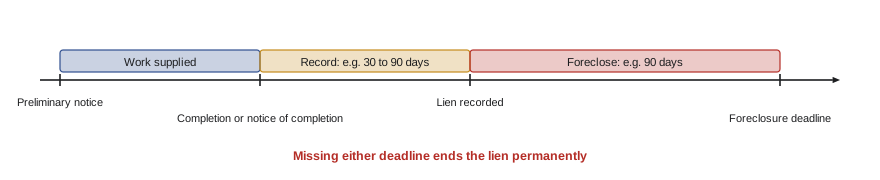
Worked problem
Calculating lien deadlines
A California electrical subcontractor first furnished work on February 3 and finished on September 12. The project was completed on September 30, and the owner recorded a notice of completion on October 2. What are the key deadlines?
Show solution
- Preliminary notice: within 20 days of February 3, by February 23 (a late notice covers only work in the 20 days before it and later).
- Recording: a subcontractor has 30 days after the recorded notice of completion, by November 1.
- Foreclosure: within 90 days after recording the lien.
- Diarize an internal recording target in mid-October.
Answer: Preliminary notice by February 23; record by November 1; foreclose within 90 days of recording.
How much the owner can be made to pay
In many states, an owner's liability to subcontractor lien claimants is limited to the unpaid contract balance owed to the general contractor when notice is received (the New York system). In others, subcontractors' lien rights are independent of what the owner has paid (the Pennsylvania system), so an owner can pay twice if the general contractor fails to pay its subcontractors. Owners protect themselves by collecting lien waivers with every payment, by joint checks, and by requiring payment bonds. A recorded lien can usually be released from the property by recording a lien release bond, which shifts the claim to the bond.
Worked problem
Owner's exposure without lien waivers
An owner in a state where subcontractor liens are independent of payments paid a general contractor in full ($1,500,000). The general contractor failed without paying a roofing subcontractor $120,000, which recorded a valid lien. What is the owner's exposure, and what would have prevented it?
Show solution
- The owner may have to pay $120,000 a second time to clear the lien.
- Conditional and unconditional lien waivers from the roofer with each payment would have shown the gap.
- A payment bond would have given the roofer another source of payment.
- Joint checks to the general contractor and roofer would have ensured payment.
Answer: $120,000 exposure; lien waivers, joint checks or a payment bond would have prevented it.
Lien waivers and trust fund statutes
Lien waivers, sometimes called lien releases, are documents in which a claimant gives up lien rights, usually in exchange for payment. They come in four types: conditional progress, unconditional progress, conditional final and unconditional final. A conditional waiver takes effect only when payment is actually received; an unconditional waiver takes effect immediately, whether or not the money arrives. Several states, including California and Texas, require statutory forms, and waivers on other forms may be unenforceable. Some states also have trust fund statutes, such as New York's Lien Law Article 3-A and Michigan's Builders Trust Fund Act, which make construction funds trust money and can make individuals personally liable for diverting them.
| Waiver type | Effect | When to sign |
|---|---|---|
| Conditional progress | Waives rights for a progress amount once payment clears | With a progress invoice |
| Unconditional progress | Waives rights for a progress amount immediately | Only after the payment has cleared |
| Conditional final | Waives all rights once final payment clears | With the final invoice |
| Unconditional final | Waives all rights immediately | Only after final payment has cleared |
Payment and performance bonds
A surety bond is a three-party guarantee. The principal, usually the contractor, buys the bond from a surety, an insurance or bonding company, for the benefit of the obligee, usually the owner. Two bonds matter most.
- A performance bond protects the owner if the contractor defaults: the surety may complete the work, arrange for completion or pay the owner up to the bond amount.
- A labor and material payment bond protects subcontractors and suppliers: if the contractor does not pay them, they can claim on the bond.
On federal construction contracts above $150,000, the Miller Act (40 U.S.C. §§ 3131–3134), implemented through FAR 28.102, requires a performance bond and a payment bond, each usually for 100 % of the contract price. First-tier subcontractors and suppliers can claim directly on the payment bond. Second-tier claimants, who contracted with a subcontractor, must give written notice to the prime contractor within 90 days after last furnishing labor or material. Suit must be brought in federal court within one year after the last labor or material, and not until 90 days after the last work. Every state has a Little Miller Act requiring bonds on state and local public work, with its own thresholds, notice periods and limits on how far down the chain protection extends.
Worked problem
Checking a Miller Act claim
A sheet metal supplier to a mechanical subcontractor on a federal project last supplied material on August 30 and was not paid $48,000. What must it do?
Show solution
- It is a second-tier claimant, so it must give written notice to the prime within 90 days, by November 28.
- Send notice by a method that provides written proof of receipt.
- Suit must be filed in federal court within one year after August 30, but not before November 28.
- Liens are not available on federal property.
Answer: Give notice to the prime by November 28; suit between November 28 and August 30 of next year.
Managing lien and bond risk
- Contractors and subcontractors: diarize lien and bond deadlines for every job from the first day of work; send required notices early; never let an unpaid amount drift past the deadline in hope of a settlement.
- Owners and payers: retain holdback or retainage correctly; collect waivers or statutory declarations with each payment; check title or county records before paying; require bonds on large projects.
- Everyone: keep accurate records of the last day work was supplied, because many deadlines run from it, and minor warranty or repair work may not extend the period.
Removing liens and dealing with exaggerated claims
A registered or recorded lien clouds title and can stall a project's financing, so owners and contractors often need to remove it quickly while the dispute is resolved. The usual method is to post security, either money paid into court or a lien bond from a surety, in the amount the statute requires, often the amount of the claim plus an allowance for costs. The court then orders the lien removed from title, and the claimant's rights attach to the security instead of the land. The underlying dispute continues.
Lien statutes also discourage abuse. A claimant who registers a lien for an amount it knows is exaggerated, or registers a lien without a reasonable basis, can be liable for damages caused by the lien and for costs. Claims should be calculated carefully, should exclude amounts not yet earned or not secured by the statute, such as damages for lost profit on unperformed work in many jurisdictions, and should be supported by the contract, invoices and records. A modest, well-founded lien is far more effective than an inflated one.
When a project is in financial trouble, lien and bond rights become the most valuable assets a subcontractor has. Insolvency proceedings can freeze contract claims against a failed contractor, but properly preserved liens, trust claims and bond claims usually survive and may be paid ahead of ordinary creditors. This is another reason never to let a lien or bond deadline pass while waiting to see how a dispute develops.
Common mistakes
MistakeWaiting to see whether the payer pays before preserving a lien.
InsteadLien deadlines run regardless of negotiations; preserve or record in time and negotiate afterwards.
MistakeAssuming warranty or touch-up work extends the lien period.
InsteadMinor or remedial work often does not; use the date of the last substantive work.
MistakeSigning an unconditional waiver before the money clears.
InsteadUse a conditional waiver until payment has actually been received.
MistakeFiling a lien on a public project where liens are not allowed.
InsteadUse the payment bond or statutory notice process for public work.
MistakeOverstating the amount of a lien.
InsteadClaim only what is owed; exaggerated liens can lead to liability for damages and costs.
Summary and key terms
- Liens give unpaid suppliers of labor, services and materials security in the improved land.
- Mechanics' liens require timely preliminary notices, recording and foreclosure under state statutes.
- Owner exposure depends on whether the state limits liens to the unpaid contract balance.
- Lien waivers can be conditional or unconditional, progress or final; some states require statutory forms.
- Performance bonds protect owners; payment bonds protect subcontractors and suppliers.
- The Miller Act requires 100 % bonds on federal contracts above $150,000, with a 90-day notice for second-tier claimants.
- Diarize every deadline from the first day of work.
- Lien
- A statutory charge on land securing payment for work or materials supplied to improve it.
- Preserve
- To register or give notice of a lien within the statutory period.
- Perfect
- To take the further step, such as starting an action, that keeps a preserved lien alive.
- Legal hypothec
- In Quebec, the security granted to persons who took part in construction.
- Preliminary notice
- An early notice some states require before a lien can be recorded.
- Lien waiver
- A document giving up lien rights, usually in exchange for payment.
- Statutory trust
- A trust created by statute over construction money for those down the chain.
- Surety
- The company that issues a bond guaranteeing the principal's obligations.
- Payment bond
- A bond guaranteeing payment to subcontractors and suppliers.
- Performance bond
- A bond guaranteeing completion of the contract.
Practice problems
Work each problem on paper first, then reveal the answer to check.
Within how many days must a California preliminary notice be given?
Show answer
20 days after first furnishing.
How long after recording must a California lien be foreclosed?
Show answer
90 days.
What type of waiver should be signed before payment clears?
Show answer
A conditional waiver.
Can liens be filed against federal property?
Show answer
No; claimants use payment bonds.
Name a state trust fund statute.
Show answer
New York Lien Law Article 3-A or Michigan's Builders Trust Fund Act.
Which bond protects subcontractors and suppliers?
Show answer
The labor and material payment bond.
Above what amount does the Miller Act require bonds?
Show answer
Above $150,000.
Last work July 10; deadline 60 days after. What is the date?
Show answer
September 8.
Why should a lien amount not be exaggerated?
Show answer
Exaggerated liens can lead to liability for damages and costs.
Does touch-up work extend the lien period?
Show answer
Often not; minor remedial work may not count.
Lesson quiz · 5 questions
Score 60% or more to complete this lesson.
Create a free account to save your progress, take quizzes and earn a certificate.