
CON-220 · Lesson 9 of 12 · 32 min
Delay, disruption and time extensions
Time is money in construction, for everyone. An owner whose building opens late loses rent or revenue and pays more interest. A contractor whose job runs long pays for supervision, site facilities, equipment and head office support for months it never priced, and may face liquidated damages. Subcontractors lose productivity when they cannot work in sequence. Delay claims are the largest and most complex construction claims, and they turn on the contract's time provisions, on notices given during the work and on the quality of the schedule. This lesson covers the legal framework: who bears delay, how time extensions are earned, liquidated damages, concurrent delay, acceleration and disruption. CON-210 covered schedule analysis; CON-420 covers delay claims in depth.
Types of delay
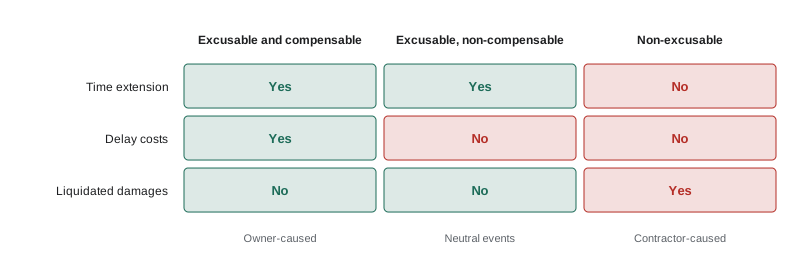
The law classifies delays by who is responsible and what remedy follows.
- Excusable and compensable delay: caused by the owner or those it is responsible for, such as late drawings, late access, owner changes or suspension. The contractor gets more time and its delay costs.
- Excusable but non-compensable delay: caused by events beyond either party's control, such as unusually severe weather, strikes not involving the contractor, or fire. The contractor gets more time but not money, and the owner cannot charge liquidated damages for that period.
- Non-excusable delay: caused by the contractor or those it is responsible for, such as its subcontractors and suppliers. No time and no money; the contractor may owe liquidated or actual damages.
Only delays that affect the completion date, typically delays to activities on the critical path, entitle a contractor to a time extension. A delay to an activity with float may cost money through disruption but does not usually extend the contract time. This is why a good schedule, updated regularly, is the most important evidence in any delay dispute.
Contract provisions on delay
Under A201-2017 § 8.3.1, the contract time is extended for delay caused by an act or neglect of the owner or architect, by changes ordered in the work, by labor disputes, fire, unusual delay in deliveries, unavoidable casualties, adverse weather conditions documented in accordance with § 15.1.6.2, or other causes beyond the contractor's control. Claims for extensions must follow Article 15, including notice within 21 days. Adverse weather claims require data showing the weather was abnormal for the period and had an adverse effect on the scheduled construction. On federal contracts, the Default clause at FAR 52.249-10 excuses delays from unforeseeable causes beyond the contractor's control, and the Suspension of Work clause at FAR 52.242-14 compensates unreasonable government-caused suspensions.
| Cause | A201-2017 result | Notes |
|---|---|---|
| Late owner drawings or decisions | Time and costs | Excusable and compensable |
| Owner-directed change | Time and costs, via the change | Price time impact in the change |
| Strike not involving the contractor | Time only | Excusable, non-compensable |
| Abnormal weather | Time if documented as abnormal under § 15.1.6.2 | Normal weather is the contractor's risk |
| Subcontractor late | No time, no costs | Contractor responsible for its subcontractors |
| Supplier fire or unavoidable casualty | Time only | Check the definitions |
Written notice: the condition that decides most delay claims
Nearly every contract requires written notice of a delay within a short period after the contractor becomes aware of it, followed by particulars and a claim. Courts have increasingly treated these notice requirements as conditions precedent: if notice is not given in time and in the required form, the claim fails, however meritorious.
American courts are divided. Some enforce notice provisions strictly; others excuse late notice if the owner had actual knowledge and suffered no prejudice. Federal boards and the Court of Federal Claims often excuse late notice under the changes and differing site conditions clauses absent prejudice to the government, but the Contract Disputes Act requires a written claim to the contracting officer within six years of accrual, and claims above $100,000 must be certified. The safe course is formal written notice in the required form every time.
Worked problem
Writing an effective delay notice
A contractor learns on June 4 that structural steel shop drawings, already approved, must be revised because the architect changed a column grid. Fabrication will be delayed about three weeks. The contract requires written notice of any claim for time within 10 days. What should the notice contain and when should it be sent?
Show solution
- Send by June 14 at the latest, sooner if possible.
- Identify the event (architect's column grid change of June 4), the clause relied on, and that it will delay steel fabrication and erection.
- State that the contractor claims an extension of time and associated costs, with particulars to follow when the impact is known.
- Attach the instruction and the affected schedule activities, and send to the address and person named in the contract.
Answer: Send notice by June 14, identifying the event, the clause, the effect and the claim for time and costs.
Liquidated damages
Liquidated damages are a fixed sum per day or week, stated in the contract, that the contractor pays the owner for each day of non-excusable delay after the completion date. They spare the owner from proving its actual losses and give the contractor a known exposure. They also usually operate as the owner's exclusive remedy for delay.
American courts enforce liquidated damages if, when the contract was made, actual damages were difficult to estimate and the amount was a reasonable forecast of them, following Restatement (Second) of Contracts § 356 and UCC § 2-718; an unreasonably large amount is a penalty and unenforceable. On federal contracts, FAR 11.502 and clause 52.211-12 govern liquidated damages for construction.
Liquidated damages cannot be charged for excusable delay, and an owner who causes delay may lose the right to them. If the owner's delay makes the completion date impossible and no time extension mechanism applies, the contractor may argue that time is at large, meaning the contractor must complete within a reasonable time and liquidated damages fall away. Extension clauses exist partly to prevent this result.
Worked problem
Calculating liquidated damages
The completion date is September 30 and the contract sets liquidated damages of $4,500 per calendar day, capped at 5 % of the $6,000,000 contract price. Substantial completion is achieved on November 14. The contractor has been granted a 12-day extension for an owner change and proves a further 8 days of excusable delay for a strike. What liquidated damages apply?
Show solution
- Total delay: October has 31 days and November 14 more, so 45 days late against September 30.
- Excusable delay: 12 + 8 = 20 days.
- Non-excusable delay: 45 − 20 = 25 days.
- Damages: 25 × $4,500 = $112,500.
- Cap: 5 % × $6,000,000 = $300,000, not reached.
Answer: $112,500.
Concurrent delay
Concurrent delay occurs when two or more delays, one the owner's responsibility and one the contractor's, affect the critical path at the same time. Neither party can show that it alone caused the overall delay.
Most American courts and boards hold that, where delays are truly concurrent, the contractor gets a time extension (so no liquidated damages) but no delay damages, unless the delays can be apportioned. Federal boards will apportion where the record allows it. Expert schedule analysis is almost always required.
Worked problem
Apportioning concurrent delay
During a 30-day period on the critical path, the owner's late design approvals and the contractor's late steel delivery each independently delayed completion. The contractor's daily time-related costs are $3,200; liquidated damages are $4,000 per day. Under the common approach of time without money for truly concurrent delay, what is the result for those 30 days?
Show solution
- The contractor receives a 30-day extension, so no liquidated damages: 30 × $4,000 = $120,000 avoided.
- The contractor recovers no delay costs: 30 × $3,200 = $96,000 not recovered.
- Each party bears its own costs for the concurrent period.
Answer: 30 days of time, no delay costs, no liquidated damages.
Acceleration and disruption
When a project falls behind, someone pays to catch up. Directed acceleration occurs when the owner orders the contractor to finish earlier than the contract requires, or to recover delay the owner caused; it is a change and is compensable. Constructive acceleration occurs when the contractor is entitled to an extension, asks for it, is refused, and is required to meet the original date, so it accelerates at its own cost to avoid liquidated damages. Courts recognize constructive acceleration claims where the contractor gave notice of the excusable delay, requested an extension, was refused and actually incurred acceleration costs.
Disruption is a loss of productivity, rather than a delay to completion: crews work out of sequence, trades stack in the same area, work is interrupted and restarted. Disruption is compensable when caused by the owner, but it is hard to prove. The preferred method is the measured mile: comparing productivity in an unaffected period or area with productivity in the disrupted period, on similar work, using the contractor's own records.
Worked problem
Measured mile
In an undisrupted period, a crew installed 2,400 units in 1,600 hours (1.5 units per hour). During owner-caused disruption, the crew installed 1,800 units in 1,500 hours. The loaded labor rate is $88 per hour. What is the lost productivity cost?
Show solution
- Hours that 1,800 units should have taken at the measured mile rate: 1,800 ÷ 1.5 = 1,200 hours.
- Actual hours: 1,500. Lost hours: 1,500 − 1,200 = 300.
- Cost: 300 × $88 = $26,400.
Answer: $26,400.
Head office overhead
Contractors also claim unabsorbed head office overhead for owner-caused delay: costs of the head office that would have been recovered from this project's revenue during the delay period. Several formulas exist. The Eichleay formula, developed by the US Armed Services Board of Contract Appeals in 1960 and used in federal contracting when the contractor was on standby and could not take other work, allocates overhead by the ratio of contract billings to total billings and divides by the days of performance.
On federal contracts, the Eichleay formula is the exclusive method for unabsorbed home office overhead when the government suspends or delays work and the contractor is on standby. State courts are divided on whether to accept Eichleay.
Worked problem
Eichleay calculation
A contractor billed $9,000,000 on a contract over 360 days of performance, against total company billings of $45,000,000 in that period, with total head office overhead of $3,600,000. The owner caused a 40-day standby delay. What is the Eichleay claim?
Show solution
- Allocated overhead: ($9,000,000 ÷ $45,000,000) × $3,600,000 = $720,000.
- Daily rate: $720,000 ÷ 360 = $2,000 per day.
- Claim: 40 × $2,000 = $80,000.
Answer: $80,000.
Common mistakes
MistakeRelying on meeting minutes instead of formal delay notices.
InsteadSend written notice in the form and time the contract requires for every delay event.
MistakeClaiming time for delays to activities with float.
InsteadShow the effect on the critical path with schedule analysis.
MistakeAccelerating without first requesting a time extension.
InsteadGive notice, request the extension and record any refusal before accelerating.
MistakeProving disruption with estimates instead of records.
InsteadKeep daily labor and quantity records so a measured mile can be shown.
MistakeAssuming liquidated damages are always enforceable.
InsteadThey may be unenforceable as a penalty, and cannot apply to excusable delay.
Summary and key terms
- Delay is excusable and compensable, excusable but non-compensable, or non-excusable.
- Only critical path delays extend the completion date.
- A201 § 8.3.1 extends time for listed causes; FAR clauses govern federal delays and suspensions.
- Delay notice requirements are often conditions precedent; give formal written notice every time.
- Liquidated damages are enforceable if a genuine pre-estimate or reasonable forecast, and not a penalty.
- Concurrent delay usually gives time without money unless apportioned.
- Acceleration, disruption (measured mile) and head office overhead (Eichleay) are recoverable when caused by the owner and proved.
- Excusable delay
- A delay for which the contractor is entitled to more time.
- Compensable delay
- A delay for which the contractor is also entitled to costs.
- Critical path
- The longest chain of activities, which determines completion.
- Liquidated damages
- A fixed sum per period of delay agreed in the contract.
- Penalty
- An extravagant sum, unrelated to likely loss, that courts will not enforce.
- Time at large
- A situation where the completion date no longer binds and work must be done within a reasonable time.
- Concurrent delay
- Overlapping owner-caused and contractor-caused delays to completion.
- Constructive acceleration
- Acceleration forced by refusing an extension to which the contractor is entitled.
- Measured mile
- A comparison of productivity in unaffected and disrupted periods.
- Eichleay formula
- A formula for allocating unabsorbed head office overhead during owner-caused delay.
Practice problems
Work each problem on paper first, then reveal the answer to check.
Name the three types of delay.
Show answer
Excusable and compensable, excusable non-compensable, non-excusable.
Does a delay to an activity with 10 days of float extend completion?
Show answer
Not unless the delay exceeds the float.
Completion was 18 days late; 6 days were excusable; LDs are $2,000 a day. What is owed?
Show answer
12 × $2,000 = $24,000.
What makes liquidated damages a penalty?
Show answer
An extravagant amount unrelated to any genuine pre-estimate or reasonable forecast of loss.
What is the usual result of truly concurrent delay?
Show answer
Time without money.
What four elements support a constructive acceleration claim?
Show answer
Excusable delay, a request for extension, refusal, and actual acceleration costs.
Normal productivity 2 units/h; disrupted 900 units in 600 h; $80/h. Loss?
Show answer
(600 − 450) × $80 = $12,000.
Contract billings $5M of $25M total; overhead $2M; 250 days. Daily Eichleay rate?
Show answer
$400,000 ÷ 250 = $1,600.
Why should notice be sent even if the owner already knows about a delay?
Show answer
Delay notice provisions are often conditions precedent.
What is time at large?
Show answer
The completion date no longer binds, so work must be finished within a reasonable time.
Lesson quiz · 5 questions
Score 60% or more to complete this lesson.
Create a free account to save your progress, take quizzes and earn a certificate.