
CON-300 · Lesson 1 of 12 · 30 min
The estimate as a business process
CON-200 taught the estimator's craft: reading drawings, measuring quantities and pricing labor, equipment and materials one item at a time. This course takes the next step. A contractor does not win work by measuring quantities accurately; it wins work by assembling complete, competitive and defensible bids, again and again, while keeping enough margin to stay in business. That makes estimating a business process as much as a technical skill. It consumes money, competes for the time of scarce people, and feeds the company's strategy, risk profile and cash flow.
This first lesson looks at estimating from the point of view of the firm. It asks which projects a contractor should pursue, what it costs to prepare a bid, how a bid moves through an estimating department, how firms measure their estimating performance and how the estimate connects to the rest of the business once a job is won. Later lessons build each part of a complete bid: labor and equipment pricing for self-performed work (Lessons 3 and 4), mechanical and electrical estimating (Lessons 5 and 6), subcontractor pricing (Lesson 7), general conditions and markups (Lesson 8), taxes, escalation and contingency (Lesson 9), bid day and the law of tendering (Lesson 10), bid strategy (Lesson 11) and conceptual estimating with a capstone bid (Lesson 12).
Estimates serve different purposes
CON-200 introduced estimate classes and the idea that accuracy improves as design develops. In practice, a contractor's estimating department prepares several kinds of estimates, each with a different purpose, level of effort and audience. A budget estimate for a developer deciding whether a site is feasible might take a day. A guaranteed maximum price for a construction management at risk contract might take several weeks and be negotiated line by line. A hard bid for a public tender might take three weeks of intense work by a team of estimators, ending in a few chaotic hours on bid day.
| Estimate | Typical purpose | Basis | Who relies on it |
|---|---|---|---|
| Order of magnitude | Is the project worth pursuing at all? | Cost per unit area or per unit of capacity | Owner, developer, lender |
| Conceptual or schematic budget | Set the budget; compare options | Systems or elemental pricing | Owner, design team |
| Design development estimate | Check the design against the budget | Partial quantities and assemblies | Owner, construction manager |
| Guaranteed maximum price (GMP) | Fix a ceiling price before design is complete | Detailed quantities plus allowances and contingency | Owner and contractor, contractually |
| Hard bid (stipulated price or lump sum) | Win a contract in competition | Complete documents, detailed quantities, trade quotes | Contractor, bonding company, owner |
| Unit price bid | Price work whose quantities are uncertain | Unit rates applied to estimated quantities | Owner (often public works) |
| Change order estimate | Price a change to an existing contract | Detailed quantities and contract markups | Owner, consultant, contractor |
The level of effort should match the purpose. Spending three weeks on an order-of-magnitude number wastes money; spending a day on a hard bid invites disaster. A mature estimating department sets a standard for each kind of estimate: what documents must be reviewed, which trades must be quoted, what checks are required and who must approve the number before it leaves the building.
The cost of estimating
Estimating is expensive. A hard bid on a mid-sized commercial building may involve a senior estimator, one or two junior estimators, a project manager reviewing constructability and schedule, a superintendent walking the site, and administrative staff soliciting and logging dozens of trade quotes. Add printing, software licenses, travel and the opportunity cost of other bids not pursued, and a single bid can easily cost tens of thousands of dollars. Most of those bids are lost.
Firms often express the cost of estimating as a percentage of the value of the work bid, or as a cost per contract won. If a general contractor spends 0.3 % of bid value preparing each bid and wins one bid in five, the estimating cost per dollar of work won is five times higher: 1.5 %. That cost has to be recovered from the overhead and profit on the jobs that are won (Lesson 8). It is one reason why chasing every bid that comes along is a losing strategy.
Worked problem
Estimating cost per contract won
Northline Builders, an invented general contractor, bid 40 projects last year with a total bid value of $260 million. It won 7 projects worth $41 million. Estimating department costs (salaries, benefits, software, plan rooms and overhead allocated to estimating) were $1.15 million. Calculate the hit rate by number and by value, the estimating cost as a share of value bid and as a share of value won.
Show solution
- Hit rate by number = 7 ÷ 40 = 17.5 %.
- Hit rate by value = 41 ÷ 260 ≈ 15.8 %.
- Estimating cost as a share of value bid = 1.15 ÷ 260 ≈ 0.44 %.
- Estimating cost as a share of value won = 1.15 ÷ 41 ≈ 2.8 %.
Answer: Every dollar of work won carries about 2.8 cents of estimating cost. If Northline's average fee is 4 %, estimating alone consumes most of it; improving the hit rate or bidding more selectively matters more than shaving a fraction of a percent off each estimate.
Choosing what to bid
The bid or no-bid decision (often called go or no-go) is one of the most important decisions an estimating department makes. A contractor that bids every opportunity spreads its estimators thin, prepares rushed estimates and wins the jobs where it made the biggest mistakes (a pattern called the winner's curse, discussed in Lesson 11). A contractor that bids selectively can prepare better estimates, price risk more carefully and choose jobs that fit its strengths.
Common factors in the decision include the following.
- Fit with strategy and capability: project type, size, location and delivery method the firm knows how to build.
- Capacity: whether the firm has project managers, superintendents and estimators available, and whether winning would overload them.
- Bonding and financial capacity: whether the surety will support the bond, and whether the cash flow is manageable (CON-320 and CON-350).
- Owner and consultant: reputation for fair dealing, payment record, quality of documents and how changes are handled.
- Competition: how many bidders, who they are and how hungry they are.
- Risk: contract terms, unusual conditions, liquidated damages, design completeness, site conditions and schedule.
- Profit potential and strategic value: expected margin, repeat work, entry into a new market or relationship.
Many firms formalize the decision with a scoring sheet. Each factor is given a weight that reflects its importance to the firm, the project is scored on each factor, and the weighted total is compared with a threshold. A scoring sheet does not replace judgment, but it forces the team to discuss each factor and leaves a record that can be reviewed later when the firm asks why it bid a project it lost badly or regretted winning.
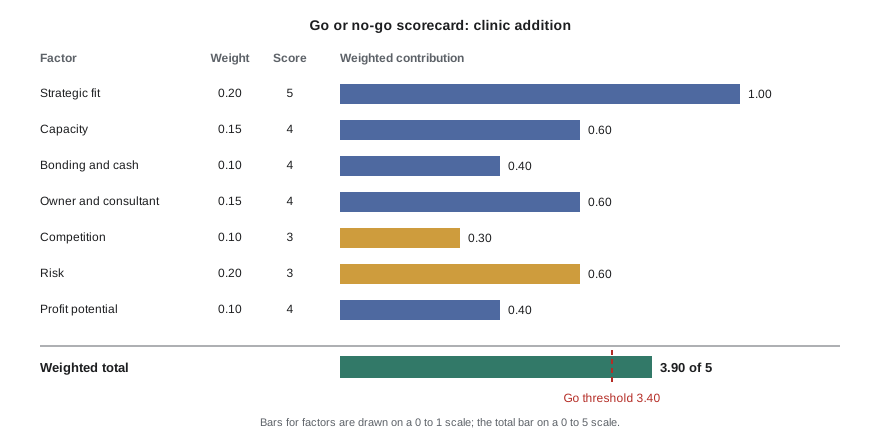
# Weighted go/no-go score for two opportunities (scores 1 = poor to 5 = excellent)
weights = {"Strategic fit": 0.20, "Capacity": 0.15, "Bonding and cash": 0.10,
           "Owner and consultant": 0.15, "Competition": 0.10, "Risk": 0.20, "Profit potential": 0.10}
projects = {
    "Clinic addition": [5, 4, 4, 4, 3, 3, 4],
    "Industrial plant": [2, 2, 3, 3, 4, 2, 5],
}
THRESHOLD = 3.4
for name, scores in projects.items():
    total = sum(w * s for w, s in zip(weights.values(), scores))
    decision = "GO" if total >= THRESHOLD else "NO-GO"
print(f"{name:17s} weighted score {total:.2f} -> {decision}")Clinic addition weighted score 3.90 -> GO Industrial plant weighted score 2.75 -> NO-GO
The clinic addition fits Northline's strengths and passes the threshold, even though competition is stiff. The industrial plant offers attractive margins but scores poorly on fit, capacity and risk. A firm that bids it anyway because the profit potential looks good is likely to underestimate the unfamiliar risks, which is exactly how many contractors get into trouble.
How a bid moves through an estimating department
Although every firm organizes its work differently, most competitive bids follow a similar sequence. Understanding the sequence helps an estimator plan the work backward from the bid closing date and spot where time will be short.
| Stage | Main activities | Typical timing for a three-week bid |
|---|---|---|
| 1. Intake and decision | Log the opportunity, obtain documents, go or no-go decision | Days 1 to 2 |
| 2. Bid plan | Assign team, schedule, break the work into packages, decide self-perform versus subcontract | Days 2 to 3 |
| 3. Document and site review | Read specifications and contract, walk the site, list questions | Days 2 to 6 |
| 4. Trade solicitation | Invite subcontractors and suppliers, issue scope sheets | Days 3 to 5 |
| 5. Quantity takeoff and pricing | Self-performed work, general conditions, allowances | Days 4 to 14 |
| 6. Questions and addenda | Submit questions, track and incorporate addenda | Throughout; questions usually close several days before bid |
| 7. Estimate review | Peer and senior review of quantities, pricing, scope and risk | Days 14 to 17 |
| 8. Bid day | Receive and level trade quotes, finalize markups, submit | Final day |
The bid plan is the most overlooked step. It is a short document, often a single page or spreadsheet, that records who is doing what, which trades will be self-performed and which subcontracted, how the estimate will be broken down, the key dates (site visit, last day for questions, bid closing), the bonding requirements and the known risks. It takes an hour to write and saves days of confusion. Lesson 2 shows how the bid plan connects to the structure of the estimate itself.
Measuring estimating performance
An estimating department can measure its own performance, and the measures it chooses shape its behavior. The most common are the hit rate (bids won divided by bids submitted, by number and by value), the spread between the firm's bid and the low bid on lost jobs, and the accuracy of won estimates compared with final costs.
- Hit rate: a very high hit rate can mean the firm is leaving money on the table; a very low one means bids are not competitive or the firm is bidding the wrong work.
- Bid spread: how far the firm's price was from the winning price when it lost, as a percentage. Consistently being 1 to 2 % high suggests the firm is close and might adjust markups; being 10 % high suggests a problem with scope, method or competitiveness.
- Estimate-to-actual variance on won jobs: the most important measure of estimating quality, because it shows whether the estimate predicted the cost. It requires the estimate and the cost reports to use the same cost codes (CON-310).
- Cost and effort per bid: hours and dollars spent by estimate type and size.
Owners and public agencies publish bid results for public tenders, and many contractors keep a database of every bid they submit and every result they learn. Over time this database reveals which competitors bid which kinds of work, how their prices compare and how the number of bidders affects the low bid. Lesson 11 uses this kind of data to model bid strategy.
Worked problem
Bid spread on lost jobs
On five recent lost bids, Northline's price and the winning price were as follows ($ million): 6.42 vs 6.21; 11.80 vs 11.62; 3.95 vs 3.48; 8.10 vs 7.97; 14.60 vs 14.35. Calculate the spread for each bid and comment.
Show solution
- Spread = (Northline − low) ÷ low.
- Bid 1: 0.21 ÷ 6.21 ≈ 3.4 %. Bid 2: 0.18 ÷ 11.62 ≈ 1.5 %. Bid 3: 0.47 ÷ 3.48 ≈ 13.5 %.
- Bid 4: 0.13 ÷ 7.97 ≈ 1.6 %. Bid 5: 0.25 ÷ 14.35 ≈ 1.7 %.
- Four bids are within about 3.5 %; bid 3 is an outlier.
Answer: Northline is competitive on most bids, but bid 3 needs a debrief: either the winner missed scope, or Northline priced the work with an unsuitable method, carried too much risk or misread the documents.
From estimate to project
When a bid is won, the estimate does not disappear. It becomes the starting point for the project budget, the schedule of values for progress billing, the buyout of subcontracts and purchase orders (CON-330), and the baseline for cost control (CON-310). A handover meeting between estimating and the project team transfers the estimate, the assumptions behind it, the trade quotes and their scope qualifications, the allowances and the risks priced or left out. A poor handover means the project team discovers the estimate's assumptions only when costs come in.
Feedback flows the other way too. Final cost reports, productivity data from timesheets and lessons learned should flow back into the firm's historical cost database so that the next estimate starts from actual experience. A contractor that never compares estimated and actual productivity will repeat the same pricing errors for years.
Ethics and professional conduct in estimating
Estimators handle confidential information and make decisions with real financial consequences for subcontractors, owners and their own firms. Several ethical issues come up repeatedly. Bid shopping is the practice of using one subcontractor's price to pressure another into lowering theirs, before or after award; it erodes trust and is restricted by some bid depository rules (Lesson 10). Bid peddling is the subcontractor's version: offering a lower price after the bid to displace a competitor. Collusion or bid rigging, in which competitors agree on who will win or what prices to submit, is a criminal offense.
In the United States, bid rigging is a felony under the Sherman Act, prosecuted by the Department of Justice Antitrust Division, with penalties for individuals that include up to 10 years in prison. The Procurement Collusion Strike Force, created in 2019, focuses specifically on public procurement.
Other duties are simpler but just as important: keeping competitors' and subcontractors' prices confidential, not misrepresenting capacity or experience in prequalification submissions, disclosing conflicts of interest and declining to bid when the firm cannot honestly do the work.
Common mistakes
MistakeBidding every project that comes in, on the theory that more bids mean more wins.
InsteadBid selectively, using a go or no-go process; more bids spread estimators thin and favor winning the jobs with the biggest errors.
MistakeTreating estimating as free because estimators are salaried staff.
InsteadTrack estimating cost per bid and per dollar won; it is recovered from overhead and profit on the jobs that are won.
MistakeStarting takeoff on day one without a bid plan.
InsteadWrite a short bid plan first: team, packages, self-perform decisions, key dates, bonding and risks.
MistakeJudging estimators only by how many jobs they win.
InsteadUse hit rate together with bid spread and estimate-to-actual variance on won jobs.
MistakeHanding the project team a single number at award.
InsteadHold a handover meeting that transfers quantities, quotes, assumptions, allowances and risks.
MistakeUsing one subcontractor's price to beat down another's.
InsteadTreat quotes as confidential and avoid bid shopping; it damages relationships and may breach depository rules.
Summary and key terms
- Estimating is a business process that consumes money and scarce people and drives the firm's revenue and risk.
- Different estimates serve different purposes, and the effort should match the purpose.
- The estimating cost per dollar won equals the cost per bid divided by the hit rate.
- A structured go or no-go decision weighs strategic fit, capacity, bonding, owner, competition, risk and profit.
- A bid plan organizes the team, packages, self-perform decisions, dates and risks before takeoff starts.
- Hit rate, bid spread and estimate-to-actual variance together measure estimating performance.
- The estimate becomes the project budget, schedule of values and cost-control baseline after award.
- Bid rigging is a crime; bid shopping and peddling undermine fair competition.
- Hit rate
- Bids won divided by bids submitted, by number or by value.
- Go or no-go decision
- The decision whether to pursue a particular bid opportunity.
- Bid plan
- A short plan for preparing a bid: team, packages, dates, decisions and risks.
- Bid spread
- The percentage difference between a bidder's price and the winning price.
- Guaranteed maximum price (GMP)
- A ceiling price agreed before design is complete, with savings often shared.
- Hard bid
- A competitive stipulated-price bid on complete documents.
- Bid shopping
- Using one subcontractor's price to pressure others to lower theirs.
- Bid peddling
- A subcontractor offering a lower price after the bid to displace a competitor.
- Bid rigging
- An agreement among bidders on who will win or what they will bid; a criminal offense.
- Estimate handover
- The transfer of the estimate and its assumptions from estimating to the project team.
Practice problems
Work each problem on paper first, then reveal the answer to check.
Name three kinds of estimates a contractor prepares and the purpose of each.
Show answer
Order of magnitude (feasibility), GMP (price ceiling before design is complete), hard bid (win a contract), change order estimate (price a change); any three.
A firm spends 0.4 % of bid value per bid and wins 1 in 6. What is the estimating cost per dollar won?
Show answer
0.4 % × 6 = 2.4 %.
List five factors in a go or no-go decision.
Show answer
Strategic fit, capacity, bonding and cash, owner and consultant, competition, risk, profit potential (any five).
A project scores 4, 3, 5 on three factors weighted 0.5, 0.3 and 0.2. What is its weighted score?
Show answer
0.5 × 4 + 0.3 × 3 + 0.2 × 5 = 3.9.
What goes into a bid plan?
Show answer
Team and responsibilities, packages, self-perform versus subcontract decisions, key dates, bonding and risks.
Northline bid $9.30M; the low bid was $9.00M. What was the spread?
Show answer
0.30 ÷ 9.00 ≈ 3.3 %.
Why can a very high hit rate be a warning sign?
Show answer
It may mean the firm's prices are too low and it is leaving money on the table.
What does the estimate become after award?
Show answer
The project budget, schedule of values, buyout baseline and cost-control baseline.
What is the difference between bid shopping and bid rigging?
Show answer
Bid shopping is a contractor pressuring subcontractors with others' prices; bid rigging is an agreement among competitors and is a crime.
Why must estimates and cost reports use the same cost codes?
Show answer
So estimated and actual costs can be compared to measure estimate accuracy and update historical data.
Lesson quiz · 5 questions
Score 60% or more to complete this lesson.
Create a free account to save your progress, take quizzes and earn a certificate.