
CON-300 · Lesson 9 of 12 · 29 min
Taxes, escalation, allowances and contingency
After direct costs, general conditions and markups, four items remain that can quietly add or remove several percent from a bid: sales taxes, escalation, allowances and contingency. Each is easy to misunderstand. Taxes depend on who is legally the consumer of the materials and on the jurisdiction. Escalation depends on when the money will be spent, not when the bid is submitted. Allowances are amounts the owner tells bidders to carry, with rules about what they include. Contingency is the price of uncertainty, and its size should reflect how much the estimate does not yet know. CON-200 introduced taxes on materials and price escalation at the level of individual quotes; this lesson treats them at the level of the whole bid.
Sales taxes in a construction bid
In the United States, there is no federal sales tax, and each state (and often counties and cities) sets its own rules. In most states, a contractor building real property is treated as the consumer of the materials it incorporates into the building: it pays sales tax when it buys the materials (or use tax if the seller did not collect it), and the tax becomes part of the contractor's cost. The contractor does not charge sales tax on its contract price to the owner in those states, so the estimate must include the tax on materials in the direct costs.
There are important exceptions. Some states treat construction contractors as retailers of the materials in some situations, collecting tax from the owner on the materials portion of the contract. A few states tax the contract price or the contractor's gross receipts: for example, Hawaii's general excise tax and New Mexico's gross receipts tax apply to construction receipts, and in Washington State the prime contractor generally collects retail sales tax on the full contract price of most private construction. Projects for exempt owners such as federal agencies or some nonprofits may or may not allow contractors to buy materials tax-free, depending on state law. The estimator must confirm current treatment with the firm's tax adviser for each state.
| Situation | Typical US treatment | Effect on the estimate |
|---|---|---|
| Sales tax on materials in a consumer state | Paid by the contractor as consumer; not recoverable | Include in material cost |
| Use tax on out-of-state purchases | Self-assessed by the contractor | Include in material cost |
| Gross receipts or contract-price tax states | Tax on the contract value, paid or passed on per state law | Show separately or include as the bid form requires |
| Owner-supplied materials | Tax treatment depends on who buys them | Exclude from contractor cost; note in scope |
| Rental equipment and consumables | Usually taxable to the contractor | Include non-recoverable tax in cost |
Worked problem
Tax on materials in a bid
A project in a state that treats contractors as consumers has $3,400,000 of materials in self-performed work and supply-and-install subcontracts. The combined state and local sales tax rate where the materials are delivered is 7.25 %. How much tax should be built into the estimate?
Show solution
- Materials are taxable to the contractor as consumer.
- Sales tax = 0.0725 × 3,400,000 = $246,500, carried in material cost (subcontractors carry their share in their quotes).
Answer: About $246,500 of tax belongs in the estimate, mostly inside subcontract prices. The contract price is not taxed again in this state.
Because most material tax sits inside subcontract quotes, the general contractor's main task is to make sure every quote states its tax basis consistently: whether provincial or state taxes are included, and on a Canadian bid that federal tax is excluded. A quote that includes recoverable tax, or excludes non-recoverable tax, distorts leveling (Lesson 7).
Escalation to the midpoint of construction
Construction prices change over time. A bid submitted today will be built over the next year or two, and the costs that matter are the costs at the time each item is bought, not at the time of the bid. Firm quotes from subcontractors and suppliers fix some prices, but many quotes are valid only for 30 to 90 days, some contain escalation clauses for volatile materials, and the general contractor's own labor rates will rise with collective agreements. Escalation is the allowance for these increases.
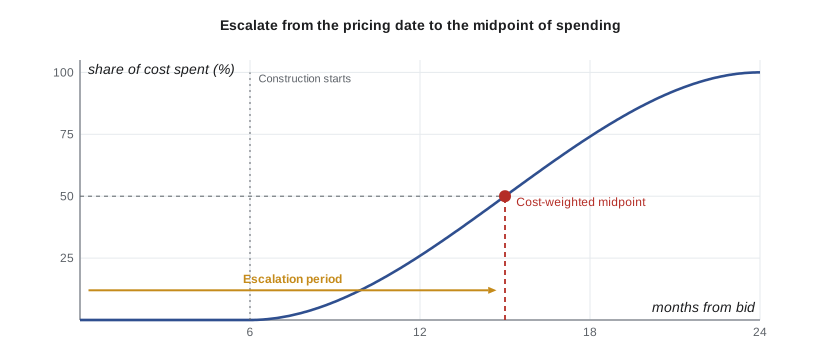
A common method is to escalate each cost from the pricing date to the midpoint of the period over which it will be spent. For the whole project, the midpoint of construction (or more precisely, the cost-weighted midpoint of the spending curve) is a reasonable proxy. Because escalation compounds, the factor is the annual rate raised to the number of years from the pricing date to the midpoint.
Worked problem
Escalating an estimate
Northline prices a project in October 2026 for a construction start in April 2027 and completion in October 2028. The estimate in October 2026 dollars is $22.0 million, of which $8.0 million is already covered by firm quotes held until purchase. The firm expects 4 % annual escalation on the remaining costs. What escalation should it carry?
Show solution
- Construction lasts 18 months; the midpoint is 9 months after April 2027, in January 2028.
- Time from pricing (October 2026) to midpoint (January 2028) = 15 months = 1.25 years.
- Factor = 1.04^1.25 ≈ 1.0503.
- Escalation = (22.0 − 8.0) × 0.0503 ≈ $0.70 million.
Answer: Carry about $700,000 of escalation on the costs not protected by firm quotes. If spending is front-loaded, the cost-weighted midpoint is earlier and the escalation smaller.
Published indexes, such as the Producer Price Index for inputs to construction from the Bureau of Labor Statistics and commercial cost indexes from publishers such as ENR, give a picture of recent cost changes. Past changes are not a forecast, but they help calibrate the rate. Volatile materials such as steel, copper, aluminum and some electrical equipment can move much faster than the general index, and tariffs on steel and aluminum imports imposed and raised in 2025 added to their volatility.
Allowances
An allowance is an amount specified in the bid documents for an item whose details have not been decided, such as finish hardware, signage, artwork, or the cost of unknown site conditions. Every bidder carries the same amount, so the allowance does not affect competition. The contract then adjusts the price up or down when the actual cost is known. The key question is what the allowance covers. In many contracts, a cash allowance covers only the net cost of the materials or the subcontract, and the contractor's other costs (handling, installation if not included, overhead and profit) must be included elsewhere in the bid. If the estimator assumes the allowance covers everything, those costs are missing.
Under AIA A201, allowances cover the cost to the contractor of materials and equipment delivered to the site and all required taxes, less applicable trade discounts; the contractor's costs for unloading and handling at the site, labor, installation costs, overhead, profit and other expenses contemplated for allowance amounts are included in the contract sum but not in the allowances. Supplementary conditions often modify these rules, so the estimator must read them.
Worked problem
Carrying an allowance correctly
The specifications include a $120,000 cash allowance for supply of finish hardware. The contract states that installation, handling, overhead and profit are not included in the allowance. Northline's carpenters will install 86 openings at about $272 per opening (from Lesson 4); handling is estimated at $3,500, and overhead and profit are applied at 8 % to the allowance-related costs. What should the estimate carry?
Show solution
- Allowance = $120,000.
- Installation = 86 × 272 ≈ $23,400; handling = $3,500.
- Overhead and profit = 0.08 × (120,000 + 23,400 + 3,500) ≈ $11,750, usually applied through the general markups.
- Total carried ≈ 120,000 + 23,400 + 3,500 = $146,900 before markups.
Answer: Carrying only $120,000 would leave out about $27,000 of cost before markups. The allowance amount is not the whole cost.
Contingency
Contingency is an amount added to cover costs that are expected to occur but cannot be identified individually at the time of the estimate: quantity errors, minor scope omissions, pricing uncertainty, unexpected conditions within the contractor's risk. It is not a substitute for pricing known risks (which should be priced explicitly, Lesson 11 and CON-350) and not a hidden profit. Different parties carry different contingencies. A contractor's estimating contingency covers its own uncertainty in a stipulated price bid. A design contingency in an owner's budget covers design development. An owner's construction contingency covers changes the owner will pay for after award. Confusing them leads to double counting or gaps.
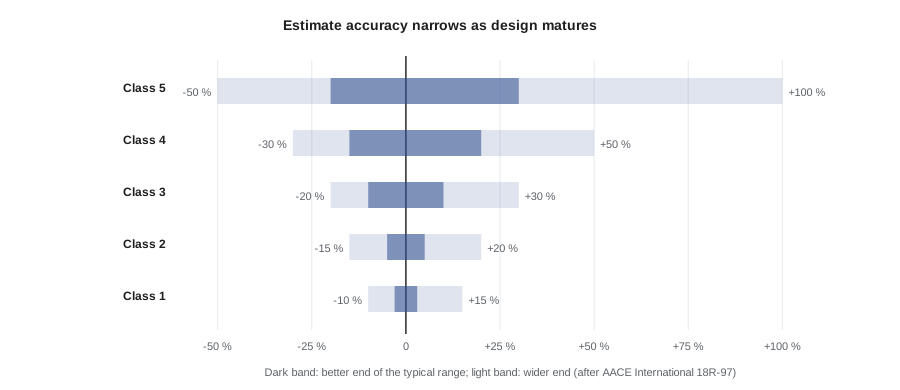
The size of contingency should reflect the maturity of the information. AACE International's recommended practice for estimate classification describes typical accuracy ranges by class: a class 5 estimate (concept screening, about 0 to 2 % of design complete) might range from 20 to 50 % low to 30 to 100 % high, while a class 1 estimate (check estimate or bid on complete documents) might range from 3 to 10 % low to 3 to 15 % high. CON-200 introduced these classes; here they help explain why contingency is large early and small at bid time.
| Class | Design maturity | Typical purpose | Typical accuracy range |
|---|---|---|---|
| 5 | 0 to 2 % | Concept screening | Low −20 to −50 %; high +30 to +100 % |
| 4 | 1 to 15 % | Feasibility study | Low −15 to −30 %; high +20 to +50 % |
| 3 | 10 to 40 % | Budget authorization | Low −10 to −20 %; high +10 to +30 % |
| 2 | 30 to 75 % | Control or bid on partial design | Low −5 to −15 %; high +5 to +20 % |
| 1 | 65 to 100 % | Check estimate or bid on complete documents | Low −3 to −10 %; high +3 to +15 % |
One way to set contingency is to model the uncertainty in the main cost items and simulate many possible outcomes. A Monte Carlo simulation draws random values for each uncertain item from a chosen distribution, adds them up, repeats the process thousands of times and reports the distribution of total cost. The contingency is then the difference between the base estimate and a chosen confidence level, such as the 80th percentile (P80).
import random
random.seed(42)
# Uncertain cost items: (base estimate $, low factor, most likely factor, high factor)
items = {
    "Self-performed concrete": (1_920_000, 0.95, 1.00, 1.15),
    "Mechanical":              (2_850_000, 0.97, 1.00, 1.08),
    "Electrical":              (1_640_000, 0.97, 1.00, 1.07),
    "Envelope":                (1_480_000, 0.96, 1.00, 1.10),
    "Other subcontracts":      (2_300_000, 0.98, 1.00, 1.05),
    "General conditions":      (  910_000, 0.95, 1.00, 1.12),
}
base = sum(v[0] for v in items.values())
totals = sorted(sum(b * random.triangular(lo, hi, ml) for b, lo, ml, hi in items.values())
                for _ in range(20_000))
p50, p80 = totals[len(totals) // 2], totals[int(0.8 * len(totals))]
print(f"Base estimate ${base:,.0f}")
print(f"P50 ${p50:,.0f}  P80 ${p80:,.0f}")
print(f"Contingency to reach P80: ${p80 - base:,.0f} ({(p80 - base) / base:.1%})")Base estimate $11,100,000 P50 $11,302,199 P80 $11,414,510 Contingency to reach P80: $314,510 (2.8%)
Because the uncertainties are skewed upward (costs are more likely to rise than fall), even the median outcome is above the base estimate. A contingency of a few percent brings the bid to the 80th percentile. Simulation is only as good as its inputs, and it ignores correlations between items unless they are modeled, but it makes the discussion of contingency explicit and repeatable instead of a number pulled from the air on bid day.
Common mistakes
MistakeAssuming the contractor never pays tax on materials.
InsteadIn most states the contractor is the consumer and must carry sales tax on materials in its cost.
MistakeEscalating from the bid date to the completion date.
InsteadEscalate to the cost-weighted midpoint of spending, and only costs not protected by firm prices.
MistakeAssuming a cash allowance covers installation, overhead and profit.
InsteadRead the contract: many allowances cover only net material or subcontract cost.
MistakeUsing contingency to cover risks that could be priced explicitly.
InsteadPrice known risks individually; use contingency for unidentifiable variation.
MistakeApplying the same contingency percentage at every stage of design.
InsteadSize contingency to the maturity of the information and the estimate class.
MistakeAccepting quotes with inconsistent tax treatment.
InsteadRequire every quote to state its tax basis and adjust when leveling.
Summary and key terms
- In most states contractors are consumers of materials and carry sales or use tax in cost; some states tax receipts or contract prices.
- Tax treatment must be consistent across subcontract quotes.
- Escalation compounds from the pricing date to the cost-weighted midpoint of spending.
- Firm quotes reduce escalation exposure; volatile materials need special attention.
- Allowances are carried equally by all bidders, but the costs they exclude must be priced elsewhere.
- Contingency covers unidentified variation, sized to the estimate class and information maturity.
- Monte Carlo simulation can express contingency as a confidence level such as P80.
- Input tax credit
- A credit for GST or HST paid on business inputs, recoverable by registered businesses.
- Consumer of materials
- The party legally responsible for sales tax on materials incorporated into real property.
- Use tax
- Tax self-assessed on taxable purchases on which sales tax was not collected.
- Escalation
- An allowance for price increases between the pricing date and the time of purchase.
- Cost-weighted midpoint
- The point in time by which half the project's cost has been spent.
- Cash allowance
- An amount specified in the documents for undecided items, adjusted to actual cost.
- Contingency
- An amount for costs expected to occur but not identifiable individually.
- Estimate class
- A category describing the maturity and expected accuracy of an estimate.
- Monte Carlo simulation
- Repeated random sampling of uncertain inputs to produce a distribution of outcomes.
- P80
- The value that 80 % of simulated outcomes fall below.
Practice problems
Work each problem on paper first, then reveal the answer to check.
In a consumer state, is sales tax on materials part of the contractor's cost? Why?
Show answer
Yes; the contractor is the consumer and cannot recover it.
Materials of $800,000 at 6.5 % sales tax in a consumer state. Tax cost?
Show answer
$52,000.
A 24-month project starts 6 months after pricing. How far is the midpoint from pricing?
Show answer
18 months.
At 3 % per year, what is the escalation factor for 1.5 years?
Show answer
1.03^1.5 ≈ 1.0453.
$10M of unprotected cost escalated by that factor adds how much?
Show answer
About $453,000.
Why escalate to the midpoint instead of completion?
Show answer
Costs are spent throughout construction; the midpoint approximates average timing.
A $50,000 allowance excludes installation of $9,000. What should be carried before markups?
Show answer
$59,000.
What is the difference between an estimating contingency and an owner's contingency?
Show answer
The estimating contingency covers the contractor's own uncertainty in its price; the owner's contingency covers changes the owner will pay for.
What is the typical accuracy range of a class 1 estimate?
Show answer
Low −3 to −10 %, high +3 to +15 %.
Why does the P50 in a skewed simulation exceed the base estimate?
Show answer
Upside uncertainty is larger than downside, so the median outcome is above the most likely values.
Lesson quiz · 5 questions
Score 60% or more to complete this lesson.
Create a free account to save your progress, take quizzes and earn a certificate.