
CON-300 · Lesson 10 of 12 · 25 min
Bid day and submission
Every competitive bid ends in a few hours of intense work. Subcontractor quotes arrive until minutes before closing, packages are leveled and re-leveled, numbers change on the summary sheet, senior managers decide the final markup, forms are signed and the bid is delivered, physically or electronically, before the deadline. Then the results are read, sometimes publicly, and the low bidder learns whether it has won a contract or a problem. This lesson covers bid day itself, the formal requirements of a compliant bid, and the law that governs competitive tendering, which differs significantly between Canada and the United States.
Preparing for bid day
The best bid days are mostly prepared in advance. By the day before closing, the self-performed work, general conditions and allowances should be priced and reviewed; every major package should have a leveling sheet with plugs; the bid form, bid security and other required documents should be prepared and checked; and the team should know who does what on the day. The bid-day leader is usually the chief estimator or a senior manager who makes final decisions on carried numbers and markups. Others are assigned to receive and log quotes, level specific packages, maintain the summary sheet and prepare the submission.
| Item | Done before bid day | Done on bid day |
|---|---|---|
| Self-performed work and general conditions | Priced and reviewed | Adjusted only for late information |
| Leveling sheets | Prepared for every major package with plugs | Updated as quotes arrive |
| Bid form and required documents | Completed except for price and late items; signatures arranged | Final price entered, checked and signed |
| Bid security | Bid bond or other security obtained | Confirmed attached and correct |
| Addenda | All logged and priced | Confirmed acknowledged on the form |
| Submission logistics | Route, courier or electronic platform tested | Delivered well before the deadline |
The bid-day sequence
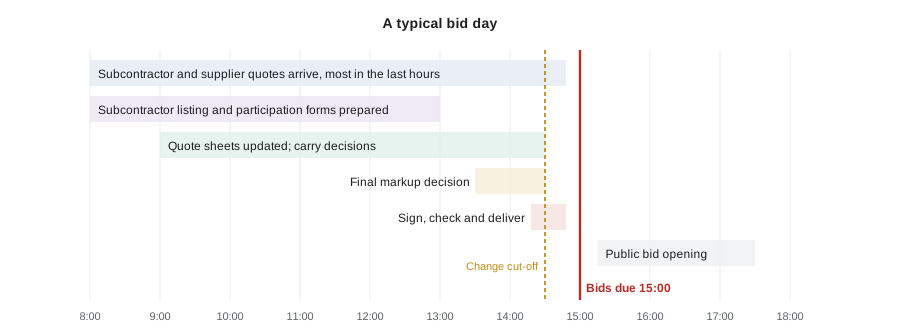
Most subcontractors submit their prices in the last hours before closing, partly to limit bid shopping and partly because their own suppliers are late. As quotes arrive, the package estimators update leveling sheets and the summary. A typical rule is to stop changing the summary at a fixed time, often 30 to 60 minutes before the deadline, except for single large adjustments that the bid-day leader approves. Late changes are usually made as adjustments on a separate sheet (for example, "mechanical: carried quote −$84,000") rather than by reworking the detailed estimate, and the final markup is applied to the adjusted total.
# Bid-day adjustments applied to the summary before final markup ($)
cost_of_work = 12_850_000            # from the summary at 11:00
adjustments = [("Mechanical: new low adjusted quote", -84_000),
               ("Electrical: lighting package excluded, plug added", +46_000),
               ("Roofing: quote missing addendum 3, adjusted", +12_500),
               ("Doors and hardware: lower supplier quote", -9_800)]
cost = cost_of_work + sum(a for _, a in adjustments)
for name, a in adjustments:
    print(f"{name:52s} {a:>+10,}")
markup = 1.04 * 1.035 * 1.014        # overhead, profit, bond and insurance
price = cost * markup
print(f"Adjusted cost of work {cost:,.0f}; price {price:,.0f}; "
f"rounded bid {round(price, -3):,.0f}")Mechanical: new low adjusted quote -84,000 Electrical: lighting package excluded, plug added +46,000 Roofing: quote missing addendum 3, adjusted +12,500 Doors and hardware: lower supplier quote -9,800 Adjusted cost of work 12,814,700; price 13,986,855; rounded bid 13,987,000
The final price is often rounded, and some firms adjust the last digits deliberately to avoid ties or to land just below a round number a competitor might choose. The bid-day leader also makes the final markup decision, informed by the competition (who picked up documents, who is known to be busy) and the risks discovered during the bid (Lesson 11). Every change is recorded, because a bid that wins will be examined closely afterward.
Bid security and other required documents
Most public owners and many private owners require bid security: a guarantee that the bidder will enter into the contract and provide the required performance and payment bonds if its bid is accepted. On federal construction contracts, where performance and payment bonds are required, the Federal Acquisition Regulation requires a bid guarantee of at least 20 % of the bid price, but not more than $3 million. Many states and localities require 5 to 10 %. Under the Miller Act, federal construction contracts over $150,000 require performance and payment bonds, generally each equal to 100 % of the contract price, and states have similar Little Miller Acts for state and local public work.
Other common requirements include the signed bid form with prices for the base bid, alternates, separate prices and unit prices; acknowledgment of addenda; a list of subcontractors where required; statutory declarations or certificates (for example, of workers' compensation coverage, safety certification or non-collusion); and evidence of insurance. Missing any mandatory item can make a bid non-compliant.
The law of tendering
Public bidding in the United States is governed by statute and regulation rather than by a single doctrine. For federal construction, Part 14 of the Federal Acquisition Regulation sets out sealed bidding: bids are opened publicly at the stated time, and award goes to the responsible bidder whose bid, conforming to the invitation, is most advantageous to the government considering only price and price-related factors. A bid is responsive if it complies in all material respects with the invitation; a bidder is responsible if it has the capacity, integrity and resources to perform. States and localities have their own public bidding laws, which commonly require award to the lowest responsive and responsible bidder for contracts above a threshold.
Mistakes in bids are handled by rules rather than by contract doctrine. Under FAR 14.407, a bidder that alleges a mistake before award may be permitted to correct or withdraw its bid if it provides clear and convincing evidence of the mistake and, for correction, of the intended bid; after award, relief is limited. Many states have statutes allowing a bidder to withdraw a bid for a clerical mistake if it gives prompt written notice, often forfeiting the right to bid on the re-solicitation. Unsuccessful bidders can challenge awards: for federal procurements, protests may be filed with the agency, the Government Accountability Office (generally within 10 days of when the protester knew or should have known the basis) or the Court of Federal Claims.
The practical consequences for estimators are similar to those in other systems: a sealed public bid generally cannot be changed after opening; a bid that takes exception to the invitation's material terms risks being found nonresponsive; questions should be raised before bid opening, and protests about the solicitation itself generally must be filed before bids are due. On private work, owners have much more freedom to negotiate, and the formal rules of public bidding apply only if the invitation adopts them.
| Concept | US position | Consequence for the bidder |
|---|---|---|
| Withdrawing after closing | Generally barred after opening; mistake rules may allow withdrawal before award | Check arithmetic before submission |
| Non-compliant bids | Nonresponsive bids must be rejected | Do not qualify or condition the bid |
| Owner's discretion | Owner may reject all bids if in the public interest | Low price does not guarantee award |
| Challenges | Bid protests to the agency, GAO or courts; state procedures vary | Keep records of the process |
Subcontractor listing and preferences
Many states require bidders on public works to list their subcontractors above a threshold on the bid form; California's Subletting and Subcontracting Fair Practices Act, for example, requires listing of subcontractors whose work exceeds one-half of one percent of the prime contractor's total bid and restricts later substitution. Public owners may also apply small business, disadvantaged business or local preference programs: federally funded highway and transit projects set Disadvantaged Business Enterprise goals, and bidders must show they met the goal or made good-faith efforts. These requirements must be built into the bidders list and the bid-day process.
Professional associations publish guidance on fair bidding. The American Institute of Architects and the Associated General Contractors, for example, publish recommended bidding practices and standard forms such as AIA A701 Instructions to Bidders, which many invitations to bid adopt.
Electronic submission
Many owners now accept or require bids through electronic platforms. Electronic bidding removes the courier race but brings its own risks: upload failures, platform time stamps that differ from office clocks, file size limits, digital signature requirements and the temptation to submit at the last second. A sensible rule is to upload a complete bid at least an hour before closing and then, if the platform allows it, revise the price later; most platforms accept the last submission before the deadline. A bid that arrives one second late is late, whether physical or electronic.
After the bid
Once bids are opened or results announced, the estimating team should compare its price with the others, identify where it differed if results are itemized, and record the information in the firm's bid history (Lesson 1). If the firm is low, it must confirm its own price immediately: review the summary for arithmetic errors, check that major packages were leveled correctly, and confirm key subcontractor numbers in writing. A low bidder that discovers a large error faces a hard choice between proceeding at a loss and seeking to withdraw under whatever rules apply. If the firm is not low, a polite debrief with the owner can reveal whether price, scope interpretation or other factors decided the result.
Worked problem
Is the low bid an error?
Five bids are received: $8.42M (Northline), $8.95M, $9.04M, $9.21M and $9.36M. Is Northline's bid suspiciously low?
Show solution
- Average of the other four = (8.95 + 9.04 + 9.21 + 9.36) ÷ 4 = $9.14M.
- Northline is 0.72 ÷ 9.14 ≈ 7.9 % below that average and 0.53 ÷ 8.95 ≈ 5.9 % below the next bid.
- The other four bids are within about 4.6 % of each other.
Answer: A gap of nearly 6 % to the second bidder, when the others are clustered, is a warning sign. Northline should immediately check for missed scope, wrong quotes or arithmetic errors before the owner asks it to confirm its price.
Payment terms to read before bidding
Payment law also affects the bid. The federal Prompt Payment Act sets interest penalties for late payment on federal contracts and requires prime contractors to pay subcontractors promptly, and most states have prompt payment statutes for public work and many for private work. Retainage (often 5 to 10 % withheld until completion, with some states capping it or requiring release at substantial completion) sets how much of the contractor's money is tied up. Both change the financing cost that general conditions or overhead must carry, so the estimator should note the payment terms and retainage in the bid plan, and pass them on to subcontractors in the scope sheets.
Common mistakes
MistakeLeaving the bid form, bid security and signatures until the last hour.
InsteadPrepare everything except the final price before bid day and test the submission route.
MistakeReworking the detailed estimate as late quotes arrive.
InsteadRecord late changes as adjustments on the summary and apply markups to the adjusted total.
MistakeQualifying a public bid to deal with an unclear requirement.
InsteadAsk a question before the deadline; qualified bids may be non-compliant.
MistakeAssuming an error found after closing can be corrected.
InsteadCheck arithmetic before submission; post-closing relief is limited and may cost the bid security.
MistakeSubmitting electronically in the final minute.
InsteadUpload a complete bid well before closing and revise if the platform allows.
MistakeCelebrating a large winning margin without checking it.
InsteadInvestigate a large gap to the second bidder immediately.
Summary and key terms
- Good bid days are prepared in advance: priced self-performed work, leveling sheets with plugs, forms, security and logistics.
- Late quotes are handled as adjustments on the summary, with a cut-off time for changes.
- Federal bids need a bid guarantee of at least 20 % (to $3 million), and the Miller Act requires performance and payment bonds over $150,000.
- FAR Part 14 sealed bidding awards to the lowest responsive, responsible bidder; FAR 14.407 governs mistakes.
- Listing laws and business participation goals shape subcontractor selection on public work.
- Electronic submission needs a margin of time; late is late.
- A low bid far below the others must be checked immediately.
- Sealed bidding
- A method in which bids are submitted sealed and opened publicly at a set time.
- Responsive bid
- A bid that conforms in all material respects to the invitation.
- Responsible bidder
- A bidder with the capacity, integrity and resources to perform.
- Bid guarantee
- Security submitted with a bid, such as a bid bond.
- Miller Act
- The federal law requiring performance and payment bonds on federal construction contracts over $150,000.
- Little Miller Act
- A state law requiring bonds on state or local public construction.
- Bid protest
- A formal challenge to a solicitation or award.
- Listing law
- A law requiring bidders to name subcontractors on the bid form.
- Mistake in bid
- An error in a bid for which correction or withdrawal may be allowed under set rules.
- Debrief
- A meeting with the owner after the bid to learn why the bid did or did not succeed.
Practice problems
Work each problem on paper first, then reveal the answer to check.
List four things that should be ready before bid day.
Show answer
Self-performed work priced, leveling sheets with plugs, bid form prepared, bid security, addenda logged, submission route tested.
Why record late changes as adjustments rather than reworking the estimate?
Show answer
It is faster, traceable and less error-prone under time pressure.
Cost of work $9.0M, adjustments −$60,000 and +$25,000, markup factor 1.09. Price?
Show answer
8,965,000 × 1.09 = $9,771,850.
What minimum bid guarantee does the FAR require on federal construction needing bonds?
Show answer
20 % of the bid price, up to $3 million.
When are Miller Act bonds required?
Show answer
On federal construction contracts over $150,000.
What is the difference between responsive and responsible?
Show answer
Responsive concerns the bid's conformity; responsible concerns the bidder's ability to perform.
Why should bidders ask questions rather than qualify their bids?
Show answer
Qualified bids may be non-compliant or nonresponsive.
How does a listing law affect the general contractor?
Show answer
It must name subcontractors above a threshold and cannot freely substitute them.
What is a sensible rule for electronic submission?
Show answer
Upload a complete bid well before closing and revise if allowed.
Bids: $6.1M, $6.9M, $7.0M, $7.1M. What should the low bidder do?
Show answer
Check its bid immediately; it is about 12 % below the next bid.
Lesson quiz · 5 questions
Score 60% or more to complete this lesson.
Create a free account to save your progress, take quizzes and earn a certificate.