
CON-310 · Lesson 10 of 12 · 27 min
Changes, claims and their cost impact
Few building projects finish with the scope they started with. Owners add and delete work, designers issue revisions, site conditions differ from the drawings, and regulators impose new requirements. Each change has a cost, and on a lump sum job each change the contractor fails to price, record and recover comes straight out of the fee. Changes also disrupt the control system: they add budget that was never in the estimate, consume crews and time charged to base-contract codes, and blur the line between overrun and extra work. This lesson covers how the cost system tracks changes from first notice to final settlement, how pending changes are reflected in the forecast, how the direct and indirect costs of changes are captured, and how productivity loss and acceleration are measured. The legal rules for changes, notice and claims are in CON-220 Lessons 8 and 9; delivery-method and risk issues in CON-340 and CON-350.
The life of a change
A change usually passes through several stages, and the cost system should know where each one stands.
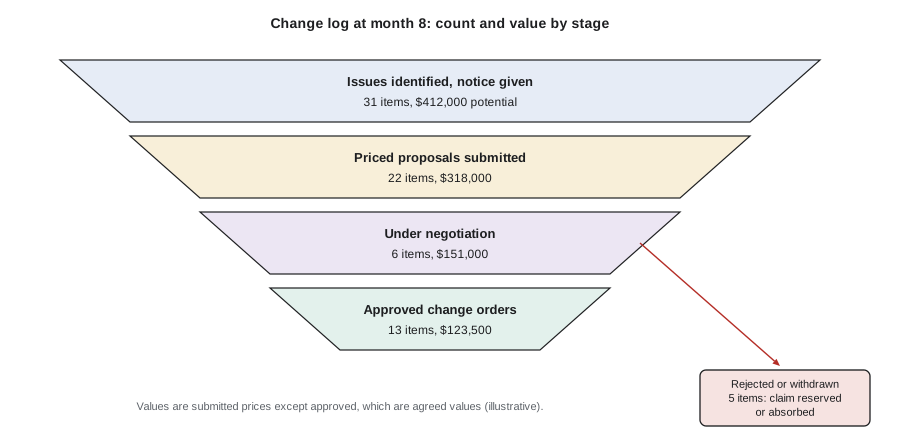
| Stage | Typical document | Cost treatment |
|---|---|---|
| Issue identified | Request for information, site instruction, notice of change or delay | Open a potential change item; start tracking cost separately |
| Priced proposal | Change order request (COR) or proposed change order (PCO) | Estimate of cost and time impact submitted to the owner |
| Under negotiation | Revised pricing, meetings, consultant review | Forecast with an estimate of the likely outcome |
| Approved | Change order or construction change directive signed | Add to contract value and current budget |
| Rejected or withdrawn | Owner's written rejection or contractor withdrawal | Cost stays in base-contract codes or becomes a claim |
Under AIA and ConsensusDocs contracts, a construction change directive allows the owner to instruct a change before price and time are agreed, with the price later set by the contract's valuation rules, often the reasonable cost plus markup; the contractor must keep detailed records of the cost of the work done under the directive. CON-220 Lesson 8 explains the rules.
Change logs
A change log is the register of every potential and approved change. It records the number, description, origin (owner request, design error or omission, site condition, regulator), date of notice, value submitted, value approved, time impact, status and the cost codes used to track it. The log is reviewed weekly with the project team and monthly in the cost review. Its two most important uses are to make sure nothing is forgotten and to calculate the exposure from pending changes.
| No. | Description | Origin | Submitted | Status | Likely value |
|---|---|---|---|---|---|
| PC-014 | Added fire-rated shaft walls at stair 2 | Design omission | $38,400 | Approved | $36,900 |
| PC-019 | Rock excavation at elevator pit | Site condition | $61,200 | Negotiating | $48,000 |
| PC-022 | Revised retail storefront to owner spec | Owner request | $27,800 | Priced, not reviewed | $27,800 |
| PC-025 | Winter heating from shoring drawing delay | Delay (disputed) | $44,500 | Rejected by owner | $0 (claim reserved) |
| PC-027 | Added drywall bulkheads for mechanical | Coordination | Not yet priced | Open | $12,000 est. |
Pending changes in the forecast
Approved changes enter the budget and contract value cleanly: the budget line rises by the estimated cost and the contract value by the agreed price. Pending changes are harder. If the contractor has spent money on a change that is not yet approved, that cost sits in the cost report with no matching budget, so the job looks worse than it will be if the change is approved. If the contractor forecasts full recovery of every pending change, the job looks better than it may be. The honest approach is to forecast both the cost and the likely recovery of each pending change, with the recovery weighted by its probability or set at the amount realistically expected.
# Pending change exposure, Riverbend Commons month 8 (amounts $)
pending = [  # number, cost incurred or forecast, price submitted, probability of approval, likely settlement share
    ("PC-019 rock excavation",       43_600, 61_200, 0.90, 0.80),
    ("PC-022 storefront revision",   23_900, 27_800, 0.95, 1.00),
    ("PC-025 winter heating (claim)", 38_700, 44_500, 0.30, 0.70),
    ("PC-027 bulkheads",             10_400, 12_000, 0.80, 1.00),
]
cost = recovery = 0
for name, c, price, p, share in pending:
    expected = price * p * share
    cost += c; recovery += expected
    print(f"{name:<30} cost {c:>7,}  expected recovery {expected:>8,.0f}  net {expected - c:>+8,.0f}")
print(f"Total cost {cost:,}; expected recovery {recovery:,.0f}; net exposure {recovery - cost:+,.0f}")PC-019 rock excavation cost 43,600 expected recovery 44,064 net +464 PC-022 storefront revision cost 23,900 expected recovery 26,410 net +2,510 PC-025 winter heating (claim) cost 38,700 expected recovery 9,345 net -29,355 PC-027 bulkheads cost 10,400 expected recovery 9,600 net -800 Total cost 116,600; expected recovery 89,419; net exposure -27,181
The pending changes carry $116,600 of cost and an expected recovery of about $89,000, a net exposure of about $27,000, almost all from the disputed winter heating claim. A cost report that ignored expected recovery would overstate the overrun by about $89,000; one that assumed full recovery of the submitted prices ($145,500) would overstate the fee by about $56,000. The forecast should show pending change cost and expected recovery as separate items so management can see both.
Tracking the cost of changes
The cost of a change can be priced in advance from an estimate, or it can be recorded as the work is done (force account or time and materials). Either way, the contractor needs records that separate change work from base-contract work. The simplest method is to open a separate cost code for each significant change, so that labor, materials and equipment are charged there rather than to the base codes. Without this, change work inflates the base codes, the productivity factors there look worse than they are, and the contractor cannot prove what the change cost.
| Record | Purpose |
|---|---|
| Separate change cost code | Keeps change cost out of base-contract performance |
| Daily time and materials tickets signed by the owner's representative | Agreed record of labor, equipment and materials on force-account work |
| Photos and daily reports | Evidence of conditions, crews and work performed |
| Quotes from subcontractors with breakdowns | Support for subcontract portions of the change |
| Schedule fragnets | Evidence of time impact (CON-210 Lesson 11) |
Worked problem
Pricing a change
PC-022 changes the retail storefront. Northline's storefront subcontractor quotes $19,600. Northline's own forces need 42 hours at $81/h for revised framing and blocking, plus $1,150 of material. The contract allows 10 % markup on Northline's own work and 5 % on subcontract work, plus the bond rate of 0.8 % on the total. What is the price?
Show solution
- Own work: 42 × 81 + 1,150 = 3,402 + 1,150 = $4,552; with 10 %: $5,007.
- Subcontract: 19,600 × 1.05 = $20,580.
- Subtotal: 5,007 + 20,580 = $25,587.
- Bond: 25,587 × 0.008 = $205.
- Total: $25,792.
Answer: About $25,800. Northline submitted $27,800 because it also claimed two days of extended general conditions for the storefront delay; whether that is recoverable depends on the contract's rules on time-related costs.
Indirect costs of changes
The direct cost of a change, the labor, material, equipment and subcontract work to perform it, is the easy part. Changes also carry indirect costs that are often larger and harder to prove: extended general conditions when the change delays completion, disruption to base-contract work, the cost of re-sequencing, extra supervision and coordination, and lost productivity when many changes arrive at once. Contracts treat these differently. Some allow markups intended to cover small indirect effects; some allow separate claims for time-related costs when a change extends the critical path; some exclude certain consequential costs. The cost system's job is to keep records good enough that whatever the contract allows can be proved.
Measuring productivity loss: the measured mile
When changes or other disruptions reduce productivity on base-contract work, the loss must be measured to be recovered or even understood. The preferred method is the measured mile: compare productivity on a part of the work that was not disrupted with productivity on a comparable part that was. The difference, applied to the disrupted quantity, estimates the hours lost. The method is persuasive because it uses the project's own data rather than industry studies, but it requires good records of hours and quantities by area and period: exactly the data Lessons 4 and 5 recommended.
# Measured mile for drywall framing (hours and quantities by floor)
undisrupted = {"L2": (2_350, 1_420)}                 # floor: (quantity in units, hours)
disrupted = {"L3": (2_410, 1_790), "L4": (2_380, 1_710)}   # floors hit by bulkhead revisions
rate = sum(h for _, h in undisrupted.values()) / sum(q for q, _ in undisrupted.values())
print(f"Undisrupted rate: {rate:.3f} h per unit")
lost_total = 0
for floor, (q, h) in disrupted.items():
    should = q * rate
    lost = h - should
    lost_total += lost
    print(f"{floor}: actual {h} h, at measured-mile rate {should:.0f} h, lost {lost:.0f} h ({lost / h:.0%})")
print(f"Total hours lost {lost_total:.0f}; at $79/h loaded = ${lost_total * 79:,.0f}")Undisrupted rate: 0.604 h per unit L3: actual 1790 h, at measured-mile rate 1456 h, lost 334 h (19%) L4: actual 1710 h, at measured-mile rate 1438 h, lost 272 h (16%) Total hours lost 606; at $79/h loaded = $47,844
About 600 hours, or roughly $48,000 at the loaded rate, were lost on levels 3 and 4. Before claiming that amount, the contractor must check that the floors are truly comparable (same partition types, same crew, similar access) and that the loss is caused by the owner's changes rather than by its own problems. Where no undisrupted period exists, other methods, such as comparison with similar projects or published studies, are weaker and more likely to be challenged.
The cost of acceleration
When a project falls behind, the owner may direct acceleration, or the contractor may choose to accelerate to avoid delay damages. Either way, recovering time costs money. Overtime pays premium wages for hours that are usually less productive, especially when sustained; second shifts add supervision, lighting and coordination; adding crews to a crowded floor reduces each crew's output. Studies of extended overtime on construction have found productivity losses that grow with the number of weeks worked at long hours, so a short burst of overtime is far cheaper per hour gained than months of it. The cost engineer should price acceleration options before they are chosen, not discover their cost afterwards.
# Cost to recover 3 weeks on slab forming by overtime vs added crew (illustrative)
base_rate = 81.0                   # $/h loaded, straight time
ot_premium = 0.5                   # time and a half, applied to the wage share of the loaded rate
wage_share = 0.62                  # share of loaded rate that is wages
crew = 10
hours_needed = 3 * 5 * 8 * crew    # crew-hours of work to recover (3 weeks of normal output)
# Option A: 10 hours a day, 6 days a week -> 20 extra hours per worker per week, productivity factor on OT hours 0.80
ot_rate = base_rate + base_rate * wage_share * ot_premium
ot_hours = hours_needed / 0.80
cost_a = ot_hours * ot_rate
# Option B: add a second crew of 6 on straight time; congestion lowers both crews' productivity by 10 %
extra_hours = hours_needed / 0.90 + 0.10 * (crew * 40 * 6)  # extra crew hours plus loss on base crew over 6 weeks
cost_b = extra_hours * base_rate + 6 * 2_400               # plus foreman and equipment allowance per week
print(f"Option A overtime: {ot_hours:,.0f} paid hours at {ot_rate:.2f} = ${cost_a:,.0f}")
print(f"Option B added crew: {extra_hours:,.0f} hours plus supervision = ${cost_b:,.0f}")
print(f"Straight-time value of the work: ${hours_needed * base_rate:,.0f}")Option A overtime: 1,500 paid hours at 106.11 = $159,165 Option B added crew: 1,573 hours plus supervision = $141,840 Straight-time value of the work: $97,200
Both options cost substantially more than the straight-time value of the recovered work, and the comparison depends heavily on assumptions about productivity that should be checked against the project's own data. If the delay was caused by the owner, the acceleration cost may be recoverable; if by the contractor, it is an overrun. Either way, it belongs in the forecast as soon as the decision is made.
Claims
When a change is disputed and cannot be resolved through the normal change process, it may become a claim. Claims are handled under the contract's dispute resolution provisions (CON-220 Lesson 12), and the cost system's role is to support them with records. A claim built on good cost records, separate change codes, daily reports and measured productivity is far stronger than one built on a total cost calculation (actual cost minus bid), which courts and adjudicators generally treat with suspicion because it assumes the bid was perfect and all overruns were the owner's fault. In the forecast, claims should be carried at a conservative expected value, often zero until there is a realistic basis for recovery, so that the reported fee does not depend on winning a dispute.
Many states provide expedited dispute processes for payment disputes on public work, and federal contracts follow the Contract Disputes Act, which requires a certified claim above a threshold. Either way, a claim depends on records made at the time; assembling them after the fact is slow and less persuasive.
Common mistakes
MistakeCharging change work to base-contract cost codes.
InsteadOpen separate cost codes for significant changes so base performance and change cost are both clear.
MistakeForecasting full recovery of every pending change.
InsteadForecast cost and a realistic, probability-weighted recovery for each pending change.
MistakeIgnoring the cost of pending changes until they are approved.
InsteadShow pending change cost and expected recovery separately in the forecast.
MistakePricing only the direct cost of a change.
InsteadConsider extended general conditions, disruption and supervision, as the contract allows.
MistakeClaiming productivity loss as total cost minus bid.
InsteadUse the measured mile on the project's own data where possible.
MistakeChoosing acceleration without pricing it.
InsteadPrice overtime, extra crews and shifts with realistic productivity before deciding.
Summary and key terms
- Changes pass through stages from notice to approval or rejection, and the cost system tracks each stage.
- A change log records origin, value, status, time impact and cost codes for every potential change.
- Pending changes should be forecast with their cost and a realistic, weighted recovery.
- Separate cost codes and signed time and materials tickets keep change cost provable and base performance clean.
- Indirect costs of changes, including extended general conditions and disruption, need records to be recovered.
- The measured mile compares disrupted and undisrupted productivity on the project's own data.
- Acceleration costs more than straight-time work and should be priced before it is chosen.
- Change order
- A signed agreement changing the work, contract price or time.
- Change directive
- An owner instruction to proceed with a change before price and time are agreed.
- Potential change
- An issue that may lead to a change order, tracked before pricing or approval.
- Change log
- The register of all potential and approved changes.
- Pending change exposure
- The net effect on the forecast of pending changes' cost and expected recovery.
- Force account
- Work paid on the basis of recorded labor, equipment and material costs plus markup.
- Measured mile
- A method comparing disrupted and undisrupted productivity to estimate hours lost.
- Acceleration
- Speeding up work to recover or avoid delay, usually at extra cost.
- Total cost method
- Claiming actual cost minus bid as damages; generally viewed sceptically.
- Claim
- A disputed request for additional payment or time pursued under the contract.
Practice problems
Work each problem on paper first, then reveal the answer to check.
Name four stages a change passes through.
Show answer
Issue identified, priced proposal, negotiation, approved or rejected.
Why open a separate cost code for a significant change?
Show answer
To keep change cost out of base performance and to prove the cost.
A pending change costs $20,000, is priced at $26,000, and has a 75 % chance of approval at full value. What is its expected net effect?
Show answer
26,000 × 0.75 − 20,000 = −$500.
Name three indirect costs of changes.
Show answer
Extended general conditions, disruption to base work, re-sequencing, extra supervision, cumulative productivity loss.
Undisrupted productivity is 0.60 h per unit. A disrupted floor took 1,500 h for 2,000 units. How many hours were lost?
Show answer
1,500 − 1,200 = 300 hours.
Why is the total cost method viewed sceptically?
Show answer
It assumes the bid was perfect and all overruns were caused by the other party.
Own-forces cost of a change is $8,000 and subcontract cost $30,000, with 10 % and 5 % markups. What is the price before bond?
Show answer
8,800 + 31,500 = $40,300.
Why does extended overtime cost more per hour gained than a short burst?
Show answer
Productivity on overtime falls further as long hours continue.
How should a disputed claim usually be carried in the forecast?
Show answer
At a conservative expected value, often zero until recovery is realistic.
What records make a change claim strong?
Show answer
Separate cost codes, signed tickets, daily reports, photos, schedule fragnets, measured productivity.
Lesson quiz · 5 questions
Score 60% or more to complete this lesson.
Create a free account to save your progress, take quizzes and earn a certificate.