
CON-310 · Lesson 12 of 12 · 29 min
Cost control actions, reporting to owners and capstone: a monthly cost report
Measurement without action is just bookkeeping. The previous lessons built a system that tells the project team, early and accurately, where the job is heading. This final lesson is about what to do with that knowledge: the corrective actions available when a job is going wrong, how to choose among them, how to report cost to management and to owners on different contract types, and how to close the loop by feeding actual results back into estimating. It ends with a capstone in which you assemble the month 11 cost report for Riverbend Commons from the methods of the whole course.
Corrective actions
When a variance analysis (Lesson 8) identifies a cause, the project team chooses actions to address it. Actions fall into a few broad groups, and the right one depends on whether the cause is still active, whether it lies within the contractor's control, and how much of the work remains.
| Type of action | Examples | When it fits |
|---|---|---|
| Fix the method | Change formwork system, re-plan crane use, prefabricate, resequence floors | Self-performed productivity problems with much work remaining |
| Fix the inputs | Get drawings, approvals or materials ahead of crews; clear access | Crews waiting or re-working because inputs arrive late |
| Fix the people | Add an experienced foreman, change crew mix, train | Supervision or skill gaps |
| Recover from others | Price and submit changes, back-charge subcontractors, pursue claims | Cost caused by owner, designer or subcontractor |
| Buy better | Rebid unbought packages, value-engineer with owner agreement | Remaining scope not yet committed |
| Cut time-related cost | Release idle equipment, demobilize early, reduce temporary facilities | General conditions overruns |
| Accept and forecast | Recognize the overrun honestly in the forecast | Cause is past and cannot be recovered |
A few principles help. Act on causes, not symptoms: cutting overtime because labor cost is high will not help if the real cause is late drawings. Act early: the further the work has progressed, the less any action can change the outcome (Lesson 8). Price the action: recovery measures such as acceleration have their own cost (Lesson 10) and should be compared with the cost of doing nothing. And record the decision and its expected effect, so next month's report can show whether it worked.
Worked problem
Choosing an action for the structure account
At month 8 the structure account has CPI 0.94 and is about three weeks late, with level 4, the roof slab and some columns remaining (about 12 % of the account). The causes are late shoring drawings, an inexperienced forming foreman on one crew, and cold weather. Which actions make sense?
Show solution
- Shoring drawings: already approved for level 4 and roof; action complete.
- Foreman: replace or support with an experienced foreman for the remaining six weeks; cost about $14,000, expected to raise PF from 0.82 to about 0.92 on the remaining 1,100 hours, saving about 120 hours (about $10,000) plus schedule time.
- Weather: winter heating is already budgeted from contingency; no further action.
- Schedule: compare overtime on strip and reshore with accepting the delay; three weeks of extended general conditions cost about $90,000, so modest acceleration is worth pricing.
Answer: Add the experienced foreman, price limited overtime against the cost of delay, record the expected effect, and forecast the remaining structure work at PF 0.92 rather than budget. The past overrun cannot be recovered, so it should be accepted in the forecast.
Reporting to management
Inside the contractor, cost reports go up the line to operations managers and executives, who look across many jobs. They need consistent, comparable information: projected fee against bid fee, change in projected fee since last month, the biggest risks and opportunities, cash position and billing status. A one-page project summary, backed by the full cost report for those who want detail, is the usual format. The most important quality is honesty: a company where project managers fear reporting bad news will learn about losses only when they are too large to hide.
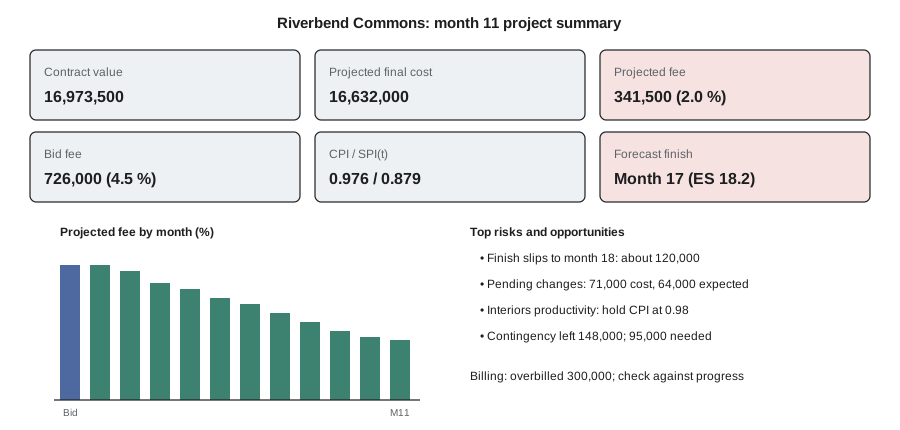
| Item | Purpose |
|---|---|
| Contract value and approved changes | Shows the revenue base |
| Projected final cost and projected fee, with bid fee | Shows the expected result against the plan |
| Change in projected fee since last month | Shows the trend and forecast quality |
| CPI, SPI(t) and forecast completion date | Summarizes cost and schedule performance |
| Pending changes and claims, with expected recovery | Shows exposure and upside |
| Top risks and opportunities with contingency remaining | Shows what could move the result |
| Billing position and cash | Shows working capital tied up in the job |
Reporting to owners
What the owner sees depends on the contract. On a lump sum contract the owner sees progress claims, the schedule, change pricing and perhaps a cash flow forecast for its own financing, but not the contractor's costs or fee. On cost-plus, GMP and construction management contracts, the owner usually sees the cost report itself: budget, cost to date, commitments, forecast, contingency use and savings, often monthly and in a format the contract specifies. Open-book reporting raises the stakes for cost control: miscoded costs, unexplained transfers or contingency used without approval can lead to disallowed costs and disputes.
GMP and cost-plus contracts in the United States, such as the AIA A102 and A133 or ConsensusDocs 200-series forms, define which costs are reimbursable, how contingency and allowances may be used and what records the owner may audit; public owners add their own requirements. A contractor working under these forms should set up its cost codes and reports to match the contract's definitions from the start, so that the owner's report is a filtered view of the contractor's own system rather than a separate set of books.
| Contract type | Owner typically receives |
|---|---|
| Lump sum | Progress claims, schedule updates, change pricing; no cost data |
| Unit price | Quantities installed and progress claims at bid unit rates |
| Cost plus a fee | Full cost report, invoices and payroll records on request; audit rights |
| GMP | Cost report, contingency log, savings calculation, audit rights |
| Construction management | Trade package budgets, commitments and forecasts; often owner approval of contingency use |
Closing out and feeding back
At the end of the job, the cost record becomes the company's most valuable estimating resource. A close-out review compares final cost with the original budget for each line, records actual quantities, hours and unit rates for self-performed work, notes subcontract buyout results and change history, and captures lessons about methods, suppliers and risks. The results update the historical cost database that estimators use (CON-200 Lesson 1 and CON-300 Lesson 12). Contractors that do this consistently bid more accurately and recognize risky work sooner; those that skip it repeat the same mistakes.
| Close-out output | Used for |
|---|---|
| Final cost by cost code against original and current budget | Understanding where the margin was made or lost |
| Actual unit rates and productivity factors | Historical database for estimating |
| Buyout results by trade | Pricing subcontract packages on future bids |
| Change log summary by origin | Assessing design quality and owner behavior |
| Forecast accuracy over time | Improving forecasting practice |
| Lessons learned | Methods, suppliers, risks and controls to repeat or avoid |
Capstone: the month 11 cost report for Riverbend Commons
It is now the end of month 11. Structure is complete; envelope, mechanical, electrical and interiors are under way. Your task is to assemble the monthly cost report and summary, using the methods of this course. The data are below; the code then carries out the main calculations so that you can check your own work. Work through the steps in order before reading the results.
| Data item | Value |
|---|---|
| Contract value including approved changes | $16,973,500 (approved changes $123,500) |
| Current cost budget (BAC) including approved changes | $16,236,000 |
| Cumulative planned value at month 11 | $12,830,000 (month 10: $11,690,000; month 9: $10,330,000) |
| Earned value at month 11 (measured progress) | $11,240,000 |
| Actual cost including accruals | $11,520,000 |
| Bottom-up cost to complete from the line-by-line report | $5,112,000 |
| Pending changes: cost incurred / expected recovery | $71,000 / $64,000 |
| Contingency remaining in BAC / needed for remaining risks | $148,000 / $95,000 |
| Planned duration / forecast completion used by the team | 16 months / month 17 |
| Billed to date (gross) / earned contract value | $12,050,000 / $11,750,000 |
- Step 1: calculate CV, SV, CPI and SPI.
- Step 2: calculate earned schedule, SV(t), SPI(t) and the earned schedule forecast duration.
- Step 3: calculate the bottom-up EAC, BAC ÷ CPI and the CPI × SPI EAC, and the TCPI the bottom-up EAC requires.
- Step 4: calculate VAC and the projected fee, with and without pending change recovery.
- Step 5: assess the billing position.
- Step 6: write the three-line management summary.
contract, BAC = 16_973_500, 16_236_000
pv = {9: 10_330_000, 10: 11_690_000, 11: 12_830_000}
EV, AC, AT, PD = 11_240_000, 11_520_000, 11, 16
etc_bottom_up = 5_112_000
pend_cost, pend_recovery = 71_000, 64_000
billed, earned_rev = 12_050_000, 11_750_000

# Step 1
CV, SV, CPI, SPI = EV - AC, EV - pv[11], EV / AC, EV / pv[11]
print(f"1) CV {CV:+,}  SV {SV:+,}  CPI {CPI:.3f}  SPI {SPI:.3f}")
# Step 2: EV lies between PV at months 9 and 10
ES = 9 + (EV - pv[9]) / (pv[10] - pv[9])
print(f"2) ES {ES:.2f} months  SV(t) {ES - AT:+.2f}  SPI(t) {ES / AT:.3f}  forecast duration {PD / (ES / AT):.1f} months")
# Step 3
eac_bu = AC + etc_bottom_up
eac_cpi = BAC / CPI
eac_cs = AC + (BAC - EV) / (CPI * SPI)
tcpi = (BAC - EV) / (eac_bu - AC)
print(f"3) EAC bottom-up {eac_bu:,}  BAC/CPI {eac_cpi:,.0f}  CPIxSPI {eac_cs:,.0f}  TCPI {tcpi:.3f}")
# Step 4
vac = BAC - eac_bu
fee_without = contract - eac_bu
fee_with = fee_without + pend_recovery
print(f"4) VAC {vac:+,}  projected fee {fee_without:,} ({fee_without / contract:.1%}); "
      f"with expected change recovery {fee_with:,} ({fee_with / contract:.1%})")
# Step 5
pos = billed - earned_rev
print(f"5) Billing position {pos:+,} ({'overbilled' if pos > 0 else 'underbilled'})")1) CV -280,000 SV -1,590,000 CPI 0.976 SPI 0.876 2) ES 9.67 months SV(t) -1.33 SPI(t) 0.879 forecast duration 18.2 months 3) EAC bottom-up 16,632,000 BAC/CPI 16,640,456 CPIxSPI 17,364,790 TCPI 0.977 4) VAC -396,000 projected fee 341,500 (2.0%); with expected change recovery 405,500 (2.4%) 5) Billing position +300,000 (overbilled)
Compare your answers with the results. Cost performance has stabilized since month 8 (CPI 0.976 against 0.969), because the troubled structure is finished and most remaining work is fixed-price subcontracts. Schedule remains the main concern: the project is about 1.3 months behind its baseline on an earned schedule basis, and SPI(t) projects about 18.2 months, longer than the team's month 17 assumption. The bottom-up EAC is almost exactly equal to BAC ÷ CPI and needs a TCPI of 0.977, essentially the CPI achieved to date, so it assumes no unexplained improvement: a realistic, if sobering, forecast. The projected fee is about 2.0 % before expected change recovery, against 4.5 % bid.
Worked problem
Step 6: the management summary
Write three lines for the operations manager.
Show solution
- Line 1, position: projected final cost $16.63 million against budget $16.24 million; projected fee about $341,000 (2.0 %), rising to about $405,000 (2.4 %) with expected change recovery, against $726,000 bid.
- Line 2, trend and cause: cost performance has stabilized at CPI 0.98 now that the structure is complete; the main remaining risk is schedule, with earned schedule pointing to about month 18 against the team's month 17.
- Line 3, actions: reconcile the completion date with the critical path this week; if month 18 is confirmed, add about $120,000 of general conditions to the forecast and price limited acceleration of interiors; submit the two remaining priced changes; hold CPI at about 0.98 through weekly productivity review on carpentry.
Answer: A good summary states the position, the trend and its cause, and specific actions, in plain numbers. It also flags the one disagreement in the data, the completion date, rather than hiding it.
The billing position shows Northline about $300,000 overbilled, which helps cash but should be checked: if it comes from claims running ahead of measured progress, the certifier may correct it, and it leaves less contract value for the remaining work. CON-320 explains how this overbilling appears as a liability in the contractor's financial statements.
What makes cost control work
Across the whole course, a few habits separate contractors whose jobs finish close to their forecasts from those that are regularly surprised. They set up a control budget that traces to the estimate. They code costs carefully at the source and accrue at month-end. They measure progress objectively. They forecast from current performance and specific plans, test forecasts against independent formulas, and show ranges. They track changes from first notice and price them promptly. They watch cash as closely as cost. And they act early, record what they did and feed the results back into estimating. None of this needs sophisticated software; it needs discipline and honest reporting.
Common mistakes
MistakeTaking action on symptoms rather than causes.
InsteadUse variance analysis to find the cause and target the action at it.
MistakeChoosing recovery measures without pricing them.
InsteadCompare the cost of each action with the cost of doing nothing.
MistakeReporting good news up the line and holding back bad news.
InsteadReport honestly and early; late surprises are far more damaging.
MistakeRunning a separate set of books for the owner on open-book contracts.
InsteadSet up cost codes and reports to match the contract so the owner's report is a filtered view of one system.
MistakeClosing the job without a cost review.
InsteadRecord final costs, unit rates, buyout results and lessons, and update the estimating database.
MistakeHiding disagreements between data sources.
InsteadFlag differences, such as earned schedule against the scheduler's date, and resolve them.
Summary and key terms
- Corrective actions fix methods, inputs or people, recover cost from others, buy better, cut time-related cost or accept the overrun.
- Act on causes, act early, price the action and record its expected effect.
- Management reports should be consistent, honest and focused on projected fee, trend, risks and cash.
- Owner reporting depends on the contract: none of the contractor's costs on lump sum, full open-book reporting on cost-plus and GMP.
- Close-out reviews feed actual unit rates and lessons back into estimating.
- The capstone month 11 report combines earned value, earned schedule, EAC methods, TCPI, fee and billing position.
- Good cost control depends on discipline and honest reporting more than on software.
- Corrective action
- A step taken to address the cause of an adverse variance.
- Recovery plan
- A set of priced actions to recover cost or time on a troubled job.
- Project summary
- A one-page monthly report of a project's cost, schedule, risk and cash position.
- Projected fee
- Contract value minus estimate at completion.
- Open-book contract
- A contract under which the owner sees and may audit the contractor's costs.
- Disallowed cost
- A cost the owner refuses to reimburse under a cost-reimbursable contract.
- Close-out review
- The end-of-job review of final costs, productivity, buyout and lessons.
- Historical cost database
- The company's record of actual costs and productivity used for estimating.
- Lessons learned
- Documented insights from a project to repeat or avoid on future work.
- Management reserve
- An amount held by management outside the project budget for unknown risks.
Practice problems
Work each problem on paper first, then reveal the answer to check.
Name four types of corrective action.
Show answer
Fix the method, fix the inputs, fix the people, recover from others, buy better, cut time-related cost, accept and forecast.
Why should recovery measures be priced before they are chosen?
Show answer
They have their own cost, which must be compared with the cost of doing nothing.
What does an owner usually see on a lump sum contract?
Show answer
Progress claims, schedule updates and change pricing, but not the contractor's costs.
Name four items on a monthly project summary for management.
Show answer
Contract value, projected final cost and fee, change since last month, CPI and SPI(t), pending changes, risks, billing and cash.
Contract value is $12.4 million and EAC $11.95 million. What is the projected fee?
Show answer
$450,000, about 3.6 %.
Why should cost codes match the contract definitions on a GMP job?
Show answer
So the owner's report is a filtered view of one system and costs are not disallowed.
What does a close-out review produce for estimating?
Show answer
Actual unit rates, productivity factors, buyout results and lessons.
Why is the capstone bottom-up EAC credible?
Show answer
It is almost equal to BAC ÷ CPI and needs a TCPI of 0.977, matching the CPI to date, so it assumes no unexplained improvement.
What disagreement does the capstone summary flag?
Show answer
Earned schedule points to about month 18 while the team assumes month 17.
Billed to date exceeds earned contract value by $300,000. What is the billing position and why check it?
Show answer
Overbilled; it may reflect claims ahead of progress and leaves less value for remaining work.
Lesson quiz · 5 questions
Score 60% or more to complete this lesson.
Create a free account to save your progress, take quizzes and earn a certificate.