
CON-310 · Lesson 7 of 12 · 25 min
Earned value management fundamentals
The cost report in Lesson 6 compares cost with budget line by line. It answers 'will this line overrun?' but it does not directly answer 'are we getting the work done we planned to, for the money we planned to spend?' Earned value management (EVM) answers that question with three numbers measured in the same units: what we planned to have done by now, what we have actually done, and what it actually cost. From those three numbers come variances and indices that summarize cost and schedule performance for a line, a control account or the whole project. This lesson defines the measures, works through them on Riverbend Commons, and explains where formal EVM systems are required.
Three measures
Earned value uses three cumulative quantities, all expressed in budget dollars (or budget hours) so that they can be compared directly.
| Measure | Also called | Definition |
|---|---|---|
| Planned value (PV) | Budgeted cost of work scheduled (BCWS) | The budget for the work scheduled to be done by the status date |
| Earned value (EV) | Budgeted cost of work performed (BCWP) | The budget for the work actually done by the status date |
| Actual cost (AC) | Actual cost of work performed (ACWP) | The cost actually incurred for the work done, including accruals |
| Budget at completion (BAC) | The total budget for the work; PV and EV both end at BAC |
Planned value comes from the cost-loaded schedule (Lesson 3). Earned value comes from measured percent complete (Lesson 4): for each item, EV equals percent complete multiplied by the item's budget. Actual cost comes from the job cost ledger with accruals (Lesson 5). The key idea is that EV converts physical progress into the same currency as the budget, so that it can be compared with both the plan and the actual cost.
Variances
Two variances compare earned value with the other two measures.
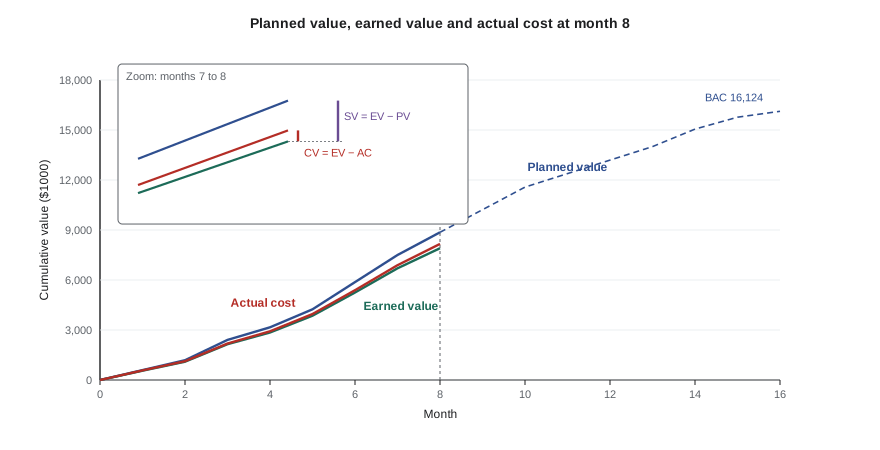
The cost variance (CV) is negative when the work done cost more than its budget: an overrun on the work performed. The schedule variance (SV) is negative when less work has been done than planned: the project is behind. Note that SV is measured in dollars, not days; Lesson 8 explains why that matters and how earned schedule converts it into time. In this course, following the usual EVM convention, negative variances are unfavorable.
Performance indices
Indices express performance as ratios, which makes it easier to compare control accounts or projects of different sizes.
The cost performance index (CPI) is the budget value earned for each dollar spent. A CPI of 0.95 means that each dollar spent has produced 95 cents of budgeted work. The schedule performance index (SPI) is the share of planned work actually done; an SPI of 0.90 means the project has done 90 % of the work planned by this date. Values above 1.0 are favorable; below 1.0 unfavorable.
| Index value | Cost (CPI) | Schedule (SPI) |
|---|---|---|
| Above 1.0 | Work is costing less than budget | More work done than planned |
| Equal to 1.0 | On budget for work done | On plan |
| Below 1.0 | Work is costing more than budget | Less work done than planned |
A worked example at the project level
# Riverbend Commons, status at end of month 8 (amounts $)
BAC = 16_124_000
PV = 8_860_000        # from the cost-loaded schedule
EV = 7_907_000        # sum of percent complete x budget for every line
AC = 8_163_000        # job cost including accruals
CV, SV = EV - AC, EV - PV
CPI, SPI = EV / AC, EV / PV
print(f"Planned {PV / BAC:.1%} complete, actually {EV / BAC:.1%} complete")
print(f"CV = {CV:+,}  SV = {SV:+,}")
print(f"CPI = {CPI:.3f}  SPI = {SPI:.3f}")
print(f"Each dollar spent earned {CPI * 100:.1f} cents of budgeted work")Planned 54.9% complete, actually 49.0% complete CV = -256,000 SV = -953,000 CPI = 0.969 SPI = 0.892 Each dollar spent earned 96.9 cents of budgeted work
At month 8 the project had planned to be 54.9 % complete and is 49.0 % complete. It is behind schedule by $953,000 worth of work and has spent $256,000 more than the budgeted value of the work done. Both indices are below 1.0: cost performance slightly, schedule performance more. These are project-level figures; the useful next step is to see which control accounts produce them.
Drilling down
Project-level indices summarize, but they do not diagnose. A CPI of 0.969 could be a uniform small overrun or one large overrun hidden among many lines on budget. Earned value is therefore calculated for each control account and examined from the top down: first the project, then the accounts with the largest variances, then the items within them.
# Earned value by control account at month 8 (amounts $1000)
accounts = {  # name: (BAC, PV, EV, AC)
    "Site and foundations":       (1_420, 1_420, 1_420, 1_455),
    "Structure":                  (3_160, 3_160, 2_780, 2_960),
    "Envelope":                   (2_740, 1_644, 1_370, 1_390),
    "Mechanical and electrical":  (3_310, 1_324, 1_210, 1_200),
    "Interiors":                  (2_880,   360,   175,   180),
    "General conditions":         (1_904,   952,   952,   978),
}
print(f"{'Account':<28}{'CV':>7}{'SV':>7}{'CPI':>7}{'SPI':>7}")
for name, (bac, pv, ev, ac) in accounts.items():
    print(f"{name:<28}{ev - ac:>7,}{ev - pv:>7,}{ev / ac:>7.2f}{ev / pv:>7.2f}")
tot = [sum(v[i] for v in accounts.values()) for i in range(4)]
print(f"{'Project':<28}{tot[2] - tot[3]:>7,}{tot[2] - tot[1]:>7,}{tot[2] / tot[3]:>7.2f}{tot[2] / tot[1]:>7.2f}")Account CV SV CPI SPI Site and foundations -35 0 0.98 1.00 Structure -180 -380 0.94 0.88 Envelope -20 -274 0.99 0.83 Mechanical and electrical 10 -114 1.01 0.91 Interiors -5 -185 0.97 0.49 General conditions -26 0 0.97 1.00 Project -256 -953 0.97 0.89
Structure produces most of both variances: it is $380,000 of work behind plan and $180,000 over on the work it has done. Envelope is behind but roughly on cost, which suggests it is waiting on the structure rather than struggling itself. General conditions are level of effort, so their SV is zero by definition (Lesson 4), but their CV of minus $26,000 shows they are running above the monthly budget. This pattern points the project manager at one place: the structure, and specifically the elevated slab forming that Lesson 5 already flagged.
Earned value in hours
For self-performed work, earned value is often tracked in hours rather than dollars, especially at the crew level. Planned hours, earned hours and actual hours give an hours CPI that equals the productivity factor of Lesson 5 (earned over actual) and an hours SPI. Working in hours strips out wage rates, so it measures productivity directly. Dollar-based EV is needed to combine labor with materials and subcontracts at the control account level; both are useful.
Conditions for meaningful earned value
Earned value is only as good as its inputs. Three conditions matter most. The baseline must be realistic and stable: if the cost-loaded schedule is front-loaded or not updated after approved changes, planned value is meaningless. Progress must be measured objectively by the rules of credit (Lesson 4); earned value calculated from optimistic percentages simply hides the problem one level down. And actual cost must be collected at the same level and for the same scope as the budget, with accruals, so that EV and AC describe the same work over the same period.
| Input | Common failure | Effect on EV analysis |
|---|---|---|
| Planned value | Baseline front-loaded or not revised for approved changes | False schedule variances |
| Earned value | Percent complete by opinion; credit for stored materials | Overstated progress; CPI and SPI too high |
| Actual cost | No accruals; costs coded to the wrong account | CPI too high in one account, too low in another |
| Level of effort | Large share of an account classed as LOE | SV hidden; account looks on schedule |
Formal earned value management systems
On most private building projects, earned value is an internal tool that the contractor applies as it sees fit. On some public and defense projects, the owner requires the contractor to run a formal earned value management system (EVMS) that meets a published standard, with reports in a specified format and periodic reviews by the owner.
In the United States, the industry standard is EIA-748, Earned Value Management Systems, maintained by the National Defense Industrial Association. A revision, EIA-748-E, was issued in February 2026; it reduces the guidelines from 32 to 27 by merging, deleting and adding guidelines while keeping five process categories. Federal civilian agencies apply EVMS under FAR Subpart 34.2 to major acquisitions as each agency sets thresholds. For the Department of Defense, a class deviation effective February 1, 2026 raised the threshold for EVMS reporting from $20 million to $50 million and kept a compliance review by the cognizant agency, usually the Defense Contract Management Agency, for contracts of $100 million or more. Construction contracts for federal facilities may also carry agency-specific cost and schedule reporting requirements, such as the US Army Corps of Engineers' cost-loaded schedule specifications.
Even where no formal system is required, the ideas of a formal EVMS are good practice: a defined scope broken into control accounts, a time-phased budget baseline, objective progress measurement, actual cost at the same level, variance analysis with thresholds, and disciplined control of baseline changes.
Earned value and the cost report together
Earned value and the line-by-line cost report are complementary. The cost report forecasts the final cost of each line from commitments and judgment; earned value summarizes performance to date and gives an independent, index-based forecast (Lesson 9). When the two disagree sharply, for example when the cost report shows a line on budget but its CPI is 0.85, someone's forecast is wrong and the difference should be explained. Used together, they make it hard for a problem to stay hidden.
Baseline changes and earned value
Earned value depends on a stable baseline, but the scope of a building project changes. When a change order is approved, its budget must be added to the baseline: to BAC, and to planned value in the periods when the change work is scheduled. If it is not, the change work will earn value against nothing, or its cost will appear as an overrun on base work. If the baseline is changed too freely, on the other hand, variances can be made to disappear by moving the plan to match the actuals, a practice sometimes called rubber baselining. Formal EVMS standards therefore restrict baseline changes to approved scope changes and a few defined cases, and require every change to be logged.
| Event | Baseline treatment |
|---|---|
| Approved change order | Add its budget to BAC and to planned value in the scheduled periods |
| Pending change with work started | Track cost on a separate code; add to the baseline only on approval |
| Contingency transfer to a cost line | Moves budget between accounts; total BAC unchanged |
| Schedule revision without scope change | Re-spread remaining planned value only through a controlled re-plan; never change past periods |
| Poor performance | No baseline change; show the variance and forecast it |
Worked problem
Adding a change to the baseline
Change order PC-014, fire-rated shaft walls, is approved in month 8 with a cost budget of $33,500, scheduled to be built evenly in months 9 and 10. How do BAC and planned value change?
Show solution
- BAC rises from $16,124,000 to $16,157,500.
- Planned value rises by $16,750 in month 9 and $16,750 in month 10; months 1 to 8 are unchanged.
- The change gets its own cost code, so its earned value and actual cost can be compared directly.
Answer: BAC becomes $16,157,500 and cumulative planned value rises by $16,750 at month 9 and $33,500 from month 10 onward, with no change to past periods.
Common mistakes
MistakeComparing actual cost with planned value to judge cost performance.
InsteadCompare actual cost with earned value; planned value measures schedule, not cost.
MistakeCalculating earned value from opinion percentages.
InsteadUse objective progress measurement under the rules of credit.
MistakeReading SV as a number of days.
InsteadSV is in dollars of work; use earned schedule (Lesson 8) for time.
MistakeStopping at project-level indices.
InsteadDrill down to control accounts and items to find the cause.
MistakeLeaving the baseline unchanged after approved changes.
InsteadRevise planned value for approved changes through controlled baseline changes.
MistakeAssuming EVMS rules apply to every public contract.
InsteadRead the contract; formal EVMS requirements depend on the owner and thresholds.
Summary and key terms
- Earned value compares planned value, earned value and actual cost in the same units.
- Planned value comes from the cost-loaded schedule, earned value from measured progress, actual cost from the ledger with accruals.
- CV = EV − AC and SV = EV − PV; negative values are unfavorable.
- CPI = EV ÷ AC and SPI = EV ÷ PV; values below 1.0 are unfavorable.
- Project indices summarize; drilling down to control accounts finds the cause.
- Earned value needs a realistic baseline, objective progress and matching actual cost.
- Formal EVMS standards such as EIA-748 apply on some public and defense contracts.
- Earned value management
- A method that integrates scope, schedule and cost to measure project performance.
- Planned value (PV)
- The budget for work scheduled to be done by the status date.
- Earned value (EV)
- The budget for work actually done by the status date.
- Actual cost (AC)
- The cost incurred for the work done.
- Budget at completion (BAC)
- The total budget for the work.
- Cost variance (CV)
- Earned value minus actual cost.
- Schedule variance (SV)
- Earned value minus planned value.
- Cost performance index (CPI)
- Earned value divided by actual cost.
- Schedule performance index (SPI)
- Earned value divided by planned value.
- EIA-748
- The US industry standard for earned value management systems.
Practice problems
Work each problem on paper first, then reveal the answer to check.
PV = $2.0 million, EV = $1.8 million, AC = $1.9 million. Calculate CV and SV.
Show answer
CV = −$100,000; SV = −$200,000.
Using the same values, calculate CPI and SPI.
Show answer
CPI = 0.947; SPI = 0.90.
What does CPI = 1.08 mean?
Show answer
Each dollar spent has earned $1.08 of budgeted work: under budget for work done.
Where do PV, EV and AC come from?
Show answer
Cost-loaded schedule, measured progress times budget, job cost with accruals.
An item with BAC $250,000 is 60 % complete. What is its EV?
Show answer
$150,000.
Why is SV not a measure of time?
Show answer
It is the dollar value of work behind or ahead of plan.
Why does level of effort show SV = 0?
Show answer
It earns value equal to planned value by definition.
Name two inputs that can distort EV analysis.
Show answer
Front-loaded or stale baseline, opinion-based progress, missing accruals, miscoded cost, large LOE share.
What is the hours-based CPI for a crew?
Show answer
Earned hours ÷ actual hours, the productivity factor.
When might a contractor be required to run a formal EVMS?
Show answer
On public or defense contracts above owner thresholds that specify a standard such as EIA-748.
Lesson quiz · 5 questions
Score 60% or more to complete this lesson.
Create a free account to save your progress, take quizzes and earn a certificate.