
CON-355 · Lesson 3 of 12 · 18 min
Site safety plans and emergency response
Every construction project needs a written plan that says how the general rules of the company and the law will be applied on this site, with these hazards, this layout, these trades and this schedule. On Larkspur Commons that document is the site-specific safety plan. It is not a copy of the company manual with the address changed. A good plan is short enough to be read, specific enough to be useful and kept up to date as the site changes from an excavation to a podium to a six-story wood-frame building with trades on every floor.
What goes into a site-specific safety plan
Thornbury's template has the sections below. Priya drafted the Larkspur Commons plan with Dana and Omar during preconstruction, and they revise it at each major phase change.
| Section | Contents for Larkspur Commons |
|---|---|
| Project and roles | Owner, controlling employer, superintendent, safety coordinator, subcontractor safety contacts, first-aid-trained workers |
| Site layout | Logistics plan from CON-325: access, gates, laydown, crane, hoist, first aid room, muster point, washrooms |
| Hazard register | Major hazards by phase with controls and the procedures that apply (excavation, falls, lifting, electrical, silica, traffic, fire) |
| High-risk work plans | Fall protection plan, excavation plan, lift plans, hot work, confined spaces (the elevator pit and the storm tank) |
| Training and orientation | Site orientation content, training requirements by task, records |
| Inspections and meetings | Daily, weekly and monthly inspections; huddles, toolbox talks and the site safety committee |
| Incident reporting and investigation | Who reports what, to whom and how fast; investigation procedure |
| Emergency response plan | Emergencies, alarms, muster, first aid, rescue, contacts, drills |
| Subcontractor requirements | Prequalification, site-specific plans for their work, supervision, records |
| Public and neighbor protection | Hoarding, covered way, traffic control, dust and noise (CON-325) |
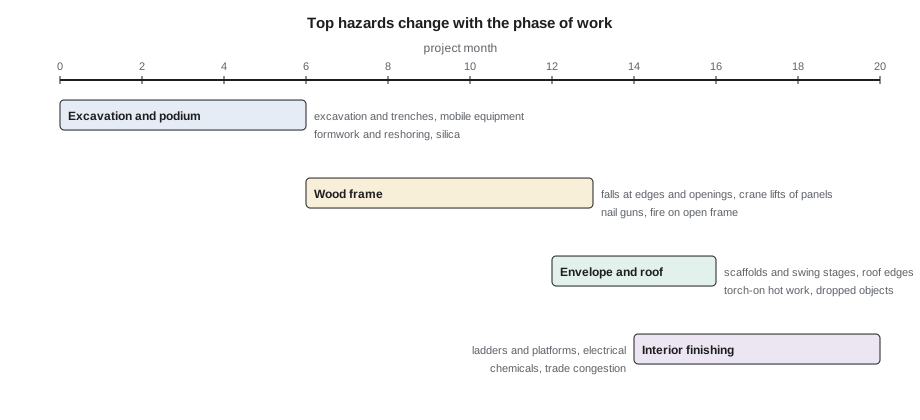
The hazard register is the heart of the plan. It lists hazards by phase because the site changes so much. During excavation and the podium, the major hazards were excavation, mobile equipment, concrete pumping, formwork and reshoring, and silica from cutting and drilling. During wood framing they are falls from leading edges, floor openings and stairs, crane lifts of wall panels, nail guns, and fire on an open wood structure. During finishing they shift to ladders and scaffolds inside suites, electrical work, chemicals and many trades working close together.
Keeping the plan alive
A plan written in preconstruction and filed is out of date within weeks. Thornbury's rule is that the plan is reviewed at each phase change, when a new high-risk activity starts, after any serious incident, and at least every three months. The review is not a rewrite: Dana, Omar and Priya walk the site, check the hazard register and layout against reality and change what no longer fits. The revision record at the front of the plan shows what changed and when. When the tower crane was erected at month 5, the plan gained a section on crane operations, an updated logistics drawing with the swing radius, and new rules for working under suspended loads. When the wood frame reached level 4, the emergency response plan was revised because the original muster point was now inside the crane's swing radius.
Each subcontractor with significant hazards writes its own site-specific plan for its work, which Thornbury reviews before the trade mobilizes. Ridgeline Framing's plan covers its fall protection methods, its nail gun rules and its crew supervision. Thornbury does not copy these into its own plan; it checks that they fit and that the interfaces between trades are covered.
The emergency response plan
OSHA requires construction employers to plan for emergencies through several standards, including 1926.35 for employee emergency action plans where other standards require them, fire protection under Subpart F and rescue requirements in the excavation, confined space and fall protection standards. On a multi-employer site the general contractor normally coordinates a single plan, and Thornbury's emergency response plan for Larkspur Commons covers every employer on site.
| Emergency | First actions | Who leads |
|---|---|---|
| Serious injury or medical emergency | Call 911, send the first aid attendant, send a person to the gate to meet the ambulance, keep the route clear | Nearest supervisor, then the superintendent |
| Fall arrest with worker suspended | Call for the rescue team and 911; start the rescue plan; talk to the worker; time is critical | Foreman of the crew, with the trained rescue team |
| Trench or excavation collapse | Call 911; do not enter the trench; keep people and equipment back from the edge | Superintendent; rescue by emergency services |
| Fire | Raise the alarm, evacuate to the muster point, call 911, meet the fire department at the gate with site drawings | Superintendent or the designated fire warden |
| Structural collapse or crane incident | Evacuate the area, call 911, prevent re-entry, isolate power where safe | Superintendent |
| Gas line strike | Shut down equipment, evacuate upwind, call 911 and the gas utility, no ignition sources | Superintendent |
| Severe weather or wildfire smoke | Stop crane and exposed work at the set limits; shelter or evacuate | Superintendent (wind and smoke limits in CON-325) |
The plan names the alarm signal (three long blasts on the air horn), the primary and secondary muster points, the person who takes the head count at each, and the meeting point for emergency services at the north gate. A laminated card with the site address, the nearest intersection, the gate number and the first aid room location is posted at every phone, every floor's stair landing and the hoist. In an emergency people forget addresses, and a dispatcher who is told 'the building site by the lake' loses minutes.
Rescue after a fall arrest needs particular attention. A worker hanging in a harness can develop suspension trauma, where blood pools in the legs and the worker can lose consciousness within minutes. The fall protection plan for Larkspur Commons therefore includes a rescue plan for every work area: on the frame, rescue from the floor below using a rescue kit and a trained crew; on the swing stage, rescue by the stage supplier's procedure; at the crane, by the fire department. The target is to reach a suspended worker within a few minutes, which means the equipment and trained people must be on site before the work starts, not called in afterwards.
First aid
OSHA's construction first aid standard, 1926.50, requires the employer to ensure prompt medical attention is available for serious injuries. If there is no infirmary, clinic, hospital or physician reasonably accessible in terms of time and distance, a person with a valid first aid certificate must be available at the worksite. OSHA has interpreted 'reasonably accessible' as a response time of about three to four minutes for life-threatening injuries such as stopped breathing or severe bleeding, which few construction sites can rely on, so most contractors keep first-aid-trained workers on every crew. First aid supplies must be available, emergency phone numbers must be posted, and eyewash facilities are required where workers may be exposed to injurious corrosive materials. On Larkspur Commons, with up to about 125 workers at the peak of framing, Thornbury keeps at least one first-aid-trained worker on each crew and a first aid room near the site office.
# First-aid-trained workers per phase (company rule: at least one per crew and one per 25 workers)
import math
phases = [("excavation and podium", 35, 4), ("wood frame peak", 125, 13), ("interior finishing", 90, 11)]
for name, workers, crews in phases:
    need = max(crews, math.ceil(workers / 25))
    print(f"{name:24s} {workers:4d} workers, {crews:2d} crews -> at least {need} first-aid-trained workers")
response_minutes = 9   # measured ambulance response to the site at midday
print("hospital or clinic 'reasonably accessible' (3-4 minutes)?", response_minutes <= 4)excavation and podium 35 workers, 4 crews -> at least 4 first-aid-trained workers wood frame peak 125 workers, 13 crews -> at least 13 first-aid-trained workers interior finishing 90 workers, 11 crews -> at least 11 first-aid-trained workers hospital or clinic 'reasonably accessible' (3-4 minutes)? False
Because an ambulance takes about nine minutes to reach the site, the 'reasonably accessible' test is not met, and first-aid-trained workers must be on site. The company rule of one per crew goes further than the standard requires, because the person who can help in the first minutes needs to be close to the work.
Washrooms, water and welfare
OSHA's construction sanitation standard, 1926.51, sets minimum toilet facilities by the number of workers: one toilet for 20 or fewer workers, one toilet seat and one urinal per 40 workers for 20 or more, and one toilet seat and one urinal per 50 workers for 200 or more. It also requires potable drinking water and handwashing facilities. These are often treated as minor items, but a site where the portable toilets overflow, the handwash stations are empty and there is nowhere to cool down in August tells workers that the company does not care about them, and it is hard to persuade the same workers that the company cares about their safety.
# Toilet count by phase under 1926.51 (minimum), and the company standard
import math
def osha_min(workers):
    if workers <= 20: return "1 toilet"
    if workers < 200: return f"{math.ceil(workers / 40)} toilet seats and {math.ceil(workers / 40)} urinals"
    return f"{math.ceil(workers / 50)} toilet seats and {math.ceil(workers / 50)} urinals"
phases = [("excavation and podium", 35), ("wood frame peak", 125), ("interior finishing", 90)]
for name, workers in phases:
    company = max(2, math.ceil(workers / 15))
print(f"{name:24s} {workers:4d} workers -> OSHA minimum {osha_min(workers)}; company standard {company} units")excavation and podium 35 workers -> OSHA minimum 1 toilet seats and 1 urinals; company standard 3 units wood frame peak 125 workers -> OSHA minimum 4 toilet seats and 4 urinals; company standard 9 units interior finishing 90 workers -> OSHA minimum 3 toilet seats and 3 urinals; company standard 6 units
Thornbury goes beyond the minimum because a toilet five floors down costs a framer twenty minutes and tempts people to use the building instead. Units on the upper floors are lifted by crane and serviced from the hoist. The same thinking applies to heated or shaded break areas, drinking water close to the work in hot weather (HSE-243 covers heat stress) and lockable storage for workers' tools and clothes.
Traffic, deliveries and the public
The site safety plan includes the traffic management plan from CON-325: one-way routes for trucks, a spotter for every reversing vehicle in the laydown area, pedestrian routes separated from vehicles by barriers, and a speed limit of 10 km/h on site. Struck-by incidents with vehicles and mobile equipment are a leading cause of death in construction in both countries, and most happen when a vehicle reverses or a worker walks into an equipment's blind spot. The plan also sets the rules for delivery drivers, who are often not employees of anyone on site and have had no orientation: drivers stay in or beside their cab unless directed, and every delivery is met by a Thornbury or subcontractor worker.
Protection of the public, the hoarding, the covered way over the sidewalk and the control of dust and noise, was covered in CON-325 and is summarized in the plan. A supervisor's duty extends to people who are not workers: a child who gets through a gap in the fence at night is the contractor's responsibility, which is why the night security round checks the fence line as well as the materials.
Common mistakes
MistakeUsing the company safety manual as the site plan with the address changed.
InsteadWrite a short, site-specific plan with this site's layout, hazards by phase, roles and procedures.
MistakeWriting the plan in preconstruction and never revising it.
InsteadReview it at each phase change, when new high-risk work starts, after serious incidents and at least quarterly.
MistakePlanning rescue after a fall arrest by calling 911 and waiting.
InsteadHave equipment and trained rescuers on site so a suspended worker can be reached within minutes.
MistakePosting the site address only in the site office.
InsteadPost the address, nearest intersection, gate and first aid location at every phone, stair landing and the hoist.
MistakeTreating washrooms, water and break areas as minor items.
InsteadProvide welfare facilities beyond the minimum, close to the work, because they show workers the company cares.
Summary and key terms
- A site-specific safety plan applies the company system and the law to this site's hazards, layout, trades and schedule.
- Its core is a hazard register by phase, because hazards change from excavation to framing to finishing.
- The plan is reviewed at phase changes, new high-risk work, serious incidents and at least quarterly.
- The emergency response plan covers medical emergencies, rescue, collapse, fire, gas strikes and weather, with alarms, muster points and a meeting point for emergency services.
- Rescue after a fall arrest must be planned and equipped before work starts because of suspension trauma.
- OSHA requires first-aid-trained workers on site unless medical care is reasonably accessible, interpreted as three to four minutes for life-threatening injuries.
- Washrooms, water, break areas and traffic and public protection are part of the plan, not afterthoughts.
- Site-specific safety plan
- A written plan applying company and legal requirements to one site's hazards, layout, trades and schedule.
- Hazard register
- A list of a site's significant hazards with their controls, organized by phase.
- Emergency action plan
- Written procedures for alarms, evacuation, rescue and contact with emergency services.
- Suspension trauma
- Loss of consciousness from blood pooling in the legs of a worker suspended in a harness.
- Reasonably accessible
- OSHA's test for whether medical care is close enough to avoid on-site first aid, interpreted as three to four minutes for life-threatening injuries.
- Muster point
- The assembly place where workers gather and are counted after an evacuation.
Practice problems
Work each problem on paper first, then reveal the answer to check.
Why does the Larkspur Commons hazard register list hazards by phase?
Show answer
Because the main hazards change completely between excavation, framing and finishing.
Why was the emergency response plan revised when framing reached level 4?
Show answer
The original muster point was inside the tower crane's swing radius.
What should be on the emergency card posted at every phone?
Show answer
The site address, nearest intersection, gate for emergency services and the first aid room location.
Why must Larkspur Commons have first-aid-trained workers on site?
Show answer
Because ambulance response takes about nine minutes, longer than the three to four minutes OSHA treats as reasonably accessible.
Why does Thornbury put washrooms on the upper floors?
Show answer
A trip to the ground costs a worker a long time and tempts people to use the building; welfare facilities near the work show care.
Lesson quiz · 5 questions
Score 60% or more to complete this lesson.
Create a free account to save your progress, take quizzes and earn a certificate.