
CON-355 · Lesson 9 of 12 · 19 min
High-risk work I: working at heights
Falls are the leading cause of serious injury and death in construction. The Bureau of Labor Statistics counted 1,034 construction deaths in 2024, released in February 2026, and 389 of them, about 38 percent, were falls, slips and trips. Falls are the first of OSHA's construction Focus Four hazards, with struck-by, caught-in or between, and electrocution, and fall protection in construction has been OSHA's most frequently cited standard for many years. On Larkspur Commons, with a two-story podium and four stories of wood frame going up at the rate of a floor every few weeks, falls are the top hazard for most of the project, and this lesson treats them in detail.
HSE-212, Working at Heights and Fall Protection, in the Safety stream, covers fall protection equipment and techniques for workers. This lesson is about what a supervisor plans, provides and checks.
When fall protection is required
OSHA's construction fall protection standard, Subpart M, requires fall protection where an employee on a walking or working surface with an unprotected side or edge is 6 ft or more above a lower level. Other subparts set their own triggers: 10 ft for scaffolds under Subpart L, and ladder rules under Subpart X. A written fall protection plan is permitted only for leading-edge work, precast concrete erection and residential construction where the employer can show that conventional fall protection is infeasible or creates a greater hazard, and the plan must be prepared by a qualified person. On Larkspur Commons, Thornbury uses conventional fall protection on every floor and prepares a written site plan anyway, because the plan forces the planning.
| Situation on Larkspur Commons | Fall height | Protection used |
|---|---|---|
| Podium slab edges during formwork | Up to about 23 ft | Guardrails on formwork edges; perimeter safety screens |
| Leading edge of wood-frame floors | 26 to 59 ft | Guardrails on completed edges; engineered anchors and fall arrest at the leading edge |
| Floor openings: stairs, shafts, ducts | One story or more | Guardrails or secured, marked covers (lesson 8) |
| Exterior wall panels by crane | 26 to 59 ft | Tie-off to engineered anchors during setting; guardrails replaced immediately |
| Low-slope roof | About 65 ft | Parapet acts as guardrail where high enough; temporary guardrails elsewhere |
| Frame scaffold on the east elevation | Up to 59 ft | Full guardrails and toe boards on every working platform |
| Interior suites, ladders and platforms | Under 10 ft | Platform ladders and podiums instead of step ladders where possible |
The fall protection hierarchy
The hierarchy of controls from lesson 5 applies to falls in a specific form. Each step down depends more on equipment working perfectly and on people using it correctly every time.
| Level | Method | Example |
|---|---|---|
| 1. Eliminate the fall hazard | Do the work at ground level or from inside the edge | Prefabricated wall panels framed on the deck; roof equipment installed before parapets are removed |
| 2. Guardrails and covers | A physical barrier that prevents a fall without any action by the worker | Perimeter guardrails, stair and shaft guardrails, secured covers |
| 3. Travel restraint | Equipment that stops the worker from reaching the edge | A short lanyard to an anchor set back from the edge |
| 4. Fall arrest | Equipment that stops a fall after it starts | Full-body harness, energy-absorbing lanyard or self-retracting lifeline, engineered anchor |
| 5. Administrative methods | Rules and monitoring where nothing else is practicable | Controlled access zones and safety monitoring systems, permitted for some leading-edge and roofing work |
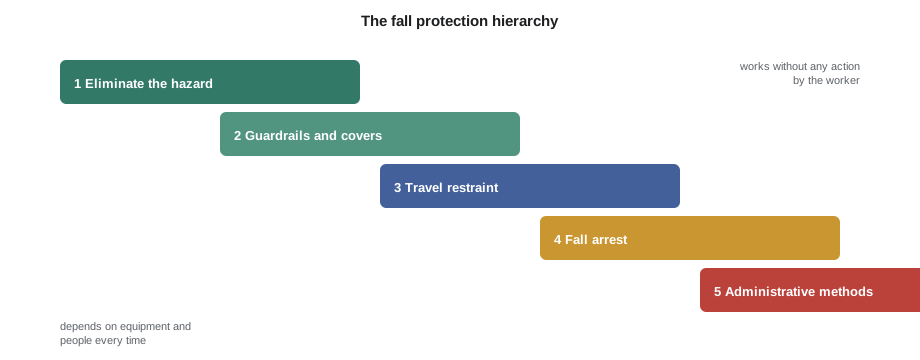
The difference between restraint and arrest matters a great deal. A worker in restraint cannot fall; a worker in fall arrest does fall, and depends on the anchor, lanyard and harness to stop them before they hit something, and then on a rescue. Wherever a restraint system can be used, it is better.
Planning fall protection for a floor
On Larkspur Commons, the fall protection plan for each wood-frame floor is a two-page document prepared by Ridgeline Framing's foreman with Omar before the floor starts. It covers the hazards and how each is protected, the anchors and their locations, the equipment, the procedures for installing and removing guardrails, the rescue plan, and the names of the workers trained in it.
Anchors are the part most often improvised. A worker who needs to tie off and cannot see an anchor will find something: a top plate, a pipe, a joist hanger. Those may not hold the forces of a fall. Thornbury's floor plans show the engineered anchors that will be installed for that floor, roof truss anchors and floor-plate anchors rated for fall arrest, and the framing sequence includes installing them before workers need them. A fall arrest anchor must be able to resist the forces of a fall with a safety margin; in practice that means using anchors certified for the purpose and installed as their instructions require, or anchors designed by an engineer, rather than judging strength by eye.
Fall clearance
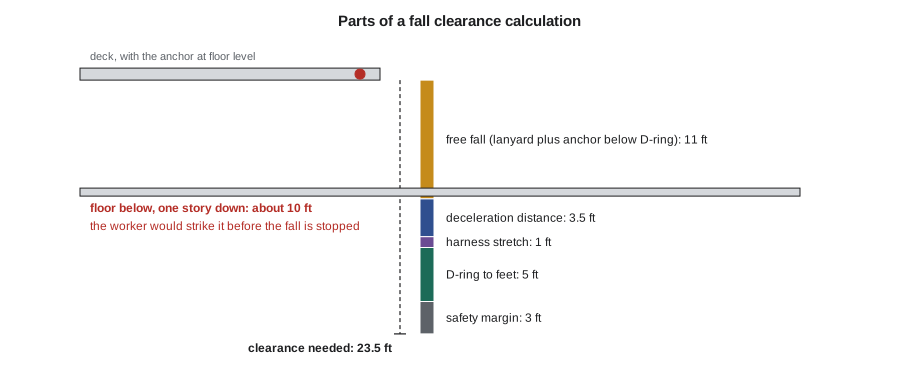
A fall arrest system only works if it stops the worker before they hit the floor below or an obstruction. The total distance needed, the fall clearance, adds up several components. Supervisors should check it whenever workers tie off to an anchor at or below foot level, which is common on a wood-frame deck.
# Fall clearance check for a 6 ft energy-absorbing lanyard on a floor-level anchor (illustrative values)
lanyard = 6.0                 # lanyard length, ft
anchor_below_dring = 5.0      # anchor at floor level, D-ring about 5 ft above the floor
free_fall = lanyard + anchor_below_dring
deceleration = 3.5            # maximum deployment of the energy absorber (manufacturer data)
harness_stretch = 1.0
dring_to_feet = 5.0
safety_margin = 3.0
required = free_fall + deceleration + harness_stretch + dring_to_feet + safety_margin
for name, available in [("floor to floor, levels 4-5", 10.0), ("deck to grade at the podium", 23.5)]:
    ok = "OK" if available >= required else "NOT ENOUGH - use a self-retracting lifeline or restraint"
    print(f"{name:28s} available {available:.1f} ft, required {required:.1f} ft -> {ok}")
print(f"free fall {free_fall:.0f} ft exceeds 6 ft: {free_fall > 6}")floor to floor, levels 4-5 available 10.0 ft, required 23.5 ft -> NOT ENOUGH - use a self-retracting lifeline or restraint deck to grade at the podium available 23.5 ft, required 23.5 ft -> OK free fall 11 ft exceeds 6 ft: True
With the anchor at the worker's feet, a standard lanyard needs more clearance than one story of a wood-frame building provides, and the free fall also exceeds the 6 ft limit in OSHA's personal fall arrest rules. That is why the Larkspur Commons plan specifies self-retracting lifelines on overhead or horizontal anchors for leading-edge work above a finished floor, and restraint wherever the work allows. The figures in the example are illustrative; real calculations use the equipment manufacturer's data.
Guardrails, openings and the trades that remove them
Guardrails are the most effective fall protection on most sites, and the most often removed. Every trade has a reason: landing materials, installing windows, setting equipment, running pipe. The problem is not removal but what happens after. Thornbury's rules are that only the trade that needs the opening may remove a guardrail section; it must protect the opening while it is open, by tying off its own workers and barricading the area for others; it must replace the guardrail before it leaves the area, even for a break; and it must tell the superintendent. Lesson 7 described how material landing platforms with swing gates removed most of the reasons for taking guardrails down on Larkspur Commons. Lesson 8 showed what happens when an opening cover is lifted and not replaced.
OSHA requires guardrail top rails to be 42 in, plus or minus 3 in, above the walking surface, able to withstand a 200 lb force applied outward or downward, with midrails or equivalent and toe boards where objects could fall. Purpose-made guardrail systems clamp to slab edges or attach to wood-frame floors and are quicker to install and inspect than site-built rails.
Ladders and scaffolds
Ladders cause a large share of falls from lower heights, including many serious injuries. Thornbury's site rules limit their use: stair towers are installed early so that workers do not climb between floors on ladders, and platform ladders or rolling podiums replace step ladders for interior work wherever possible. Where ladders are used, they must be in good condition, set at about four to one, secured, and extended about 3 ft above the landing, and workers keep three points of contact and do not carry loads in their hands while climbing.
Subpart L requires scaffolds to be designed by a qualified person, erected, moved, altered and dismantled under the supervision of a competent person, inspected by a competent person before each shift and after any occurrence that could affect their integrity, and used only within their rated loads. The tag system on Larkspur Commons is simple: green means inspected and safe to use, red means do not use, and a scaffold with no tag is treated as red. Workers who alter a scaffold, even to move a single plank, have made it a red scaffold until it is re-inspected.
Aerial work platforms
Boom lifts and scissor lifts are used for exterior cladding, high ceilings in the commercial units and the parkade services. Operators must be trained and familiarized on the model. In boom lifts, occupants wear a harness with a short lanyard attached to the platform's anchor point, so that a sudden movement does not throw them out; in scissor lifts, the guardrails are the primary protection, and the manufacturer's instructions govern whether tie-off is required. Lifts are not used as material hoists, guardrails are never climbed, and the ground is checked for soft fill, slopes and overhead lines before setup.
What a supervisor checks every day
- Every open edge, opening and stair has a guardrail or secured cover, or workers at it are tied off under the plan.
- Anchors for today's work are installed and identified before workers need them.
- Harnesses and lanyards are inspected before use, and damaged equipment is removed from service.
- Self-retracting lifelines are used where clearance is short.
- Scaffold tags are green and current; no one is on a red or untagged scaffold.
- Ladders are the right type, secured and used correctly, and stairs are used where they exist.
- The rescue kit and trained rescuers are on site and know where today's work is.
A supervisor's check before work at height starts
Plans and equipment matter only if they are in place when the work begins. Before a crew starts work at an open edge, the supervisor or foreman should be able to answer a few questions without looking anything up. Which level of the fall protection hierarchy is being used, and why not a higher one? If workers will be tied off, where are the anchors, who confirmed that they are rated for the load, and is the fall clearance enough for the connector being used? Has every worker on the crew been trained on this equipment and inspected their own harness today? Who will carry out a rescue if someone falls, with what equipment, and how quickly can it be done?
Ben Kowalski runs this check as part of his morning field-level hazard assessment with the Thornbury carpenters, and Ridgeline's foreman does the same with the framing crew. When an answer is missing, the work waits until it is found. The check takes a few minutes and has stopped work twice on Larkspur Commons: once when a new crew arrived with lanyards instead of the self-retracting lifelines the plan required above a finished floor, and once when the rescue kit had been moved to another level.
Common mistakes
MistakeUsing fall arrest where a guardrail or restraint could be used.
InsteadWork down the fall protection hierarchy: eliminate, guard, restrain, and only then arrest.
MistakeLetting workers choose their own anchors.
InsteadShow engineered or certified anchors on the floor plan and install them before workers need them.
MistakeIgnoring fall clearance when anchors are at foot level.
InsteadCalculate clearance and use self-retracting lifelines or restraint where a lanyard would not stop the worker in time.
MistakeAllowing trades to remove guardrails and leave openings unprotected.
InsteadRequire the trade to protect the opening while it is open, replace the guardrail before leaving and tell the superintendent.
MistakeTreating an altered scaffold as still safe because it was tagged green this morning.
InsteadAny alteration makes the scaffold red until a qualified or competent person re-inspects it.
Summary and key terms
- Falls are the leading cause of serious injury and death in construction.
- OSHA requires fall protection at 6 ft in construction, with other triggers for scaffolds and ladders.
- The fall protection hierarchy runs from elimination through guardrails, restraint and arrest to administrative methods.
- Restraint prevents a fall; arrest stops one after it starts and needs clearance and rescue.
- Fall clearance adds free fall, deceleration, harness stretch, the worker's height and a safety margin; short clearances need self-retracting lifelines or restraint.
- Guardrails removed by trades must be protected and replaced; landing platforms reduce the need to remove them.
- Ladders, scaffolds and aerial platforms each have rules a supervisor checks daily.
- Fall protection plan
- A written plan describing a site's fall hazards, protection methods, anchors, procedures and rescue.
- Travel restraint
- A system that prevents a worker from reaching a point where a fall could occur.
- Fall arrest
- A system that stops a worker's fall after it has started.
- Fall clearance
- The vertical distance needed below a worker for a fall arrest system to stop them before they strike anything.
- Self-retracting lifeline
- A device that pays out and retracts a line, locking quickly if the worker falls, reducing free fall.
- Anchor
- A secure point for attaching a fall protection system, able to resist the forces of a fall.
- Free fall
- The distance a worker falls before the fall arrest system begins to slow them.
Practice problems
Work each problem on paper first, then reveal the answer to check.
Why is restraint better than arrest wherever it can be used?
Show answer
A worker in restraint cannot fall; a worker in arrest falls and depends on the equipment, clearance and rescue.
In the clearance example, which situation had enough clearance with a standard lanyard on a floor anchor?
Show answer
Only the deck-to-grade case at the podium; the floor-to-floor case on the wood frame did not.
What does a supervisor do if a framer cannot find an anchor and clips to a top plate?
Show answer
Stop the work, provide an engineered or certified anchor and review the floor plan's anchor locations.
A worker moves one scaffold plank to reach a window. What is the scaffold's status?
Show answer
Red: it has been altered and must be re-inspected before use.
Name two ways Larkspur Commons reduces ladder use.
Show answer
Installing stair towers early and using platform ladders or rolling podiums instead of step ladders.
Lesson quiz · 5 questions
Score 60% or more to complete this lesson.
Create a free account to save your progress, take quizzes and earn a certificate.