
CON-355 · Lesson 8 of 12 · 18 min
Incident reporting and investigation
Despite good planning, incidents happen. When one does, the supervisor's first job is the injured worker, and the second is to make sure it cannot happen again. In between come duties to report, to protect the scene and to investigate. This lesson follows a real-feeling incident on Larkspur Commons from the moment it happened to the corrective actions that closed it, and covers the reporting rules, investigation methods and the mistakes that turn investigations into blame exercises.
The incident
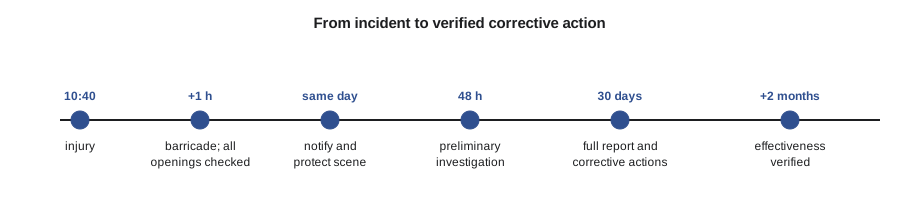
At 10:40 on a Thursday in month 11, a first-year carpentry apprentice working for Thornbury, Kiran Dhaliwal, was carrying blocking along the level 4 corridor. He stepped on a sheet of plywood covering a duct opening about 2 by 3 ft. The cover shifted, his right leg went through the opening to the thigh, and he twisted his ankle and knee as he fell forward. A coworker helped him out. The first aid attendant suspected a fracture, and Kiran was taken to hospital, where an ankle fracture was confirmed. He would be off work for about eight weeks.
Nobody fell through to the floor below, but the opening was large enough for that, and the drop was a full story. This was a serious injury that could easily have been a fatal one, which made it a high-potential event as well as a lost-time injury.
The first hour
The first actions after an incident are the same everywhere.
- Care for the injured. First aid, emergency services if needed, and someone with the worker throughout. Kiran's foreman went to hospital with him and stayed until his family arrived.
- Make the area safe. The opening was barricaded immediately and every other duct opening on levels 3 to 6 was checked within the hour. Two more unsecured covers were found and fixed.
- Protect the scene. The cover and the area were left as they were, photographed and measured, except for the barricade.
- Report. The superintendent was told within minutes, and the regulatory reports were made as required (below).
- Start the investigation. Witnesses were identified and asked to write down what they saw before talking it over among themselves.
Checking the other openings in the first hour was the most important prevention step of the whole investigation. The cause of one incident is often present elsewhere on the site, waiting for the next person.
Reporting requirements
Under 29 CFR 1904.39, the employer must report a work-related fatality to OSHA within 8 hours, and any work-related in-patient hospitalization, amputation or loss of an eye within 24 hours. Kiran was treated in the emergency department and sent home with a cast that afternoon; he was not admitted, so the 24-hour report did not apply. The injury was, however, recordable on the OSHA 300 log because it involved medical treatment beyond first aid and days away from work, and it had to be entered within seven calendar days. Establishments with 100 or more employees in designated high-hazard industries, which include construction, must also submit their 300 and 301 data to OSHA electronically each year. The workers' compensation claim was filed with Thornbury's insurer under Idaho's rules.
| Event | Requirement |
|---|---|
| Work-related fatality | Report to OSHA within 8 hours |
| In-patient hospitalization, amputation or loss of an eye | Report to OSHA within 24 hours |
| Recordable injury or illness (medical treatment beyond first aid, days away, restricted work, loss of consciousness, significant diagnosis) | Enter on the OSHA 300 log within 7 calendar days; complete a 301 incident report |
| Annual summary | Post the 300A from February 1 to April 30; submit electronically if required |
| Workers' compensation | Report to the insurer under the state's rules |
Investigation duties and timelines
OSHA does not require employers to investigate incidents, but every serious safety program does, and an investigation is the best evidence of the reasonable care discussed in lesson 2. Thornbury's procedure follows the same pattern used by many companies and by the Canadian provinces: a preliminary review within 48 hours to fix immediate hazards and decide on interim controls, a full investigation within 30 days, and a corrective action plan with named people and dates. A worker representative from the site safety committee takes part, because the people who do the work know things the supervisors do not.
For Kiran's incident, the team was Omar as lead investigator, Priya as facilitator, the carpenter foreman Ben Kowalski, a worker member of the site safety committee, and Northgate Mechanical's foreman, because Northgate's crew had worked at that opening the day before.
Gathering the facts
An investigation gathers facts in four categories, sometimes remembered as people, position, parts and paper.
| Category | Questions | Findings for the level 4 opening |
|---|---|---|
| People | Who was involved or saw it? What did each person see, do and know? | Kiran, two carpenters nearby, the Northgate pipefitter who had worked at the opening |
| Position | Where were people, materials and equipment? What did the scene look like? | Cover lying askew across the opening, unscrewed, no marking, in a corridor used as a walkway |
| Parts | What equipment and materials were involved? What condition were they in? | A 19 mm plywood cover with no cleats, screw holes at the corners but no screws; blocking carried in both arms |
| Paper | What procedures, plans, permits, training and records apply? | Site rule requires covers to be secured and marked; no permit or sign-off for removing covers; Kiran oriented 3 weeks earlier |
Interviews are conducted one at a time, in a quiet place, soon after the incident, by someone who explains that the purpose is to prevent a repeat, not to blame anyone. Open questions work best: 'Tell me what you were doing before it happened' rather than 'Didn't you see the cover?' The Northgate pipefitter's interview was the turning point. He explained that his crew had lifted the cover the previous afternoon to run a sleeve through the opening, put it back when they finished, and had not screwed it down because they had no screws with them and expected to return in the morning. Nobody had told anyone, and there was no rule that required them to.
Finding the causes
Investigations go wrong when they stop at the first cause they find, usually the action of the person who was hurt or the person nearest the hazard. 'Kiran didn't look where he was going' and 'the pipefitter didn't screw down the cover' are both true, and both are useless as conclusions, because they lead only to telling people to be more careful. Thornbury uses a layered approach, asking why at each level until it reaches causes that the company can change.
| Level | Question | Findings |
|---|---|---|
| Immediate cause | What directly caused the injury? | An unsecured, unmarked cover shifted when stepped on |
| Contributing conditions | What conditions made that possible? | The cover had no cleats to stop it sliding; it was in a busy walkway; blocking carried in both arms blocked the view of the floor |
| Underlying causes | Why were those conditions present? | Trades routinely lift covers to work through openings; no procedure for removing and replacing covers; screws and markings not stocked on each floor |
| Root causes | What in the system allowed the underlying causes? | The site plan treated covers as a one-time installation rather than something that would be disturbed repeatedly; interfaces between trades at openings were not managed |
This approach resembles several formal methods used in industry, such as the 5 whys introduced in CON-345 and PMP-131, and incident cause analysis methods that look at absent or failed defenses, individual and team actions, task and environmental conditions, and organizational factors. HSE-403, Incident Investigation and Root Cause Analysis, in the Safety stream covers formal methods in depth. The point for a supervisor is to keep asking why past the person, to the conditions and systems that made the error possible.
The phrase human error deserves particular caution. People make errors all the time; a safe system is designed so that an ordinary error does not lead to serious harm. If an investigation's conclusion is 'human error', it has stopped too early.
Corrective actions
Corrective actions are chosen using the hierarchy of controls from lesson 5, and each one has a named owner, a date and a way to check that it worked.
| Action | Level of control | Owner | Due |
|---|---|---|---|
| Redesign covers with cleats on the underside so they cannot slide, painted with "HOLE - DO NOT REMOVE" and screwed at four corners | Engineering | Ben Kowalski | Within 1 week, all floors |
| Where possible, frame and sheath around duct openings with guardrails until the duct is installed, instead of covering them | Engineering | Omar Haddad | From level 5 onward |
| Opening removal procedure: a trade that lifts a cover must barricade the opening while it is open, replace and screw the cover when it leaves, and record it on the floor's opening log | Administrative | Omar Haddad | Within 1 week |
| Stock screws, a driver and marking paint in a box at each floor's stair landing | Administrative | Ben Kowalski | Within 3 days |
| Add opening covers to the daily walk and the foremen's start-of-shift check | Administrative | Dana Whitfield | Immediately |
| Toolbox talk on openings for every crew, led by Kiran's foreman and including the Northgate foreman | Administrative | Priya Sandhu | Within 1 week |
| Update the site safety plan to treat openings as a repeatedly disturbed hazard managed between trades | Administrative | Priya Sandhu | Within 2 weeks |
The best action was the second one. Framing around duct openings with guardrails, instead of covering them, removed the cover from the walkway altogether on the upper floors. It cost a few hours of carpentry per opening and made the covers' weaknesses irrelevant.
Thirty days later, the corrective action report showed all seven actions complete. Priya checked effectiveness over the following two months: the opening log was being used, the daily walks found no unsecured covers, and near-miss reports involving covers fell to zero.
Measuring injury rates
Injury rates let a company compare its performance over time and against others. They are lagging indicators: they measure harm that has already happened. Lesson 11 covers why lagging indicators are not enough on their own.
# Injury rates for Thornbury's own workers on Larkspur Commons, year to date (illustrative)
hours = 186_400          # hours worked by Thornbury employees
recordable = 4           # OSHA recordable cases
dart_cases = 3           # days away, restricted or transferred
days_away = 2            # cases with days away from work
trir = recordable * 200_000 / hours
dart = dart_cases * 200_000 / hours
dafwii = days_away * 200_000 / hours
print(f"total recordable incident rate (per 200,000 h, i.e. 100 full-time workers): {trir:.2f}")
print(f"DART rate: {dart:.2f}")
print(f"days-away rate: {dafwii:.2f}")total recordable incident rate (per 200,000 h, i.e. 100 full-time workers): 4.29 DART rate: 3.22 days-away rate: 2.15
A rate based on a few incidents moves sharply with each one, so a small site's rate says little about whether it is safe. Kiran's injury alone added about one point to the rates. That is one more reason to pay attention to high-potential events and leading indicators rather than to the injury rate alone.
Common mistakes
MistakeConcluding that the injured worker should have been more careful.
InsteadKeep asking why past the person to the conditions and systems that made the error possible.
MistakeInvestigating only the location where the incident happened.
InsteadCheck for the same hazard everywhere on site within the first hour.
MistakeDisturbing the scene before it is recorded.
InsteadHelp the injured and make the area safe, then photograph, measure and protect the scene as required.
MistakeInterviewing witnesses together, or with leading questions.
InsteadInterview people one at a time, soon after the event, with open questions, explaining that the aim is prevention.
MistakeChoosing only administrative corrective actions.
InsteadUse the hierarchy of controls; engineering fixes such as cleated covers or framed openings work regardless of memory.
Summary and key terms
- After an incident: care for the injured, make the area safe, protect the scene, report and start the investigation.
- OSHA requires fatality reports within 8 hours and hospitalization, amputation or eye-loss reports within 24 hours, with recordable cases logged within 7 days.
- Investigations gather facts on people, position, parts and paper, using separate, open interviews.
- Causes are found in layers, from the immediate cause to contributing conditions, underlying causes and root causes in the system.
- Human error is a starting point, not a conclusion.
- Corrective actions follow the hierarchy of controls, with owners, dates and checks of effectiveness.
- Injury rates are lagging indicators and move sharply on small sites.
- Recordable case
- A work-related injury or illness that must be entered on the OSHA 300 log.
- OSHA 300 log
- The employer's log of recordable work-related injuries and illnesses.
- TRIR
- Total recordable incident rate: recordable cases per 200,000 hours worked.
- DART rate
- Cases with days away, restricted work or job transfer per 200,000 hours worked.
- Root cause
- A cause in the system which, if removed, would prevent the incident from recurring.
- Lagging indicator
- A measure of harm that has already happened, such as an injury rate.
Practice problems
Work each problem on paper first, then reveal the answer to check.
Why was checking every other duct opening the most important early step?
Show answer
The same hazard was likely elsewhere; two more unsecured covers were found and fixed.
Did the OSHA 24-hour report apply to Kiran's injury? Was it recordable?
Show answer
No, because he was not admitted as an in-patient; yes, it was recordable because of medical treatment and days away.
What did the Northgate pipefitter's interview reveal?
Show answer
His crew lifted the cover to run a sleeve and replaced it without screws, expecting to return, with no rule requiring otherwise.
What was the root cause?
Show answer
The site plan treated covers as a one-time installation instead of a hazard repeatedly disturbed by trades, so the trade interface at openings was not managed.
Which corrective action was most effective, and why?
Show answer
Framing around duct openings with guardrails on upper floors, because it removed the cover from the walkway altogether.
Lesson quiz · 5 questions
Score 60% or more to complete this lesson.
Create a free account to save your progress, take quizzes and earn a certificate.