
CON-410 · Lesson 8 of 12 · 25 min
Work structuring, location-based management and buffers
Takt planning and the Last Planner System both depend on decisions made before any schedule is drawn: how the work is divided into pieces, how the building is divided into places, and where slack is held to absorb the variability that no plan can remove. Lean construction calls the first set of decisions work structuring. Location-based management, developed in Finland by Olli Seppänen and Russell Kenley among others, provides a way of planning and controlling work by location that is especially useful when trades do not all move at one rhythm. And buffers, the deliberate slack in a production system, determine how well a plan survives contact with reality. This lesson covers all three.
Work structuring
Work structuring is the design of the production system itself: deciding how to break the project into pieces of work, who will do each piece, in what order and in what batch sizes, and where the hand-offs between trades will be. In traditional practice these decisions are made implicitly, by the way the estimate is organized into trade packages and the schedule into activities. Lean practice makes them explicit and makes them together with the trades. Good work structuring aims for pieces of work that one crew can complete without interruption, hand-offs that are few and clear, and batch sizes small enough that work flows.
| Work structuring decision | Traditional default | Lean alternative |
|---|---|---|
| How work is divided | By trade contract | By the flow of work through locations, with trades grouped where they work together |
| Batch size | Whole floor or whole building | Zones of a few rooms or suites |
| Hand-offs | Implicit; each trade starts when it can | Explicit release and acceptance between trades |
| Where work is done | Mostly in place on site | Prefabricated or kitted where it adds value (lesson 9) |
| Who decides | Estimator and scheduler | Design team, contractor and trades together |
| Decoupling points | Not considered | Buffers placed where variability is highest |
One useful idea is to separate work by the kind of flow it follows. Work in repeated spaces suits takt. Work in unique spaces suits a conventional critical path schedule. Long-lead procurement and fabrication follow a supply chain flow that must be pulled to match installation. Recognizing these flows early lets each be planned with the right tool and lets the interfaces between them be managed deliberately.
The location breakdown structure
Location-based planning starts with a location breakdown structure (LBS): a hierarchy of places, such as building, floor and zone, analogous to the work breakdown structure of a CPM schedule (CON-210). Each trade's work is then quantified by location, so that the planner knows how many hours of framing, rough-in or tile each zone needs. Because quantities often differ between locations, for example a ground floor with retail space and an upper floor with suites, the planner can see where each trade will take longer and adjust crews or sequences accordingly.
| Level | Willowmere example | Typical use |
|---|---|---|
| 1 | Building: Willowmere Residences | Master schedule |
| 2 | Section: podium (ground floor) and residential tower | Phase planning |
| 3 | Floor: levels 1 to 8 and roof | Line of balance, structure |
| 4 | Zone: four zones per residential floor (A to D) | Takt and fit-out flow |
| 5 | Room or suite | Quality checks, deficiencies |
Flowlines and location-based control
In the location-based management system (LBMS), each trade is drawn as a flowline: a line through the locations over time, like a line of balance chart. The planner aims for three things: continuous flow, so each crew moves from location to location without stopping; parallel flowlines, so trades work at matching rates; and no crossing lines, which would mean two trades in the same place at once. During construction, actual progress by location is recorded and plotted against the plan. Because each trade's actual production rate is known, the system can forecast where it will be in the coming weeks and raise an alarm if two flowlines are forecast to collide, well before the collision happens.
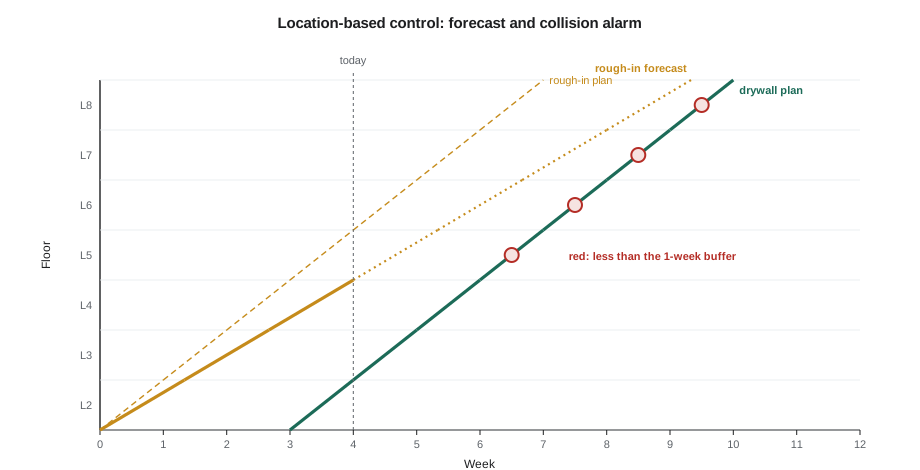
# Location-based forecast: will drywall catch rough-in? (floors 2..8, illustrative)
# Rough-in actual: started floor 2 at week 0; has finished 3 floors by week 4 -> actual rate 0.75 floors/wk
# Drywall plan: start floor 2 at week 3, planned rate 1.0 floor/wk, needs 1 week buffer behind rough-in
rough_start, rough_done_floors, now = 0.0, 3, 4.0
rough_rate = rough_done_floors / (now - rough_start)
dry_start, dry_rate, buffer = 3.0, 1.0, 1.0
print(f"Rough-in actual rate: {rough_rate:.2f} floors per week")
for i, floor in enumerate(range(2, 9)):
    rough_finish = rough_start + (i + 1) / rough_rate          # forecast finish of this floor
    dry_start_floor = dry_start + i / dry_rate                 # planned drywall start on this floor
    gap = dry_start_floor - rough_finish
    flag = "  <-- conflict" if gap < buffer else ""
print(f"floor {floor}: rough-in done wk {rough_finish:5.2f} drywall planned start wk {dry_start_floor:5.2f} gap {gap:5.2f}{flag}")Rough-in actual rate: 0.75 floors per week floor 2: rough-in done wk 1.33 drywall planned start wk 3.00 gap 1.67 floor 3: rough-in done wk 2.67 drywall planned start wk 4.00 gap 1.33 floor 4: rough-in done wk 4.00 drywall planned start wk 5.00 gap 1.00 floor 5: rough-in done wk 5.33 drywall planned start wk 6.00 gap 0.67 <-- conflict floor 6: rough-in done wk 6.67 drywall planned start wk 7.00 gap 0.33 <-- conflict floor 7: rough-in done wk 8.00 drywall planned start wk 8.00 gap 0.00 <-- conflict floor 8: rough-in done wk 9.33 drywall planned start wk 9.00 gap -0.33 <-- conflict
The forecast shows that, at rough-in's actual rate, drywall will have exactly its one-week buffer on floor 4 and will run short of it from floor 5 onward, until by floor 8 it would be trying to start before rough-in has finished. The team has several weeks' warning and can choose a response: add a rough-in crew, slow the drywall start so its crew works continuously behind rough-in, or resequence. Location-based control turns a vague sense that rough-in is behind into a specific forecast of where and when the problem will hit.
Buffers
A buffer is slack deliberately placed in a production system to absorb variability. Lesson 3 showed that variability among dependent trades reduces throughput unless something absorbs it. That something can be extra time, extra capacity, extra inventory of ready work or extra space. Each kind protects the flow in a different way and has a different cost.
| Buffer type | Construction example | Protects against | Cost |
|---|---|---|---|
| Time (schedule) buffer | Pooled buffer before a milestone; buffer takt between wagons | Late upstream completion | Longer overall duration |
| Capacity buffer | Crews sized below 100 % of takt; spare hoist time | Variation in task duration | Idle or flexible labor and equipment |
| Inventory (work) buffer | Workable backlog of ready zones; materials on site | Blocked tasks, late deliveries | Money tied up, damage, space |
| Space buffer | Empty zone between two trades | Interference and crowding | Fewer zones in production at once |
| Plan buffer | Workable backlog in the Last Planner System | Last-minute constraints | Effort spent making work ready early |
The principle is to reduce variability first and then place buffers where the remaining variability is highest and does the most damage, sized to the level of protection needed. Traditional projects have plenty of buffers, but they are hidden: padding in each trade's duration, stockpiles of material, floors left idle. Lean planning makes buffers visible, pools them and manages their consumption.
Sizing a time buffer
How much time buffer is needed between two trades depends on how variable the upstream trade's completion is and on how much protection the downstream trade needs. A simulation can show the trade-off: for each buffer size, how often does the downstream trade find its zone not ready?
# How often is the next zone not ready for drywall? Effect of a time buffer (seeded simulation)
import random
rng = random.Random(410)
def late_prob(buffer_days, n=20000):
    late = 0
    for _ in range(n):
        # upstream wagon planned at 2.0 days per zone; actual: usually on time, sometimes late
        actual = 2.0 + max(-0.5, rng.gauss(0.2, 0.6)) + (rng.random() < 0.08) * rng.uniform(1, 3)
        if actual > 2.0 + buffer_days:
            late += 1
    return late / n
for b in (0, 0.5, 1.0, 2.0, 3.0):
print(f"buffer {b:>3} days: downstream zone not ready {late_prob(b):6.1%} of the time")buffer 0 days: downstream zone not ready 65.4% of the time buffer 0.5 days: downstream zone not ready 37.0% of the time buffer 1.0 days: downstream zone not ready 15.3% of the time buffer 2.0 days: downstream zone not ready 4.8% of the time buffer 3.0 days: downstream zone not ready 1.3% of the time
With no buffer, the board crew would find its zone not ready about two times in three, because the upstream wagon usually runs a little late. A half-day buffer cuts that to a little over one in three, a one-day buffer to about one in seven and a two-day buffer to about one in twenty, but the last few percent come from occasional large delays that a time buffer of practical size cannot cover. Those are better attacked at the source, through make-ready planning and constraint removal, than by ever-larger buffers. Each day of buffer between every pair of wagons would add many days to the overall schedule, so buffers belong where they are most needed, typically before trades with long set-up, after inspections and where hand-offs have historically been unreliable.
Worked problem
The schedule cost of buffers in a takt plan
The Willowmere takt plan has 28 zones, 9 wagons and a 2-day takt, for 72 working days. Northgate is considering adding one buffer takt (an empty two-day step) after the inspection wagon. What is the new duration, and what would it be if a buffer takt were added after every wagon?
Show solution
- One buffer: wagons become 10; duration = (28 + 10 − 1) × 2 = 74 days.
- Buffer after every wagon except the last: 9 + 8 = 17 steps; duration = (28 + 17 − 1) × 2 = 88 days.
Answer: One targeted buffer costs 2 days; buffering every hand-off costs 16 days. Targeted buffers protect the weakest hand-offs at modest cost.
Decoupling and hand-offs
A buffer decouples two steps: it lets the upstream trade's variability be absorbed before it reaches the downstream trade. Good places to decouple are where the upstream work is highly variable (for example after an inspection by a third party), where the downstream work has a long set-up (for example a tile setter who must prepare substrates and materials) and between groups of trades from different companies with different rhythms. Between closely coordinated trades in a stable takt, buffers can be small or absent. Formal hand-offs, in which the upstream trade releases a zone with a short checklist and the downstream trade accepts it, reduce the variability that buffers must absorb by catching incomplete work before the next trade starts.
| Hand-off checklist item (rough-in to insulation) | Checked by |
|---|---|
| All in-wall services installed and secured | Mechanical, plumbing and electrical forepersons |
| Pressure and continuity tests passed and recorded | Trade forepersons |
| Municipal in-wall inspection passed | Northgate superintendent |
| Firestopping at penetrations complete | Firestop foreperson |
| Zone clean, debris removed | Releasing trades |
| Accepted by insulation foreperson | Insulation foreperson |
Location-based planning and the critical path
Location-based planning does not abandon network logic. Dependencies still exist: rough-in before board, board before tape. What changes is that dependencies are expressed between locations as well as between activities, and that continuity of crews is treated as a goal in itself. Some scheduling software supports both views, so that the critical path is calculated with location-based logic and crews are scheduled to work continuously where possible. The contract schedule required by the owner can still be produced in CPM form, while the field is managed by location.
Common mistakes
MistakeLetting trade contracts define the work structure by default.
InsteadDesign the production system explicitly with the trades: work pieces, batches, hand-offs and buffers.
MistakeHiding buffers in every trade's durations.
InsteadMake buffers visible, pool them and place them where variability is highest.
MistakeAdding a time buffer after every hand-off.
InsteadTarget buffers at unreliable hand-offs; each buffer step lengthens the schedule.
MistakeRelying on buffers instead of reducing variability.
InsteadAttack the sources of variability first, then size buffers for what remains.
MistakeTracking progress only in percent complete by activity.
InsteadTrack progress by location so that collisions can be forecast.
Summary and key terms
- Work structuring is the explicit design of how work is divided, sequenced, batched and handed off.
- A location breakdown structure divides the building into places so that work and quantities can be planned by location.
- Location-based management uses flowlines aiming for continuous, parallel, non-crossing trade flow.
- Tracking actual production rates by location allows collisions to be forecast weeks ahead.
- Buffers of time, capacity, inventory, space and planning absorb variability, each with its own cost.
- Buffers should be visible, pooled and placed where variability is highest, after variability has been reduced.
- Formal hand-offs with checklists reduce the variability that buffers must absorb.
- Work structuring
- Designing the production system: how work is divided, sequenced, batched and handed off.
- Location breakdown structure
- A hierarchy of locations used to plan and track work by place.
- Location-based management system
- A planning and control method based on flowlines through locations.
- Flowline
- A line showing a trade's progress through locations over time.
- Continuous flow
- A crew moving from location to location without interruption.
- Buffer
- Deliberate slack placed in a production system to absorb variability.
- Decoupling point
- A place in the flow where a buffer separates upstream variability from downstream work.
- Capacity buffer
- Spare capacity in crews or equipment.
- Space buffer
- Unoccupied locations between trades.
- Hand-off checklist
- A short list used to release and accept a zone between trades.
Practice problems
Work each problem on paper first, then reveal the answer to check.
Name four kinds of buffer.
Show answer
Any four of time, capacity, inventory, space, plan buffers.
What is the cost of an inventory buffer of ready material on floors?
Show answer
Money tied up, damage risk and space.
A takt plan has 20 zones, 7 wagons and a 3-day takt. What does one buffer takt add?
Show answer
3 days: (20 + 8 − 1) × 3 = 81 versus 78.
Where are good places to decouple trades?
Show answer
After highly variable work such as inspections, before long set-ups and between groups with different rhythms.
A trade has finished 2 floors in 4 weeks. What is its actual rate?
Show answer
0.5 floors per week.
What three goals does location-based planning aim for?
Show answer
Continuous flow, parallel flowlines, no crossing lines.
Why are hidden buffers a problem?
Show answer
They are consumed by Parkinson's law and late starts, and nobody can manage them.
Give one item on a rough-in to insulation hand-off checklist.
Show answer
For example, in-wall inspection passed, or tests recorded.
Why does a one-day buffer not remove all lateness in the simulation?
Show answer
Occasional large delays exceed any practical buffer; they need to be attacked at the source.
How does location-based management relate to CPM?
Show answer
Dependencies remain but are expressed by location, with crew continuity as a goal; a CPM contract schedule can still be produced.
Lesson quiz · 5 questions
Score 60% or more to complete this lesson.
Create a free account to save your progress, take quizzes and earn a certificate.