
CON-420 · Lesson 2 of 12 · 29 min
Change management under standard contracts
A change management system turns the owner's right to change the work into a predictable process with clear steps, owners and records. CON-220 explained the legal basis of changes: the owner's right to order changes within the general scope, the requirement for written authority, and the rules for pricing and differing site conditions. CON-310 showed how changes enter the cost report and forecast. This lesson works through the procedure under the standard forms in more detail, from the first request to the signed change order, with the pricing calculations and records that make each step defensible.
The standard form framework
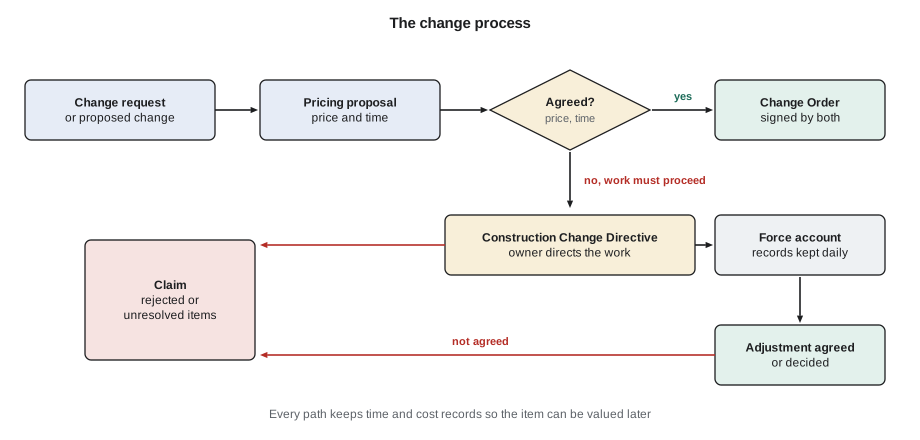
AIA A201-2017 deals with changes in Article 7. A Change Order (§7.2) is signed by the owner, contractor and architect and states the change in the work, the adjustment to the contract sum and the adjustment to the contract time. A Construction Change Directive (§7.3) is signed by the owner and architect and directs the work before price or time is agreed; the contractor must proceed, and the adjustment is determined later by one of the methods in the directive. The architect may also order minor changes that involve no change in price or time (§7.4). Concealed or unknown conditions are dealt with in §3.7.4, delays and extensions in §8.3 and claims in Article 15. Most owners add supplementary conditions that change the markups, notice periods or documentation, so the printed form is only the starting point.
Where changes start
Changes begin in several ways, and the change log should capture all of them, because the source affects both entitlement and pricing.
| Starting point | Who starts it | Typical document |
|---|---|---|
| Owner request for a quotation | Owner or consultant | Proposed change notice or request for proposal |
| Answer to a request for information that changes the work | Consultant | RFI response, supplemental instruction or sketch |
| Field instruction from the consultant | Consultant | Site instruction or field order |
| Contractor-identified change | Contractor | Change request or notice of change |
| Concealed condition | Contractor | Written notice of concealed condition |
| Value engineering proposal | Contractor | Value engineering or cost reduction proposal |
A recurring problem is the instruction that changes the work without saying so. An RFI response that tells the contractor to 'provide additional bracing as shown on the attached sketch', or a site instruction that 'clarifies' a detail by adding work, may be a change even though the document says it is not. The contractor's protection is to respond promptly in writing, identifying the instruction as a change and reserving its right to an adjustment, before doing the work. Doing the work silently and claiming later invites the argument that the contractor accepted the instruction as part of the original scope.
Pricing a change
A change proposal needs three things: a clear description of the change, a price built up from its components, and a statement of the time effect. Prices for additive changes are usually built up from direct costs, with markups as allowed by the contract.
| Component | What it includes | Notes |
|---|---|---|
| Labor | Crew hours at wage rates plus payroll burden | Use the contract's defined rates if any; burden includes statutory deductions, benefits and insurance |
| Materials | Quantities at supplier prices, including delivery and taxes as applicable | Attach quotes; watch for minimum order and restocking charges |
| Equipment | Owned equipment at agreed rates; rented equipment at invoice | Avoid double counting with small tools in overhead |
| Subcontractor work | The subcontractor's own priced change | Review the subcontractor's build-up as carefully as your own |
| Site overhead | Extra supervision or general conditions caused by the change | Only if time-related or genuinely added |
| Markups | Overhead and profit percentages allowed by the contract | Often different for own work and subcontracted work |
| Bonds and insurance | Premium adjustment on the added value | Usually a small percentage if allowed |
The contract usually defines the markups, often in the supplementary conditions. A common pattern is a higher percentage on the contractor's own work and a lower one on subcontracted work, to reflect the different management effort, with a cascade so that the subcontractor's own markup is included in its price and the general contractor adds its smaller percentage on top. Deductive changes are usually credited at direct cost, and contracts differ on whether the contractor must also credit markup on deleted work.
# Pricing the Ashford scoreboard change (illustrative rates and markups)
crew_hours = 96          # own forces: blocking, embedded conduit, patching
wage_rate = 62.50        # dollars per hour
burden = 0.38            # payroll burden as a share of wages
materials = 7_850.00
equipment = 1_200.00
sub_price = 118_400.00   # electrical and AV subcontractor, including its own markup
own_markup = 0.15        # overhead and profit on own work (contract value, illustrative)
sub_markup = 0.07        # overhead and profit on subcontracted work
bond_ins = 0.012         # bond and insurance premium on the total

wages = crew_hours * wage_rate * (1 + burden)
own_direct = wages + materials + equipment
own_total = own_direct * (1 + own_markup)
sub_total = sub_price * (1 + sub_markup)
subtotal = own_total + sub_total
price = subtotal * (1 + bond_ins)
print(f"Own forces: wages {wages:,.2f} + materials {materials:,.2f} + equipment {equipment:,.2f} = {own_direct:,.2f}")
print(f"  with {own_markup:.0%} markup: {own_total:,.2f}")
print(f"Subcontract: {sub_price:,.2f} with {sub_markup:.0%} markup: {sub_total:,.2f}")
print(f"Subtotal {subtotal:,.2f}; bond and insurance {bond_ins:.1%}: {price - subtotal:,.2f}")
print(f"Change price: {price:,.2f}")Own forces: wages 8,280.00 + materials 7,850.00 + equipment 1,200.00 = 17,330.00 with 15% markup: 19,929.50 Subcontract: 118,400.00 with 7% markup: 126,688.00 Subtotal 146,617.50; bond and insurance 1.2%: 1,759.41 Change price: 148,376.91
The pricing above is straightforward because the scoreboard is a discrete addition. The harder questions are about what the price leaves out. Does it include the time effect, if the scoreboard installation extends the finishing phase? Does it include the effect on other work, such as the tile crews who must work around new embedded conduit? Standard forms expect the contractor to include all effects of the change in the change order price, and many supplementary conditions say that a signed change order is full and final compensation for the change, including its impact on other work. A contractor who signs a change order for the direct cost alone may have given up its right to claim the indirect effects later.
Reservation of rights
When the full effect of a change cannot yet be priced, the contractor has three options. It can price the direct cost now and expressly reserve its right to claim time and impact costs later, if the contract permits a reservation. It can delay signing the change order until the full effect is known, while proceeding under a directive. Or it can include an estimate of the impact in the price now and accept the risk that the estimate is wrong. Many owners resist reservations, and some contracts state that change orders cannot contain them. The safest approach is to agree the wording with the owner expressly, for example 'This change order covers the direct cost of the work described. The contractor reserves its claim for any extension of time and associated costs, to be submitted within 30 days.' A reservation buried in a cover letter, or added by hand to a signed form without agreement, is weak protection.
| Approach | Advantage | Risk |
|---|---|---|
| Price everything now, including impact | Closes the issue; quick approval | Impact may be underestimated |
| Price direct cost now, reserve impact | Cash flow on direct cost; impact preserved | Owner may refuse or the reservation may be unenforceable |
| Proceed under directive, price later | Full effect known before pricing | Slower payment; force account paperwork |
| Sign a full and final change order for direct cost only | Fast payment | Impact claim may be waived |
Change directives and force account
When an owner directs work before the price is agreed, the adjustment must eventually be valued. Standard forms allow several methods: a lump sum agreed later, unit prices, or the cost of the work plus a fee. Where cost plus fee applies, the contractor must keep detailed records of the labor, materials and equipment used on the directed work, usually on daily force account or time-and-materials sheets signed by the owner's representative. These sheets are often the only reliable evidence of the cost of directed work, and disputes about them are common: the owner's inspector may refuse to sign, or sign 'for hours only', or the contractor may forget to separate directed work from base-contract work done by the same crew on the same day.
Good practice is simple but demanding. Open a separate cost code for each directive. Record the crew, hours, equipment and materials daily, on a form that identifies the directive and the location. Ask the owner's representative to sign the sheet the same day, and if they will not, send the unsigned sheet to them in writing the same day so that there is a contemporaneous record. Summarize the sheets weekly and send the running total, so that the owner sees the cost growing and cannot later say it was surprised.
# Weekly force account summary for the contaminated fill directive (illustrative)
import datetime as dt
rates = {"helper": 58.0, "operator": 71.0, "foreman": 79.0}   # dollars per hour incl. burden
equip_rates = {"excavator 30t": 185.0, "tandem truck": 125.0}  # dollars per hour
sheets = [  # date, {trade: hours}, {equipment: hours}, materials $, signed by owner?
    (dt.date(2026, 4, 6), {"operator": 9, "helper": 18, "foreman": 4}, {"excavator 30t": 9, "tandem truck": 16}, 0.0, True),
    (dt.date(2026, 4, 7), {"operator": 9, "helper": 18, "foreman": 4}, {"excavator 30t": 9, "tandem truck": 18}, 640.0, True),
    (dt.date(2026, 4, 8), {"operator": 8, "helper": 16, "foreman": 4}, {"excavator 30t": 8, "tandem truck": 14}, 0.0, False),
    (dt.date(2026, 4, 9), {"operator": 9, "helper": 18, "foreman": 4}, {"excavator 30t": 9, "tandem truck": 18}, 1_180.0, True),
]
fee = 0.15  # fee on cost under the directive (contract value, illustrative)
week_cost = 0.0
for d, lab, eq, mat, signed in sheets:
    cost = sum(rates[t] * h for t, h in lab.items()) + sum(equip_rates[e] * h for e, h in eq.items()) + mat
    week_cost += cost
    flag = "signed" if signed else "NOT SIGNED - sent to owner same day"
    print(f"{d}  cost {cost:9,.2f}  {flag}")
print(f"Week cost {week_cost:,.2f}; with {fee:.0%} fee {week_cost * (1 + fee):,.2f}")2026-04-06 cost 5,664.00 signed 2026-04-07 cost 6,554.00 signed 2026-04-08 cost 5,042.00 NOT SIGNED - sent to owner same day 2026-04-09 cost 7,094.00 signed Week cost 24,354.00; with 15% fee 28,007.10
Disposal of the contaminated soil itself, charged by a licensed receiving facility by weight, would be added from invoices, with manifests as proof of quantity. The unsigned sheet for 8 April is a typical problem: it was sent to the owner the same day, which preserves the record, but it will need to be reconciled before the directive is valued.
Reviewing change pricing as the owner
Owners and their consultants review change proposals against the contract and their own estimates. Common review points include quantities taken off the drawings, labor productivity compared with standard references and the contractor's own base bid, rates that match the contract's schedule, markups applied only once, no double counting of supervision or small tools already in overhead, and credits for work deleted. A good review is prompt and specific: it accepts what is reasonable, questions what is not and explains why. Long delays in reviewing changes are themselves a common cause of disputes, because they leave the contractor financing work it cannot bill and blur the record of what was agreed.
| Review question | Why it matters |
|---|---|
| Is the work actually a change? | Avoids paying for work already in the base contract |
| Are quantities consistent with the drawings? | Inflated quantities are the most common pricing error |
| Are labor hours reasonable? | Compare with productivity references and the bid |
| Are markups applied as the contract says? | Avoids markup on markup and wrong percentages |
| Is overhead claimed only if time-related or added? | Avoids double recovery of site overhead |
| Does the price state its time effect? | An open time effect becomes tomorrow's delay claim |
| Is the change order full and final? | Closes the issue or records an agreed reservation |
The change log
Both parties should keep a change log that tracks every potential change from first notice to final agreement. CON-310 showed how pending changes affect the cost forecast. For claims purposes, the log also proves when each issue was raised, how long the owner took to respond and which items remain open. A typical log records the change number, description, source and date raised, the contractor's proposed price and time, the owner's response, the status (pending, priced, approved, rejected, in dispute) and the signed amount.
# Ashford change log: exposure from open items (illustrative)
log = [  # number, description, proposed $, proposed days, status, approved $
    ("PCN-014", "Contaminated fill remediation (directive)", 612_000, 15, "directive", 0),
    ("PCN-021", "Roof truss redesign: extra steel and connections", 286_500, 30, "pending", 0),
    ("PCN-022", "Roof truss redesign: delay costs", 455_000, 0, "claim", 0),
    ("PCN-030", "Timing and scoreboard system", 0, 3, "approved", 0),
    ("PCN-031", "Competition pool tile layout change", 64_800, 5, "pending", 0),
    ("PCN-033", "Deleted sauna", -38_000, 0, "approved", -38_000),
]
log[3] = ("PCN-030", "Timing and scoreboard system", 148_377, 3, "approved", 148_377)
approved = sum(a for *_, a in log)
open_items = [r for r in log if r[4] in ("pending", "directive", "claim")]
exposure = sum(r[2] for r in open_items)
print(f"Approved change orders: {approved:,.0f}")
print(f"Open items: {len(open_items)}, proposed value {exposure:,.0f}, proposed days {sum(r[3] for r in open_items)}")
for n, d, p, days, s, a in open_items:
print(f" {n} {s:<9} {p:>10,.0f} {days:>3} days {d}")Approved change orders: 110,377 Open items: 4, proposed value 1,418,300, proposed days 50 PCN-014 directive 612,000 15 days Contaminated fill remediation (directive) PCN-021 pending 286,500 30 days Roof truss redesign: extra steel and connections PCN-022 claim 455,000 0 days Roof truss redesign: delay costs PCN-031 pending 64,800 5 days Competition pool tile layout change
The log makes the exposure visible: about $1.4 million of proposed value and 50 proposed days are still open, most of it in the contaminated fill directive and the truss redesign. Both parties should be reviewing this list at every site meeting. An owner who sees a large and growing open balance should prioritize decisions; a contractor should push for resolution while the facts are fresh.
Worked problem
Is the RFI response a change?
Halloway Partners answers an RFI about pool deck drainage by issuing a sketch that adds a second trench drain along the competition pool. The sketch says "for clarification only; no change in contract sum". The trench drain is not on the original drawings. What should Kestrel Ridge do?
Show solution
- Compare the sketch with the contract documents: the trench drain is new work.
- Respond in writing within the contract time, stating that the sketch adds work, that Kestrel Ridge considers it a change and that it reserves its right to an adjustment.
- Ask for a change directive if the work must proceed before pricing; otherwise submit a priced proposal.
- Record the work separately so that its cost can be proved.
Answer: Kestrel Ridge should treat the sketch as a change despite its wording, give written notice promptly and keep separate records. The label on the sketch does not decide whether it is a change; the contract documents do.
Common mistakes
MistakeDoing extra work shown in an RFI response without objecting in writing.
InsteadIdentify the instruction as a change in writing before doing the work.
MistakeSigning a 'full and final' change order for direct cost only.
InsteadInclude the time and impact effect or agree an express reservation.
MistakeMixing directive work and base-contract work on one time sheet.
InsteadUse a separate cost code and daily force account sheet for each directive.
MistakeApplying markup on top of the subcontractor's markup at the full own-work rate.
InsteadApply the contract's subcontract markup once on the subcontract price.
MistakeLetting change proposals sit unreviewed for months.
InsteadReview promptly and specifically; delays breed disputes.
Summary and key terms
- Standard forms give the owner a right to change the work and set out change orders, directives, concealed conditions, delay and claims procedures.
- Changes start from owner requests, RFI responses, field instructions, contractor notices, concealed conditions and value engineering.
- An instruction that adds work is a change whatever its label; respond in writing before doing the work.
- Change prices are built from labor, materials, equipment, subcontract and overhead costs plus contract markups.
- A full and final change order may waive impact claims; include the impact or agree an express reservation.
- Directed work needs daily force account records, signed or sent the same day.
- The change log tracks every item and shows the open exposure that both parties should be managing.
- Change directive
- An instruction to proceed with a change before price or time is agreed.
- Force account
- Valuing work on the actual cost of labor, materials and equipment, recorded daily, plus an agreed fee.
- Markup
- The percentage added to direct cost for overhead and profit, as allowed by the contract.
- Payroll burden
- Costs added to wages, such as statutory contributions, benefits and insurance.
- Reservation of rights
- An express statement preserving a claim for effects not included in an agreed price.
- Full and final
- Wording that makes a change order complete compensation for the change and its effects.
- Supplemental instruction
- A consultant instruction that interprets or adds detail to the documents.
- Value engineering
- A proposal to achieve the required function at lower cost.
- Change log
- A register tracking every potential change from first notice to agreement or dispute.
- Credit
- A reduction in contract price for deleted work.
Practice problems
Work each problem on paper first, then reveal the answer to check.
A crew of three works 8 hours on a change at $60 per hour with 40 % burden. What is the wage cost?
Show answer
3 × 8 × 60 × 1.40 = $2,016.
A subcontractor prices a change at $50,000 including its markup, and the contract allows 7 % on subcontracted work. What does the general contractor price?
Show answer
$53,500.
Why should a contractor respond in writing to an RFI answer that adds work?
Show answer
To identify it as a change and reserve rights before doing the work.
Give two valuation methods for a change directive.
Show answer
Lump sum agreed later, unit prices, or cost plus fee.
What should happen if the owner's inspector will not sign a force account sheet?
Show answer
Send it to the owner in writing the same day.
What risk does a 'full and final' change order create?
Show answer
It may waive claims for delay and impact on other work.
Name three review questions an owner should ask about a change price.
Show answer
Is it a change, are quantities right, are markups applied correctly (also labor hours, overhead, time effect).
What does the change log show at a site meeting?
Show answer
Open items, their proposed value and time, and how long they have been pending.
Why is a reservation in a cover letter weak protection?
Show answer
The signed change order may say it is full and final; the reservation should be agreed in the document.
How are deductive changes usually valued?
Show answer
As a credit at direct cost, with markup treatment depending on the contract.
Lesson quiz · 5 questions
Score 60% or more to complete this lesson.
Create a free account to save your progress, take quizzes and earn a certificate.