
CON-420 · Lesson 8 of 12 · 25 min
Total cost methods and presenting a claim
The previous three lessons built the pieces of a claim: entitlement to time, the delay quantum and the disruption quantum. This lesson deals with two related questions. First, what can a contractor do when it cannot separate its losses event by event, and is tempted to claim the difference between what the job cost and what it bid? Second, once the analysis is done, how should the claim be written and presented so that a reviewer can follow it, test it and agree with it?
The answers are connected. Most claims fail not because the contractor suffered no loss, but because the claim document does not show, in an order a reviewer can follow, which events happened, why the owner is responsible, how each event affected time and cost, and what records support each figure. A total cost claim is often the symptom of a project where those records were never kept.
Total cost and global claims
A total cost claim calculates damages as the contractor's actual cost of the work minus its bid, plus markup. It assumes that the whole overrun was caused by the owner. A global claim, the Commonwealth term, is similar: it lists many events and claims a single sum for their combined effect without linking each event to its own cost. Both are attractive to contractors because they need little analysis, and both are viewed with deep suspicion by owners, courts and arbitrators, because they assume what should be proved.
The weaknesses are obvious once stated. The bid may have been too low. The contractor may have managed the work badly. Some of the overrun may have been caused by events that are the contractor's risk, such as its own subcontractor's default or weather that was not abnormal. A total cost claim lumps all of these together and charges them to the owner.
US courts and boards apply a four-part test for total cost claims, usually traced to WRB Corp. v. United States (Ct. Cl. 1968): the contractor must show that it is impractical to prove its actual losses directly, that its bid was realistic, that its actual costs were reasonable, and that it was not responsible for the added costs. The method is described as disfavored and is allowed only where all four elements are proved.
| Element | Question the reviewer asks | Evidence that helps |
|---|---|---|
| Impracticability | Why could the contractor not track costs by event? | Many overlapping changes, owner's refusal to issue change orders, records showing the attempt |
| Reasonable bid | Was the bid itself realistic? | Comparison with other bids and the owner's estimate, bid review notes, independent estimate |
| Reasonable actual costs | Were the actual costs incurred efficiently? | Audited job costs, productivity comparisons, absence of rework for contractor errors |
| No contractor responsibility | Did the contractor cause any of the overrun? | Event analysis, schedule analysis, honest concessions |
Modified total cost
The modified total cost method starts from the same calculation but adjusts it for the known weaknesses: it corrects the bid for errors, removes costs caused by the contractor's own problems, and removes costs already paid through change orders. What remains is a more defensible estimate of the owner-caused overrun. Courts and arbitrators accept it more readily than total cost, but it still requires that direct proof was impractical.
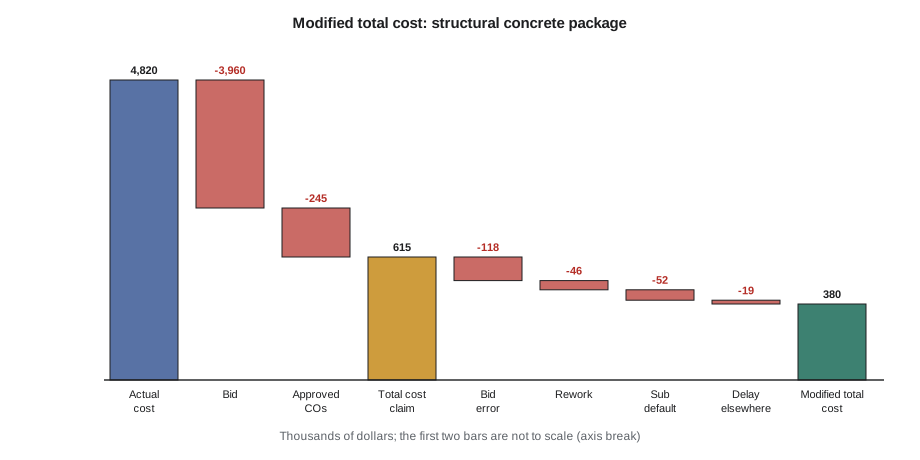
# Total cost and modified total cost for Kestrel Ridge's structural concrete package (illustrative)
actual_cost = 4_820_000          # audited job cost for the package
bid = 3_960_000                  # concrete package in the tender
approved_cos = 245_000           # change orders already paid for this package

total_cost = actual_cost - bid - approved_cos
print(f"Total cost claim before markup:    ${total_cost:,.0f}")

adjustments = {
    "Bid error: formwork reuse assumed 6 uses, realistic 4": 118_000,
    "Rework of honeycombed walls (contractor)":             46_000,
    "Formwork subcontractor default (contractor risk)":      52_000,
    "Delay costs claimed separately (lesson 6)":             19_000,
}
mtc = total_cost - sum(adjustments.values())
for k, v in adjustments.items():
    print(f"  less {k:<52} ${v:>8,}")
print(f"Modified total cost claim before markup: ${mtc:,.0f}")
print(f"With 10% markup: ${mtc * 1.10:,.0f}")Total cost claim before markup: $615,000 less Bid error: formwork reuse assumed 6 uses, realistic 4 $ 118,000 less Rework of honeycombed walls (contractor) $ 46,000 less Formwork subcontractor default (contractor risk) $ 52,000 less Delay costs claimed separately (lesson 6) $ 19,000 Modified total cost claim before markup: $380,000 With 10% markup: $418,000
The adjustments cut the claim from $615,000 to $380,000. That is still a large claim, and it now survives the first questions a reviewer will ask: was the bid realistic, did Kestrel Ridge cause any of the overrun, and has any of it been paid already? The adjustment for delay costs claimed separately is a reminder that a modified total cost claim must not overlap with the other heads of claim. If extended field overhead for the concrete period is in the delay claim, it must come out of the concrete overrun.
Even so, a modified total cost claim is weaker than a claim that ties each event to its cost. If Kestrel Ridge could have used a measured mile for the concrete crews, as lesson 7 did for tiling, it should have. The modified total cost method is best used for a residual part of a claim, where other parts are proved directly and the remainder genuinely cannot be separated.
Pricing the claim
Whatever method is used, the quantum must be priced consistently. A few rules apply on most projects.
| Item | Typical rule | Check |
|---|---|---|
| Labor | Actual payroll cost plus burden, at the rates in force when the work was done | Payroll records and union rate sheets |
| Equipment | Rental invoices, or ownership and operating rates from the source the contract specifies | Equipment logs; standby at reduced rates |
| Materials | Invoiced cost, net of discounts and rebates | Invoices and delivery tickets |
| Subcontractor costs | The subcontractor's own substantiated claim, reviewed by the contractor | The subcontractor's records; avoid passing through unreviewed claims |
| Markup | As the contract specifies for changes; delay costs may carry no markup or a reduced one | The contract and supplementary conditions |
| Interest | As the contract or statute allows, from the date the money was due | Contract payment terms and applicable law |
| Claim preparation costs | Often not recoverable as damages; may be recoverable as legal costs in litigation or arbitration, or under specific contract terms | The contract and the governing rules |
Interest can be significant on a claim that takes years to resolve. Some contracts specify a rate for late payments. Statutes may provide interest on unpaid amounts and on court awards. The contractor's own financing costs are a separate head that some contracts allow and others exclude.
# Simple interest on the Ashford claim components from the date each was due (illustrative rate)
from datetime import date
rate = 0.055                       # illustrative annual rate; check the contract and statute
settled = date(2027, 6, 30)
items = [
    ("Fill change balance",         62_400, date(2025, 6, 30)),
    ("Delay quantum (lesson 6)",   329_300, date(2025, 11, 30)),
    ("Tiling disruption",           51_000, date(2026, 2, 28)),
    ("Concrete modified total cost", 418_000, date(2026, 4, 30)),
]
total_interest = 0
for name, amt, due in items:
    days = (settled - due).days
    i = amt * rate * days / 365
    total_interest += i
    print(f"{name:<29} ${amt:>9,}  {days:>4} days  interest ${i:>9,.0f}")
principal = sum(a for _, a, _ in items)
print(f"Principal ${principal:,}; interest ${total_interest:,.0f}; total ${principal + total_interest:,.0f}")Fill change balance $ 62,400 730 days interest $ 6,864 Delay quantum (lesson 6) $ 329,300 577 days interest $ 28,631 Tiling disruption $ 51,000 487 days interest $ 3,743 Concrete modified total cost $ 418,000 426 days interest $ 26,832 Principal $860,700; interest $66,070; total $926,770
On these assumptions the interest adds about $66,000 to a principal of about $861,000 if the claim settles in mid-2027. Interest is often traded away in settlement, but a claimant that does not calculate it cannot bargain with it. The rate here is illustrative; Canadian claims look to the contract, provincial interest statutes and, for prompt payment regimes, the interest provisions of the relevant act, while US federal claims under the Contract Disputes Act earn interest at a rate set by the Treasury from the date the contracting officer receives the claim.
Writing the claim document
A claim document is an argument written for a skeptical reader who has not lived through the project. The owner's project manager, the consultant, an in-house lawyer, an adjudicator or an arbitrator will read it, often months later, with the contract open beside it. The document should let that reader follow the story, check every assertion against a record and reach the claimed sum without doing their own analysis.
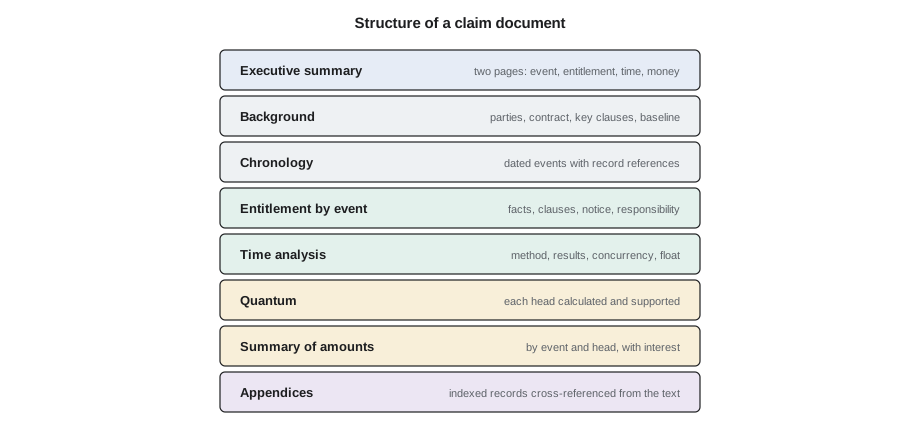
| Section | Content | Common failing |
|---|---|---|
| Executive summary | Two pages: what happened, what the contract says, what is claimed in time and money | Missing, or written as advocacy rather than a summary |
| Background | Parties, contract form and key clauses, scope, baseline schedule, contract sum | Pages of project description no one needs |
| Chronology | Dated events with references to records | Narrative without dates or references |
| Entitlement | For each event: facts, contract clauses, notice given, why the owner is responsible | Clauses quoted without applying them to the facts |
| Time | Schedule analysis method, results, concurrency, float | A bar chart with no method stated |
| Quantum | Each head of claim, calculated and supported | Totals with no build-up |
| Summary | Table of amounts by event and head, with totals and interest | Different totals in different sections |
| Appendices | Records cross-referenced from the text: letters, notices, daily reports, cost reports, schedules, photos | Thousands of pages with no index |
Each event should be presented separately where possible, so that the owner can accept some and reject others. A claim that bundles everything into a single sum forces the owner to reject the whole thing, and makes settlement harder. The tone should be factual and measured. Adjectives such as 'egregious' and accusations of bad faith rarely help, and a reviewer who finds an overstated claim in one place will discount the rest.
In the US, an A201-2017 claim goes first to the Initial Decision Maker under §15.2 after notice, then to mediation and, if the parties agreed, arbitration; on federal contracts the claim goes to the contracting officer under the Contract Disputes Act and must be certified if it exceeds $100,000 (lesson 11). The certification states that the claim is made in good faith and the supporting data are accurate and complete, so overstated claims carry real risk.
Worked problem
Spotting the weaknesses in a claim summary
A subcontractor's claim summary reads: "Due to the owner's numerous changes, delays and interference, our costs exceeded our bid of $1.9 million by $640,000. We claim $640,000 plus 15 % markup." List the questions the reviewer will ask and the improvements the subcontractor should make.
Show solution
- It is a total cost claim: the reviewer will ask why costs could not be tracked by event.
- No events are identified: list each change, delay and instance of interference with dates and records.
- The bid is assumed reasonable: show how it compares with other bids.
- No contractor causes are considered: show that the overrun was not caused by its own problems.
- Change orders already paid are not deducted: remove them.
- Markup is applied without reference to the contract: check what markup is allowed on claims.
Answer: The claim should be rebuilt event by event, using measured mile or other direct methods where records allow, with modified total cost only for any residue that genuinely cannot be separated.
Common mistakes
MistakeClaiming actual cost minus bid as the default.
InsteadProve losses event by event; use total cost only as a last resort and after adjusting it.
MistakeLeaving paid change orders and separately claimed delay costs in a total cost figure.
InsteadDeduct everything already paid or claimed elsewhere.
MistakeBundling all events into one sum.
InsteadPresent each event separately so the owner can accept some and settle.
MistakeWriting the claim as an angry narrative.
InsteadWrite factually, with dated events and record references; concede where appropriate.
MistakeIgnoring interest and its starting dates.
InsteadCalculate interest from the date each amount was due, at the rate the contract or statute allows.
Summary and key terms
- Total cost claims (actual minus bid) assume the owner caused the whole overrun and are treated as a last resort.
- A total cost claim usually needs impracticability of direct proof, a reasonable bid, reasonable costs and no contractor responsibility.
- Modified total cost adjusts for bid errors, contractor-caused costs and amounts paid or claimed elsewhere.
- Price claims at actual costs, with markup and interest as the contract and law allow.
- A claim document should contain a summary, background, chronology, entitlement by event, time analysis, quantum, a summary of amounts and indexed appendices.
- Separate events, factual tone and honest concessions make claims easier to accept and settle.
- Total cost method
- Calculating damages as actual cost minus the bid, assuming the owner caused all of the overrun.
- Global claim
- A claim for a single sum for the combined effect of many events, not linked event by event.
- Modified total cost method
- A total cost calculation adjusted for bid errors, contractor-caused costs and amounts already paid or claimed.
- Impracticability
- The inability to prove losses directly, required before total cost methods are accepted.
- Markup
- An addition for overhead and profit on cost, at the rate the contract allows.
- Prejudgment interest
- Interest on an amount from when it was due until judgment or award.
- Claim document
- The written presentation of a claim, setting out facts, entitlement, time and quantum.
- Chronology
- A dated list of events with references to the records that prove them.
Practice problems
Work each problem on paper first, then reveal the answer to check.
Actual cost is $2.4 million, the bid $2.0 million and approved changes $150,000. What is the total cost claim before markup?
Show answer
$250,000.
In the previous question, bid errors were $40,000 and contractor rework $30,000. What is the modified total cost?
Show answer
$180,000.
Name the four elements usually required for a total cost claim.
Show answer
Impracticability, reasonable bid, reasonable costs, no contractor responsibility.
Why should events be presented separately?
Show answer
The owner can accept some, and settlement is easier.
What is the risk of overlapping heads of claim?
Show answer
Double recovery, which damages credibility.
What does a chronology need besides dates?
Show answer
References to the records that prove each event.
$100,000 is due for 200 days at 5 % simple interest. What is the interest?
Show answer
About $2,740.
Why is the tone of a claim document important?
Show answer
Overstatement leads reviewers to discount the whole claim.
When is modified total cost best used?
Show answer
For a residual part of a claim that cannot be separated, with the rest proved directly.
What must a US federal claim over $100,000 include?
Show answer
A certification by the contractor.
Lesson quiz · 5 questions
Score 60% or more to complete this lesson.
Create a free account to save your progress, take quizzes and earn a certificate.