
CRE-120 · Lesson 1 of 12 · 26 min
How people read on social media
Almost everything a creator publishes depends on writing, even when the final product is a video or a photo. Titles and thumbnails text decide whether a video gets clicked; the first line of a caption decides whether anyone taps "more"; scripts decide whether viewers stay past the first ten seconds; newsletters decide whether readers stay subscribed. Writing for social media is a distinct craft from academic or business writing. It is shorter, more conversational, more visual and ruthlessly competitive for attention. This course teaches that craft: hooks, captions, scripts, threads, carousels, newsletters, storytelling, voice and editing, search and accessibility. This first lesson looks at how people actually read on social platforms and the principles that follow.
The attention environment
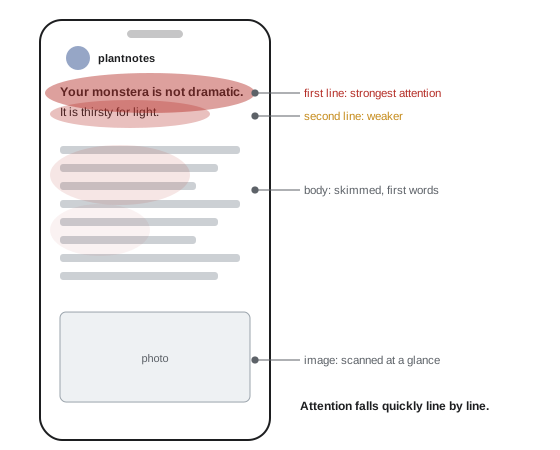
People encounter social content in feeds that move fast and offer endless alternatives. They scroll on phones, often in short gaps between other activities: commuting, waiting in line, taking a break, lying in bed. They decide in a fraction of a second whether to stop, and in a few more seconds whether to keep reading or watching. Research on web reading by the Nielsen Norman Group has shown for decades that people scan rather than read word by word, often in an F-shaped or layer-cake pattern: they read the first lines and headings, then skim down the left side, picking out words that match what they are looking for. On mobile, screens show only a few lines at a time, so the first words carry even more weight.
This does not mean people will not read long content. They will happily read a long newsletter, watch a forty-minute video or listen to a two-hour podcast when it is valuable to them and well made. What it means is that every piece of content must earn attention at the start and keep earning it, because leaving costs the reader nothing.
Three questions every reader asks
At each moment, a reader or viewer is implicitly asking three questions:
- Is this for me? Does it relate to my interests, problems or identity?
- Is it worth my time? Will I learn something, feel something, be entertained, or get something useful?
- Do I trust it? Does the source seem credible, honest and competent?
The opening of any piece must answer the first two quickly; the voice, specificity and accuracy of the whole piece answer the third. Writing that addresses these questions explicitly, by naming the audience and the benefit early and by being concrete and honest, performs better than writing that hopes readers will figure it out.
Platform contexts
Each platform shapes how writing is read:
- Short-form video platforms (TikTok, Instagram Reels, YouTube Shorts): writing appears as on-screen text, captions and the spoken script; viewers decide within one to three seconds.
- Long-form video (YouTube): titles and thumbnail text compete in search results and recommendations; descriptions support search; scripts structure the whole video.
- Image and carousel platforms (Instagram, Pinterest, LinkedIn documents): the image or first slide must stop the scroll; captions add context, story and calls to action; Pinterest descriptions behave like search snippets.
- Text-first platforms (LinkedIn, X, Threads, Bluesky, Reddit, Facebook): the first one or two lines appear before a "see more" cut, so they must create enough interest to earn the tap.
- Email newsletters and blogs: subject lines and preview text compete in crowded inboxes; the body can be longer, but readers still skim.
- Audio (podcasts): scripts and outlines are spoken, so writing must sound natural aloud.
Writers adapt the same idea to each context rather than copying text unchanged across platforms.
| Platform type | Where writing appears | Decision window | Typical length |
|---|---|---|---|
| Short-form video | On-screen text, spoken hook, caption | 1–3 seconds | 15–90 seconds of script |
| Long-form video | Title, thumbnail text, script, description | A few seconds in a feed or search | 1,000–5,000 words of script |
| Carousels and images | First slide, slide text, caption | 1–2 seconds | 5–10 slides, short caption |
| Text posts | First lines before the cut, body | 1–2 seconds | 50–300 words |
| Newsletters | Subject line, preview text, body | A glance in the inbox | 300–2,000 words |
| Podcasts | Title, description, spoken script or outline | Title and first minute | Outline or full script |
Principles of writing for social
Several principles hold across platforms:
- Lead with the payoff: put the most interesting, useful or surprising point first, not last. Journalists call this the inverted pyramid.
- Be specific: "Save $340 a month on groceries" beats "save money"; "the 3 settings I change on every new camera" beats "camera tips". Specific details signal knowledge and make promises concrete.
- Write the way people talk: short sentences, everyday words, contractions, and direct address ("you"). Read it aloud; if it sounds stiff, rewrite it.
- One idea per piece: a post that tries to say five things says none of them well.
- Use white space: short paragraphs, line breaks, lists and headings make text skimmable on small screens.
- Show, do not just tell: examples, numbers, stories and images persuade more than claims.
- Cut ruthlessly: remove words that do not add meaning, such as "really", "very", "in order to" and "I just wanted to say".
- End with a purpose: invite a specific action, question or next step.
Worked problem
Rewriting a weak opening
A fitness creator drafts this first line for a post: "Hey everyone! Today I wanted to talk a little bit about something that a lot of people ask me about, which is how to get started with running." Rewrite it for a text post.
Show solution
- Identify the payoff: beginners can start running without getting injured or quitting.
- Identify the audience: people who have never run or have quit before.
- Cut the warm-up phrases: "Hey everyone", "Today I wanted to talk a little bit about".
- Make it specific: give a concrete method or result.
- Rewrite: "Never run before? This 3-run-a-week plan got 400 of my clients to 5 km without a single injury."
Answer: Lead with the audience and a specific, credible payoff, and cut the throat-clearing.
Readability
Readable writing reaches more people, including those reading in a second language, readers with cognitive or learning disabilities, and anyone reading quickly on a small screen. Readability formulas, such as the Flesch Reading Ease score and the Flesch–Kincaid grade level, estimate difficulty from sentence length and word length (syllables per word). They are rough guides, not goals in themselves, but they reliably flag long sentences and unnecessary jargon. Much successful social content reads at around a grade 6 to 8 level, which is not "dumbing down" but writing clearly. Specialist audiences can handle technical terms, but even expert readers prefer clear sentences. Lesson 9 returns to readability and editing.
Writing that respects the reader
Attention-grabbing techniques can be abused. Clickbait that promises more than it delivers, outrage designed to provoke rather than inform, false urgency and manipulative fear may earn clicks once but erode trust, drive away the audience a creator actually wants, and can breach platform rules or advertising laws. The goal of this course is writing that earns attention honestly: openings that make real promises, content that keeps them, and calls to action that serve the reader as well as the creator. Over time, audiences learn whether a creator's headlines can be trusted, and that trust is one of the most valuable assets a creator can build.
Building a writing habit
Writing improves with volume and feedback. Many successful creators write every day: ideas in a notes app, drafts of hooks and titles, captions, scripts and newsletters. Keeping a swipe file, a collection of headlines, hooks, posts and emails that grabbed your attention, with notes on why they worked, builds an instinct for what resonates. Studying analytics (Lesson 12 and CRE-202) shows which of your own pieces performed and why. Throughout this course, each lesson ends with practice that builds toward a portfolio of writing across formats.
Reading patterns on screens
Eye-tracking studies of web pages, starting with work by the Nielsen Norman Group in the 2000s, identified several common scanning patterns. The best known is the F-pattern: readers move across the top line, then across a shorter line lower down, then scan down the left side, picking up the first words of lines and paragraphs. Later research added the layer-cake pattern, where readers jump from heading to heading, the spotted pattern, where they hunt for specific words, numbers or links, and the commitment pattern, where a motivated reader reads almost everything. Which pattern a reader uses depends on their motivation, the layout and the task. For social writers, the lesson is that the first few words of every line, paragraph and slide carry far more weight than the words that follow them, so important terms should come first rather than buried at the end of sentences.
The cost of attention
Every piece of content competes with everything else in the feed, with notifications, and with the reader's life. A reader decides, often in well under a second, whether a post looks worth their time. That decision depends on the visible cues: the image or first frame, the first line of text, the creator's name and how much text there is. A dense block of text signals effort; a short, clear first line with white space below it signals that the post will be easy to read. Writers sometimes resist this, feeling that their ideas deserve careful reading. They may, but the reader has to be persuaded to start first. The aim is not to dumb writing down but to lower the cost of beginning, then reward the reader for every line they read with something useful, surprising or entertaining.
Writing for the thumb
Most social content is read on a phone, held in one hand and scrolled with the thumb. This has practical consequences for writing:
- Lines wrap after roughly 30 to 40 characters on a phone screen, so a sentence that looks short on a laptop can fill four or five lines on mobile.
- Paragraphs of one to three short sentences look manageable; anything longer looks like a wall.
- Truncation points matter: platforms hide text after the first one to three lines behind a "more" link, so the opening must work on its own.
- Links are harder to tap accurately than on a desktop and may not be clickable at all in some captions.
- Readers are frequently interrupted, so each section should make sense if they come back to it later.
Drafting on a laptop and checking on a phone before publishing catches most of these problems. Many writers now draft directly in a notes app on their phone so they see the text as readers will.
Matching depth to the reader's moment
Not every reader wants the same depth. Someone scrolling on a bus might want a single useful tip; the same person at home on a weekend might read a long thread or watch a 30-minute video on the same topic. Good social writing often offers several levels of depth: a headline or first line that delivers a takeaway, a body that explains it, and a link, saved post or longer piece for those who want more. This layered structure, sometimes called progressive disclosure, respects readers' time while giving committed readers what they want. It also means a post still delivers value to the majority of people who never read past the first lines.
Testing readability before publishing
A quick pre-publication check catches most readability problems. Read the post aloud and notice where you stumble or run out of breath, because those are usually sentences that are too long or awkwardly built. Look at the post on a phone and ask whether the first line alone would make you stop. Check that each paragraph has one main idea and that the most important words come early. Count the asks: if the post requests more than one action, decide which one matters most. Finally, ask whether a reader who stops halfway still gets something of value. These checks take a minute or two and steadily improve writing over time.
Common mistakes
MistakeOpening with greetings and preamble.
InsteadLead with the payoff for a named audience.
MistakeCopying the same text to every platform.
InsteadAdapt length, format and opening to each platform.
MistakeWriting vague promises like "tips and tricks".
InsteadMake specific, concrete promises.
MistakeLong, unbroken paragraphs on mobile.
InsteadUse short paragraphs, line breaks and lists.
MistakeUsing clickbait that the content does not deliver.
InsteadMake honest promises and keep them.
Summary and key terms
- Social readers scan quickly and decide in seconds.
- Every opening must answer: is this for me, and is it worth my time?
- Trust comes from specificity, honesty and competence.
- Each platform shapes where writing appears and how long readers give it.
- Lead with the payoff, be specific, write conversationally and cut ruthlessly.
- Readable writing reaches more people; formulas flag long sentences.
- Honest attention-getting builds lasting trust.
- Scanning
- Reading by picking out key words and lines.
- F-pattern
- Common eye-tracking pattern of reading web pages.
- Hook
- Opening designed to capture attention.
- See more cut
- Point where a post is truncated in the feed.
- Inverted pyramid
- Writing structure putting the most important point first.
- Specificity
- Using concrete details rather than general claims.
- White space
- Empty space that makes text easier to read.
- Readability
- How easy text is to read and understand.
- Clickbait
- Headlines that promise more than content delivers.
- Swipe file
- Collection of examples that inspire writing.
Practice problems
Work each problem on paper first, then reveal the answer to check.
How do most people read web pages?
Show answer
They scan rather than read word by word.
What three questions do readers ask?
Show answer
Is this for me? Is it worth my time? Do I trust it?
Where does writing appear on short-form video?
Show answer
On-screen text, the spoken hook and captions.
What is the inverted pyramid?
Show answer
Putting the most important point first.
Make "learn to cook" more specific.
Show answer
For example, "cook 5 weeknight dinners in 20 minutes each".
Name three words to cut.
Show answer
Really, very, just, in order to.
What do readability formulas measure?
Show answer
Sentence length and word length.
What grade level do many successful posts read at?
Show answer
Around grade 6 to 8.
Why avoid clickbait?
Show answer
It erodes trust and may break rules.
What is a swipe file?
Show answer
A collection of effective examples with notes.
Lesson quiz · 5 questions
Score 60% or more to complete this lesson.
Create a free account to save your progress, take quizzes and earn a certificate.