
CRE-120 · Lesson 6 of 12 · 25 min
Text posts, threads and carousels
Some of the most shared content online is mostly words: a sharp observation on LinkedIn, a thread that explains a complex topic step by step, a Reddit post telling a story, an Instagram carousel that teaches a skill in ten slides. Text-first formats reward clarity, structure and a strong voice, and they are often the fastest way for a creator to test ideas, because a post can be written in minutes and its performance shows what resonates before investing in a video. This lesson covers writing standalone text posts, threads, carousels and slide-based documents, and adapting them to the norms of each platform.
Text posts
A text post on LinkedIn, X, Threads, Bluesky, Facebook or a community forum stands on its own words. Its structure is simple but demanding:
- First line: the hook, which must earn the "see more" tap. It works best as a complete, intriguing thought rather than a fragment.
- Second line: an extension that deepens the curiosity or makes the promise specific.
- Body: the insight, story, lesson or argument, in short paragraphs or a list.
- Ending: a takeaway, a question or a call to action.
The best text posts usually share one clear idea, supported by a specific example or story, written in a recognizable voice. Common types include lessons learned ("I made 3 hiring mistakes in my first year as a manager"), frameworks ("The 4 questions I ask before every client call"), contrarian opinions with reasoning, short stories with a point, observations about an industry, and questions that invite expertise from the audience. On professional platforms such as LinkedIn, posts that share genuine experience and useful insight tend to outperform self-promotion, and overly formulaic posts with one-sentence paragraphs and dramatic line breaks have become a cliché that many readers find tiresome.
Worked problem
Drafting a LinkedIn post
A project manager wants to share a lesson: projects run late mainly because of unclear decisions, not slow work. Draft the opening and structure.
Show solution
- Hook: "Our last three projects did not run late because people worked slowly."
- Second line: "They ran late because nobody knew who could make decisions."
- Body: a short story about a two-week delay waiting for an approval, followed by the fix: a one-page decision log listing owners and deadlines.
- Takeaway: "Speed comes from clear decision rights, not longer hours."
- Question: "Who owns decisions on your team, and how do you know?"
Answer: A two-line hook, a specific story and fix, a one-sentence takeaway and a genuine question.
Threads
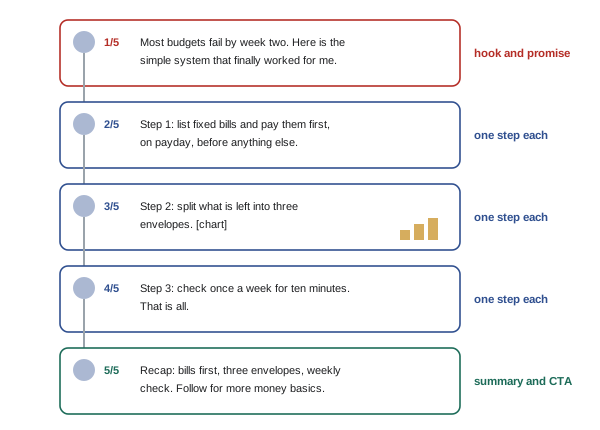
A thread is a series of connected posts, popular on X, Threads and Bluesky, that lets a writer develop an idea at length while each post remains short. Threads work well for explanations, step-by-step guides, stories, summaries of research or books, and case studies. Effective threads:
- Start with a strong first post that states the promise and signals there is more ("A thread on how I...", or a numbered format like 1/10).
- Make each post a complete, readable unit that also pulls the reader to the next one.
- Follow a clear structure, such as numbered steps or a narrative sequence.
- Use visuals, such as images, screenshots or charts, at intervals to break up text.
- End with a summary and a CTA, such as following for more, a link to a fuller resource, or a question.
Threads should be as long as the content needs and no longer; ten tight posts beat twenty padded ones. Because the first post is what most people see, it carries most of the work.
Carousels and slide posts
Carousels on Instagram and LinkedIn present a sequence of images or slides that readers swipe through. They are often among the most saved and shared formats for educational content, because they combine visual design with step-by-step text, and every swipe signals engagement. Writing a carousel is like writing a tiny presentation:
- Slide 1, the cover: a bold hook in large text, often with a specific promise ("7 phrases that make your emails sound confident"). It must stop the scroll on its own.
- Slide 2: context or the problem, or a quick preview of what is coming.
- Middle slides: one idea per slide, with a short heading and one to three lines of supporting text, or a visual example.
- Last slides: a summary, and a slide with a call to action, such as save, share or follow.
Text on slides must be large enough to read on a phone, with plenty of contrast and white space; a common rule is no more than about 20 to 40 words per slide. Consistent design templates help followers recognize a creator's carousels instantly. The caption complements the slides with a short summary and question (Lesson 3), and descriptive alt text or an accessible text version of the slides helps people using screen readers (Lesson 11).
| Slide | Purpose | Example text |
|---|---|---|
| 1 | Hook and promise | 7 phrases that make your emails sound confident |
| 2 | Problem | Weak phrases make you sound unsure, even when you are right. |
| 3–9 | One phrase per slide | Instead of "I just wanted to check", write "Following up on..." |
| 10 | Summary | All 7 phrases on one slide |
| 11 | Call to action | Save this for your next email. Follow for weekly writing tips. |
Adapting to platform norms
Each platform has its own culture. LinkedIn rewards professional insight, career stories and practical frameworks, with a conversational but respectful tone. X and Threads favor concise opinions, humor, timely commentary and threads. Reddit communities value authenticity and expertise, follow their own rules strictly, and react badly to self-promotion and marketing language, so creators participate as members first. Facebook groups reward community and helpfulness. Instagram carousels reward visual polish and saveable education. Repurposing the same idea across platforms works well, but the wording, length and tone should change: a LinkedIn post might become a carousel on Instagram, a thread on X and a short video script on TikTok, each written for its context.
Repurposing long content into text
A single long piece, such as a video, podcast episode or newsletter, can yield many text posts. A one-hour podcast interview might produce a thread summarizing the five best insights, several quote graphics, a carousel of key tips, a LinkedIn post telling one story from the episode, and short captions for clips. Repurposing efficiently requires identifying the strongest standalone ideas, rewriting them for each format rather than pasting excerpts, and linking back to the original for people who want more. Transcripts make this faster, and AI tools can help draft summaries, although the creator should edit for accuracy and voice (Lesson 12).
Engaging with replies
Text platforms are conversational, and the post is often only the start. Replying thoughtfully to comments, especially early ones, extends the discussion, shows the creator is present and signals activity to recommendation systems. Good replies add value, answer questions, thank people for insights and handle disagreement respectfully. Some creators add further detail or a resource in the first comment. Avoid arguing with trolls; CRE-301 and CRE-350 cover community management and handling harassment.
Choosing between a post, a thread and a carousel
The same idea can become a single text post, a thread or a carousel, and each has strengths. A single post suits one sharp idea, an opinion or a quick tip that can be expressed in a few lines. A thread suits a sequence of related points, a story told in stages, or an argument that builds, especially on text-first platforms such as X, Threads and Bluesky. A carousel suits visual learners and step-by-step content, comparisons and frameworks, and it works well on Instagram and LinkedIn, where swipeable documents are popular. The deciding questions are how many distinct points the idea contains, whether visuals add clarity, and which platform the audience uses most. Many creators repurpose the same idea across all three formats.
Writing strong single posts
Text-only posts succeed on clarity and voice. A strong post usually opens with a line that states a surprising claim, a specific result or a relatable feeling; follows with a few short lines that explain or support it; and ends with a takeaway or a question. Line breaks between sentences make posts easier to read on mobile, though some readers find excessive one-line paragraphs gimmicky, so the rhythm should vary. Opinions and personal experience tend to drive more discussion than generic advice, but posts should still be fair and accurate. On professional platforms such as LinkedIn, posts that share specific lessons from real work generally perform better than motivational slogans.
Thread structure in detail
A well-built thread has a clear arc. The first post hooks the reader and promises a payoff, often stating how many parts follow. Each following post delivers one point, readable on its own but leading naturally to the next. Numbering, such as "1/" or "3 of 8", helps readers track progress. Examples, screenshots and short stories keep the thread concrete. The final post summarizes, delivers the main takeaway, and includes a call to action, such as following for more or reading a longer version. Threads lose readers at each post, so the strongest points should not all be saved for the end, and filler posts should be removed.
Carousel design and writing
Carousels combine writing and design. Each slide should carry one idea in large, readable text, usually no more than 20 to 30 words, with a consistent layout, typeface and visual style across slides. The first slide works like a thumbnail: a bold headline, a clear promise and a reason to swipe. Middle slides deliver the steps, points or examples, often with icons or simple illustrations. The last slide summarizes and asks for a save, share or follow, sometimes with a preview of related content. Because text in images is invisible to screen readers, the caption or alt text should contain the slide text or a summary. Accessible contrast and font sizes matter on small screens.
Repurposing between formats
Repurposing turns one piece of work into several. A long video can become a thread of key points, a carousel of steps, a short clip of the best moment and a newsletter issue. A popular thread can become a carousel, a script or a blog post. Repurposing is not simply copying: each format and platform has its own conventions, so the hook, length, structure and call to action must be adapted. A good process starts from the strongest idea or moment, then rewrites it natively for each format. This multiplies reach without multiplying research, and different audiences discover the same idea in the format they prefer.
Measuring text posts and carousels
Useful measures for text formats include impressions, engagement rate, saves, shares, profile visits and follows that result from the post. For carousels, many platforms report how many people swiped through each slide, revealing where readers drop off, much like a retention graph for video. A high save rate suggests useful, reference-worthy content; a high share rate suggests content people want to pass on or that expresses something they identify with. Comparing similar posts over time, rather than reacting to single results, shows which hooks, structures and topics resonate.
A carousel outline example
A personal finance creator plans a seven-slide carousel called "The 3-envelope budget". Slide 1 carries the hook: "The budget that finally worked for me (3 envelopes, 10 minutes a month)". Slide 2 states the problem: complicated budgets get abandoned. Slides 3 to 5 explain one envelope each: needs, wants and future. Slide 6 shows a sample month with real numbers. Slide 7 summarizes the method and asks readers to save the post for payday. The caption repeats the key points in text for screen readers and adds one question inviting readers to share what has or has not worked for them. Planning the slides as a list before designing them keeps each slide focused on a single idea and makes the sequence easy to follow.
Common mistakes
MistakeStarting a post with a fragment that gives no reason to tap.
InsteadMake the first line a complete, intriguing thought.
MistakePadding threads to seem substantial.
InsteadKeep each post tight; length should fit the content.
MistakeCrowding carousel slides with small text.
InsteadUse one idea per slide in large, high-contrast text.
MistakePosting the same text everywhere.
InsteadRewrite for each platform's norms.
MistakeIgnoring replies after posting.
InsteadEngage thoughtfully, especially early.
Summary and key terms
- Text posts need a hook, an extension, a focused body and a clear ending.
- Share one idea supported by a specific example in a distinct voice.
- Threads develop ideas in self-contained, numbered posts.
- Carousels are tiny presentations: cover hook, one idea per slide, summary, CTA.
- Each platform has its own culture and expectations.
- Repurpose long content by rewriting standalone ideas for each format.
- Replies extend the conversation and build community.
- Text post
- A standalone written social post.
- Thread
- A series of connected short posts.
- Carousel
- Sequence of swipeable slides or images.
- Cover slide
- First slide of a carousel acting as the hook.
- Framework post
- Post presenting a structured method.
- Repurposing
- Adapting content for other formats.
- Platform norms
- Expected styles and behaviors on a platform.
- Quote graphic
- Image presenting a short quotation.
- Transcript
- Text version of spoken content.
- First comment
- Comment adding detail or links to a post.
Practice problems
Work each problem on paper first, then reveal the answer to check.
What must the first line of a text post do?
Show answer
Earn the see-more tap as a complete, intriguing thought.
Name three types of text posts.
Show answer
Lessons learned, frameworks, contrarian opinions, stories, observations.
What makes a good thread post?
Show answer
Self-contained but pulling to the next.
What goes on a carousel cover?
Show answer
A bold hook with a specific promise.
How much text per carousel slide?
Show answer
About 20 to 40 words at most.
Why are carousels often saved?
Show answer
They package useful step-by-step information.
How do Reddit norms differ?
Show answer
Strict rules, authenticity, low tolerance for self-promotion.
List three text pieces from one podcast episode.
Show answer
Thread of insights, quote graphics, carousel, story post.
Why reply to early comments?
Show answer
It extends discussion and signals activity.
What should change when repurposing?
Show answer
Wording, length and tone for each platform.
Lesson quiz · 5 questions
Score 60% or more to complete this lesson.
Create a free account to save your progress, take quizzes and earn a certificate.