
CRE-120 · Lesson 2 of 12 · 28 min
Hooks and headlines that earn attention
The hook is the first thing a person sees or hears: the title of a video, the first line of a post, the first sentence of a script, the subject line of an email, the text on the first slide of a carousel. It does one job: make the right person stop and give the next few seconds. A good hook does not need to be clever or loud. It needs to be relevant, specific and intriguing enough that the reader wants to know more. This lesson explains the psychology behind effective hooks, common hook structures, how to write titles and headlines, how to test them, and where the line falls between compelling and misleading.
Why hooks work
Hooks draw on a few well-studied psychological effects:
- Relevance: people notice information that relates to their goals, problems and identity. Naming the audience ("New managers:") or the problem ("If your sourdough comes out flat") triggers this immediately.
- Curiosity gap: George Loewenstein's information-gap theory holds that curiosity arises when we notice a gap between what we know and what we want to know. A hook that opens a specific gap ("The one setting that ruins most phone photos") motivates the reader to close it.
- Novelty and surprise: unexpected claims, counterintuitive findings and unusual images grab attention because the brain prioritizes new information.
- Emotion: stories, stakes and feelings, such as hope, humor, nostalgia, frustration or awe, make content memorable.
- Social proof and credibility: numbers, results and experience signal that the content is worth trusting ("After 300 client kitchens, here is what I would never install").
- Concreteness: specific numbers, names and details are easier to picture and more believable than abstractions.
Strong hooks usually combine two or three of these: relevance plus a specific curiosity gap, or credibility plus a surprising claim.
Common hook structures
Writers use recurring structures as starting points. They are not formulas to fill in mechanically, but patterns to adapt:
- The problem: "Your houseplants are not dying from too little water."
- The result: "How I paid off $28,000 of debt in 19 months on a teacher's salary."
- The how-to: "How to film yourself without a camera operator, using only your phone."
- The list: "5 email mistakes that make recruiters ignore you."
- The contrarian take: "Stop posting every day. Here is what grew my account instead."
- The question: "Why do airline tickets get more expensive when you search twice?"
- The story opening: "The client called at 2 a.m. with one sentence: the bridge was moving."
- The mistake or warning: "I wasted $4,000 on camera gear before learning this."
- The comparison or test: "I tried the 3 most popular budgeting apps for 30 days each."
- The direct address: "If you are a nurse working nights, this is for you."
| Structure | Main driver | Example |
|---|---|---|
| Problem | Relevance, curiosity | Your sourdough is flat because of this one step |
| Result | Credibility, aspiration | How I grew to 10,000 subscribers in 6 months |
| How-to | Usefulness | How to light a video with one window |
| List | Clarity, completeness | 7 phrases that make emails sound confident |
| Contrarian | Surprise | Why I stopped using hashtags |
| Story opening | Emotion, curiosity | I got the call at 2 a.m. |
| Test or comparison | Curiosity, usefulness | I tested 4 budget mics so you do not have to |
Titles and headlines
Titles for videos, articles and podcast episodes must work in search results and recommendation feeds, often alongside a thumbnail. Good titles:
- State a clear, specific promise the content keeps.
- Front-load key words, because titles are truncated on many screens (roughly the first 50 to 60 characters are visible in many layouts).
- Work together with the thumbnail rather than repeating it: the thumbnail can show the emotion or result, and the title can add the context.
- Use words the audience would search for, especially for evergreen, search-driven content (Lesson 10).
- Avoid all-capital shouting, excessive punctuation and vague teasers.
Headline writers often draft many options, ten to twenty, before choosing. The first idea is rarely the best; generating variations forces new angles. Changing one element at a time, such as the number, the audience, the outcome or the framing, reveals stronger versions.
Worked problem
Generating headline variations
A creator has made a video showing how to plan a week of family dinners on a budget. The working title is "Meal Planning Tips". Generate stronger alternatives.
Show solution
- Add the audience: "Meal Planning for Busy Families".
- Add a specific result: "A Week of Family Dinners for $75".
- Add a credibility or method angle: "How I Plan 7 Dinners in 20 Minutes Every Sunday".
- Try a problem framing: "Stop Wondering What is for Dinner: A 20-Minute Weekly Plan".
- Combine the best elements: "7 Family Dinners for $75: My 20-Minute Sunday Plan".
Answer: Specific, audience-focused titles such as "7 Family Dinners for $75: My 20-Minute Sunday Plan".
Hooks in video
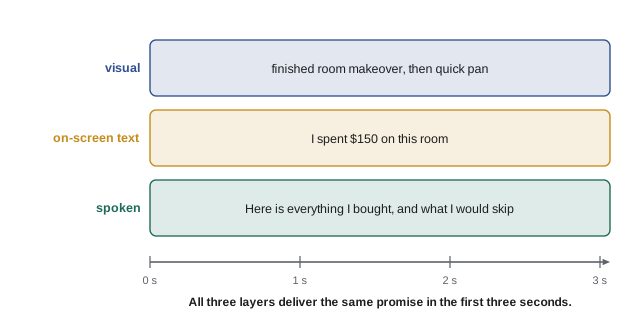
In video, the hook is a combination of visuals, on-screen text and the first spoken line, all working within the first one to three seconds for short-form and the first ten to thirty seconds for long-form. Effective video hooks often start in the middle of the action or with the most striking image, show the result first ("this is the finished room"), state the promise explicitly ("by the end of this video you will be able to..."), or open a question the video will answer. They avoid slow intros, logos, long greetings and "before we start, remember to subscribe", which give viewers a reason to leave. The spoken hook, the on-screen text and the visual should reinforce each other, so a viewer watching without sound still understands the promise.
Testing hooks
Creators can test hooks rather than guess. Platforms increasingly offer built-in title and thumbnail testing, showing different versions to different viewers and reporting which earns more watch time. Email services allow A/B testing of subject lines on a sample before sending the winner to the rest of the list. Text posts can be tested more informally by trying different hook styles over several weeks and comparing performance. Meaningful tests change one element at a time, run long enough to reach enough people, and judge results on the right metric: a title that increases clicks but reduces watch time or satisfaction has not really won. Lesson 12 and CRE-202 cover analytics in more depth.
Worked problem
Comparing two titles
In a title test, version A gets 52,000 impressions and 2,340 clicks, with average view duration of 4:10. Version B gets 51,500 impressions and 2,990 clicks, with average view duration of 2:35 on a 7-minute video. Which is better?
Show solution
- CTR of A: 2,340 / 52,000 = 4.5 %.
- CTR of B: 2,990 / 51,500 = 5.8 %.
- Total watch time A: 2,340 × 4.17 min ≈ 9,760 minutes.
- Total watch time B: 2,990 × 2.58 min ≈ 7,720 minutes.
- B earns more clicks but less total watch time and shorter views, suggesting viewers felt it overpromised; A is the better title overall.
Answer: Title A: lower CTR but more total watch time and better viewer satisfaction.
Compelling versus misleading
The difference between a strong hook and clickbait is whether the content delivers. "I tried the viral 5-minute bread recipe and it actually works" is a strong hook if the video shows it working; it is clickbait if the bread fails and the creator buries that at the end. Practices that cross the line include false claims of urgency or exclusivity, thumbnails showing things that do not appear in the video, fake shock reactions, and headlines that misrepresent facts, especially in news, health and finance. Besides damaging trust, misleading hooks can violate platform policies against deceptive practices and, for sponsored content, advertising laws on misleading claims (CRE-320). A practical test: would a viewer who watched the whole piece feel the hook was fair?
Writing many hooks
Because hooks matter so much, experienced creators spend a disproportionate share of their writing time on them. A common practice is to write the content first, then draft ten or more hooks, choose the strongest, and revisit the opening of the content so it delivers immediately on the hook's promise. Keeping a running list of hooks that performed well, and of hooks from other creators that caught your attention, builds a personal library of patterns to adapt.
Hooks across formats
The hook takes different shapes depending on the format. In a short video, the hook is the first one to three seconds: the opening line, the first image and any on-screen text working together. In a long-form video, it is the title, thumbnail and first 30 seconds. In a caption, it is the first line before the "more" link. In a thread or carousel, it is the first post or slide. In a newsletter, it is the subject line, preview text and opening sentence. In a podcast, it is the episode title and the cold open. The principles are the same everywhere: make a clear, specific promise, create curiosity or relevance, and make the reader or viewer feel the content is for them. What changes is the space available and the senses involved.
The visual and verbal hook together
In video, words are only part of the hook. A strong opening shot, movement, a surprising object, a finished result shown first, or the creator speaking directly to camera can all stop the scroll before a word is understood. On-screen text reinforces the spoken line for people watching without sound and gives a second chance to grab attention. The most effective hooks align all three: the image shows what the words promise, the on-screen text summarizes it in a few words, and the spoken line adds personality or tension. When they conflict, such as a calm landscape shot with an urgent spoken line, viewers can feel confused and scroll on.
Specificity and numbers
Specific hooks generally outperform vague ones because they help readers judge quickly whether content is relevant and believable. "How I saved money" is vague; "How I cut my grocery bill from $900 to $520 a month" is specific, credible and concrete. Numbers help, especially odd or precise ones, because they suggest real experience rather than generic advice. Specific audiences help too: "for first-time renters", "for nurses on night shifts" or "if you have a small balcony" tell the right people that the content is for them, even if it means fewer people overall feel addressed. Specificity must remain honest: inventing precise figures to sound credible is deceptive.
Building a swipe file
Professional copywriters keep swipe files: collections of headlines, hooks, subject lines and openings that caught their attention. A creator's swipe file might include screenshots of posts that stopped their scroll, titles of videos they clicked on, subject lines of emails they opened, and notes on why each worked. Over time, patterns emerge: certain structures, words and angles work repeatedly in a niche. The swipe file is a source of patterns, not text to copy: copying another creator's hook word for word is plagiarism and rarely works, because the audience may recognize it. Adapting a structure, such as "I tried X for 30 days, here is what happened", to your own content and experience is standard practice.
Hook mistakes beyond clickbait
Clickbait is the most discussed hook problem, but there are others. Slow openings, such as greetings, introductions and housekeeping, waste the most valuable seconds. Overly clever hooks that rely on puns or obscure references can confuse readers who do not get them. Hooks that answer their own question remove the reason to continue: "Here is why your bread is dense: too little kneading" delivers the payoff immediately. Hooks that are too broad attract the wrong viewers, who leave quickly. And hooks that are identical across every post become wallpaper that the audience learns to ignore. Varying hook types while keeping them honest and specific keeps an audience engaged over time.
Thumbnails and titles as a pair
On YouTube and similar platforms, the title and thumbnail work together as a single hook. The thumbnail usually carries the emotion or the visual promise, while the title adds context and the search terms. Repeating the same words in both wastes space: if the thumbnail says "I quit", the title can explain what and why. A useful exercise is to describe the thumbnail and title together in one sentence and ask whether that sentence would make the target viewer curious. Testing tools now let creators compare several thumbnail and title combinations on live traffic, which turns hook writing into an evidence-based craft rather than guesswork.
Common mistakes
MistakeOpening with a greeting or a channel intro.
InsteadStart with the promise, result or question.
MistakeWriting one title and stopping.
InsteadDraft ten or more variations before choosing.
MistakeJudging hooks by clicks alone.
InsteadConsider watch time, read-through and satisfaction.
MistakeBurying keywords at the end of long titles.
InsteadFront-load the important words.
MistakePromising what the content does not deliver.
InsteadMake hooks the content can keep.
Summary and key terms
- Hooks make the right people stop and give the next few seconds.
- Relevance, curiosity gaps, novelty, emotion, credibility and concreteness drive hooks.
- Common structures include problem, result, how-to, list, contrarian, question and story.
- Titles front-load key words and work with thumbnails.
- Video hooks align visuals, on-screen text and the spoken line.
- Test hooks one element at a time and judge by satisfaction, not just clicks.
- Compelling hooks deliver; misleading ones erode trust and may break rules.
- Hook
- Opening that captures attention.
- Curiosity gap
- Difference between what someone knows and wants to know.
- Social proof
- Signals that others value or trust something.
- Contrarian hook
- Opening that challenges common belief.
- Front-loading
- Placing key words at the start.
- Thumbnail
- Preview image for a video.
- Click-through rate
- Clicks divided by impressions.
- A/B test
- Comparing two versions with different audiences.
- Impression
- A time content was shown to someone.
- Clickbait
- Hook that misrepresents the content.
Practice problems
Work each problem on paper first, then reveal the answer to check.
What job does a hook do?
Show answer
Makes the right person stop and give the next seconds.
Explain the curiosity gap.
Show answer
Interest arises from a gap between known and wanted information.
Write a problem hook for a gardening video.
Show answer
For example, "Your tomatoes crack because of how you water them."
Why front-load titles?
Show answer
Titles are truncated on many screens.
How should title and thumbnail relate?
Show answer
Complement each other rather than repeat.
What should a video avoid in the first seconds?
Show answer
Slow intros, logos and long greetings.
CTR for 1,200 clicks on 40,000 impressions?
Show answer
3 %.
Why can a higher CTR title lose?
Show answer
It may reduce watch time or satisfaction.
What test separates compelling from misleading?
Show answer
Whether a viewer would feel the hook was fair after watching.
How many headline options should you draft?
Show answer
Ten or more.
Lesson quiz · 5 questions
Score 60% or more to complete this lesson.
Create a free account to save your progress, take quizzes and earn a certificate.